Alabama Employment-Based Biometrics: When Birmingham Is Enough and When Montgomery Matters
Disclaimer: This guide is for general information and document-preparation planning. It is not legal advice. USCIS routing can change by case type, workload, and security checks, so your appointment notice always controls.
For Alabama applicants, the practical question is not “What does USCIS usually do nationwide?” It is simpler: will my case stop at Birmingham for biometrics, or will I later need to deal with Montgomery? In most employment-based cases, Birmingham is the local biometrics stop, while Montgomery becomes relevant only if USCIS requires an interview or another limited in-person step. Understanding that split early can help you prepare the right documents, avoid mailing mistakes, and decide when certified translation work should happen.
Key Takeaways
- Birmingham ASC is not your interview office. USCIS identifies the Birmingham Application Support Center as a biometrics site, not a document-review or interview office. If you are going there, you are usually going for fingerprints, photo, and signature only. See the official Birmingham page on USCIS.
- Montgomery may never come into play. Employment-based adjustment cases can be interviewed or waived on a case-by-case basis under the USCIS Policy Manual interview guidance. If USCIS waives your interview, you may never need to appear in Montgomery.
- Many dependents no longer need biometrics. USCIS announced that, effective October 1, 2023, all Form I-539 applicants are exempt from the biometrics services fee and generally do not need a biometrics appointment unless USCIS later requires one in an individual case. See the official USCIS alert.
- Do not mail your packet to Birmingham or Montgomery. Employment-based filings follow the USCIS filing instructions for Form I-485 and related forms. Alabama applicants generally mail to the correct lockbox or service address listed by USCIS, not to the local offices.
Who This Guide Is For
This guide is for people living in Alabama who are filing or tracking an employment-based adjustment of status case, or a related dependent filing, and who are confused about local USCIS routing. It is especially useful if you:
- have an employment-based green card case and just received a Birmingham biometrics notice;
- are a spouse or child in H-4, L-2, or another dependent track and do not know whether you should still expect biometrics;
- hold non-English documents such as birth certificates, marriage certificates, divorce decrees, family registers, police records, or court records;
- need to decide when to order a USCIS-compliant certified translation and when it is not yet necessary to carry those documents to an appointment; or
- are trying to avoid two common Alabama mistakes: assuming Birmingham handles the full case, and assuming translated documents should be brought to the ASC.
The most common language pairs in this kind of USCIS document work are usually Spanish, Chinese, Korean, Portuguese, Hindi, and Arabic into English. The exact Alabama ranking is not published in a reliable USCIS source, so treat those as common immigration document pairs rather than a state-specific list.
Alabama Employment-Based Biometrics vs Field Office: The Short Answer
For most Alabama employment-based applicants, the real workflow looks like this:
- You file the case using the correct USCIS filing address for your form, not a local Alabama office.
- USCIS creates the case and, if biometrics is required, schedules it at the local ASC that serves your area. In practice, Alabama applicants often see Birmingham for this step.
- USCIS continues processing the case through its centralized workflow.
- If USCIS wants an in-person interview, that is when Montgomery becomes relevant through the USCIS field office system.
- If USCIS waives the interview, your case may move without a Montgomery appearance at all.
This matters because many applicants over-prepare for the wrong step. A biometrics appointment is not the same as a merits review. If your only notice is for Birmingham biometrics, your practical task is to attend on time with the right ID and keep your translated civil documents organized for the next stage, not to bring a full interview binder.
How the Alabama Workflow Feels in Real Life
Alabama does not have a separate state rule for employment-based USCIS cases. The core rules are federal. The local difference is mostly routing, travel, and support access.
That is why people in Alabama experience the process in a very specific way:
- Birmingham feels like the case office at first because it is the first physical appointment many applicants see.
- Montgomery feels suddenly important later because it can appear only if USCIS wants a field-office interview.
- The filing step stays non-local because your packet still goes to the USCIS filing address, not to a Birmingham or Montgomery desk.
Community timelines from VisaJourney and USCIS discussion groups repeatedly reflect the same confusion: applicants assume the first Alabama office on their paperwork is the office handling everything. In practice, that is often wrong.
When Certified Translation Actually Matters in This Alabama Workflow
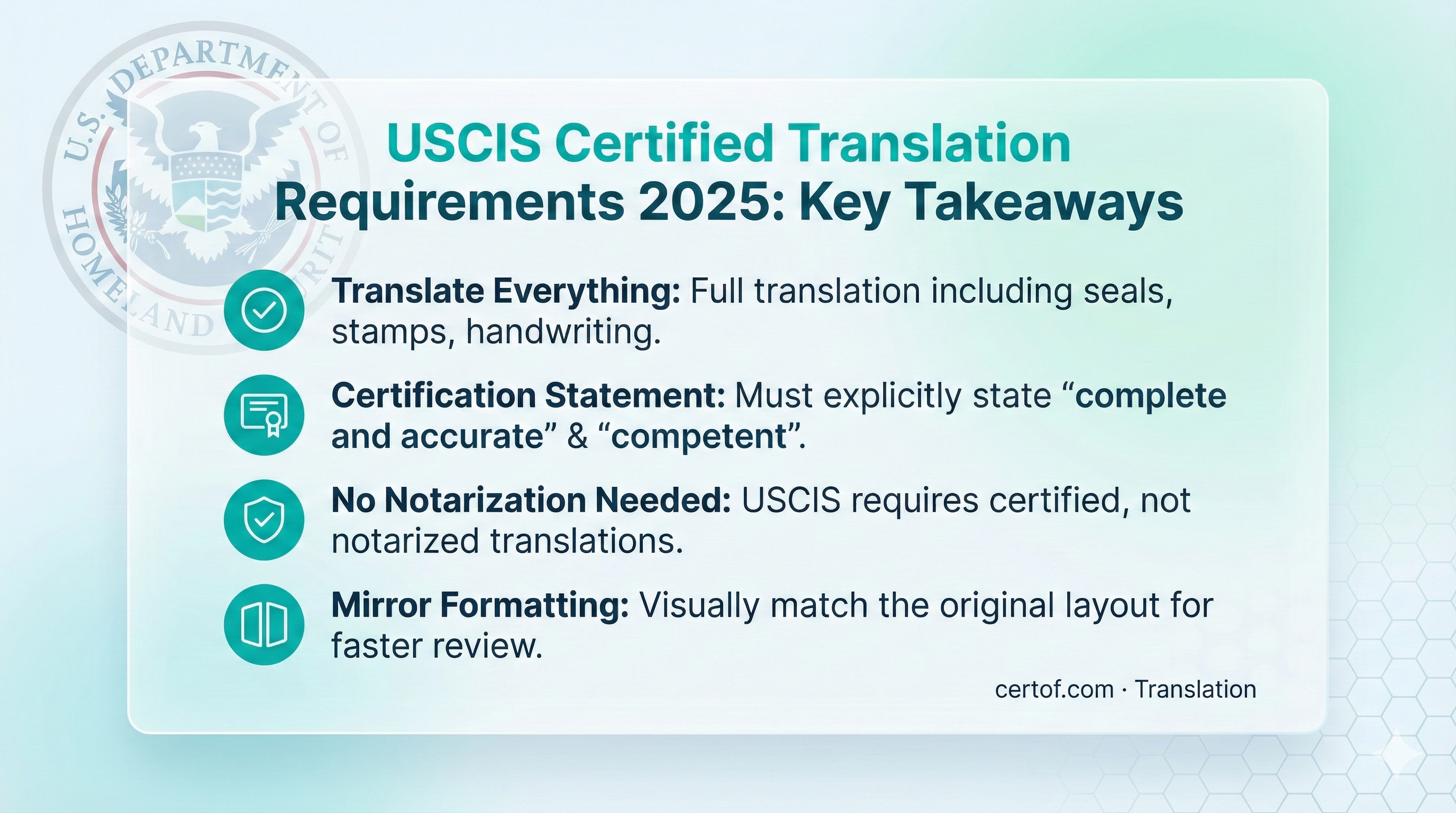
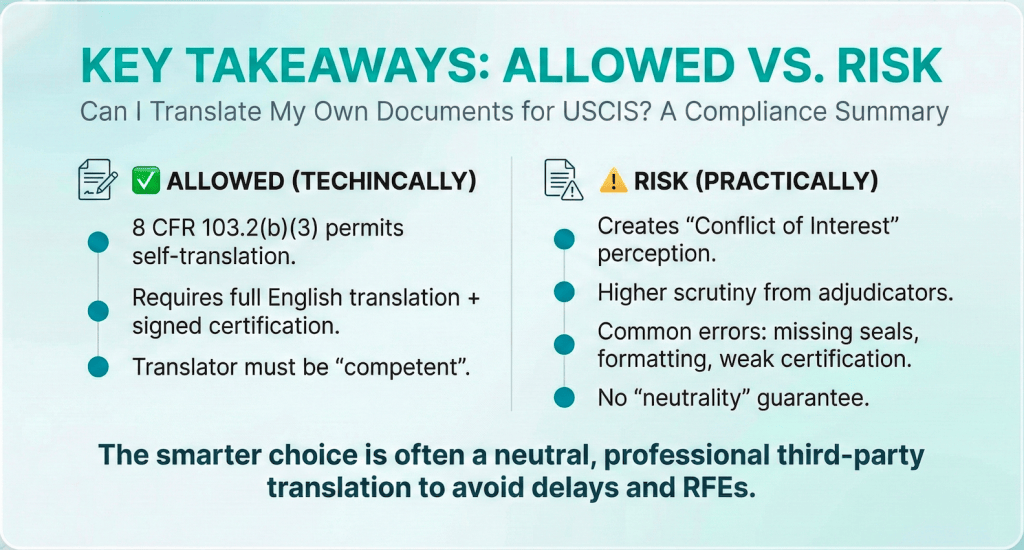
While many applicants search for certified translation, the actual USCIS requirement is usually a full English translation with a translator certification statement. If you need a refresher on the federal rule itself, keep that explanation short and use these related guides instead of repeating it here: USCIS certified translation requirements, who can certify a translation for USCIS, whether USCIS requires ATA certification, and whether you can translate your own USCIS documents.
What matters here is timing:
- Before Birmingham biometrics: Translate core identity and family-status documents early if they are likely to be needed in the initial filing, an RFE, or a later interview. Typical examples are birth certificates, marriage records, divorce judgments, adoption records, and name-change records.
- At the Birmingham ASC appointment: The focus is biometrics. This is not where officers review your civil document translations. Do not assume you can solve a document issue at the ASC.
- If your case stays paper-only after biometrics: USCIS may issue an RFE or continue processing without an interview. In that situation, certified translations matter in the response packet, not at Birmingham.
- If Montgomery schedules an interview: That is when your non-English originals and certified translations become much more important as a practical matter.
If your biggest concern is preparing non-English civil documents for a family-linked immigration file, keep those records organized early. For online ordering and digital delivery options, CertOf already has related guidance on how to upload and order certified translation online and electronic certified translation formats.
What to Bring to Birmingham and What Not to Overthink
If you are going to Birmingham for biometrics, the appointment is usually a narrow task. The official USCIS page lists the Birmingham ASC as 529 Beacon Parkway, Suite 106, Birmingham, AL 35209. Follow your notice. In practical terms, applicants typically need:
- the appointment notice;
- a valid government-issued photo ID; and
- any other item specifically listed on the notice.
What you usually do not need to carry just for Birmingham biometrics is your entire translated civil-document packet. That is the counterintuitive point many Alabama applicants miss. The better use of that waiting period is to prepare documents properly so you are ready if USCIS later asks for more.
If you already know you will need certified translations soon, use the quiet period before or after biometrics to order them in a format that is easy to submit by PDF or mail. CertOf’s document-prep content on revision and turnaround expectations can help you decide how early to order.
When Montgomery Becomes Relevant
Montgomery matters when the case moves from a collection step to an adjudication step that requires your presence. In Alabama employment-based cases, that usually means one of three things:
- USCIS schedules an interview. Under the USCIS interview guidance, some adjustment cases are interviewed and some are waived.
- USCIS asks for another limited in-person service. USCIS says field offices do not allow walk-ins, so you should rely on the appointment notice for the exact Montgomery office address, time, and security instructions.
- Your case presents issues that make a local interview more likely. Missing records, inconsistent biographic information, prior marriages, criminal or court documents, or a messy family-document chain can all increase the importance of having your certified translations ready even if you do not yet know whether Montgomery will be involved.
That is also the point where Alabama travel becomes a real planning issue. A Birmingham applicant may be able to handle biometrics locally and then later face a longer drive to Montgomery. If you live in Mobile or other parts of south Alabama, that can mean a two- to three-hour drive each way plus time away from work. That is not a separate legal rule, but it is a real Alabama-specific friction point.
Dependents After the October 1, 2023 Biometrics Change
One of the biggest practical changes for Alabama families is the federal biometrics shift for Form I-539 applicants. Since October 1, 2023, USCIS has generally stopped requiring the biometrics services fee and routine biometrics appointments for I-539 applicants, subject to case-by-case exceptions in individual files. USCIS announced that change in its official I-539 biometrics alert.
Why this matters in Alabama:
- A principal applicant may receive a Birmingham biometrics notice while a spouse does not.
- Families often assume the missing notice means something is wrong with the dependent case.
- In many cases, it simply reflects the current USCIS biometrics rule, not an Alabama error.
You should still read every notice carefully because USCIS keeps the power to require biometrics in an individual case.
Mailing, Scheduling, Wait-Time Reality, and Common Alabama Mistakes
Mailing: The packet does not go to Birmingham or Montgomery. Use the form-specific USCIS filing instructions, especially the current Form I-485 page, and match your category before mailing anything.
Scheduling: Birmingham biometrics is appointment-based. If you cannot attend, handle rescheduling promptly through the methods USCIS permits. Missing a biometrics appointment without addressing it can create serious problems for the case. Before traveling, check USCIS Office Closings because Alabama applicants may have notices involving more than one office over the life of a case.
Wait times: There is no reliable Alabama-only public number that tells you how often employment-based interviews are waived or how long after Birmingham biometrics a Montgomery interview will be scheduled. The safest guidance is operational, not predictive: treat biometrics as the likely first local step and prepare for a later field-office notice if USCIS decides it wants one.
Cost reality: USCIS fees are federal, not Alabama-specific. Your Alabama-specific costs are more likely to be travel time, missed work, document shipping, and translation preparation. That is another reason to separate the Birmingham and Montgomery stages in your planning.
The biggest Alabama mistakes are:
- mailing to a local office instead of the correct USCIS filing address;
- assuming Birmingham is the office deciding the whole case;
- waiting too long to prepare non-English civil documents because the ASC did not ask for them;
- assuming every dependent will get a biometrics notice; and
- treating community estimates of interview waiver rates as if they were official.
Why Alabama Applicants Often Experience Routing Confusion
Alabama is not one of the highest-immigration states, but it still has a meaningful pool of applicants who need document translation and routing clarity. The U.S. Census Bureau QuickFacts for Alabama reports that 6.0% of residents age 5 and over speak a language other than English at home, and 4.0% of Alabama residents are foreign-born. That matters because even a moderate immigrant population, spread across a state with only a few USCIS touchpoints, makes routing confusion more likely. In plain terms: the fewer local offices you physically see, the easier it is to assume the first one handles everything.
Common Experiences from Alabama Applicants
Community timelines are not law, but they are useful for reality-checking the Alabama experience. Across VisaJourney timelines and USCIS-focused online discussion groups, the same themes repeat:
- people think Birmingham biometrics means the full case will stay there;
- they are unsure whether translated civil documents are needed at the ASC;
- they get anxious when a dependent never receives a biometrics notice; and
- they only realize Montgomery matters when an interview notice arrives later.
Those community signals should shape your preparation, not your legal expectations. Use them to avoid preventable mistakes, not to predict your own timeline.
Commercial Translation Options Alabama Applicants Are Likely to Compare
| Provider | Public local or workflow signal | Fit for this Alabama routing issue | Notes |
|---|---|---|---|
| CertOf | Online order workflow through CertOf upload portal | Strong fit if you want USCIS-compliant certified translations ready before an RFE or Montgomery interview | No claim of Alabama government affiliation. Best used for document translation and preparation, not legal strategy. |
| Southeast Spanish, Inc. | Public Birmingham location page, says it has served Birmingham since 2008; phone listed as (205) 201-1745 | Useful if you prefer a provider with a Birmingham-area presence signal and USCIS document experience | Public pages emphasize Spanish and certified translation for USCIS and agencies. Check language-pair fit before ordering. |
| RushTranslate | Public Birmingham page states it serves Birmingham online and explicitly says no physical office is required; public certified-translation price shown at $24.95/page on that page | Useful for statewide applicants who want a fully online workflow | Good benchmark for digital ordering. Online-only model may be enough for standard USCIS civil-document jobs. |
For many standard USCIS civil documents, the practical question is not whether you need a local walk-in translator near Birmingham. It is whether the provider can produce a clean, USCIS-ready certification statement, match names and dates carefully, and turn around a PDF fast enough if Montgomery or an RFE suddenly becomes relevant.
Free or Low-Cost Legal Help and Public Support Resources
| Resource | Public signal | Best use | Contact |
|---|---|---|---|
| Hispanic and Immigrant Center of Alabama | DOJ-recognized immigration-help organization in Birmingham | Low-cost or nonprofit help with forms, screening, and referral if the issue is bigger than translation | 117 South Crest Drive, Birmingham, AL 35209; (205) 942-5505 |
| Hispanic Catholic Social Services | DOJ-recognized immigration-help organization in Birmingham | Useful if you need accredited-help options rather than a commercial translation vendor | 92 Oxmoor Road, Birmingham, AL 35209; (205) 876-8190 |
| Alabama Coalition for Immigrant Justice United | Public Alabama immigration-support organization | Helpful for community support, referrals, and scam awareness | 1826 6th Ave S, Irondale, AL 35210; (205) 945-0777 |
Use these resources when your issue is not just translation. If you are unsure which form to file, whether a prior record creates interview risk, or whether a preparer is giving unlawful advice, a nonprofit or accredited-help path is more appropriate than a translation company.
Fraud, Complaints, and Alabama-Specific Red Flags
Employment-based applicants are often targeted by document preparers who blur the line between translation and legal advice. In Alabama, the warning signs are familiar:
- someone says they can guarantee that your case will stay in Birmingham or avoid Montgomery;
- someone offers to mail your packet directly to a local office to “speed things up”;
- someone insists you need notarization for every USCIS translation when the real issue is usually a proper certification statement; or
- someone offers interview coaching as if they control USCIS routing.
If you think a local preparer or translation seller has crossed into fraud, use the Alabama Attorney General consumer complaint portal. If the problem is bad legal representation or unauthorized immigration practice, you should also look at federal immigration complaint channels and qualified legal-help options.
Frequently Asked Questions
Is Birmingham ASC enough for an Alabama employment-based case?
Sometimes yes, but only for the biometrics step. If USCIS waives your interview, Birmingham may be the only local office you ever visit. If USCIS wants an interview, Montgomery becomes relevant later.
If my biometrics is in Birmingham, will my interview also be in Birmingham?
Not usually. Birmingham and Montgomery serve different functions. Birmingham is the biometrics stop. Montgomery is the field-office stop if USCIS schedules an interview or another limited in-person service.
Do I need to bring translated birth or marriage records to the Birmingham biometrics appointment?
Usually no. Birmingham biometrics is not the stage where USCIS reviews your civil-document packet in the ordinary course. Keep those documents ready for filing, an RFE, or a later interview instead.
Do H-4 or L-2 dependents in Alabama still need biometrics?
Many do not. USCIS changed the Form I-539 biometrics rule effective October 1, 2023, and generally stopped requiring routine biometrics for those applicants, while keeping case-by-case discretion.
Where do I mail my Alabama employment-based packet?
To the USCIS filing address listed for your form and category, not to Birmingham and not to Montgomery. Check the current USCIS filing instructions before mailing.
When should I order certified translations if my case is still only at the biometrics stage?
Order them before you need them. The safest moment is often before an RFE or interview notice arrives, especially for birth, marriage, divorce, police, court, and family-relation documents that are hard to rush cleanly.
CTA
If your Alabama case is at the Birmingham biometrics stage, use that window to get your non-English civil documents ready before a later RFE or Montgomery interview creates time pressure. You can start with CertOf’s secure upload page, review how online ordering works in this ordering guide, and compare digital delivery options in this format guide. CertOf can help with the translation and document-preparation side of the case. It does not replace an immigration lawyer, schedule USCIS appointments, or control whether Birmingham is enough or Montgomery becomes relevant.