Ukraine Police Certificate for U.S. Family Immigration: FULL Version, Previous Names, and Translation Rules
If you are preparing a Ukraine police certificate for U.S. family immigration, the biggest risk is usually not the translation itself. It is getting the wrong version, leaving out previous surnames, or assuming a paper stamp matters more than the data on the record. For Ukrainian cases, the key document is the Vytiah or Витяг про несудимість, and the U.S. rules are unusually specific: the U.S. Department of State says applicants should obtain the FULL version of the Ukraine police certificate, and the U.S. Embassy in Kyiv’s current supplement says it must include all current and previous names ever used, including maiden and married surnames.
This guide is intentionally narrow. It covers how the Ukraine police certificate works in family-based U.S. immigration cases, how to avoid previous-name mistakes, and when certified English translation matters. For broader USCIS translation rules, see our guides on USCIS certified translation requirements, who can certify a translation for USCIS, and certified translation of a police clearance certificate.
Key Takeaways
- You need the FULL Ukraine police certificate, not the shortened version.
- You should ask for all previous names to appear on the certificate, including maiden and married surnames.
- A Ukraine police certificate with a serial number, QR code, and digital seal can be accepted as an original; a traditional wet stamp is not the main issue in these cases.
- For the Kyiv immigrant-visa stage, the Embassy guidance treats Ukraine police certificates differently from non-Ukrainian police certificates. For USCIS and some NVC-stage packet work, however, non-English documents still need a full certified English translation.
Who This Guide Is For
This guide is for applicants connected to Ukraine as the issuing country who are preparing U.S. family-based immigration or K visa paperwork and need to submit, upload, or carry a police certificate without creating a name mismatch.
- You are a Ukrainian applicant in Ukraine or abroad.
- Your most common language pairs are Ukrainian-English and Russian-English.
- Your file set often includes a Ukraine police certificate, passport pages, and marriage, divorce, or name-change records.
- Your practical problem is usually not “How do I translate one page?” but “How do I make sure my current name, maiden name, married surname, and older records all line up in one immigration packet?”
Disclaimer
This is a practical document-preparation guide, not legal advice. Family-based immigration cases can split into USCIS, NVC, consular, and lawyer-specific document requests. Always follow the latest case-specific instructions from USCIS, NVC, the U.S. Embassy, and your attorney if you have one.
What the Ukraine Police Certificate Actually Is
In current Ukrainian official workflows, the police certificate is the Vytiah from the Ministry of Internal Affairs system. Many people still use older wording such as dovidka pro nesudymist, but for U.S. immigration the practical issue is not the label. It is whether the certificate matches the version and naming requirements that U.S. reviewers expect.
The official Ukrainian online route is the Diia police-certificate service for the Витяг про несудимість. The U.S. side then overlays its own requirements. According to the State Department reciprocity page, the acceptable Ukraine police certificate is the FULL version. The Embassy Kyiv supplement also states that applicants should specifically request a certificate showing all names ever used and notes a two-year validity period for this document in visa processing.
How to Get a Ukraine Police Certificate in Real Life
For most applicants, the core rule is national, not city-specific. Ukraine does not have a separate Kyiv rule, Lviv rule, or Odesa rule for the certificate itself. The real differences are logistics: whether you can use Diia, whether you need help from a service center, and whether you are trying to solve a name-history problem at the same time.
- Apply through the official Ukrainian route first, usually Diia.
- Select or request the FULL version.
- Enter or request all previous names, not just your current legal surname.
- Download the electronic record and review the identity details before you upload or translate anything.
- If your prior surnames do not appear, fix that issue before you build the English packet.
Diia states an official processing standard of 10 working days, and says cases that require additional verification can take up to 30 calendar days. That timing matters because applicants often wait until an NVC or interview deadline feels close, then discover a name-chain issue that cannot be solved in one day.
The Previous-Name Problem Is the Real Compliance Problem
In Ukraine family-immigration cases, a unique and common failure point is the name chain.
If your passport shows your current surname but your older civil records use a maiden surname, a prior married surname, or a formal name-change record, the police certificate should not sit alone. It should match the story told by the rest of your file. The Embassy Kyiv guidance is explicit that the police certificate should include all current and previous names ever used. That is especially important for applicants who changed names through marriage or divorce.
A second local wrinkle is that some applicants no longer hold the original marriage certificate they think they need. The Ukraine reciprocity page explains that, in some situations, a registry extract from DRATsS (ДРАЦС), such as a витяг з державного реєстру, can do the work of proving the marriage record and prior surname history. That is why this topic overlaps with marriage and divorce extracts even though this article stays focused on the police certificate. If your surname history depends on a marriage that later ended, solve that record chain early rather than hoping the police certificate alone will carry it.
For occupied-territory or disrupted-record situations, the document chain can become even more fragile. We cover that separate problem in our Ukraine-specific guide on civil records from occupied territories in U.S. family immigration cases.
Do You Need a Certified English Translation of a Ukraine Police Certificate?
Yes for many U.S. filing uses, but not in the same way at every stage. This is the most misunderstood part of the workflow.
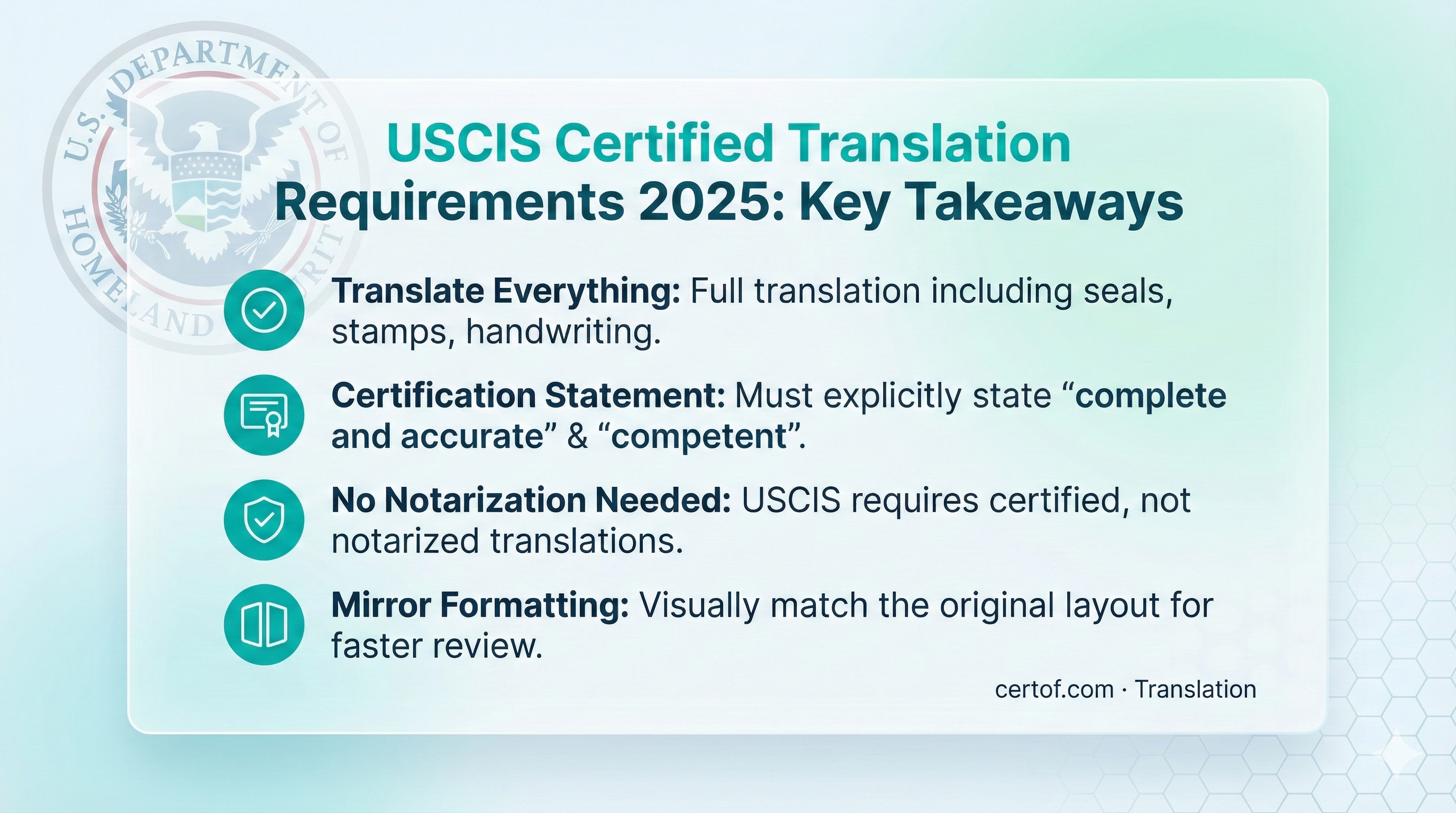
For USCIS, the general federal rule is straightforward: any foreign-language document submitted to USCIS must include a full English translation with a translator certification stating that the translation is complete and accurate and that the translator is competent to translate. USCIS explains that rule in its Policy Manual. If you are sending a Ukraine police certificate as part of a USCIS filing or a support packet assembled under USCIS standards, certified English translation is part of the job.
At the consular stage, the Kyiv supplement matters. The Embassy guidance makes a practical distinction between Ukrainian police certificates and police certificates from other countries. That is why many applicants experience a confusing but real split: the same person may need a certified English translation for a USCIS-facing packet, yet not need to translate the Ukraine police certificate again for the Kyiv interview itself.
The safest working rule is this:
- If the document is going into a USCIS filing or an attorney-prepared English packet, prepare a full certified English translation.
- If you are following the Embassy Kyiv interview checklist, read that checklist literally and do not assume the same translation rule applies to every country’s police certificate.
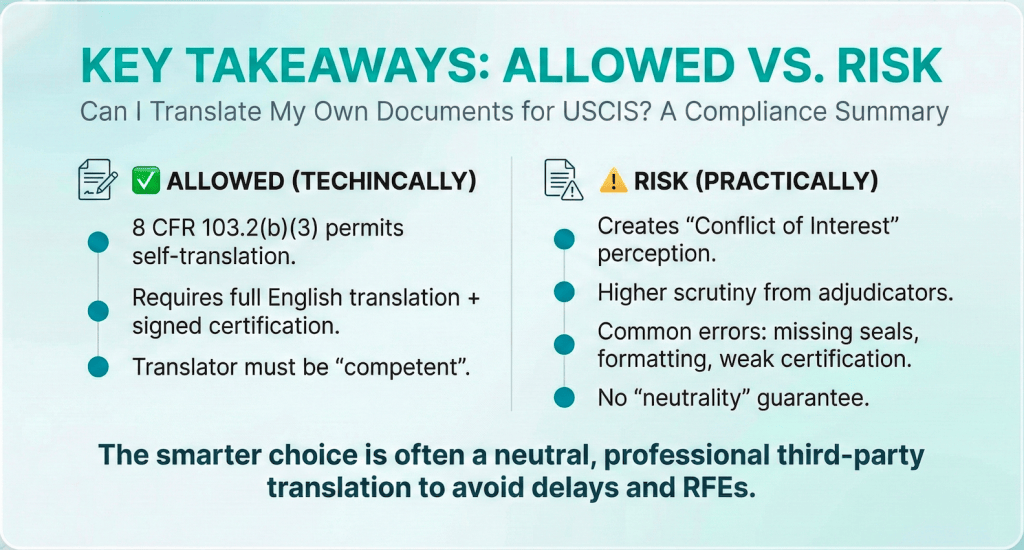
If you need a fast English packet, our related resources on self-translation for USCIS and electronic certified translation formats explain the practical submission side.
Timing, Cost, and Mailing Reality
The main cost question in this topic is often misframed. The expensive mistake is usually not the certificate itself. It is delay: getting the wrong version, having to rebuild the packet, or discovering too late that your prior surnames were not captured.
- Official timing: Diia says 10 working days, with up to 30 calendar days when extra verification is needed.
- Validity: the current Kyiv supplement uses a two-year validity rule for this document in visa processing.
- Mailing reality: many applicants now work from an electronic certificate first. If a lawyer, agency, or third party asks you to chase a paper copy immediately, check whether that is actually necessary for your stage.
- Translation timing: translation can be the fastest part if the underlying certificate is correct. It should not be used as a substitute for fixing a wrong surname history.
In real Ukraine cases, the true bottleneck is often obtaining the correct source record, rather than the translation step itself.
Common Mistakes That Cause Delays
- Ordering or downloading the shortened certificate instead of the FULL version.
- Letting the certificate show only the current surname when the rest of the immigration file uses older surnames.
- Translating a flawed source document instead of correcting the source document first.
- Treating a marriage or divorce record as irrelevant when it is actually the only document that explains the surname chain.
- Assuming notarization or apostille is the main issue. For this document, the official U.S. guidance is focused on version, names, validity, and authenticity signals such as QR code and digital seal.
What Applicants Commonly Report
Across visa-forum discussions and Ukrainian applicant communities, the same pattern appears again and again: people are less likely to complain that the translation was rejected than to say they had to redo the certificate because an older surname was missing. Another recurring theme is surprise that a printed electronic certificate with QR and digital validation can work as the operative original. That feels counterintuitive to people who expect a red-stamp paper process, but it fits the current U.S.-Ukraine document reality.
A third recurring pain point is the split between USCIS-facing translation expectations and the Kyiv interview checklist. Applicants often over-translate or translate at the wrong stage because they assume one universal rule applies everywhere. It does not.
Local Support, Fraud Prevention, and Complaint Paths
Because this issue is governed mainly by national Ukrainian issuance rules and national U.S. immigration rules, the most useful local support nodes are also national.
- Diia: primary official online path for obtaining the certificate.
- MVS support: the Ministry of Internal Affairs publishes contact information and complaint channels on its official contacts page. That includes the hotline 1536 and email channels for citizen appeals.
- Fraud caution: use official Diia and MVS links rather than paid intermediaries promising “inside acceleration” for routine cases.
If your issue is not translation but record retrieval, surname correction, or service access, start with the issuing system and support channel before paying a translation provider.
Local Data That Actually Matters
- 10 working days / 30 calendar days: this is the practical scheduling data point that affects whether you can meet a case deadline without panic.
- Two-year validity: this matters because it gives many family-based applicants more room than they expect; you usually do not need to wait until the last possible week.
- Electronic-original acceptance: this changes the logistics of cross-border document prep and reduces the need for unnecessary paper chasing.
In other words, the data that matters here is not market-size trivia. It is the timing and validity data that directly affects whether your packet is complete and consistent.
Provider Comparison
For this topic, the most important providers are the official Ukrainian issuance channels. Translation providers matter only after the source certificate is correct.
Official Retrieval and Support Options
| Option | Best for | What it helps with | Main limitation |
|---|---|---|---|
| Diia | Most standard cases | Official online request, electronic certificate, timing visibility | You still need to review version and name history carefully |
| MVS / service-center assistance | Applicants who need support beyond pure self-service | Help with official issuance path and follow-up | Does not replace the need to request all previous names correctly |
| Ukrainian consular route abroad | Applicants outside Ukraine | Cross-border support when local access is harder | Usually slower and more procedural than direct digital access |
English Certified Translation Options for USCIS or NVC Packet Work
| Provider | Public signal | Useful for this topic | Boundary |
|---|---|---|---|
| CertOf | Online certified translation platform; site states 5-10 minute average delivery and online verification | Fast English packet preparation when your source document is already correct | Does not obtain the Ukraine police certificate for you |
| RushTranslate | Public pricing and USCIS-focused certified translation page | Alternative online option for English certified translations | Translation only; not a Ukrainian issuing authority |
| MotaWord | Public USCIS-certified translation service page | Alternative online option if you prefer quote-by-text workflows | Translation only; not a fix for a wrong source certificate |
If you need to order and upload a translation quickly, our pages on ordering certified translation online, revision and guarantee logic, and full immigration packet translation bundles explain the service side.
FAQ
Do I need the FULL or shortened Ukraine police certificate?
You should use the FULL version. That is the version called for in current U.S. guidance for Ukraine family-immigration cases.
Does the certificate need to show my maiden name?
If you have used other surnames, especially maiden or married surnames, the certificate should include them. This is one of the most important compliance points in Ukraine cases.
Is the electronic certificate accepted as an original?
Yes, current U.S. guidance for Ukraine recognizes the electronic certificate format with the proper authenticity markers such as serial number, QR code, and digital seal.
Do I need a certified English translation of the Ukraine police certificate?
Often yes for USCIS-facing filings or English support packets, but not automatically in the same way at every consular step. Read the case-stage instructions carefully.
What if my marriage has ended and I no longer have the marriage certificate that explains my old surname?
Do not ignore the problem. In many cases, a registry extract can be the document that reconnects the surname chain for U.S. immigration review.
Do I need apostille for this document?
The current U.S. guidance for this specific document is centered on the correct version, prior names, authenticity markers, and validity period. It is better to follow the live checklist for your stage than to assume apostille is the default answer.
CTA
If your Ukraine police certificate, marriage record, divorce record, or name-change document needs a USCIS-compliant English translation, CertOf can help you turn a correct source document into a clean, review-friendly packet with certification, layout preservation, and fast digital delivery. You can start at the translation portal. If you are still deciding what kind of translation you need, start with our guides on police certificate translation, USCIS requirements, and PDF versus paper delivery.