Argentina Convalidación vs Reconocimiento for Foreign Secondary Diplomas
If you want to enter a university in Argentina with a foreign secondary diploma, the first decision is not your campus, your city, or your admission portal. It is whether your documents fall under convalidación or reconocimiento. That choice determines what you submit, whether local public translation is required, and how likely you are to lose time fixing the packet later.
This is a national process, not a city-by-city one. The core rules come from Argentina’s education authorities, and the practical friction usually shows up in document legalization, upload logistics, and local public-translation formalities. For background on related translation mechanics, see our guides on traducción pública and Colegio legalization in Argentina university admission and apostille vs translation order for foreign school documents. This page stays narrower and answers the route question first.
Key Takeaways
- Your route depends mainly on which country issued your secondary diploma, not which university you hope to attend.
- Argentina uses two national paths for foreign secondary diplomas used for higher education: convalidación for countries with an education agreement and reconocimiento for countries without one, as explained in the official recognition guide.
- A key local reality is that non-Spanish documents in the non-agreement route must be translated in Argentina by a Traductor Público de Registro and legalized before the corresponding Colegio de Traductores, according to the official reconocimiento page.
- A counterintuitive point: for university-entry cases, the old national-subject exam burden for non-agreement countries was removed by Resolución 3356/2019. For many applicants today, the bottleneck is paperwork, not extra school exams.
Who This Guide Is For
This guide is for students and parents preparing a foreign secondary diploma packet for university admission in Argentina. It is especially relevant if your file includes a diploma, transcript or analítico, passport or DNI, apostille or consular legalization, and Spanish translation. The most common working language pairs in this scenario are Portuguese-Spanish, Italian-Spanish, French-Spanish, and English-Spanish. If your documents are in Chinese, Russian, or another less common language pair, it is safer to start earlier because translator availability can vary by jurisdiction.
The usual situation is practical rather than theoretical: you already have the school documents, but you do not know whether you are in convalidación or reconocimiento, whether your existing translation will count in Argentina, and whether your university will let you move ahead while the national recognition process is still being completed.
Disclaimer
This guide is for document-preparation and translation planning. It is not legal advice, and it does not replace university-specific admission rules. Argentina’s recognition framework is national, but universities can still add their own enrollment, legalization, and Spanish-language requirements.
The Real Problem Applicants Run Into
Most applicants do not get stuck because the basic rule is impossible to understand. They get stuck because they prepare the wrong packet for the wrong route. In practice, the expensive mistakes are usually these:
- nobody checked first whether the issuing country is on Argentina’s agreement-country list;
- the applicant translated too early, before apostille or consular legalization was complete;
- a foreign “certified translation” was prepared for another country’s system and then assumed to be valid in Argentina;
- the upload packet included only a ceremonial diploma, but not the underlying transcript or equivalent;
- the student treated university enrollment and national diploma recognition as if they were the same step.
That is why this article keeps the order strict: route choice first, translation role second.
Convalidación vs Reconocimiento in Argentina
Argentina’s education ministry explains the split directly. Use convalidación if your diploma comes from a country with an education agreement. Use reconocimiento if it comes from a country without one.
The agreement-country route currently includes countries such as Brazil, Italy, France, Spain, Uruguay, Paraguay, Peru, Chile, Colombia, Mexico, and others listed on the ministry page. If your diploma was issued in the United States, China, or many other non-agreement countries, you will usually be in the reconocimiento route instead.
- Convalidación: simpler route for agreement countries; the official page states that the process is free, online, and handled with an appointment. It also provides country-specific downloadable PDF instructions.
- Reconocimiento: route for non-agreement countries; also free and online, but this is the route where the translation and legalization chain matters most for non-Spanish documents.
The most important rule change is the one many families still miss. Under Resolución 3356/2019, non-agreement-country applicants in this university-admission scenario no longer have to sit the old national-subject exams. For many applicants, the real work is now getting the documentary chain right.
Where Certified Translation Fits, and Why the Local Term Matters More
Many readers arrive searching for “certified translation.” In Argentina, that phrase is only a bridge term. The local concept that matters is traducción pública.
The official non-agreement-country page says that documents written in a foreign language must be translated in Argentina by a Traductor Público de Registro and legalized before the corresponding Colegio de Traductores. The Colegio de Traductores Públicos de la Ciudad de Buenos Aires also explains the legal role of the public translator in Argentina.
That is why foreign notarized or certified translations can create problems here. The issue is not only accuracy. The issue is whether the translation was produced inside the formal Argentine public-translator framework that local institutions actually expect. If your documents are not in Spanish, the safer planning assumption is that you should verify the Argentine public-translation requirement before paying for translation abroad.
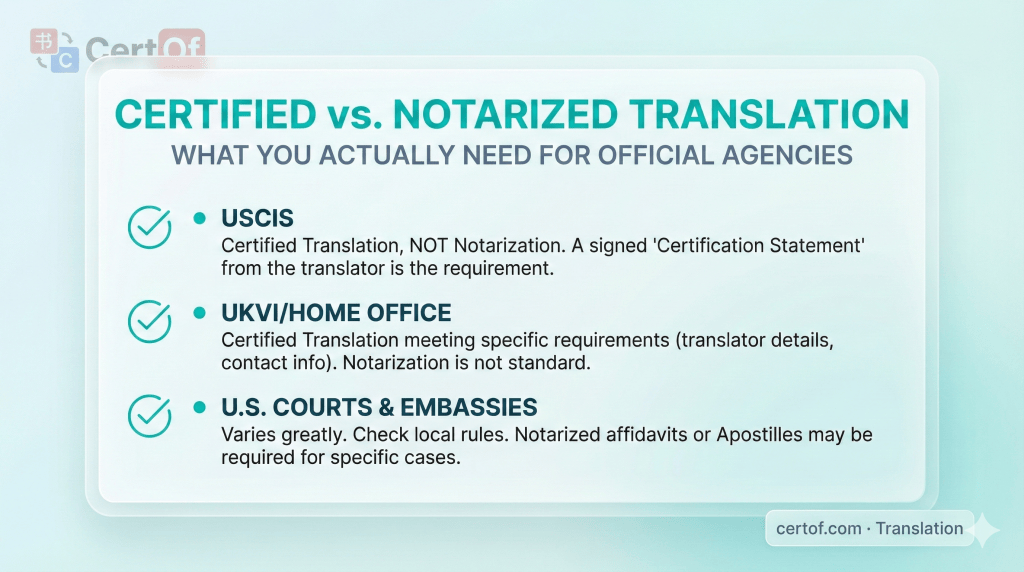
For general terminology only, keep it brief and use internal references rather than expanding this page into a global translation explainer: certified vs notarized translation and electronic certified translation formats.
Documents That Usually Matter Most
For this route-comparison topic, the standard packet usually includes:
- passport, DNI, or another accepted identity document;
- secondary diploma or graduation certificate;
- transcript or analítico, or the country-equivalent record showing subjects and completion;
- apostille or consular legalization chain, depending on the country of issue;
- the sworn declaration or other official filing form when the ministry requires it;
- Spanish public translation for non-Spanish documents.
The official reconocimiento page is unusually specific about one failure point: the name and surname on the school documents must match the current identity document textually. That detail deserves more attention than generic translation advice, because a small mismatch can delay the whole route.
How the Process Usually Works in Practice
- Check the issuing country first. That decides convalidación or reconocimiento.
- Collect both the diploma and the transcript-equivalent. Do not rely on a ceremonial graduation document alone.
- Finish apostille or consular legalization first. Translating before the legalization chain is complete can force a full redo.
- If the documents are not in Spanish, verify whether you need an Argentine traducción pública before paying for any foreign translation.
- File through the national recognition route, then complete the university’s own follow-up steps.
Argentina’s national recognition pages describe the process as free. In real life, that means the biggest costs are usually not government fees. They are translation, Colegio legalization, and document correction. The biggest delays also tend to come from packet errors, not from a published universal processing time.
Scheduling, Upload, and Queue Reality
This is where the article becomes more specifically Argentine and less generic. Both official ministry routes require the applicant to upload the school documents, valid identity document, and sworn declaration in a single PDF. That upload detail is easy to miss and often creates unnecessary resubmissions.
There is also a practical queue issue. As of March 24, 2026, the official appointment platform displayed a notice saying that no appointments were available because of high demand. The same platform listed Montevideo 950, C1020ACA and telephone numbers (011) 4129-1317 / 1318 / 1431. That does not change the legal route, but it does change how you should plan your timing: do not wait until the last moment to organize translations and legalized scans.
For applicants who cannot file personally, the official non-agreement page also sets out what a third party can use when the original identity document is unavailable, including an authenticated copy from certain Argentine authorities or a notary route later legalized through the local notarial system. That is another reason this topic is not just “translation.” It is document workflow.
Can You Start University Before Recognition Is Finished?
Sometimes yes, but this is exactly where applicants confuse the national recognition step with the university step. They are related, but not identical.
Resolución 3356/2019 is the reason applicants often talk about a 12-month window. The practical point is that some international students may move into university enrollment while the recognition process is still being completed, but they still need to finish the documentary chain in time.
The university layer can add real conditions. For example, UBA Legalizaciones makes clear that legalizations are handled through TAD-UBA, that scanned originals must be legible and in color, that certain upload limits apply, and that the filing number can be used provisionally while the review continues. UBA’s admission rules also state that students whose secondary diploma comes from a non-Spanish-speaking country must hold Spanish at C1 level under Article 306 of the university code: UBA Code, Chapter D.
The safe takeaway is simple: recognition solves one gate, not every gate.
What Is National, and What Is Actually Local
The route itself is national. The local variation shows up in three more practical areas:
- translator jurisdiction: public translators and Colegio legalization are organized by jurisdiction, not by a single national translation office;
- university implementation: each university controls its own upload, legalization, and enrollment follow-up;
- support access: appointment availability, upload friction, and contact channels can become the real bottleneck.
That is why this page stays country-level but still feels local to Argentina. The legal rule is national, but the failure points are administrative and documentary.
Pitfalls That Cause Delays
- Using a foreign translation provider as if Argentina followed a loose US-style certified-translation model. In this context, public translation by an Argentine translator may be the required path.
- Assuming apostille replaces recognition. It does not. Apostille legalizes the foreign document chain. Recognition is the Argentine education decision that lets the diploma function for higher study.
- Treating the university as the body that decides convalidación vs reconocimiento. The route is set first by the national framework.
- Waiting for a provisional admission stage before fixing the school packet. That often compresses the translation and legalization timeline into a more expensive rush.
Support, Verification, and Complaint Paths
If you need to verify whether studies have national validity before starting, the official page Información importante para iniciar estudios directs users to contact the Dirección de Validez Nacional de Títulos y Estudios by email. For the non-agreement route, the official page also points applicants toward [email protected] for certain authentication-related consultations inside Argentina.
That matters for anti-fraud purposes. If someone is selling “special access,” “guaranteed speed,” or a private workaround for the ministry route, check the official pages first. The process itself is presented as a public administrative route, not as something that should require a fixer.
How to Find the Right Kind of Translation Help
For this topic, the most useful provider distinction is not a ranking of agencies. It is the difference between:
- Argentine public translators, who are relevant when the filing route requires traducción pública and Colegio legalization; and
- document-preparation support, which is useful before that stage to organize scans, identify missing transcript pages, and catch name mismatches.
If you need the first type, start from the relevant Colegio or public translator directory and confirm the language pair. If you need the second type, use it as preparation support, not as a substitute for the legally required Argentine public-translator step.
Internal Reading If Your Packet Is Still Messy
- Buenos Aires university admission and foreign diploma recognition
- large academic record translation for university use
- how to upload and order certified translation online
FAQ
Which countries use convalidación in Argentina?
Use the current agreement-country list on the official convalidación page. The ministry publishes the list directly and also provides country-specific PDF instructions.
Do non-agreement countries still have to sit extra Argentine school exams?
For this university-entry scenario, the 2019 reform removed that old burden. The harder part now is usually legalization, translation, and file preparation.
Can I use a certified translation from my home country?
Do not assume so. In this Argentine filing context, non-Spanish documents may need a local traducción pública by an Argentine Traductor Público de Registro, plus Colegio legalization where required.
What if no appointments are available on the official platform?
Keep checking the official appointment platform and do not postpone scan preparation. Queue pressure is a practical timing problem, not a reason to switch to unofficial intermediaries.
Do I need DNI to start?
Not always. The official pages state that foreign applicants without DNI can use the valid identity document used to enter Argentina, such as a passport or cédula, depending on the case.
Does recognition mean I am fully admitted to the university?
No. Recognition is one national education step. Universities may still require their own legalization, upload, or Spanish-language proof.
CTA
If you are still sorting out the document packet, CertOf can help with the part we actually control: document review, translation support, formatting, and revision before you move into the Argentine public-translator stage. We do not act as the Argentine education authority, and we do not replace a local Traductor Público where that is legally required. But we can help you organize the packet, catch missing pages and name mismatches, and reduce the chance of paying twice for the same document set.
Start your translation request or contact us if you want a pre-flight review before your Argentina filing.