Argentina University Admission Traducción Pública: When Foreign School Documents Need Colegio Legalization
If you are preparing foreign diplomas, transcripts, or course records for study in Argentina, the key question is usually not whether you need a generic certified translation. The real issue is whether your file needs traducción pública for Argentina university admission: a translation signed by a registered traductor público and, in many cases, legalized by the relevant Colegio de Traductores. That distinction is what delays many applicants.
This article stays tightly focused on that translation standard. If you also need the broader filing order, use CertOf’s related guides on Argentina university admission document order and Buenos Aires foreign diploma recognition.
Key Takeaways
- For non-Spanish school documents, Argentine universities and education authorities commonly expect a local traducción pública, not just a foreign certified translation.
- For secondary-school recognition, the national Education Ministry says foreign-language documents must be translated in Argentina by a registered public translator and legalized by the corresponding Colegio. Official rule for non-treaty countries.
- The usual order is: apostille or legalize the source document first, then arrange the Argentine public translation, then complete Colegio legalization when the receiving body requires it. Cancillería guidance.
- The main Argentina-specific risk is procedural, not linguistic: using the wrong kind of translator, skipping Colegio legalization, or submitting an incomplete document set.
Who This Guide Is For
This guide is for applicants submitting school documents to universities or education authorities in Argentina, especially people using English-, Portuguese-, Italian-, or French-language records and trying to turn them into an Argentina-ready academic file. It is most useful if you are dealing with one of these situations:
- You finished secondary school abroad and need your diploma and transcript recognized before higher study in Argentina.
- You are applying to a university, graduate program, transfer, or credit-recognition process with a foreign degree, transcript, or course description.
- Your school records are not in Spanish and you are unsure whether a home-country certified translation will be accepted.
- You have a name mismatch across your passport and school documents and want to avoid rejection for a fixable paperwork issue.
What This Article Covers and What It Does Not
This is a reference page about the official translation standard for foreign school documents in Argentina. It does not try to cover every university-admission step. That is deliberate.
- It covers traducción pública, traductor público, Colegio legalization, apostille order, timing, file handling, and verification.
- It does not fully unpack academic recognition routes, transfer-credit strategy, or every university’s admissions workflow. For those wider questions, keep the explanation short here and use internal references such as apostille versus translation order for Argentina university admission and certified vs. notarized translation.
What “Official Translation” Usually Means in Argentina
Argentina uses its own legal vocabulary. The term many international users search for is “certified translation,” but the local standard is usually traducción pública. Under Law 20.305, public documents filed before public bodies are tied to the work of a registered traductor público, and the Colegio has authority over professional registration and signature legalization.
That is why a translation done abroad, even by a sworn or certified translator in another country, may still not be enough for Argentina. For example, the Ministry page for secondary-school recognition from non-treaty countries says the documents must be translated in Argentina by a registered public translator and legalized by the corresponding Colegio. See the ministry requirement. For treaty countries, the Ministry’s convalidación page points applicants to the same regulated filing environment. Convalidación page.
The same logic appears in higher-education workflows. The University of Buenos Aires legalizations portal states that foreign diplomas, transcripts, programs, and other non-Spanish academic documents should be translated by a traductor público nacional and then legalized at an Argentine Colegio de Traductores. UBA legalizations portal. For foreign university degrees that enter the national convalidación system, the Education Ministry’s university route also sits inside this same public-document logic. Convalidaciones universitarias.
Practical bottom line: in Argentina, the real question is rarely “Do I need a certified translation?” It is “Do I need an Argentine public translation, and does the file also need Colegio legalization?”
Which Documents Usually Trigger This Requirement
For university admission and related education filings, the documents most likely to need public translation are:
- Secondary-school diploma or leaving certificate
- Final transcript or analítico
- University diploma or degree certificate
- University transcript
- Course descriptions, syllabus summaries, or study plans
- Enrollment or expected-graduation certificates
- Identity or civil-status records only when they explain a name mismatch
If your packet is large, especially course descriptions or multi-year academic records, it also helps to look at CertOf’s guide on large academic record sets for university use before you request quotes.
When Argentina University Admission Traducción Pública Is Required
In practice, you should expect the public-translation standard to apply whenever all three of these conditions are true:
- The document is an academic or supporting record that will be submitted to an Argentine university or public education authority.
- The document is not in Spanish.
- The receiving body is asking for a filing with legal validity, not just an informal pre-review copy.
For secondary-school recognition, the national rule is explicit. For foreign university records, the same expectation appears in university legalization workflows such as UBA’s. The exact receiving office may differ, but the translation standard usually does not. This is one of those topics where the core rule is largely national; the local differences show up more in Colegio logistics, digital workflows, and university filing channels than in the translation rule itself.
The Real Workflow From Preparation to Submission
- Confirm which recognition path you are actually in. Secondary-school applicants should start with the Ministry route for countries with educational agreements or countries without agreements. Applicants using a foreign university degree should check the national convalidaciones universitarias route or the receiving university’s own page.
- Legalize the source document first. Your diploma or transcript usually needs the Hague apostille or consular legalization before it enters the Argentine translation workflow. That order matters because the translated package may need to reflect the complete legalized source set. Cancillería guidance.
- Send the full source set to a registered Argentine public translator. That often means the diploma, transcript, apostille page, and any stamps or endorsements, not only the front page of the credential.
- Complete Colegio legalization if the filing requires it. In CABA, the CTPCBA publicly explains its paper, remote, and digital legalization methods. CTPCBA legalizations.
- Submit through the actual receiving channel. UBA’s legalization workflow is digital through TAD-UBA, and the university notes that there is no fixed processing deadline. It also states that applicants can use the expediente number while the file is under review. UBA portal.
If you are organizing scans before you hand the matter to a public translator, CertOf’s guide on electronic certified translation formats is a useful preparation step.
The Argentina-Specific Reality: Costs, Timing, and Digital Handling
This is where the article becomes truly local. Argentina’s national rule may be consistent, but the filing reality is shaped by Colegio logistics and digital submission systems.
- At the CTPCBA, public legalization fees effective from January 1, 2026 are posted as ARS 26,000 for simple legalization, ARS 30,000 for urgent legalization, ARS 26,000 for digital simple legalization, and ARS 38,000 for urgent digital legalization. The posted turnaround is 24 business hours for simple in-person work, 48 business hours for digital simple work, and about three hours on average for urgent digital work. Current CTPCBA fee page.
- Those public Colegio fees do not include the translator’s professional fee. Your real cost is usually the translator’s fee plus the Colegio legalization charge.
- Digital handling matters. The CTPCBA requires the translator to upload the source document and translation together in PDF for digital legalization. Source.
- UBA’s process is also digital-first. That reduces courier friction, but it makes file order, file quality, and signature format more important than many applicants expect. Source.
Counterintuitive point: in Argentina, “translation completed” is often not the finish line. For many academic filings, the real finish line is the legalized translation package that the institution can actually accept.
Public Support and Complaint Paths
Because this topic is country-level, the most useful support nodes are not city parking tips or office-routing tricks. They are the public bodies that control or explain the translation standard.
- CTPCBA search and validation tools: If your translator is working through CABA, use the public CTPCBA directory to verify that the translator is registered and the digital legalization verification page to check a legalization code.
- CTPCBA conduct path: The CTPCBA’s Tribunal de Conducta handles complaints about professional conduct. The College publishes the function of the tribunal and the requirements for filing a complaint. Tribunal information.
- CTPCBA public offices: The College publishes its Corrientes and Callao addresses, phone numbers, and department hours. Sedes y departamentos.
- University-side contact: If the translation itself is fine but your legalizations file is stuck at UBA, the university publishes [email protected] for legalization issues.
Common Mistakes That Delay Admission Files
- Using a home-country certified translation. This is the most common wrong turn. It may be professionally done and still fail the Argentine formal requirement.
- Apostilling after translation. If the source document needed apostille first, the translation package may need to reflect that complete legalized source set.
- Sending only the diploma but not the transcript or apostille page. Argentine public translation is document-specific. Missing pages can force a redo.
- Ignoring name mismatches. The Ministry warns that names on school records must match the valid identity document. If they do not, add the supporting record early instead of waiting for rejection. Education Ministry page.
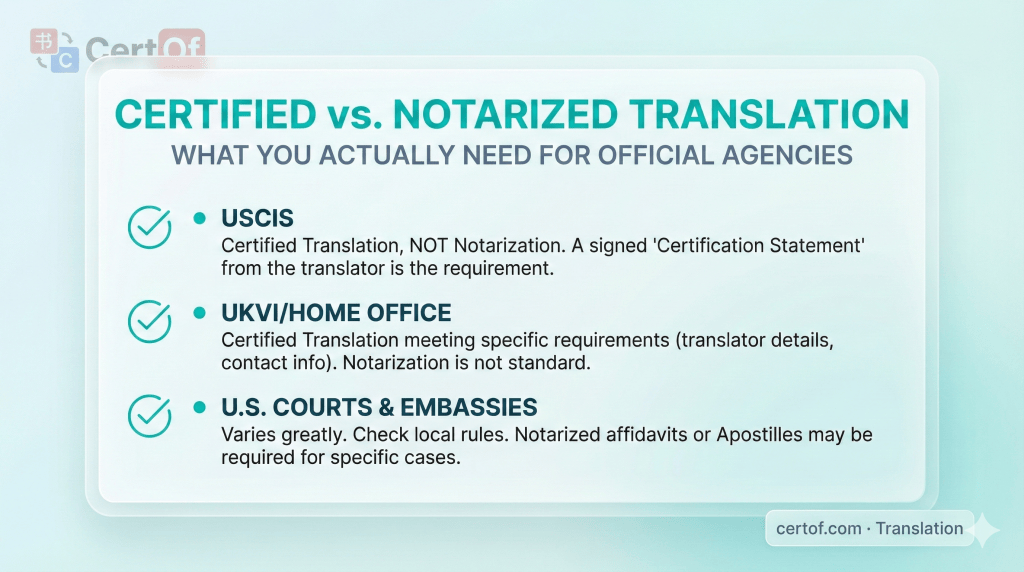
- Assuming notarization solves everything. For the ordinary university filing, the key compliance issue is usually public translation plus Colegio legalization, not a separate notarial layer. If you need a refresher on the terminology, use CertOf’s explainer on certified vs. notarized translation.
Which Service Model Fits This Workflow
| Service model | What it can realistically do | Best fit |
|---|---|---|
| Direct Argentine traductor público | Performs the regulated translation and usually coordinates Colegio legalization. | Best for applicants who already know the exact documents and language pair they need. |
| Agency coordinating a public translator | Can organize multi-document packets and coordinate the regulated translator workflow, but you should still confirm who the registered translator is and whether Colegio fees are included. | Useful when the packet is large or multilingual. |
| CertOf document-prep support | Helps you organize scans, catch missing pages, identify likely name-mismatch problems, and prepare a clean package before it goes into an Argentine public-translation path. | Useful when you are still cleaning the file set or comparing routes before you order the regulated translation. |
Where Applicants Usually Get Stuck
The recurring bottlenecks in Argentina are remarkably consistent:
- People do not realize that the apostille page itself may need to travel with the translated package.
- They ask for a quote before they know whether they need the translator fee only or the translator fee plus Colegio legalization.
- They wait until the admission deadline to ask about a less common language pair.
- They assume every university office will explain the difference between translation validity and academic recognition. In practice, those are separate problems.
If you want to reduce avoidable back-and-forth before ordering, use CertOf’s upload form or read how to upload and order a certified translation online so your scans, page order, and file naming are clean before you involve an Argentine public translator.
FAQ
Can I use a certified translation from my home country for Argentina university admission?
Often no. If the document is being filed before an Argentine university or public education authority as a formal academic record, the safer assumption is that you need a local traducción pública by a registered Argentine public translator, plus Colegio legalization when required.
Is traducción pública the same as a normal certified translation?
Not exactly. “Certified translation” is the bridge term international readers understand. In Argentina, the legally important local concepts are the traductor público and the Colegio legalization structure.
Do I need notarization too?
Usually not for the standard university filing. The main formal layer is the public translator plus the Colegio legalization requirement. Extra notarial steps are special-case issues, not the normal rule.
Do universities accept digital legalizations?
Many workflows do, and UBA’s legalization route is digital. But the practical point is not just whether a file is digital. It is whether the digital file carries the correct regulated translation and, where required, a verifiable Colegio legalization. UBA portal.
How long does the process take?
It depends on the translator, the Colegio, and the receiving institution. As of January 1, 2026, the CTPCBA posts 48 business hours for digital simple legalizations and about three hours on average for urgent digital legalizations after payment is credited. University-side review can take longer and may not have a fixed timeline. CTPCBA fees and timing.
CTA
If you already know your Argentine filing will need a public translation workflow, CertOf’s most realistic role is to help you prepare a clean source-document package, catch missing pages or name mismatches, and organize the file before it goes into a regulated Argentine translation path. Start with document upload, review delivery and revision expectations, or use the contact page if you need help sorting the document set before you request quotes.
Disclaimer: This guide is practical information, not legal advice or university-specific admissions advice. Argentine universities and education authorities can change filing instructions, and some institutions may add their own document or format rules. Always confirm the final requirement with the receiving body before you pay for translation or legalization.