Sworn Translation vs Certified Copies for Germany University Applications
Sworn translation vs certified copies for Germany university applications is one of the most common document-preparation problems for international applicants. In Germany, these terms do not describe the same thing, and that is exactly why applicants lose time, pay twice, or get a follow-up document request after they thought the file was already complete.
The short version is this: a translation solves the language problem, while a certified copy solves the authenticity problem. In the German admissions context, the local terms matter more than the English bridge term “certified translation.” What universities, uni-assist, and many admissions offices usually care about is whether you have an amtlich beglaubigte Kopie and, when needed, a beeidigte, vereidigte, or otherwise court-admissible translation.
- Key takeaway 1: A sworn or certified translation is not a certified copy. You may need both.
- Key takeaway 2: In Germany, translators can usually certify only their own translations, not your original-language diploma copy.
- Key takeaway 3: If your target school uses uni-assist and requires officially certified copies, those hard copies must be sent by post; scans of certified copies do not count as certified copies for uni-assist.
- Key takeaway 4: Germany-wide terminology is fairly consistent, but workflow differences still matter: one university may accept scans first and ask for paper later, while another route requires certified paper from the start.
Disclaimer: This is a practical document-preparation guide, not legal advice or admissions advice. German universities, uni-assist, APS-related routes, and ZAB can each set their own document workflow. Always check your target institution’s current page before paying for copies or translations.
Who This Guide Is For
This guide is for applicants preparing foreign academic documents for study in Germany, especially people applying through uni-assist or comparing uni-assist, direct university admission, APS-related requirements, and ZAB-related document rules. It is most useful if your documents are not originally in German, and you are trying to work out whether you need a sworn translation, an officially certified copy, or both.
Typical document sets include a school-leaving certificate, transcript, bachelor’s degree certificate, diploma supplement, language certificate, passport copy, and sometimes a name-change or marriage document if names do not match across records. The most common real-world situation is simple: you have originals and scans, but you do not know which authority handles the copy, which professional handles the translation, and which item has to be mailed.
Why This Confusion Happens In Germany
This topic is unusually confusing in Germany because the system mixes shared national terminology with institution-specific intake workflows. uni-assist has a clear shared standard for its member universities, but direct-application universities can stage document checks differently. For example, TU Berlin’s uni-assist listing says the university accepts an online-only pre-check and may request officially certified copies later, while Europa-Universität Viadrina explicitly says it may accept scans for application and reserve the right to demand officially certified copies and sworn translations later in the enrollment stage.
That means Germany is not just a “translation” problem. It is a sequencing problem. If you buy the wrong service first, you often still have to go back and do the missing step.
What “Amtlich Beglaubigte Kopie” And “Beeidigte Übersetzung” Actually Mean
| Term | What it solves | Who usually issues it | What it does not do |
|---|---|---|---|
| Officially certified copy amtlich beglaubigte Kopie |
Confirms the copy matches the original | Public authority with official seal, notary, German embassy/consulate, issuing school or other authorized body | It does not translate the content |
| Sworn or court-admissible translation beeidigte / vereidigte / ermächtigte Übersetzung |
Makes the document understandable in German or English for the receiving institution | Translator or institution authorized to translate under oath or admissible in court | It does not turn your original document into an officially certified copy |
| Certified translation | English bridge term used by applicants and some English-language pages | Depends on the German requirement behind it | On its own, it is too vague for Germany |
The most important non-obvious point is this: in Germany, “certified” can refer to two different compliance layers. For admissions, the safer local reading is to ask: Do they want a certified copy, a sworn translation, or both?
Which Step Each Document Action Belongs To
- Start with the original document. This is your diploma, transcript, or certificate in the original issuing language.
- Create the officially certified copy if required. This is the authenticity step. For uni-assist, if your chosen university requires officially certified copies, they must be hard-copy documents with the original official stamp and original signature. uni-assist also says scans or uploaded copies of certified documents are not sufficient.
- Get the sworn or otherwise acceptable translation if the document language requires translation. uni-assist accepts translations from persons or institutions authorized to make translations under oath or admissible in court, or an authorized department of the issuing school or university. It does not accept non-certified translations from standard translation agencies.
- Submit in the format your route requires. Some files are upload-only. Some require a paper set. Some universities ask for scans first and paper later.
If you remember only one rule, make it this one: translation and certification are different actions handled by different actors.
Germany-Specific Rules That Matter Most
For uni-assist: the official standard is the clearest nationwide rule set. It requires the original-language certificate plus a German or English translation when needed, and it requires officially certified copies when your chosen university asks for them. Hard-copy certified copies must be sent by post; uploads are not enough for those certified items. uni-assist also warns that it does not cooperate with commercial agencies that claim to place applicants at German universities.
For direct university applications: the rules can be narrower or more flexible, but they are not interchangeable with uni-assist. LMU Munich explains its own standards for officially certified copies and officially certified translations. Viadrina shows another common pattern: scans may be accepted for the application stage, but certified copies and sworn translations can still be demanded later. In practice, the university’s own admissions checklist or program-level rules are the local layer that can narrow or expand the general advice.
For APS-related applications: applicants with school or university credentials from China, India, or Vietnam may face an additional authenticity screen. TUM’s APS guidance explains that the APS certificate confirms the genuineness of the documents and whether the academic achievements qualify the applicant to study at a German university. Hochschule Düsseldorf likewise says applicants with credentials from China, India, and Vietnam must submit APS evidence. APS is not the same as a sworn translation or a certified copy; it is a separate gatekeeping document.
For ZAB: this is a separate credential-comparison route, not a substitute for university admission. If you need help distinguishing ZAB from university admission itself, read Germany ZAB Statement of Comparability vs University Admission. The official ZAB Statement of Comparability page is mainly for degree comparison, often for employment and public-sector use, not for replacing a university’s own admissions decision.
Do You Need German Or English Translation?
For uni-assist, the standard rule is original language plus a German or English translation. If your country already issues the certificate in German or English, uni-assist says a translation is generally not needed, subject to country-specific exceptions. That is why many bilingual documents are easier to use than applicants expect.
But this is also where direct-application universities can differ. Some publish broader language exemptions. Others are stricter. That is why the practical order should be: first read the university or uni-assist rule, then buy the translation. If you need a more detailed Germany-specific guide to VPD, direct admission, and foreign diploma preparation, use this Germany university application guide.
The Real Logistics In Germany: Uploads, Mail, Deadlines, And Originals
This is where the German system feels most local. Many applicants assume a scan is enough because the application portal is online. That is only partly true. uni-assist’s sending instructions say certified copies must be sent by post when required and recommend sending documents as early as possible, preferably at least eight weeks before the application deadline. On its official contact page, uni-assist lists the postal address as uni-assist e.V., 11507 Berlin, Germany, with Geneststraße 5, 10829 Berlin as a courier fallback if the carrier will not accept the postal address. It also notes a 24-hour letter box at Reichartstraße 2 in Berlin and phone hours Monday to Friday, 10:00 a.m. to 1:00 p.m.
Another Germany-specific reality is that uni-assist says you should send only certified copies, never originals, because documents are not returned. That matters for irreplaceable school or university records.
On the certification side, German public authorities may certify foreign-language documents, but uni-assist also says they are under no obligation to do so. That is a very practical local friction point: the rule exists nationally, but whether a particular office will handle your foreign-language certificate may vary. If you are preparing digital files for an online application step, this overview of PDF vs Word vs paper delivery can help you keep the format side straight.
Common Pitfalls That Delay German Applications
- You paid for a translation but never obtained an officially certified copy of the original-language diploma.
- You got a notary or local service to certify a copy, but the copy lacks the required official stamp, original signature, or proper treatment of multi-page sets.
- You assumed “certified translation” meant any agency translation with a stamp. For uni-assist, ordinary translation-agency output is not enough if it is not from an authorized under-oath or court-admissible source.
- You mailed originals instead of certified copies.
- You relied on one university’s upload workflow and applied the same logic to another school or to APS or ZAB.
The most counterintuitive point is also the one that saves the most money: the translator is usually not the person who fixes your copy problem.
What Applicants Keep Asking: Official Guidance And Public Applicant Voices
Official admissions pages already reveal the recurring trouble spots. uni-assist has FAQ entries about whether documents need certification, whether they need translation, and whether certified copies must be sent by post. Universities like LMU and Viadrina also spend substantial space explaining that a copy of a certified copy is not enough and that sworn translators may certify only translations they made themselves.
Public applicant discussions show the same pattern. In recent Reddit discussions about uni-assist, applicants describe uploading documents that were later treated as insufficient because the hard-copy certification step had not been satisfied. Older GradCafe threads about certified copies for Germany applications show the same anxiety around whether school-issued copies, notarized copies, and mailed sets are enough. Those discussions are useful as weak-signal workflow warnings, but the rule itself should still come from the official page that matches your route.
Public Resources You Should Check Before Paying Anyone
| Resource | What it helps with | Public signal | Best use |
|---|---|---|---|
| uni-assist | Shared admissions document standards for many universities | Official intake body for many German universities | Use first if your target school applies via uni-assist |
| Justiz-Dolmetscher database | Find and verify sworn translators in Germany | Official judicial translator database | Use to verify translator status before ordering |
| DAAD | Germany-wide application overview | Official national guidance body for international higher education information | Use for process overview, not as a substitute for university-specific rules |
| ZAB | Statement of Comparability for foreign university degrees | Official credential-comparison authority | Use only if your case genuinely needs ZAB |
| Verbraucherzentrale | Consumer-protection support if a private service provider dispute develops | Germany-wide network of consumer advice centers | Use for ordinary consumer escalation, not for admissions-rule interpretation |
Why This Paperwork Problem Is Bigger Than It Looks
This is not a fringe paperwork issue. The official ZAB page says it received 118,370 applications in 2024 covering qualifications from 190 countries. That is one reason document form matters so much in Germany: foreign qualifications move through standardized review channels, and small format mistakes become expensive very quickly. At the market level, the BDÜ translator search states that its directory covers more than 7,500 professional linguists and more than 80 languages, which is useful not as a quality ranking but as a reminder that applicants should search by language pair, specialization, and sworn status rather than by generic “certified translation” marketing.
Commercial Translation Routes: Use With The Right Expectation
For this topic, the most important question is not “which provider is fastest?” but “which route actually solves the translation side of the problem?” A provider can help with the translation side; it cannot replace the institution that issues an officially certified copy of your original-language document.
| Route | Public business signal | Best fit | Main caution |
|---|---|---|---|
| BDÜ member translators | Professional association search tool with language, specialization, and sworn-translation filters | Useful if you want to identify individual translators by language pair and document type | BDÜ membership is not the same thing as automatically meeting every admissions rule; you still need to confirm sworn status where required |
| lingoking GmbH | Germany-based commercial platform with published imprint and sworn-translation service pages | Useful if you specifically want an online ordering workflow for sworn translations | You still need to confirm that the output matches your target university or uni-assist requirement |
These are not official recommendations. They are examples of Germany-based market routes with public signals. For many applicants, the safer first step is still to verify the rule, then verify the translator’s status, then place the order.
Cost And Waiting Reality
The cost structure in Germany is split across different actors. The DAAD notes that there is usually a fee for document certification and often a fee for the application itself. It also notes the current uni-assist processing fee of 75 EUR for the first study choice and 30 EUR for each additional application in the same semester. Certification fees and translation fees vary by authority, page count, language pair, and provider, so they should not be treated as a single all-in “translation cost.”
Time risk is also split. Postal time, local appointment availability for certification, and translation turnaround are separate bottlenecks. For uni-assist cases that need hard-copy certified sets, the official recommendation to send them at least eight weeks before deadline is the clearest benchmark you should use.
Fraud And Complaint Paths
- First fraud warning: uni-assist explicitly says it does not cooperate with commercial agencies that claim to mediate admissions placements. Treat that as a direct warning sign.
- Second fraud warning: verify sworn translators through the official judicial database instead of relying only on marketing language.
- If the issue is document rules: contact uni-assist through its official contact page or the university admissions office, not a third-party agent.
- If the issue is a private service provider: keep invoices, order confirmations, and screenshots. Germany does not have a single national complaint line dedicated to university-application translation disputes, so your practical path is provider support first and then the relevant state consumer advice center if the problem turns into an ordinary consumer dispute.
How CertOf Fits Into This Process
CertOf is strongest on the document-preparation side: helping you identify what needs translating, preparing a clean certified translation package where that format is acceptable, and reducing avoidable back-and-forth on formatting and revisions. CertOf is not a German university admissions office, not a document-certifying authority for your original-language diploma, and not a substitute for a Germany-recognized sworn translator if your target institution specifically demands that route.
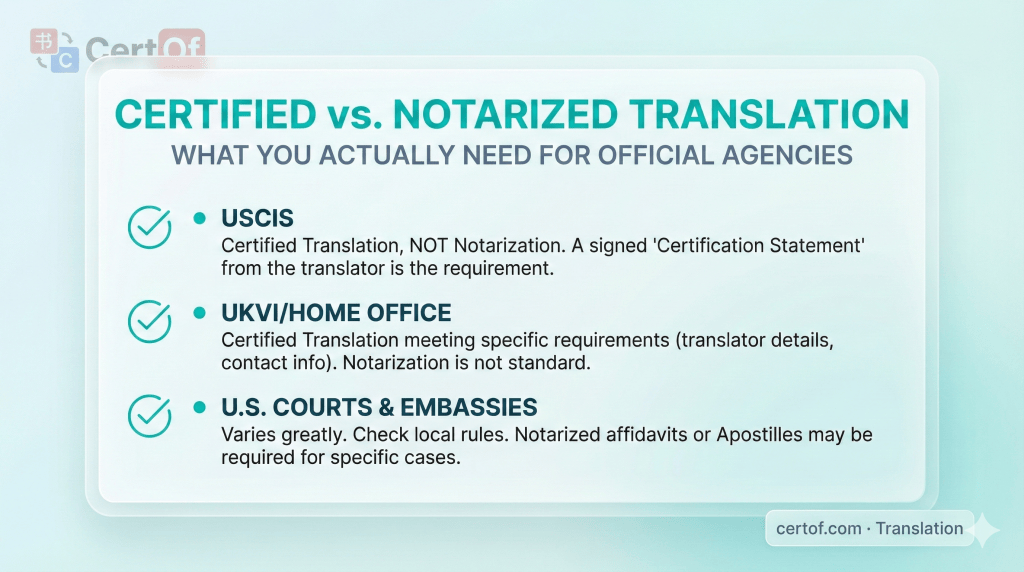
If you already know you need a translation-ready package, you can upload your documents here. If you want to understand how online ordering and file submission work before placing an order, start with our upload and order guide. If you may need paper delivery for a receiving institution, see our hard-copy delivery guide. For a broader terminology comparison, use our certified vs notarized translation explainer.
FAQ
Do I need a sworn translation, a certified copy, or both for Germany university applications?
Often both. The certified copy proves the copy matches the original. The sworn or otherwise acceptable translation makes the content usable in German or English. One does not replace the other.
Can a translator certify my original diploma copy in Germany?
Usually no. German guidance from uni-assist and universities like Viadrina says translators are not authorized to certify documents in their original language. They may certify translations they created themselves.
If my degree certificate is already in English, do I still need a German translation?
Not always. uni-assist generally accepts certificates already issued in German or English, subject to country-specific exceptions. Direct universities may publish their own language rules, so always check the exact page for your route.
Does an APS certificate replace a certified copy or a sworn translation?
No. APS is a separate authenticity and eligibility screen for certain applicants, especially those with credentials from China, India, or Vietnam. It does not erase the need to follow the translation or certified-copy rule that applies to your admissions route.
Do I have to mail certified copies to uni-assist?
If your chosen uni-assist university requires officially certified copies, yes. uni-assist says those certified copies must be submitted as hard copies by post and that scans or uploads are not enough for those certified items.
Can I send originals to uni-assist to be safe?
No. uni-assist says to send only officially certified copies, never originals, because documents are not returned.
Is ZAB the same as university admission recognition?
No. ZAB issues a Statement of Comparability for foreign university degrees in certain contexts. It is not the same thing as a university admissions decision.
Final Practical Checklist
- Identify your route first: uni-assist, direct university application, APS-related route, or ZAB.
- Read the exact wording: original language, translation language, certified copy requirement, and submission format.
- Separate the two tasks: who certifies the copy, and who provides the translation.
- Do not mail originals to uni-assist.
- Where a sworn translation is required, verify the translator through the official database.
- Where a certified copy is required, make sure the paper set has the original signature and official stamp.
- Build in mailing time early, especially if your route still depends on hard-copy certified sets.
If you want a second pair of eyes before ordering translation, CertOf can help you sort the file into the right buckets: translation needed, certified copy needed, or both. That step alone prevents a large share of avoidable Germany admissions document mistakes.