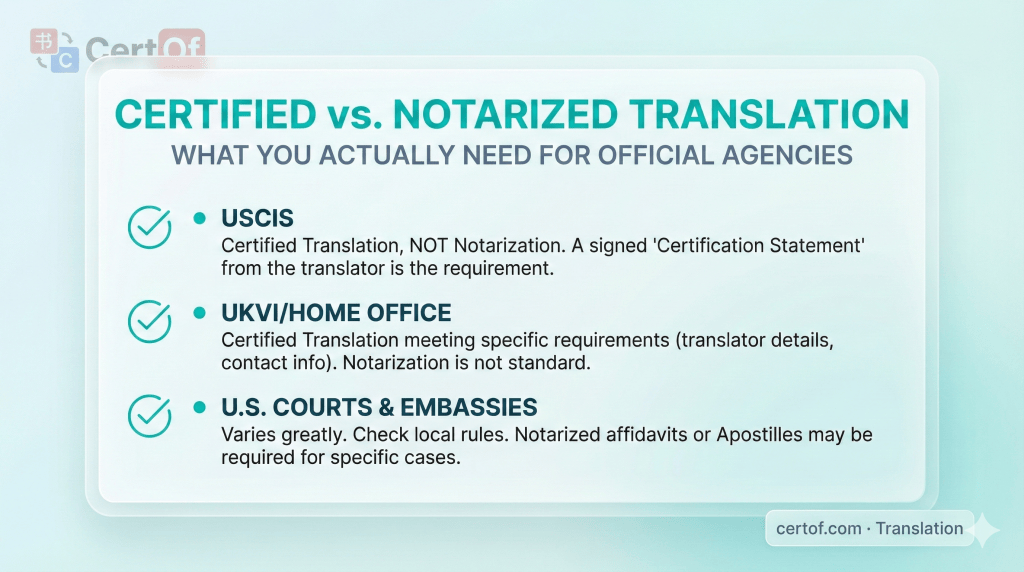
Germany VPD vs uni-assist: When You Need Each Route for University Applications
If you are applying to a German university with foreign school or university credentials, one of the first practical questions is not whether your grades are good enough. It is whether your case goes through the VPD route or the standard uni-assist procedure. In Germany, those two paths are related, but they are not interchangeable. They change who checks your documents, who receives your file, which deadline controls your case, and when a certified translation actually becomes mission-critical.
Disclaimer: This guide is practical information, not legal advice or admissions advice. German universities can change their application routing by program and semester. Always confirm the current path on your target university page and in uni-assist before you upload or mail anything.
Key Takeaways
- A VPD is not a university application. It is a preliminary review document issued by uni-assist for certain universities, and you usually still have to apply to the university separately.
- Under the standard uni-assist procedure, uni-assist reviews your documents and forwards a successful application electronically to the university. Under the VPD route, uni-assist does not forward the application for you.
- The practical risk in Germany is timing. uni-assist says processing usually takes 4 to 6 weeks, and VPD applicants need even more buffer because there is a second submission step to the university.
- For translations, the local German logic matters more than the generic English term. In practice, applicants usually need a sworn or court-authorised translation that uni-assist can accept, not just any agency translation labeled “certified” or beglaubigte Übersetzung without the right acceptance basis.
Who This Guide Is For
This guide is for applicants using foreign credentials to apply to universities in Germany, especially bachelor’s, master’s, Staatsexamen, and Studienkolleg-track applicants who are trying to work out whether they need a VPD or go through normal uni-assist review. It is most useful if your documents are not fully in German or English, or if you are juggling a diploma, transcript, grading-scale explanation, school-leaving certificate, entrance-exam proof, APS certificate, or other academic records that may need translation before submission.
The most common real-world situations are straightforward: you are applying from abroad and do not know whether uni-assist forwards your application automatically; you already paid uni-assist but are not sure whether you still need to apply in a university portal; or your file includes transcripts, back-page legends, stamps, and grading notes that must be translated correctly for a German evaluator to read them.
VPD vs standard uni-assist procedure: the main differences
| Question | Standard uni-assist procedure | VPD procedure |
|---|---|---|
| Who reviews documents first? | uni-assist | uni-assist |
| What do you receive? | An evaluation result and, if successful, forwarding to the university | A VPD PDF that summarizes the document review |
| Who sends the file to the university? | uni-assist forwards it electronically | You usually submit the VPD and the rest of the application yourself |
| Who decides admission? | The university | The university |
| Main risk | Incomplete file means no forwarding | Applicants think the VPD itself counts as the application and miss the second step |
uni-assist describes the standard procedure as the route used by most of its universities: you submit the application to uni-assist, uni-assist evaluates it, and after a positive evaluation the application is forwarded electronically to the university. By contrast, under the VPD route, uni-assist issues a preliminary review document and you then apply directly to the university with that VPD before the university deadline.
When your case usually goes through VPD
You need a VPD when your target university tells uni-assist to use that special procedure for your program or applicant group. The cleanest way to think about it is this: the university wants uni-assist to pre-check your foreign educational credentials, but it still wants to receive your actual application itself.
- You may see this for many foreign-credential applications, especially at universities that run their own application portals.
- It is common in cases where the university wants a standardized credential evaluation first, then handles program-specific admission itself.
- The VPD is usually university-specific in practice, so it should not be treated like a general-purpose academic recognition letter.
A useful example is Freie Universität Berlin’s VPD FAQ, which states plainly that applying for a VPD does not replace applying for admission. That single point eliminates one of the biggest mistakes international applicants make in Germany.
When your case usually goes through the standard uni-assist procedure
You are in the standard route when the university has uni-assist process the application itself and forward successful files on to the university. For applicants, this means uni-assist is not just issuing a pre-check document. It is acting as the first formal gate in the admissions workflow.
- You build the application in My assist.
- uni-assist checks whether the application is complete and in the required form.
- If the criteria are met, uni-assist forwards the file electronically.
- The university then decides on admission.
This route is simpler operationally because there is no extra VPD handoff step. It is still not the same as admission. uni-assist can forward a file successfully and the university can still deny admission later.
Why VPD and standard uni-assist are not interchangeable
This is the part many applicants underestimate. The two routes use the same national service infrastructure, but they create different submission chains.
- They create different deadline risk. uni-assist recommends applying at least 8 weeks before the deadline if possible, and even more time for VPD because you still have to submit the VPD to the university afterward.
- They create different document-delivery risk. In the standard route, a complete file can be forwarded electronically. In the VPD route, you still need to complete the university-side submission correctly.
- They create different mistake patterns. Standard-route applicants usually fail because the file is incomplete. VPD-route applicants often fail because they stop after receiving the VPD.
- They create different translation pressure points. With a VPD, an incomplete translation can delay the uni-assist review and then also delay your second-step university application.
The most counterintuitive fact in this entire topic is simple: getting your VPD is not the same as having applied to the university. For Germany-based university applicants, that is the single most important distinction to understand early.
Where certified translation fits in the German workflow
In this topic, “certified translation” is useful as a bridge term for global readers, but the German logic is more specific. uni-assist accepts translations from persons or institutions authorised to make translations under oath or admissible in court, or from an authorised department of the issuing school or university. It does not accept ordinary non-certified translations from standard translation agencies.
That means the local concept is closer to sworn translation, court-authorised translation, or the German market phrase beglaubigte / vereidigte Übersetzung. If you want the deeper Germany-specific distinction, see our related guide on sworn translation vs certified copies for German university applications.
For uni-assist, the practical translation triggers are usually these:
- your diploma or school-leaving certificate is not in German or English;
- your transcript includes a grading legend, back-page notes, or institutional remarks that are not in German or English;
- your country-specific document set requires the original-language file plus a translated version;
- your file includes seals, stamps, annotations, or provisional statements that an evaluator needs to read to decide whether the document is complete.
For country-specific exceptions, uni-assist’s country pages can change the rule. Some countries have special translation or certification requirements, which is why applicants should never assume that one translation format fits every origin country.
Document sets that most often create translation work
- Master’s applicants: bachelor’s degree certificate, transcript of records, grading-scale explanation, diploma supplement, course descriptions, APS certificate if applicable.
- Bachelor’s or Studienkolleg-track applicants: school-leaving certificate, annual school reports or transcripts, university entrance examination proof, language certificates.
- Edge cases: provisional graduation documents, name mismatch documents, transferred-credit records, school or university name-change notes.
A common German failure point is not the main diploma page. It is the missing legend, missing reverse side, or missing grading explanation that makes a transcript hard to assess. If you only translate the obvious front page, the file may still be functionally incomplete.
Germany timing, cost, and mailing reality
This is mostly a national, not city-level, workflow. There is no meaningful walk-in shortcut. The real logistics are online submission, document format, and lead time. uni-assist is based in Berlin, but for most applicants the process is still mainly digital unless a university asks for paper copies.
- uni-assist says processing usually takes 4 to 6 weeks after receipt of the application and payment.
- The same source warns that individual cases can take longer and that VPD applicants should allow more time because they still need to apply to the university directly.
- Processing fees are currently €75 for the first study choice in a semester and €30 for each additional study choice in the same semester, unless a university covers them.
- Some universities accept online-only submission in the uni-assist stage, while others still require officially certified copies to be sent by post.
So the practical Germany advice is not “apply before the deadline.” It is “apply early enough that a translation fix, a missing legend, or a certified-copy issue does not destroy the second step.” That matters even more in VPD cases.
What applicants in Germany most often get wrong
Across university FAQs and applicant-facing guidance, the same patterns repeat:
- Applicants think VPD equals completed university application.
- Applicants wait to order translations until after they have already started My assist.
- Applicants upload a transcript but leave out the grading system, back page, or attachment pages.
- Applicants use a general translation agency that cannot meet the acceptance standard uni-assist applies.
- Applicants rely on last year’s forum advice even though universities can change the route by program or semester.
If you want a city-level example of how this plays out inside a university-specific workflow, our Cologne guide covers that narrower scenario here: foreign diploma translation, VPD, and uni-assist in Cologne.
Local rules and support nodes in Germany
This topic is mainly governed by uni-assist’s national procedure and by each university’s own admissions setup. Germany does not have one separate state-by-state admissions rule that changes the core VPD logic. The local variation shows up instead in three places:
- University routing: whether the university uses standard uni-assist, VPD, or a mixed model for particular programs.
- Document form: whether uploads are enough or certified paper copies still need to be mailed.
- Translation acceptance in practice: whether the file clearly matches uni-assist’s accepted-source rule and the university’s own portal expectations.
Background tools such as anabin can help you understand how foreign institutions and qualifications are classified in Germany, but they do not replace the university’s own routing decision or the VPD logic used in admissions.
Germany also has a strong anti-fraud signal here. uni-assist states that it does not cooperate with commercial agencies that place applicants at German universities. If a third party presents itself as a uni-assist partner for admissions placement, treat that carefully and verify directly through uni-assist and the target university.
Local data that explains why this issue is so common
Germany remains one of the world’s largest destinations for international students, and uni-assist evaluates applications for 180 German universities. That scale matters because it creates exactly the problem this guide is addressing: a national application service with university-by-university routing differences. For applicants, that means the hard part is often not finding uni-assist. It is understanding what uni-assist is doing for your university and what it is not doing for you.
Commercial translation options for this use case
| Provider | Public signal | Best fit for this topic | Boundary |
|---|---|---|---|
| CertOf | Online ordering and document upload workflow | Applicants who need diplomas, transcripts, grading legends, and multi-page academic files translated into a submission-ready package | Not a university, not uni-assist, not an admissions representative |
| lingoking GmbH | Munich-based company with published sworn-translation workflow and shipping terms | Applicants who specifically need a German sworn-translator workflow and want digital plus postal delivery options | You still need to verify that your exact document route matches uni-assist and university rules |
| tolingo / Beglaubigung24 | Hamburg-based company with published certified-translation process and public phone contact | Applicants who want a Germany-based provider with certified-translation language and document-shipping information published online | More useful for translation execution than for university routing advice |
If your main problem is figuring out whether you need a sworn translation, a certified copy, or both, do not guess from a provider landing page. First confirm the route and document form. Then order the translation package that fits that route.
Public and free guidance resources
| Resource | What it helps with | When to use it |
|---|---|---|
| uni-assist university database | Checks whether your target university uses VPD or another procedure | Before you prepare translations or pay fees |
| Germany’s official translator database | Finds officially authorised, appointed, and sworn translators by language and location | If you need a Germany-recognisable sworn/court-authorised translator source |
| University International Office / admissions portal | Confirms the second-step submission logic and program-specific deadlines | Immediately after you learn that your case uses VPD |
Related CertOf guides
- For the Germany-specific translation form question, read Germany university application: sworn translation vs certified copies.
- If you are confusing admissions routing with background credential recognition, read ZAB Statement of Comparability vs university admission in Germany.
- If you need a practical order workflow for translated documents, see how to upload and order a certified translation online.
- If your academic file is large, see certified translation for 50+ pages of academic records.
- If you want to understand digital delivery formats before ordering, see electronic certified translation: PDF vs Word vs paper.
- For CertOf’s revision and delivery expectations, see certified translation with revision and speed guarantees.
FAQ
Does a VPD mean I have already applied to the university?
No. In Germany, a VPD is usually only the preliminary review document from uni-assist. You normally still need to submit the VPD and the rest of your application to the university itself.
Can I choose between VPD and standard uni-assist myself?
No. The route is determined by the university and sometimes by the specific program or applicant group. Your task is to identify the route early and prepare documents accordingly.
Do I need a certified translation for uni-assist in Germany?
If your required documents are not in German or English, usually yes. But in Germany the more accurate question is whether the translation comes from an accepted sworn or court-authorised source, or from an authorised department of the issuing institution.
Can one VPD be used for multiple universities?
You should not assume that. In practical admissions routing, VPDs are tied to the university procedure that requested them. Treat the VPD as route-specific unless the university instructions clearly say otherwise.
What happens if uni-assist says my documents are incomplete?
If the deadline is still open, you may be able to submit missing documents. But the timing risk is serious because uni-assist processes additional documents in order of arrival, and VPD applicants may then miss the university’s own second-step deadline.
Is a VPD the same as a ZAB Statement of Comparability?
No. They serve different functions. For admissions routing, the VPD is often the university-facing document that actually fits the application workflow. If you need the distinction in detail, use our ZAB comparison guide linked above.
Need your academic documents translated for uni-assist or a VPD upload?
CertOf can help with the part we actually control: translating diplomas, transcripts, grading legends, certificate back pages, and other academic documents into a clean, submission-ready package. We do not decide whether your university uses VPD or standard uni-assist, and we do not act as your university or admissions agent. But once you know your route, we can help you prepare the translation set you need to meet it.
Start your order here if you already know which documents need translation, or use our related guides above if you still need to confirm the right Germany-specific document path first.