Germany ZAB Statement of Comparability vs University Admission: Do You Need ZAB, uni-assist VPD, or Both?
If you are applying to a German university with foreign education documents, the hardest part is often not translation. It is choosing the right evaluation path. Many applicants hear about ZAB, anabin, uni-assist, and VPD at the same time and assume they are interchangeable. They are not.
In Germany, a ZAB Statement of Comparability can be very useful for jobs, visas, and explaining a foreign university degree inside the German system. But ZAB itself says the statement does not entitle its holder to university admission and does not convert international grades into German grades. For actual university admission, the decisive route is usually uni-assist VPD or a university-specific review, not ZAB alone.
This is also where certified translation matters in practice. In many German admission workflows, the translation package is part of the application evidence itself: diploma, transcript, grading overview, and sometimes Diploma Supplement or language certificates. If you choose the wrong evaluation route, a perfect translation package still will not save the deadline.
Disclaimer: This guide is for general information and document-preparation planning. It is not legal advice, immigration advice, or an admission decision. German universities set their own programme-level rules, and you should always confirm the final document list on the website of the university you are applying to.
Key Takeaways
- A ZAB Statement of Comparability can help explain your foreign university degree in Germany, but it does not replace university admission review.
- If your target university uses uni-assist VPD, you usually still need that VPD even if you already have ZAB.
- For uni-assist, non-German and non-English academic documents generally need a German or English translation from a source authorised to translate under oath or admissible in court; standard non-certified agency translations are not accepted under the common uni-assist standard described here.
- The biggest real-world risk is timing: ZAB usually starts its 3-month clock only after complete documents and full payment are received, while uni-assist says VPD usually takes 4 to 6 weeks. Wrong path choice can cost an intake.
Check the quick decision tree if you are deciding between ZAB, uni-assist VPD, and a university-specific review.
Who This Guide Is For
This guide is for applicants across Germany who are trying to enter a German university and are unsure whether they need a ZAB Statement of Comparability, a uni-assist VPD, or a university-specific credential review.
- You already have a foreign bachelor’s degree and want to apply for a German master’s programme.
- You have a foreign school-leaving certificate and are trying to understand direct admission, restricted admission, or preparatory study routes.
- Your diploma, transcript, or grading documents are not in German or English.
- Your file set includes a diploma, transcript, grading scale, Diploma Supplement, school certificate, or language certificate, and you are worried about whether translation alone is enough.
- You previously looked into ZAB for employment, an EU Blue Card, or a skilled-worker route and now want to know whether that document can be reused for study.
Typical language pairs in this situation are original documents in languages such as Chinese, Arabic, Russian, Turkish, Ukrainian, Spanish, or French translated into German or English. The typical pressure point is a deadline-driven application in which one missing translation, one wrong certification format, or one wrong assumption about ZAB versus VPD creates weeks of delay.
The Germany-Specific Problem: There Is No Single “Recognition Certificate” for Admission
This is the most important Germany-specific point. The core rules here are mainly national or nationwide-institutional rather than city-specific, and the local difference is mostly in which workflow your target university uses, not in geography.
Germany runs several parallel systems:
- ZAB Statement of Comparability: an official individual evaluation of a foreign university degree, mainly useful for the labour market, public employers, visa files, and general comparability.
- anabin / admission-check tools: orientation tools based on ZAB evaluation proposals.
- uni-assist VPD: a preliminary review documentation used by some universities.
- direct university review: some universities check your foreign credentials themselves.
The mistake many beginners make is assuming that if one German institution accepts their degree as comparable, every other institution must do the same. That is not how the study route works.
When ZAB Is Useful
ZAB is useful when you need an official German document that explains what your foreign university degree corresponds to in the German education system. On the ZAB site, the practical use cases are employment, government offices, embassies, and immigration-related files. The ZAB statement is valid across Germany and is now digital, downloadable, and verifiable online.
- It can help if a university asks for it as an additional supporting document.
- It can help if your file is unusual and you want an extra official document that makes the degree easier to understand.
- It can help in parallel if you are using the same degree for work or immigration in Germany.
What it does not do is replace the admission review that a university or uni-assist performs for a specific programme.
When ZAB Does Not Replace University Admission Review
This is the core decision rule.
- If your target university tells you to obtain a VPD from uni-assist, ZAB does not normally replace that step.
- If your target university reviews foreign credentials internally, the university still makes the admission decision.
- If you need German-grade conversion or programme-specific document review, ZAB is not the same tool.
- If you are applying with a school-leaving certificate rather than a completed university degree, ZAB is often not the main admission tool you actually need.
That is why this angle matters so much for Germany. The country does not have a one-document admission culture for foreign applicants.
A strong practical example: the Technical University of Munich explains that applicants who need a VPD must apply through uni-assist and apply directly via TUMonline; a VPD application alone does not count as the degree-programme application. See TUM’s official explanation here.
A Simple Decision Path
| Situation | Usually the first question | Likely path |
|---|---|---|
| You are applying to a university that explicitly requires VPD | Does the programme require uni-assist pre-check? | Get VPD first, then apply to the university |
| You are applying to a university that handles international admissions itself | Does the university ask for direct upload or postal submission instead? | Follow the university’s own admissions review and document rules |
| You already have ZAB from a job or visa process | Does the university say ZAB can replace VPD? | Usually no; treat ZAB as supporting evidence unless the university says otherwise |
| You only have a foreign school-leaving certificate | Do you have a recognised Hochschulzugangsberechtigung (HZB)? | Start with admission-check tools and university instructions, not with ZAB by default |
The Counterintuitive Point Most Applicants Miss
ZAB can be valid across Germany and still be the wrong first move for a university application.
That feels backward to many applicants, especially if they already used ZAB for employment or immigration. But the admission side cares about different things: programme fit, formal entry qualification, grade treatment, document completeness, and the university’s own workflow. A nationwide comparability statement is not the same as an admission file that fits a specific university’s rules.
Where Certified Translation Actually Fits In
In this topic, “certified translation” is a bridge term. The more natural German admission-language terms are beglaubigte Übersetzung, court-certified translator, or a translator authorised to translate under oath or admissible in court.
For many Germany university-admission files, translation matters in two ways:
- Content access: the university or uni-assist needs to read your diploma, transcript, subject list, and grading information.
- Formal acceptability: the translation source itself must meet the relevant standard.
Under the common uni-assist standard, applicants should submit certificates in the original language together with a German or English translation. uni-assist says it accepts translations from persons or institutions authorised to make translations under oath or admissible in court, or from an authorised department of the issuing school or university, and it does not accept non-certified translations from standard translation agencies.
That is the practical reason to keep translation separate from route choice. Translation is essential, but translation does not decide whether you need ZAB, VPD, or a university-specific review.
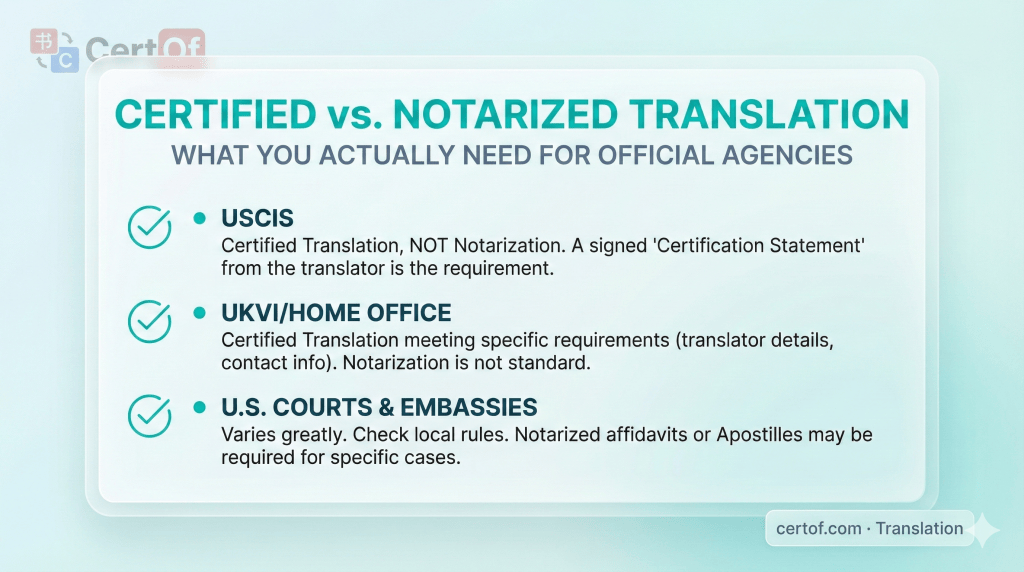
For a broader Germany VPD and document-preparation walkthrough, see our Cologne university-application guide. For the difference between translation types, keep the explanation short here and use this comparison of certified vs notarized translation. If your transcript pack is large, use this guide for 50+ page academic-record translation.
Documents That Commonly Trigger Translation Work
- School-leaving certificate
- Bachelor’s or master’s diploma
- Transcript or overview of subjects and grades
- Diploma Supplement
- Grading scale or grading explanation
- Current enrollment or provisional graduation proof
- Language certificates, if not issued in German or English
The biggest practical omission is often not the diploma itself. It is the missing transcript pages, grading scale, or attachment pages that explain the structure of the qualification.
Wait Time, Cost, and Mailing Reality in Germany
ZAB and university admission review operate on different clocks.
- ZAB’s fee for a Statement of Comparability is €208, and the ZAB says processing starts only once all required documents have been submitted and the fee has been received in full. Its standard processing time is 3 months. See the official fee page here and application page here.
- uni-assist says VPD usually takes 4 to 6 weeks. A VPD is generally valid for one year, and you need a separate VPD for each university that requires one.
The mailing reality is also very German: depending on the university, scans may be enough for some items, but officially certified copies may still need to be sent by post. uni-assist explains that certified copies requiring official certification must be mailed as hard copies when the chosen university requires them. This is why international courier time, not just evaluation time, can become the real bottleneck.
Common Failure Points
- You pay for ZAB first, then learn your university still needs VPD.
- You upload translations but the source is not acceptable under the uni-assist standard.
- You translate the diploma but not the transcript attachments or grading explanation.
- You assume VPD equals admission and miss the separate university portal step.
- You start too late and discover that ZAB’s 3-month timeline does not fit the intake you wanted.
What Applicants Keep Confusing
The same confusion shows up in university FAQs and public applicant forums. A recurring regret is paying for ZAB first and only later learning that the university still requires VPD. Another common mistake is treating VPD as an admission letter instead of a pre-check document. Both problems are preventable if you treat ZAB as a comparability document and VPD or direct university review as the admission path.
Public Resources to Use Before Paying Anyone
| Resource | What it is for | Public signal |
|---|---|---|
| ZAB, Graurheindorfer Str. 157, 53117 Bonn, +49 228 501-664 | Official Statement of Comparability for foreign university degrees | Best when you truly need comparability evidence for work, visa, or a university that explicitly wants it |
| uni-assist e.V., Geneststraße 5, 10829 Berlin, +49 30 201 646 001 | VPD and application processing for participating universities | Best first stop when the university says “apply via uni-assist” or requires VPD |
| DAAD, Kennedyallee 50, 53175 Bonn, +49 228 882-0 | Admission orientation and study information | Good for first-pass orientation before spending money |
| anabin | Database for orientation on foreign institutions and qualifications | Useful before paying for an individual comparability statement |
| justiz-dolmetscher.de | Nationwide database of officially authorised and sworn translators | Good for finding a language-pair-specific translator acceptable in Germany |
Examples of Germany-Based Translation Options
These are short examples of Germany-based providers with public contact details and an advertised certified or sworn-translation offer. They are not official partners of uni-assist or ZAB, and they should be treated as execution options, not as route-selection advisors.
| Provider | Publicly visible local signal | Best use | Caution |
|---|---|---|---|
| Alphatrad Berlin | Pariser Platz 6A, 10117 Berlin; phone 0800 101 43 63; appointment-only office; advertises sworn or certified translations | Applicants who want a Germany-based agency workflow with postal handling | Still verify whether your language pair and academic-document set are covered |
| MyBeglaubigung Berlin | Pappelallee 32a, 10437 Berlin; phone 030 92101122; visit by appointment only; advertises postal delivery of certified translations | Simple document-based orders that need a German sworn-translation route | Check acceptance for your specific university and file type before ordering |
| Linguedu, Wuppertal | Remscheider Straße 45, 42369 Wuppertal; phone +49 202 3726637; advertises sworn English-German and German-English translations | English-German academic or legal document sets | Narrower language coverage than multi-language agencies |
If you already know you need only document preparation rather than route advice, you can upload and order a certified translation online. If you want to see how digital delivery and paper options differ, use this guide to electronic certified translations. If you are comparing service mechanics, see how online certified-translation ordering works and how revision and turnaround promises should be evaluated.
Fraud and Complaint Reality
uni-assist makes one warning very clearly: it does not cooperate with commercial agencies inside or outside Germany to place applicants at German universities. If someone claims to be connected to uni-assist, treat that as a risk signal unless you can verify it directly on the university or uni-assist website.
- If your issue is about a filed ZAB application, use your ZAB account message system for the case.
- If your issue is about VPD or uni-assist document evaluation, use uni-assist’s official contact channels.
- If your issue is about deadlines, programme eligibility, or whether ZAB can replace VPD, ask the university directly, because admission authority sits there.
Data Points That Actually Matter
- ZAB’s €208 fee and standard 3-month processing time matter because they turn the wrong route into a measurable cost.
- uni-assist’s usual 4 to 6 weeks for VPD and one-year validity matter because applicants often underestimate the time needed before the actual university deadline.
- Germany’s nationwide sworn-translator database matters because it gives applicants a direct way to check whether a translator is publicly authorised, rather than relying on a generic “certified translation” label.
How CertOf Fits Without Overpromising
CertOf is most useful in this topic when you already know your path and need a clean, consistent translation package for submission. That can include diplomas, transcripts, grading explanations, language certificates, and multi-page academic records.
CertOf is not a substitute for ZAB, uni-assist, or the university’s admission office. We do not decide whether you need ZAB, whether your degree is admissible, or whether a university will waive VPD. What we can do is help you prepare the translation side of the file so that once you have the right route, the documents are ready to move.
Start your order here if you already know which documents must be translated. If you are still comparing academic-translation use cases, see when foreign diploma translation is actually needed.
FAQ
Can I apply to a German university with only a ZAB Statement of Comparability?
Usually no. ZAB itself says the statement does not entitle its holder to university admission. It may help as supporting evidence, but it does not replace the university’s own admission review.
Does ZAB replace uni-assist VPD in Germany?
Usually no. If a university requires a VPD, you should assume you still need it unless that university explicitly says otherwise.
Do I still need a beglaubigte Übersetzung (certified translation) if I already have ZAB?
Often yes. ZAB and translation serve different purposes. Your target university or uni-assist may still require the original documents and acceptable German or English translations.
Is ZAB mainly for jobs and visas rather than study?
That is the more natural default reading of the official ZAB positioning. It is especially useful for employment, government offices, and visa-related files. For study, it is often supplementary rather than decisive.
What is the difference between anabin, ZAB, and VPD?
anabin is an orientation database, ZAB is an individual comparability certificate, and VPD is a university-application pre-check used by some universities through uni-assist.
What if I already paid for ZAB but my university wants VPD?
You can usually still use ZAB as an extra supporting document, but you should move quickly to the admission path the university actually requires.
CTA
If your target university has already told you to submit translated academic documents, the practical next step is not more guessing about ZAB. It is preparing a translation file that matches the route you actually need. Upload your documents to CertOf for a certified-translation quote, or use our related guides on ordering online and digital versus paper delivery before you submit your Germany application.