India University Admission English Translation Requirements: Notarization, Certified Translation, and Self-Translation Limits
India university admission english translation requirements are easy to misunderstand because Indian universities do not all use the same wording. One office may ask for an English translation, another for a certified English translation, another for a duly attested copy, and an ICCR scholarship route may require a notarized English translation at the arrival stage. If you are applying with foreign school records, university transcripts, or course syllabi, the practical question is not just how to translate them, but who must certify or authenticate them for your route.
This guide focuses on that translation boundary for foreign academic documents in India. It does not try to cover every admission rule. For broader India admission and equivalence workflow, see our Pune guide on foreign documents and equivalence and our guide to regulated-profession exceptions in India.
Key Takeaways
- In India, the most natural local term is usually English translation, not just certified translation. But in practice, many universities still expect a version that is certified, duly attested, or backed by a competent authority rather than a casual self-translation.
- For UGC equivalence under the 2025 regulations, the critical rule is that if documents are in a language other than English or a Scheduled Indian Language, the applicant must submit an English transcript duly authenticated by the degree-awarding institution.
- For the ICCR A2A scholarship route, students are told to bring the original academic documents uploaded on the portal together with a notarized English translation in original if the documents are not in English.
- Self-translation is not framed as a nationwide criminal-style ban, but it is usually a bad risk because many Indian universities want a certified English translation, an attested copy, or institution-authenticated English records rather than the applicant’s own translation.
Who This Guide Is For
This guide is for applicants dealing with India-wide university admission or equivalence review, especially foreign nationals, OCI or PIO applicants, and overseas-educated Indian students whose academic records are not fully in English. It is most useful if your file set includes school certificates, marksheets, university transcripts, degree certificates, grading explanations, course syllabi, or medium-of-instruction letters. The typical India-specific problem is that the portal or university says “English translation” but does not clearly tell you whether that means a translator’s certification, a notary stamp, a duly attested copy, or institution-issued English records.
Why This Gets Confusing in India
The confusion is structural. India now has a national UGC Equivalence Portal for foreign qualifications, but many universities and the ICCR scholarship ecosystem still refer applicants to AIU equivalence where applicable. At the same time, universities remain autonomous on admission eligibility. ICCR explicitly tells applicants that Indian universities and institutions are autonomous and have their own eligibility criteria, and admission decisions remain with the university, not ICCR.
That creates a very Indian real-world problem: the same applicant may face one translation standard at the university application stage, another at equivalence review, and another when physically reporting with originals after provisional admission. The practical question is not “what is translation in general?” but “what kind of English translation package is actually safest for the India route I am using?”
What Indian Universities Usually Mean by These Terms
| Term on the page | What it usually means in practice | India-specific caution |
|---|---|---|
| English translation | A full and readable English version of the non-English document, usually preserving names, grades, dates, stamps, and course titles. | This is the most common local wording. Do not assume it means a casual self-translation. |
| Certified English translation | An English translation issued by a professional provider or otherwise formally certified. | IIT Bombay requires certified English translation for non-English grade transcripts. |
| Duly attested copy / duly certified by a competent authority | The translation or copy must be backed by an institution or authority with recognized standing, not merely typed in English. | Goa University says non-English certificates or transcripts must be accompanied by an English translation duly certified by a competent authority. |
| Notarized English translation | An English translation plus notarial formalization. | This shows up especially in the ICCR A2A guidelines for documents you must bring in original when joining in India. It is not the universal first rule for every direct university application. |
The Most Important India-Specific Rule: UGC Cares About Institution Authentication
The most important national rule is in Regulation 4(3) of the UGC 2025 equivalence regulations: if the required documents are in a language other than English or a Scheduled Indian Language, the applicant must submit “a transcript in English, duly authenticated by the degree awarding institution.”
That is the key India-specific distinction. In the UGC equivalence route, a generic certified translation or simple notarization may not be enough if the English version is not also linked back to the awarding institution in the way your file requires. If your end goal includes UGC equivalence, the strongest package is usually an English version that can be tied to the issuing institution, not just to a freelance translator or notary.
This is also the article’s main counterintuitive point: in India, notary is not always the core requirement. Sometimes institutional authentication matters more than notarization.
What ICCR Usually Means by Notarized English Translation
The scholarship route is stricter in a different way. The ICCR A2A applicant guidelines tell students to bring original academic documents from school education onward, together with a notarized English translation in the original when those documents are not in English. The same section also tells students to bring a certified copy of the transcript or syllabus of the last qualifying examination and, where applicable, an AIU equivalence certificate.
So if you are using ICCR, your safest reading is:
- Upload clear English-ready scans during application.
- Travel with originals, not just PDFs.
- Bring the notarized English translation in original for non-English documents.
- Do not forget the syllabus or transcript of the last qualifying examination.
ICCR also warns that admission remains provisional until the university verifies the authenticity of the original documents on arrival. That is why a translation package that looked good enough online can still fail later.
Can You Translate Your Own Academic Documents for India?
For most applicants, the practical answer is do not rely on self-translation.
The reason is not that there is one universal national ban phrased as “self-translation prohibited.” The reason is that the actual Indian requirements usually point somewhere else:
- UGC equivalence asks for an English transcript duly authenticated by the degree-awarding institution.
- Some universities ask for certified English translation.
- Some ask for a duly attested copy.
- ICCR may require notarized English translation in original at the reporting stage.
Those formulations leave very little room for a DIY translation if the document is important to eligibility, grade interpretation, or equivalence. Self-translation is especially weak when your record contains course titles, grading scales, handwritten notes, stamps, abbreviations, or local educational terminology that an Indian admissions office may not understand without a clean, formal English rendering.
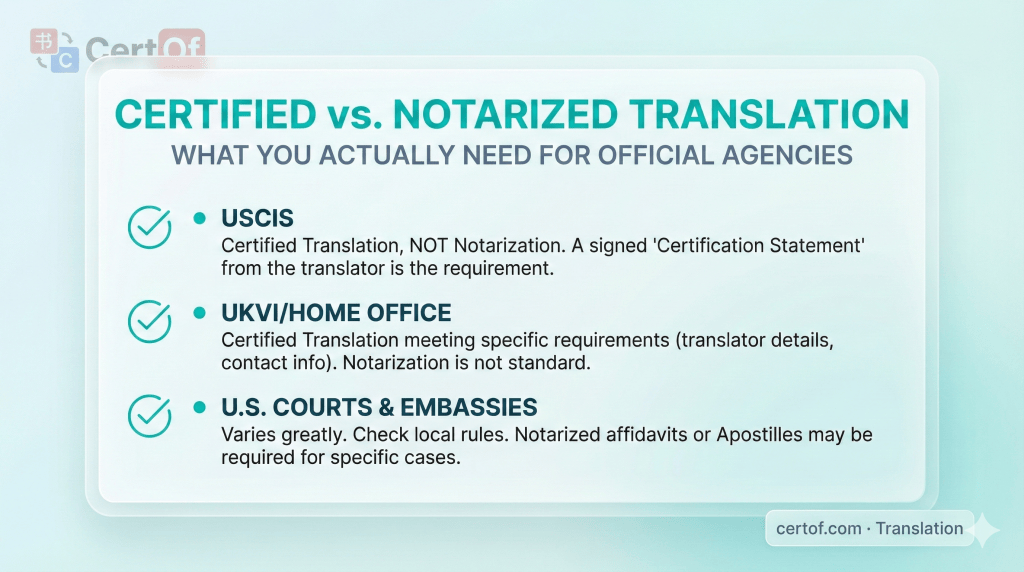
If you need a deeper general comparison between translation certification and notarization, keep that section short here and use our certified vs notarized translation explainer.
Which Academic Documents Usually Need Translation in India
In India admission and equivalence work, users often focus only on the diploma and miss the documents that actually trigger delays. Based on UGC, ICCR, and university examples, the common translation set includes:
- School leaving certificates and 10th or 12th records for undergraduate entry.
- Semester-wise university transcripts and marksheets.
- Degree certificates.
- Grade explanations, CGPA conversion notes, and class or division explanations.
- Syllabus or course descriptions, especially for PG, PhD, or equivalence review.
- Medium-of-instruction letters where the university accepts them as English-proficiency support.
This is another India-specific pattern. IIT Bombay asks for grade transcripts together with an explanation of assigned grades, with certified English translation if needed. Goa University asks not only for certificates and transcripts but also for the syllabus. ICCR likewise tells students to bring the transcript or syllabus of the last qualifying examination. In other words, the translation problem is often a package problem, not a single-document problem.
Caution: In India, many applicants translate the degree certificate and forget the syllabus, transcript, or grading explanation. That is a common way to trigger delay in admission review, AIU-related checks, or UGC equivalence review.
How the Real-World Workflow Usually Looks
- Identify your route first: direct university admission, ICCR scholarship, AIU-related requirement, or UGC equivalence.
- Read the exact wording on the university or portal page. In India, “English translation” and “notarized English translation” are not interchangeable.
- Prepare a complete English file set, not just the final degree certificate. Include transcripts, grade explanations, and syllabus where relevant.
- If the route is UGC equivalence, prioritize institution-authenticated English records.
- If the route is ICCR, prepare to carry original documents plus the notarized English translation in original.
- Keep digital scans and original paper sets aligned. A mismatch between the upload set and the arrival set is a common failure point.
The national processing timeline that is most useful to quote comes from the UGC Equivalence FAQ: decisions are typically made within 15 working days after all required documents are submitted. But the regulations also allow the Standing Committee to ask for additional information, and then the timeline extends. If your application is rejected, UGC allows a review request within 30 working days, and the final review decision is to be communicated within 15 working days from receipt of the review application under the regulation.
Wait Time, Cost, and Submission Reality
Wait time: the strongest official figure is the UGC’s typical 15-working-day timeline once a complete application is on file. That is not a promise for incomplete or unclear document packages.
Cost: there is no uniform national market tariff for academic-document translation in India, and universities do not publish one accepted translation price. ICCR also states that if an AIU equivalence certificate is a precondition, the related charges must be borne by the student. Avoid building your timeline around cheap or same-day marketing claims.
Submission reality: India is heavily portal-based at the national level, but that does not remove the original-document problem. ICCR’s guidance is explicit about bringing originals. Universities can also ask for originals or certified copies at verification. Treat your English translation package as something that must survive both online upload and later document scrutiny.
Common India-Specific Pitfalls
- Using the wrong authority logic. For UGC equivalence, the institution-authenticated English transcript matters more than a random notary stamp.
- Translating only the degree certificate. In India, transcripts, grade explanations, and syllabus often matter just as much.
- Assuming provisional admission means the document set is already safe. ICCR explicitly says admission remains provisional until authenticity and eligibility are verified on arrival.
- Confusing AIU and UGC. Some routes still point to AIU while the national equivalence framework now runs through UGC.
- Treating machine translation as a substitute for formal English documentation. Even if the meaning seems obvious to you, the risk is in how the admissions or equivalence reviewer reads the record.
Public Support, Complaints, and Fraud Prevention
If your issue is about standards, eligibility, or a portal problem, ask the official node before buying extra services.
- UGC Equivalence: the portal lists general queries at 011-23604520 and [email protected], and technical queries at +91 79-2326-8279 and [email protected], Monday to Friday, 10:00 to 17:00 IST.
- Study in India: the official Study in India contact page provides the helpdesk email and phone for international student queries.
- UGC e-Samadhan: use UGC e-Samadhan when a grievance needs escalation rather than another round of informal emails.
- AIU: where a university or ICCR route still requires AIU, use the official AIU evaluation portal and published AIU contact details, not a third party claiming inside access.
The anti-fraud rule is simple: be cautious with any provider promising guaranteed acceptance by every Indian university, guaranteed AIU or UGC approval, or “official” status without being the actual university, UGC, ICCR, or AIU. Translation companies can prepare documents, but acceptance decisions still sit with the institution or authority reviewing your file.
Why India’s Higher-Education Scale Makes Translation More Important
The translation challenge is amplified by scale. Study in India says its network includes 600+ partner institutes and 8,000+ courses. That matters because one country-level article cannot honestly tell you that every institution uses identical wording. The national framework is real, but the operational language still varies by route and campus. That is exactly why your English translation package has to be clear enough to work across multiple review points.
Official and Public Resources
| Resource | What it does | When to use it first |
|---|---|---|
| UGC Equivalence Portal | National portal for foreign qualification equivalence, with FAQ, contact details, and certificate verification. | Use first if your issue is equivalence, review timelines, or document scope under the 2025 regulations. |
| AIU Evaluation Portal | Still relevant where a university or ICCR route explicitly asks for AIU equivalence. | Use when your offer letter, university checklist, or scholarship route still names AIU. |
| Study in India Helpdesk | Government portal support for international students and institute discovery. | Use when you need to confirm institute-side routing or contact a participating institution. |
| UGC e-Samadhan | Formal grievance channel. | Use when you have already tried the ordinary contact route and need escalation. |
How CertOf Fits This India Use Case
For India admissions and equivalence work, CertOf fits best at the document preparation stage, not as a substitute for universities, UGC, ICCR, or AIU. The practical value is building a clean English translation package for marksheets, transcripts, degree certificates, grading notes, and syllabus pages, with consistent terminology and formatting that supports later certification, notarization, or institution-side authentication if your route requires it.
CertOf can help prepare the professional English translation package required for your application, but it does not issue the UGC equivalence certificate, AIU equivalence, or any university admission decision.
If you need that kind of preparation help, you can upload your documents to CertOf, review how online certified translation ordering works, or see how to manage large academic record sets. If your school wants digital delivery only, this guide on electronic certified translation formats is the better next read.
FAQ
Do Indian universities require certified translation or just English translation?
It depends on the route and the institution’s wording. Many universities simply say English translation, but examples such as IIT Bombay use certified English translation wording for non-English records. UGC equivalence focuses on an English transcript duly authenticated by the awarding institution, while ICCR may require notarized English translation in original at reporting.
Can I translate my own marksheet for an Indian university application?
You should assume self-translation is unsafe for any important admission or equivalence document. The Indian rules that matter usually point to certification, attestation, notarization, or institution authentication rather than applicant-made translations.
Do I need notarization for foreign academic documents in India?
Not always. Notarization is explicitly relevant in the ICCR reporting context. For UGC equivalence, the stronger rule is institution-authenticated English records. For direct university admission, follow the exact wording on the university page.
Do I need to translate only the degree certificate?
Usually no. Indian reviewers often care about transcripts, grade explanations, syllabus, and medium-of-instruction support, not just the final degree document.
Is AIU still relevant after the UGC equivalence regulations?
Yes. In practice it can still be relevant because some universities and the ICCR scholarship route continue to mention AIU equivalence where applicable, even though the national UGC equivalence framework now exists.
Disclaimer
This guide is for document-preparation and public-information purposes only. It is not legal advice, admission representation, or an official statement from UGC, AIU, ICCR, or any university. In India, the safest rule is to match your translation package to the exact wording of the university, scholarship portal, or equivalence authority handling your file.
Need a clean English translation package before you submit? Start with your marksheets, transcripts, degree certificates, and syllabus pages, then match the final format to your India route. CertOf can help with the translation package itself; the university, UGC, ICCR, AIU, notary, embassy, or issuing institution still controls the official acceptance decision.