Jiangsu Graduate Admission CSCSE: When Foreign-Degree Credential Evaluation Matters and Why It Does Not Replace Translation
If you are applying to a graduate program in Jiangsu with an overseas degree, the most common mistake is assuming that CSCSE credential evaluation and document translation do the same job. They do not. In this Jiangsu graduate admissions context, CSCSE answers whether your foreign degree can be officially recognized for Chinese admissions purposes; translation answers whether the graduate school, department, or faculty reviewers can actually read your transcript, degree, or enrollment proof.
The core CSCSE rule is national, not Jiangsu-specific. The local differences show up in how Jiangsu reporting points, graduate schools, and individual departments sequence their checks, what they let you defer until enrollment, and when they still ask for readable Chinese or English versions of foreign-language documents.
Key Takeaways
- In Jiangsu graduate admissions, CSCSE usually matters most for eligibility and final enrollment, while translation matters most for department-level document review.
- A foreign-degree applicant may be allowed to apply before receiving the final CSCSE report. For example, Jiangsu University says overseas-degree applicants who can obtain the CSCSE report before enrollment may submit a school-issued enrollment proof or transcript first.
- Counterintuitive but important: CSCSE removed the old Chinese translation requirement for diploma certificates in 2018, but Jiangsu schools and departments may still separately require translated or even notarized materials for their own review.
- For ordinary English-language files, notarization is often not the default. For non-Chinese, non-English files, some Jiangsu schools explicitly move closer to a notarized Chinese or English route.
Who This Guide Is For
This guide is for applicants using an overseas bachelor’s or master’s degree to apply to graduate programs in Jiangsu Province through mainland China admissions channels. The most common reader is someone applying to a Jiangsu master’s or PhD program with English-to-Chinese document needs, and less commonly Japanese-to-Chinese or Korean-to-Chinese needs.
The typical file set includes a degree certificate, full transcript, current enrollment or expected graduation proof, passport or identity records, and later a CSCSE credential evaluation report. The typical situation is not “How do I translate this?” but “Which stage needs CSCSE, which stage still needs translation, and what can wait until enrollment?”
Why Applicants Get Stuck in Jiangsu
In practice, Jiangsu applicants face a three-layer review structure:
- Provincial and reporting-point checks: online registration and confirmation through the mainland admissions system.
- Graduate school checks: school-level admissions compliance and enrollment conditions.
- Department checks: transcript readability, degree comparability, course background, and academic fit.
This is why a student can hear two statements that both sound authoritative but appear to conflict:
- CSCSE does not require a Chinese translation of the diploma certificate in the standard online application flow.
- A Jiangsu school or department still asks for translated or notarized supporting documents.
Those statements are not actually inconsistent. They come from different reviewing bodies doing different jobs.
What CSCSE Solves, and What Translation Solves
The CSCSE application materials page makes clear that mainland applicants upload electronic copies online and that the core focus is the credential itself, passport or travel record, and supporting identity material. The 2018 CSCSE rules update also expressly removed the prior requirement for a Chinese translation of the diploma certificate.
That means CSCSE is about recognition and verification. It is not a substitute for a readable department file. A translated transcript, translated degree certificate, or translated enrollment proof is still useful when a Jiangsu faculty reviewer needs to understand course names, grading context, graduation status, or expected completion timing.
If you need a broader China-wide backgrounder on translation versus notarization for university applications, CertOf already has a separate guide here: China university application: foreign diploma and transcript translation vs. notarization. This Jiangsu page stays narrower and focuses on when CSCSE matters and when it does not replace translation.
When CSCSE Credential Evaluation Matters in Jiangsu Graduate Admissions
1. Online registration and confirmation
At this stage, Jiangsu applicants run into the first real local issue: timing. Jiangsu University’s online confirmation notice says that applicants with overseas degrees must provide a CSCSE report photo with a clear 12-digit online verification code or 7-digit certification number. But it also says that if the applicant has not yet obtained it at the time of application and can obtain it before enrollment, the applicant may instead submit a school-issued enrollment proof or transcript.
That is a practical Jiangsu-facing answer to a common beginner question: you may not always need the final CSCSE report on day one, but you do need a defensible temporary package.
2. Departmental document review
This is where translation becomes independent from CSCSE. Jiangsu departments do not review your file merely to confirm whether your degree exists. They review whether your academic background fits the program. That is why translated transcripts still matter, especially for course-heavy or research-intensive reviews.
A useful Jiangsu example comes from the Nanjing University Nanjing-Helsinki Institute doctoral rules. The school requires applicants to submit undergraduate and master’s transcripts with English translations, degree materials with English translations, and for overseas-degree holders, a CSCSE credential evaluation before enrollment. That is a clean example of the split: CSCSE for recognition, translation for reviewability.
3. Final enrollment
In Jiangsu, this is often where CSCSE becomes non-negotiable. The same Nanjing University doctoral rules require holders of overseas degrees to obtain the CSCSE evaluation before matriculation. Jiangsu University’s doctoral admissions charter says the same in substance: overseas students who have not yet received the final degree may submit enrollment proof first, but must provide the CSCSE report before doctoral enrollment.
4. Name mismatch and identity mismatch cases
Jiangsu University’s online confirmation notice also shows a second real-world friction point: if your online degree check fails because of a name change or ID-number change, you may need household registration records or a police-issued proof explaining the change. In other words, the failure point may not be your degree itself. It may be the name trail connecting your foreign record to your Chinese admissions record.
What Usually Needs Translation in This Jiangsu Scenario
In this reference topic, the translation question should stay narrow. The most common translation targets are:
- Full transcripts
- Degree or graduation certificates
- Current enrollment or expected graduation proof
- Name-change or identity-linking records
- Sometimes thesis abstracts, course descriptions, or other department-requested academic material
For English-language originals, some departments may accept English directly, while others still request a translated or bilingual presentation for smoother internal review. For non-Chinese, non-English originals, the risk rises. Jiangsu University’s doctoral charter says that if the enrollment proof is in another language, it should be submitted as a Chinese or English original, or as a Chinese or English notarized version. That is exactly the kind of edge case where ordinary translation and notarized translation part ways.
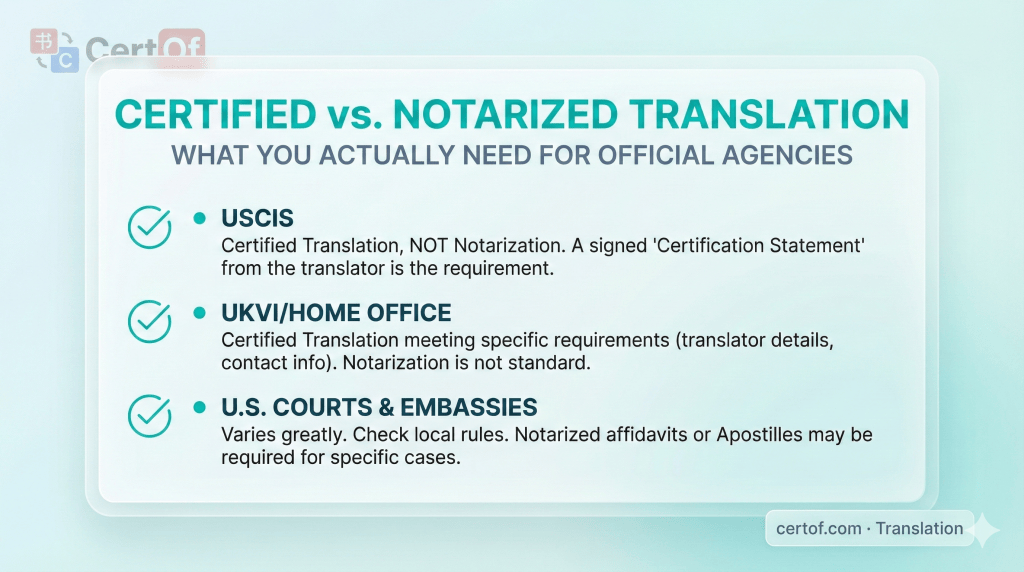
If you need a general refresher on this distinction, see certified vs. notarized translation. For a Jiangsu-adjacent school-level example, see our Yangzhou University guide on foreign diploma translation and credential checks.
Jiangsu Workflow Reality: Timing, Cost, Uploading, and Mailing
CSCSE itself is now an online workflow. According to the official CSCSE process page, applicants complete online registration, upload materials, pay the fee, and track the result online. The same page states a 360 RMB fee, and says that results are generally issued within 10 to 20 working days, subject to country-specific verification timing and any document supplements.
That matters in Jiangsu because admissions timing is tight. The Jiangsu Education Examinations Authority is the provincial node for research examination consultation, and its published contact page lists the main hotline numbers and Nanjing address. The older but still useful JSEEA reporting-point contact roundup shows how dispersed the reporting-point ecosystem is across Jiangsu universities and city examination bodies. For applicants, the practical lesson is simple: you cannot treat Jiangsu as one office with one document list.
It also helps to think in actual dates. Jiangsu University’s 2026 master’s online confirmation example ran from November 1 to November 5, 2025, which is a good illustration of how short online-confirmation windows can be. For some PhD applications, there is also a paper stage. Nanjing University’s Nanjing-Helsinki Institute rules require both online registration and physical mailing of paper materials to the Suzhou campus by a stated deadline. So even though CSCSE is fully online, your overall admissions packet may still have a paper submission stage.
Local Risks and Pitfalls
- Thinking CSCSE equals a complete admissions packet. It does not. It covers recognition, not the department’s readability needs.
- Checking only the graduate school page and not the department page. In Jiangsu doctoral admissions especially, translation requirements are often more specific at the department level.
- Waiting too long on enrollment proof. If you do not yet have the final degree, your temporary package must still be coherent and credible.
- Assuming English always removes translation risk. English helps, but some Jiangsu departments still ask for translated or bilingual support for internal review.
- Ignoring name mismatch issues. If your passport name, Chinese ID name, and educational records do not line up, fix the paper trail early.
- Paying a premium for a so-called “designated” translation provider. The official CSCSE and Jiangsu admissions pages cited here do not publish a designated commercial translation company list.
What Applicants Commonly Say in Community Discussions
Community reports from school forums, Zhihu threads, and creator posts should not replace official rules, but they are useful for understanding where people actually get delayed. Three patterns show up repeatedly:
- “I already had CSCSE, but the department still asked for a translated transcript.”
- “I thought English originals would be enough, but the department wanted a more readable or stamped version.”
- “The hard part was not the online system. It was discovering that the department page had an extra translation requirement.”
Treat these as workflow signals, not law. They help explain why applicants in Jiangsu often need both a credential evaluation strategy and a translation strategy.
Official Guidance, Complaint Paths, and Special-Case Notarization
| Resource | Public contact signal | Best use | When to go there first |
|---|---|---|---|
| Jiangsu Education Examinations Authority | Beijing West Road 15-2, Nanjing; 025-83235898 / 83235998 / 66000114 | Provincial admissions consultation, reporting-point questions, escalation when you do not know which Jiangsu node controls your next step | Use first when your issue is reporting-point confirmation, not translation quality |
| CSCSE online service hall | National online platform for filing, status checks, and result retrieval | Official credential evaluation filing and follow-up | Use first when your question is whether your foreign degree can be recognized in China |
| Nanjing Notary Office / Suzhou Notary Office | Nanjing public listing shows Changjiang Road 99, 7F, 025-84796666; Suzhou public site lists reception points in Suzhou city and high-tech zone | Special-case path when a Jiangsu school explicitly asks for a notarized Chinese or English version rather than an ordinary translation | Do not start here unless your school, department, or language profile clearly triggers notarization |
Professional Preparation Options
Because this is a province-level reference page, the snapshot below is illustrative rather than exhaustive. The point is to show the types of preparation paths Jiangsu applicants actually use, not to imply that any one commercial provider is officially preferred.
| Provider | Public local signal | What it appears suitable for | Boundary |
|---|---|---|---|
| Nanjing Ruike Translation | Nanjing office listed at Hongshan Road 88, Changfa Plaza, Building 3, Rooms 825-829; phone 025-83602926 / 025-83602369 | General document translation, multilingual pairs, DTP and formatting support that can help with transcript and certificate presentation | No public official tie to Jiangsu graduate admissions; applicants still need to check school-specific rules themselves |
| Zhiyuan Translation Jiangsu service points | Public Jiangsu contact points listed for Nanjing and Suzhou; Nanjing office at Hanzhong Road 27, Youyi Plaza 21F; Suzhou center at Suzhou Avenue West 1, Century Financial Tower 1807 | Credential and certificate translation across multiple language pairs | Commercial listing is useful for contact data, but it is not proof that a school prefers or endorses the company |
Fraud Warnings and Timing Risks
CSCSE has a dedicated fraud-warning and false-materials enforcement framework. If a third party claims it can “guarantee” a favorable CSCSE result, that is the wrong signal. CSCSE is an official recognition process, not a commercial approval service. Use the official CSCSE platform and published channels, and avoid anyone promising to file the recognition in your name as if they controlled the outcome.
There is another timing risk that many applicants miss: CSCSE sometimes places certain overseas institutions under strengthened review. In its October 28, 2025 strengthened-review announcement, CSCSE said listed cases would be delayed to at least 60 working days. If your university falls under one of these announcements, your Jiangsu admissions planning may need a much earlier start.
For Jiangsu admissions-side problems, start with the relevant school or reporting point, then the provincial examination authority if the problem is about reporting-point process or admissions confirmation. For translation-related problems, the right fix is usually a corrected translation or a school-specific document package, not a complaint to CSCSE.
Small Data Points That Actually Matter
- 360 RMB CSCSE fee: this is not high compared with a missed admissions cycle, so delay usually costs more than the fee itself.
- 10-20 working days: this is long enough to disrupt Jiangsu deadlines if you start late or get a document supplement request.
- November 1-5, 2025: that five-day Jiangsu University online-confirmation example shows how narrow an action window can be once the admissions cycle starts.
- Paper mailing still exists in some PhD tracks: Suzhou- or Nanjing-based departmental submission deadlines can turn a translation delay into an application failure.
Related CertOf Guides
Use these if your question starts to move beyond this page’s narrow focus:
- China university application: translation vs. notarization
- Yangzhou University foreign diploma translation and credential checks
- How to upload and order certified translation online
- Electronic certified translation: PDF vs. Word vs. paper
- Certified translation with revision and turnaround guidance
FAQ
Do I need CSCSE before applying to a graduate program in Jiangsu?
Not always on day one. Some Jiangsu admissions notices allow applicants who can obtain CSCSE before enrollment to submit temporary proof such as an enrollment certificate or transcript first. But for final matriculation, CSCSE is often required.
If I already have CSCSE, why is the school still asking for translation?
Because CSCSE proves recognition, not readability. Departments still need to review your courses, grades, degree status, and academic background.
Do English-language documents still need translation in Jiangsu?
Sometimes no, sometimes yes. English reduces risk, but some Jiangsu departments still ask for English-translated or bilingual materials in a particular format, especially in doctoral admissions packets.
For non-English documents, is ordinary translation enough?
Not always. Jiangsu University’s doctoral rules show that some non-Chinese, non-English enrollment proofs may need a Chinese or English notarized version. Check the exact school and department language.
Can I translate my own transcript for a Jiangsu graduate application?
That is risky. Even when a school does not spell out a specific translation provider, self-translation is much easier to challenge than a professionally prepared document package.
CTA
If your Jiangsu target school needs a readable Chinese or English version of your transcript, degree certificate, enrollment proof, or name-linking documents, CertOf can help on the translation and document-preparation side. We do not replace CSCSE, public notaries, or school admissions offices. We help you prepare accurate translated files with clean formatting, revision support, and delivery formats that are easier to submit online or include in a paper admissions packet.
Start your order here or contact us if you want us to review which documents in your Jiangsu graduate application need translation first.
Disclaimer
This guide is for document-preparation and admissions-planning purposes only. It is not legal advice and it is not an official statement from CSCSE, Jiangsu authorities, or any university. Graduate schools and departments in Jiangsu may update their document rules between admission cycles, so always verify the current school- and department-level notice before you submit.