Applying to Yangzhou Universities With Foreign Diplomas: Translation, Notarization Triggers, and When CSCSE Matters
A Yangzhou university application with foreign diplomas usually stalls on document handling, not on the course choice itself. Which files must be translated? Does the school accept English, or does it want Chinese? When is a translated file enough, and when do notarization or a separate credential evaluation become important? In this setting, certified translation is a useful bridge term for global readers, but Yangzhou schools usually speak more directly about a Chinese or English translation, notarized copies, or a CSCSE evaluation report rather than a USCIS-style certification formula.
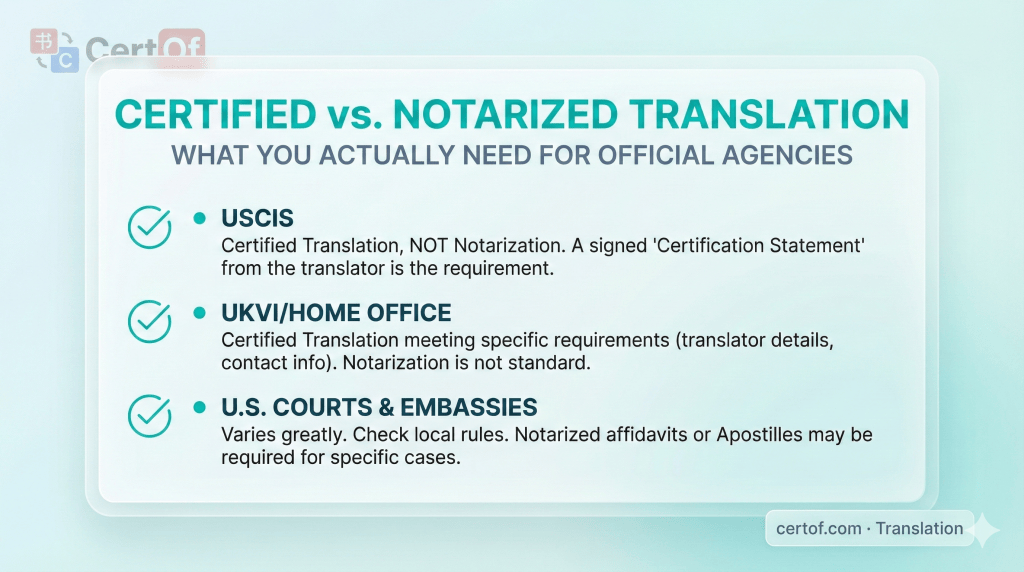
This guide focuses on the real path for applicants using foreign academic records in Yangzhou, especially at Yangzhou University and, as a local comparison point, Yangzhou Polytechnic College. For broader background, keep the generic explanation short and use our related guides on certified vs. notarized translation, electronic certified translation formats, and large academic record bundles.
Key Takeaways
- At Yangzhou University, recent admissions guidance says that when the original document is not in Chinese or English, the applicant must submit a Chinese or English translation. That local rule matters more than generic internet advice.
- Translation and CSCSE evaluation are different. Translation makes the file readable for admissions. CSCSE helps with formal recognition of an overseas degree inside China.
- The most useful local contact node is the Yangzhou University International Students Admission Office at Hehuachi Campus, Room 807, 88 South Daxue Road, with office hours and language-specific phone support published on the official contact page.
- Yangzhou schools do not publish one uniform threshold. Yangzhou University is translation-led in its recent guides, while Yangzhou Polytechnic has publicly described a more notarization-heavy document set.
Who This Guide Is For
This guide is for people trying to enter a degree program in Yangzhou with foreign educational documents, especially:
- international applicants to Yangzhou universities whose diploma, transcript, police certificate, or recommendation letters are not in Chinese;
- applicants whose records are in a third language and need to be routed into English or Chinese before upload;
- overseas degree holders applying to graduate study in Yangzhou and unsure when a CSCSE report may matter;
- former Chinese citizens now applying on a foreign passport and worried about eligibility review under national education rules;
- families or sponsors preparing mixed document sets such as diploma, transcript, passport, no-criminal-record certificate, language test results, financial proof, and later arrival paperwork.
The real Yangzhou workflow
- Choose the target school before you buy translation or notarization. In Yangzhou, the main split is institutional, not city-wide.
- Build the academic packet first. For most applicants that means diploma, transcript, passport, language proof, and supporting items such as a no-criminal-record certificate or financial proof.
- Translate before upload. If the school accepts Chinese or English translations, prepare the file in that language before using the application portal.
- Check whether your path also needs notarization or CSCSE. This is where many applicants lose time because they assume translation solves recognition.
- Use the local admissions contact early. For Yangzhou University, that means the actual admissions office, not a generic study-abroad forum.
What schools in Yangzhou actually ask for
Yangzhou University
In its 2025 international admissions notice, Yangzhou University said it would accept applications from January 1 to May 15, charge an application fee of CNY 600, require insurance of CNY 1000 per year, and list dormitory charges in the CNY 3000 to CNY 6000 range depending on campus and room type. The same notice routes applicants to separate undergraduate, master, and doctoral application guides.
Those guides are where the translation point becomes concrete. Across degree levels, the core rule is consistent: if the original file is not in Chinese or English, the applicant must provide a Chinese or English translation. In practice, that means the first question is not whether you need a destination-country sworn translator. The first question is whether your upload pack includes a complete Chinese or English version that the Yangzhou admissions team can actually review.
This is also where English-language applicants often overcomplicate the process. If your transcript is already in English, the school may not need a Chinese translation. If it is in Spanish, Russian, Arabic, Japanese, or another language, the translation step becomes operational immediately.
Yangzhou Polytechnic College as a local contrast
The public guide for Yangzhou Polytechnic College frames the document pack more conservatively. It asks for originals and notarized graduation documents, original academic transcripts, passport pages, a bank statement, a physical examination record, and a no-criminal-record certificate. For applicants comparing schools inside the same city, that is the local lesson: Yangzhou is not a single compliance environment.
If you are applying to more than one school in Yangzhou, do not copy one packet to every institution. Check each school’s own document page first, then translate and notarize only what that institution actually requires.
Translation is not the same as CSCSE evaluation
This is the most important non-obvious point in the whole process. A translated diploma helps a Yangzhou admissions officer read your academic record. It does not replace a formal overseas degree recognition step when one is required.
The national authority for overseas degree recognition is the Chinese Service Center for Scholarly Exchange, or CSCSE. If you are applying to a graduate program in Yangzhou with an overseas bachelor’s or master’s degree, ask your specific program when it expects that report: at application, later during review, or before enrollment. Translation usually comes first because the school must read your file. CSCSE may become the next layer if your degree must be formally recognized inside China.
That is why this page keeps the nationwide CSCSE process brief. The local problem is simpler and more urgent: do not confuse readability with recognition.
Where to ask questions in Yangzhou
The most useful local node is the Yangzhou University International Students Admission Office contact page. It gives applicants details that generic university-application articles usually skip:
- Room 807, Teaching Building, Hehuachi Campus;
- 88 South Daxue Road, Yangzhou, Jiangsu, China;
- office hours of 8:30-11:30 and 14:30-17:30, Monday to Friday;
- telephone number 86-514-87347092;
- language-based consultation slots in Chinese, English, French, and Arabic;
- named email contacts for scholarships, bachelor’s questions, and graduate questions.
That local detail changes how applicants should behave. If your file contains a difficult script, a dual-language diploma, a missing graduation date, or a school-issued explanation letter, contact the Yangzhou office and ask which upload language they want for that item. The contact page publishes office hours and room details, but not a separate online appointment system, so calling or emailing first is the safer move before an in-person visit.
Another practical point from Yangzhou University’s admissions materials is that the process is highly digital. The school routes applicants to at0086 and, in the 2025 guidance, described the admission notice and visa form as electronic. That means the translation pack should be prepared for clean PDF upload first, not only for paper handling. If you are comparing delivery formats, our guide to PDF vs. Word vs. paper certified translation delivery is the right place for the generic piece.
Core rules that shape the Yangzhou path
The national background rule is the Management Measures for the Recruitment and Training of International Students by Schools. That framework is nationwide. The Yangzhou-specific difference is not a separate city law. It is the combination of school-level document rules, local contact channels, and the way each institution handles translation, notarization, and follow-up.
A second national rule matters for a narrower group of applicants: the Ministry of Education’s 2020 notice on former Chinese citizens who later acquired foreign nationality and then apply to study in China. If that is your situation, check the eligibility issue before paying for translation, because a perfect document pack does not cure an eligibility mismatch.
Common Yangzhou failure points
- Using the wrong target language. At Yangzhou University, non-Chinese and non-English originals need a Chinese or English translation. Applicants often assume Chinese is mandatory when English may already be acceptable.
- Importing the wrong terminology. In this setting, the local working phrase is usually translation into Chinese or English, sometimes with notarization. Do not import USCIS-style certification wording unless the school actually asks for it.
- Missing the institution split. One Yangzhou school may accept a translated packet, while another wants notarized documents or a more formal original-based file set.
- Ignoring the former-Chinese-citizen rule. If that rule applies to you, verify it early.
- Leaving CSCSE too late. Translation may be fast. CSCSE is a separate process and should not be treated as a last-day add-on.
Complaint and anti-fraud paths
For ordinary applicants, the most useful escalation path is not a lawyer. It is the right office.
- School rule questions: start with the Yangzhou University admissions office and the named program contacts on the official contact page.
- Overseas degree recognition questions: use the official CSCSE portal and service guidance.
- Paid translation disputes: the national consumer complaint channel is the 12315 platform. This matters if a provider promises a school-acceptable translation or claims that notarization is always required.
The anti-fraud lesson is simple: if a provider says it can replace CSCSE evaluation, guarantee school acceptance without reviewing the target program’s own rule, or sell notarization as automatically required for every Yangzhou application, slow down and verify against the school page first.
Which help source matches which problem
| Need | Best first stop | Why |
|---|---|---|
| Which language should this file be uploaded in? | Yangzhou University admissions office | The school decides whether your specific file can stay in English or needs translation. |
| Does my overseas degree need formal recognition in China? | CSCSE | Recognition and translation are separate issues. |
| I only need the document pack translated and prepared for upload | CertOf | That is a document-preparation problem, not a school-eligibility problem. |
| A school has expressly asked for notarization | A notary office after you confirm the exact requirement | Notarization should follow a real rule trigger, not a generic assumption. |
This order matters. If your bottleneck is translation, use a translation service. If your bottleneck is recognition, use CSCSE. If your bottleneck is eligibility, ask the school. Keeping those lanes separate is the safest way to avoid paying twice for the wrong step.
What public student feedback can and cannot tell you
Weak signal only: public student feedback about Yangzhou usually helps more with campus expectations than with admissions compliance. People talk about teaching, dorm life, and the study environment far more than they talk about whether a foreign transcript needs English translation only or a notarized copy. That makes peer comments useful for lifestyle expectations after arrival, but not reliable enough to decide document rules before submission.
Practical advice before you submit
- Ask the target school one direct question: does this file need Chinese, English, notarization, or later CSCSE evaluation?
- Translate the full academic record, not only the diploma title page. Missing grade legends, back-page stamps, or annotations cause avoidable follow-up.
- Keep names consistent across passport, diploma, transcript, and financial proof. If they are not consistent, prepare the linking document early.
- Prepare upload-ready PDFs first. Yangzhou University’s workflow is heavily digital. If you need a clean online workflow, see how to upload and order certified translation online.
- Do not pay for notarization just because a generic article told you to. In Yangzhou, the answer depends on the school.
FAQ
Do Yangzhou universities require certified translation?
Usually the local phrasing is more direct. Yangzhou University’s recent guides say non-Chinese and non-English documents need a Chinese or English translation. That is why certified translation is better treated here as a bridge term, not the core official phrase.
Can I apply to Yangzhou University with documents in English?
Yes, in many cases. The recent guides say that if the original is not in Chinese or English, you must add a Chinese or English translation. English is therefore already one of the school’s working languages for admissions documents.
Where is the Yangzhou University international admissions office?
It is in Room 807, Teaching Building, Hehuachi Campus, 88 South Daxue Road, Yangzhou. The official contact page lists office hours of 8:30-11:30 and 14:30-17:30, Monday to Friday, plus phone and email contacts.
When does CSCSE matter in a Yangzhou application?
It matters when a foreign degree must be formally recognized inside China, especially for some graduate-admission or later enrollment scenarios. It does not replace translation, and translation does not replace it.
Do I need notarization for every Yangzhou school application?
No. Yangzhou University’s published guidance is translation-led. Yangzhou Polytechnic has publicly described a more notarization-heavy package. Check the target institution, not a city-wide assumption.
Need help with the translation pack?
If your next step is not legal analysis but getting a clean application pack ready, CertOf can help with diploma, transcript, no-criminal-record certificate, bank proof, and related supporting documents. Use us for the translation and preparation layer, not for school representation or official recognition. You can start an order at our translation submission page, or read more about how revisions and delivery expectations work.
Disclaimer: University admissions rules, application windows, and supporting-document thresholds can change by intake and by program. Always confirm the current rule on the school page you are applying through before paying for translation, notarization, or CSCSE evaluation.