
Disclaimer: This article is general information, not legal or migration advice. Requirements can change by visa stream and case facts. Always confirm current instructions on Department of Home Affairs pages and, if needed, consult a registered migration agent for personal advice.
About the author: Erin Chen is the Co-Founder and Translation Strategist at CertOf™ Translation, focused on compliance-ready certified translation workflows for immigration, legal, and academic submissions.
NAATI Certified Translation Birth Certificate Australia 189 Visa: Fast, Compliant, and No Unnecessary Spend
If you searched for naati certified translation birth certificate australia 189 visa, the short answer is: for a Subclass 189 case, you must provide the original non-English document plus a full English translation, but whether NAATI is strictly required depends largely on where the translation is completed. The costly mistake is not “missing a stamp”; it is submitting a package that is hard to verify in ImmiAccount.
Key Takeaways
- Inside Australia: Home Affairs says use a NAATI-accredited translator for documents not in English.
- Outside Australia: NAATI is not always mandatory, but the translation must show translator identity and qualifications in English.
- Most avoidable delay: low-quality scans, missing back pages/seals, or missing translator details.
- Money-saving rule: pay NAATI when the receiving authority needs it; do not overpay for other countries where NAATI is not required.
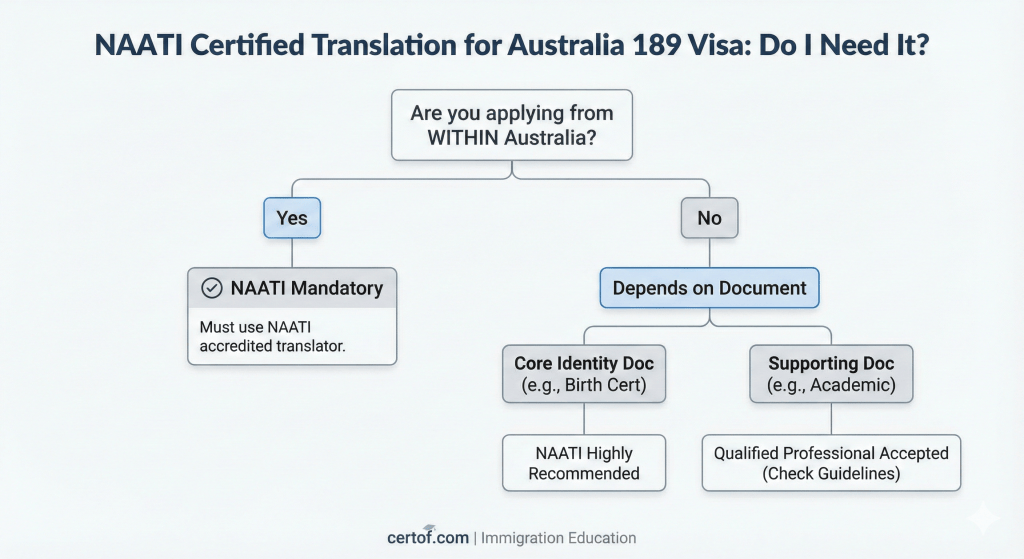
NAATI decision path for Subclass 189 document translation
Who This Guide Is For (and Why They Get Stuck)
This guide is for skilled professionals preparing a points-tested Subclass 189 pathway, especially applicants managing deadlines across multiple countries. The pain points are predictable: fear of rework, uncertainty about NAATI vs non-NAATI translation, and anxiety that one small formatting miss could create a document request and push timelines by months.
Home Affairs states that after invitation you have 60 days to complete and submit your visa application in ImmiAccount. That is why translation quality and packaging speed matter as much as translation accuracy.
What Home Affairs Actually Requires for Birth Certificate Translation
On the Department of Home Affairs “Attach documents” guidance (last updated 26 November 2025), the rule is explicit for non-English files: provide the original plus English translation. It also states:
- In Australia, use a translator accredited by NAATI.
- Outside Australia, translators do not have to be NAATI, but each translation must include full name, address/telephone, and qualifications/experience in the translated language.
- Scan both sides, keep original color when relevant, combine multi-page documents into one PDF, and stay within file constraints (up to 5MB per file for visa applications).
Primary source links: Attach documents (Home Affairs) and Popular questions: English translations of documents (last updated 19 February 2026).
Counter-Intuitive but Important: A NAATI “valid to” Date Is Not Translation Expiry
Many applicants think a past “valid to” date on a NAATI stamp automatically invalidates the translation. NAATI’s own practitioner identification guidance says that the stamp date relates to the practitioner credential cycle, and translations themselves do not automatically “expire” just because time passed. What matters is when the translation was completed and whether the credential was valid then. Source: NAATI Practitioner Identification.
ImmiAccount-Ready Checklist: Official Translation of Birth Certificate
Step 1: Audit before translation
- Confirm exact legal names against passport and EOI profile.
- Identify all non-English elements: seals, margin notes, endorsements, back-side text.
- Decide receiving authority first: Australia 189, plus any parallel USCIS/IRCC/UKVI file.
Step 2: Scan to Home Affairs standards
- Use color scan when the original has colored stamps or seals.
- Capture both sides and all edges; do not crop corners.
- For multi-page records, merge pages in one PDF in logical order.
Step 3: Build a reviewable translation package
- Include the source document and full translation in the same upload set.
- Show translator identity and qualifications clearly (or NAATI details when applicable).
- Use mirror formatting so officers can compare fields line-by-line quickly.
If you also need certified translation of documents for Australian immigration plus other jurisdictions, build separate compliance bundles instead of one “universal” file.
Common Mistakes and Real Risks (Pitfalls)
- Self-translation or family translation: traceability and independence concerns; can trigger document quality concerns and follow-up.
- Summary-only translation: missing seals/notes can be treated as incomplete evidence.
- Name format mismatch: one abbreviated given name can create identity clarification loops.
- Confusing notarization with certification: notarized signature does not automatically prove translation completeness.
- Any manipulated or false material: legal risk is serious under PIC 4020 (bogus document / materially misleading information), not just a minor correction request.
Regulatory source for PIC 4020: Migration Regulations 1994, Schedule 4, Public Interest Criterion 4020 (current compilation, 22 January 2026).
Cost Strategy: When NAATI Is Necessary vs When It Is Not
| Use Case | Safer Choice | Cost Logic |
|---|---|---|
| Subclass 189 package reviewed by Home Affairs | Follow Home Affairs translation pathway; NAATI in Australia is the low-risk option | Pay for compliance where the authority checks NAATI-related traceability |
| Parallel USCIS filing | USCIS-compliant certified translation package | NAATI is usually not required; avoid paying NAATI premium where not requested |
| Parallel IRCC/UKVI filing | Authority-specific certified translation bundle | Build separate bundles to reduce rejection risk and rework |
Related guides for cross-border applicants: USCIS certified translation requirements, certified translation for IRCC Canada, and certified translation for Schengen visa.
CertOf vs Traditional Translation Office
| Decision Factor | CertOf Digital Workflow | Traditional Local Office |
|---|---|---|
| Turnaround | Many standard files in about 5-10 minutes | Often 24-48+ hours including quote cycle |
| Entry pricing | Published from $9.99/page | Usually quote-based and variable |
| Formatting | Mirror formatting for faster officer review | Layout quality varies by provider |
| Acceptance-risk controls | USCIS acceptance guarantee + revision/refund policy published | Policy clarity varies |
| Ordering | Upload-pay-download online | Email, calls, or in-person handoff |
3-Step Service Workflow (Upload → Pay → Receive)
- Upload clear scans and select destination usage.
- Confirm page count and pay with transparent pricing.
- Receive certified files and submit to your authority portal.
- certified translation services online
- official document translation quote in minutes
- $9.99/page certified document translation order
Policy transparency: Refund & Returns Policy. Need a specialist check before payment? Talk to a certified translation support specialist.
Trust Module: Privacy, Security, Institutions, Urgent Support
- Data handling: published at Privacy Policy and Terms of Service.
- Institution coverage: immigration authorities, universities, banks, courts, and licensing boards (final acceptance always remains with the receiving body).
- Urgent files: digital-first submission options and escalation support through the online order channel.
FAQ (People Also Ask)
Do I need a NAATI-certified translation if I apply for 189 from outside Australia?
Not always. Home Affairs guidance says offshore translators do not have to be NAATI, but their full identity and language qualifications must be included in English. For identity documents, applicants still choose NAATI when available to reduce verification friction.
Can I translate my own birth certificate for an Australia 189 visa?
Risky. Even if language quality is good, self-translation weakens independence and traceability. A qualified third-party translator is the safer route for official translation of birth certificate submissions. Related reading: Can I translate my own documents for USCIS.
Does a NAATI birth certificate translation expire?
Usually no automatic expiry. NAATI explains that stamp “valid to” dates relate to practitioner credential cycles, not a fixed expiry date for every previously completed translation. If you are also filing in the U.S., compare how long a certified translation is valid for USCIS.
Do I need notarized translation for Australian immigration?
Notarization and certified translation are different. For most immigration workflows, completeness, translator qualification, and traceability drive acceptance more than notarization alone. See difference between certified and notarized translation.
Can I reuse one translation for USCIS, IRCC, and UKVI?
Sometimes, but do not assume one package fits all. Certification wording and supporting requirements vary. Use authority-specific guides: USCIS translation requirements, IRCC translation guidance, and Schengen translation checklist.
Related Internal Reading
- upload and order certified translation online
- immigration document translation bundle pricing guide
- electronic certified translation PDF vs Word vs paper
- ISO 17100 certified translation provider guide
Bottom line: For Subclass 189, think like an officer reviewing a digital file under time pressure: complete source, complete translation, clear translator identity, and clean scans. That is how you protect both compliance and timeline.