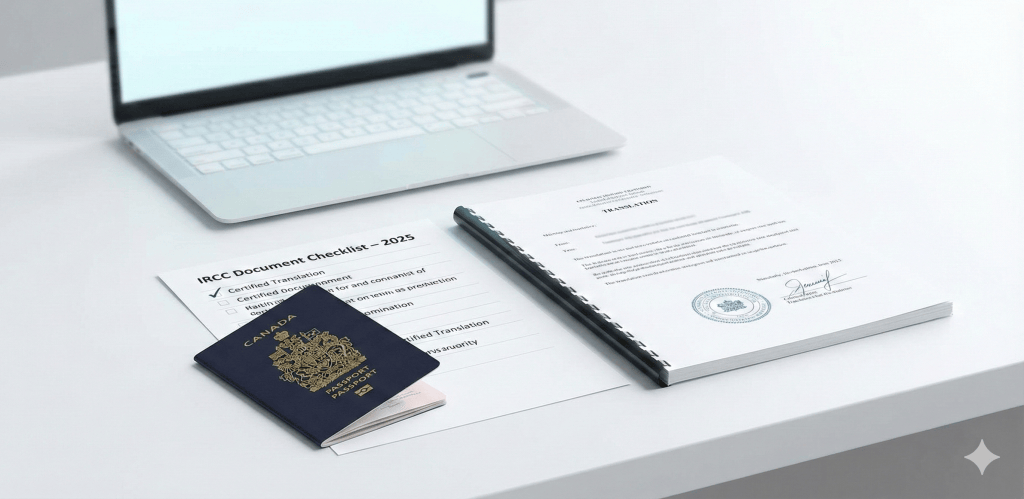
Halifax Work Permit Certified Translation Guide: Work Permit vs Digital Nomad Entry
If you are searching for Halifax work permit certified translation, the first decision is not which translator to buy. It is whether you are actually dealing with a Canadian work permit case or a visitor-based remote-work stay. In Halifax, many people still search for “remote visa,” but Canada does not run a standalone remote visa category. IRCC’s own digital nomad guidance explains that some remote workers can enter as visitors for up to six months if they are working for themselves or for an employer outside Canada, while people taking a Halifax job usually need a work permit and the supporting documents that go with it. See IRCC digital nomad guidance and Guide 5487.
Key Takeaways
- There is no standalone Halifax or Canada “remote visa.” If you will keep working only for a foreign employer, you are usually looking at visitor status, not a Canadian work permit.
- If you have a Halifax or Nova Scotia job offer, translation issues usually start with civil records, police certificates, diplomas, and employer paperwork, then come back during SIN setup, onboarding, or later status updates.
- For IRCC, “certified translation” is a bridge term. The real compliance question is whether your file uses a Canadian certified translator or a translation that also includes the required affidavit and copy rules.
- The Halifax-specific value in this topic is practical, not theoretical: the Halifax Service Canada Centre and Passport Services, ISANS support, Nova Scotia recruiter and employer compliance rules, and local failure points around scheduling, onboarding, and document mismatch.
Who This Guide Is For
This guide is for people in Halifax and the surrounding Nova Scotia job market who are either:
- moving to Halifax for a local job and preparing a work permit file;
- planning to stay in Halifax while continuing foreign remote work and trying to confirm whether visitor status is enough; or
- already in Halifax and now stuck because a translated diploma, police certificate, marriage record, or name history document is delaying onboarding, SIN-related follow-up, or a later immigration step.
It is most useful when your file includes non-English or non-French documents such as passports, birth or marriage records, divorce records, diplomas, transcripts, licences, police certificates, employment letters, contracts, and bank statements.
The most common beginner problem is not “Which translation stamp do I need?” It is “Am I even on the right status path, and which translated documents will keep being reused after I arrive?”
Disclaimer
This guide is for general information and document-planning purposes only. It is not legal advice, immigration advice, or a substitute for the exact IRCC checklist for your case. CertOf can help with document translation and file preparation, but it does not act as your immigration representative, lawyer, government booking service, or official Halifax filing agent.
The First Decision in Halifax: Work Permit or Visitor Status?
If you will work for a Halifax or other Canadian employer, you are usually in work-permit territory. For many first-time Halifax arrivals with a specific offer, that means an employer-specific work permit file built around the employment contract, employer-side compliance paperwork, and the worker’s supporting documents.
If you will stay in Halifax but keep working only for a foreign employer or your own foreign business, you may fit the visitor-side remote-work logic that IRCC describes for digital nomads. That does not mean “anything remote is allowed.” The moment your facts start looking like Canadian employment, local labour market participation, or work for a Canadian client in a way that changes your status analysis, the case stops being a simple visitor question.
This is the article’s main narrowing move, and it matters for SEO too: Halifax readers are not looking for a generic Canada work permit encyclopedia. They are usually trying to decide which route applies to them, what documents to prepare, and where translation becomes non-negotiable.
When Halifax Work Permit Certified Translation Actually Matters
In Halifax, certified translation usually matters at three moments.
- Before filing, when you collect identity, qualification, family, admissibility, and employment records.
- During upload and biometrics preparation, when your file must be complete, readable, and internally consistent.
- After arrival, when the same records may reappear during onboarding, credential checks, or later updates that expose spelling or date mismatches.
IRCC’s own rule is short: if a document is not in English or French, you need the translation and, if the translator is not a Canadian certified translator, an affidavit from the translator. IRCC also does not allow self-translation or translation by family members. Guide 5487 is the federal source. For the Canada-wide rule set, it is better to keep this Halifax article short and point readers to certified translation for IRCC Canada rather than repeat the same national explanation here.
For Halifax readers, the practical translation question is usually not “Do I need translation in the abstract?” It is “Do I need a Canadian certified translator, or will my route rely on a translator affidavit?” If you only need the general background on that distinction, use certified vs notarized translation. If your situation is closer to the visitor-side remote-work question, this digital nomad translation guide is also a useful companion page.
Typical Document Sets for Halifax Cases
For a Halifax job offer and work permit route
- Passport and identity pages
- Employment contract or offer letter
- LMIA or employer compliance documents, depending on the stream
- Diplomas, transcripts, licences, or training certificates
- Police certificates
- Marriage, birth, or divorce records if family or name history matters
For a remote worker staying in Halifax on visitor logic
- Passport
- Proof of foreign employment or foreign self-employment
- Income proof and bank statements
- Accommodation evidence and travel-planning records
- Any later visitor-record extension documents if you stay longer
The most expensive translation mistake is often ordering the wrong bundle too early. A Halifax work permit case and a Halifax remote-worker visitor case can overlap, but they do not use the same supporting file as their core package.
What the Halifax Workflow Usually Looks Like
1. Decide the route before you buy a full translation package
If you are really on a visitor-based remote-work path, your file may lean more heavily on foreign employment proof and income evidence than on a Canadian employer package. If you are really on an employer-sponsored work permit path, you will usually need stronger employment, admissibility, and identity support.
2. Build a clean upload set
Keep the translation complete. Do not omit stamps, annotations, or handwritten notes. If your file will be uploaded digitally, plan the PDF package early. CertOf’s practical guides on electronic certified translation formats and uploading and ordering certified translation online are useful at this stage.
3. Handle the Halifax in-person node correctly
The main local federal node most Halifax applicants need to know is the Halifax Service Canada Centre and Passport Services at 1800 Argyle Street, Suite 101, Halifax. The office page lists service Monday to Friday from 8:30 a.m. to 4:00 p.m., pay parking, English and French service, and multilingual support where available. Biometrics are a scheduling and readiness issue, not a translation theory issue, so Halifax readers need the office reality, not a template paragraph about “local processing.”
4. Use settlement support for the right problems
ISANS Temporary Foreign Worker Support is one of the most useful Halifax-area support nodes after arrival. Its TFW program offers one-on-one support, referrals, translation support, and employment counselling for registered clients across Nova Scotia. That is valuable when your file runs into onboarding or settlement friction. It is not a substitute for an IRCC filing service.
Nova Scotia Rules That Matter When a Halifax Employer Is Involved
The core immigration rules are federal, but Halifax workers are not dealing with a purely federal reality. Nova Scotia has worker-protection rules that materially affect employer-sponsored cases.
Under the province’s foreign-worker rules, recruiters need a recruiter licence, employers using foreign workers generally need an employer registration certificate, employers and recruiters cannot keep a worker’s passport or work permit, and they cannot charge recruitment fees directly or indirectly to the worker. The province’s own summary is here: Foreign Workers and the Labour Standards Code.
This is one of the strongest local modules in the entire article because it changes what Halifax readers should do before paying anyone. If a recruiter asks you to reimburse hiring costs, surrender your passport, or pay for access to a job, that is not just a bad sign. It is exactly the kind of situation Nova Scotia Labour Standards was built to address.
How to Verify Recruiters and Immigration Help Before You Pay
If a Halifax employer or recruiter is part of your path, verify the recruiter first. Nova Scotia publishes a live Licensed Recruiters list. That is a much better pre-payment check than trusting a promise in a chat thread or a city-branded landing page.
If you are paying an immigration consultant rather than a recruiter, check the CICC public register before you hand over documents or money. For Halifax readers, this matters as much as translation quality, because many document problems begin only after someone buys the wrong service from the wrong person.
Local Scheduling, Support, and Failure Points
- Biometrics and federal visits: plan around the Argyle Street office rather than assuming a vague “local IRCC office” will handle every step.
- Settlement help: ISANS can be extremely useful, but it is not your IRCC filing service. Its translation support is for settlement-related needs, not for replacing your immigration application translation package.
- Name mismatch problems: Halifax employers, payroll teams, and later document requests often expose inconsistencies that were easy to ignore during filing, especially when passports, diplomas, and civil records use different transliterations or name order.
- Recruiter trust problems: in Halifax and the wider province, one of the smartest pre-translation checks is whether the recruiter is licensed and whether the employer side looks compliant before you spend money on a large translation set.
- Mailing and document reuse: even when the main immigration step is online, translated files often need to be reused later in PDF form or as printable support documents. That is why format control matters. If you need a practical breakdown of delivery formats and paper-copy questions, see this hard-copy guide.
What Local Data Tells You
Halifax is not a low-volume, one-language newcomer environment. That matters because translation demand here is not theoretical. It shows up through settlement support, employer onboarding, and document repair after arrival. ISANS is one of the clearest public signals of that demand because its temporary foreign worker support program exists precisely for newcomers who need help navigating work, documents, and referrals inside Nova Scotia.
The practical lesson is simple: in a place with real newcomer volume, translation mistakes do not stay trapped inside the immigration portal. They spill into jobs, payroll, and later status maintenance. That is why a Halifax guide should focus on workflow and support ecology, not just on repeating national rules.
What Local Reporting and Community Questions Add
Official rules tell you what should happen. Local reporting and community discussions tell you where people get hurt in practice.
Local reporting on temporary foreign worker issues in Nova Scotia has repeatedly highlighted the pressure workers face when their status planning depends on employer compliance, while community discussions more often revolve around recruiter legitimacy, paperwork confusion, and document consistency after arrival. Those sources do not replace official rules, but they explain why Halifax readers care so much about document control, complaint routes, and who is actually responsible for each step.
Translation Routes With Halifax or Nova Scotia Signals
The safest local-first approach is to verify the actual translation route, not just trust a marketing label.
| Route | Best for | Public signal | Main caution |
|---|---|---|---|
| ATINS-certified translator route | Files that may specifically need a Canadian certified translator | Nova Scotia users commonly search for an ATINS-certified member as the local compliance-friendly route | You still need to confirm the exact language pair, turnaround, and whether the translator will handle your document type |
| Affidavit-supported translation route | Cases where the translator is not a Canadian certified translator | Often relevant when your original documents were translated abroad or by a non-certified professional translator | The affidavit requirement is about the translator, not a generic “notarized translation” label |
| Digital document-prep route through CertOf | Fast document translation, formatting, and upload-ready file prep | Useful when you need a clean English package and revision support | It does not replace a local immigration representative, a Canadian certified translator requirement, or an affidavit requirement where one applies |
Public and Nonprofit Resources You Should Usually Check First
| Resource | Address / contact | Best use | What it will not do |
|---|---|---|---|
| Halifax Service Canada Centre and Passport Services | 1800 Argyle Street, Suite 101, Halifax | Biometrics logistics, SIN-related follow-up, federal service access | It is not your translation provider or immigration strategy advisor |
| ISANS Temporary Foreign Worker Support | 6960 Mumford Road, Suite 2120, Halifax; 902-423-3607 | One-on-one support, referrals, translation support for registered clients, employment counselling | It does not prepare or translate IRCC application files for you |
| Nova Scotia Labour Standards | For complaints and compliance questions on foreign-worker rules | Recruiter fees, employer registration issues, passport retention, recruitment abuse | It does not replace IRCC document compliance or legal advice |
Common Halifax Pitfalls
- Using “remote visa” as the working concept: if you are really a visitor working for a foreign employer, your document logic is different from a Halifax work permit file.
- Buying translation before confirming the route: this creates unnecessary cost and often the wrong document bundle.
- Treating notarization as the main question: in Canada, the real issue is usually certified translator versus affidavit, not a generic notarization label.
- Ignoring employer-side compliance: in Nova Scotia, recruiter and employer rules are a real risk screen, not background noise.
- Forgetting post-arrival reuse: translated documents may matter again for onboarding, credential checks, and later updates after you reach Halifax.
FAQ
Is there a digital nomad visa for Halifax?
No. Canada does not currently have a standalone Halifax or Canada digital nomad visa. In many cases, remote workers enter as visitors if they are working only for themselves or for employers outside Canada.
Can I live in Halifax and work remotely for a foreign employer as a visitor?
Often yes, but only if your facts stay on the visitor side of the line and you are not entering the Canadian labour market. Once a Canadian employer is involved, work-permit analysis usually becomes central.
When do I need certified translation for a Halifax work permit case?
When your supporting documents are not in English or French. The usual trigger documents are civil records, police certificates, diplomas, transcripts, and sometimes work history or employer records.
Does ISANS translate work permit application documents?
No. ISANS is a settlement support node, not an IRCC filing translator. Use it for referrals and practical support, not as a substitute for your immigration document package.
Where do I do biometrics in Halifax?
The Halifax Service Canada Centre and Passport Services at 1800 Argyle Street is the main local node most applicants need to know.
How do I check whether a recruiter or immigration consultant is legitimate?
For recruiters tied to foreign-worker hiring in Nova Scotia, check the province’s licensed recruiter list and the employer’s registration status. For paid immigration consultants, check the CICC public register before paying for advice or representation.
How CertOf Fits Into This Process
If you already know your status path and need fast, accurate document translation, CertOf is most useful on the document side: translating civil records, police certificates, diplomas, bank statements, and supporting letters into a clean English package that is easier to upload, review, and reuse. You can start an order at CertOf’s translation portal, review how online ordering works in this step-by-step guide, and see how revisions, support, and turnaround are handled in this service explainer.
What CertOf does not do is act as your Halifax immigration representative, file provincial employer paperwork, or provide legal advice. If your case specifically requires a Canadian certified translator or an affidavit route, the right move is to confirm that requirement first and then order the translation product that fits it.
Final Word
For Halifax applicants, the big win is not learning every national immigration rule by heart. It is making the right first split between a real work permit case and a visitor-based remote-work stay, then building a translation file that remains usable from first submission through arrival and onboarding. That is what keeps this Halifax guide practical instead of becoming a generic Canada template.