Certified Translation for Edinburgh Immigration Paperwork: UKVCAS, Local Help, and Common Risks
If you are preparing immigration paperwork in Edinburgh and some of your evidence is not in English or Welsh, the real problem is usually not the translation rule alone. It is figuring out how foreign-language documents fit into a live in-country UKVI application, when to upload them, whether you will use the UK Immigration: ID Check app or a UKVCAS appointment, and where to go in Edinburgh if your case is too messy for a simple DIY submission. In this city, the translation standard is national, but the friction is local: busy advice drop-ins, city-centre biometrics logistics, student-only support channels, and the gap between regulated help and expensive mistakes.
This guide is for people already living in or around Edinburgh who need to prepare foreign-language supporting documents for a UK immigration application, extension, switch, or evidence upload. It is not legal representation, and it does not replace route-specific advice from a regulated immigration adviser or solicitor.
Key Takeaways
- If your supporting document is not in English or Welsh, UKVI expects a full translation that can be independently checked. For most applicants, that means a proper certified translation, not a casual self-translation. See the official rule on GOV.UK.
- For Edinburgh applicants, the most common failure point is not the biometric appointment itself. It is a weak evidence pack: blurry scans, untranslated pages, or files uploaded too late. GOV.UK says the full document must be visible and files must be prepared clearly before upload; the official upload guidance is here.
- Free local help exists, but it has limits. Citizens Advice Edinburgh runs busy first-come, first-served drop-ins, while Scotland’s Migration Service only covers certain migrant groups and excludes citizenship/naturalisation after ILR, asylum seekers, trafficking victims, stateless persons, and people seeking international protection.
- The most expensive local mistake is often paying for the wrong kind of help: using an unregulated adviser, paying appointment-day document support you could have avoided, or ordering notarization when a compliant certified translation would usually have been enough.
Who This Guide Is For
This guide is for people in Edinburgh, Scotland who are preparing an in-country UK immigration application or supporting-evidence upload and need to deal with documents that are not in English or Welsh. The most common readers are international students, recent graduates, sponsored workers, partners, and dependent family members already living in Edinburgh.
The most common language pairs in this context often involve English with Chinese, Arabic, Polish, Spanish, Russian, or Ukrainian, but the real issue is the document mix rather than the language pair alone. Typical bundles include birth certificates, marriage certificates, family registers, police certificates, tenancy documents, bank statements, sponsorship letters, academic records, and name-change paperwork. The usual Edinburgh situation is straightforward on paper but stressful in practice: you know you have the original document, but you are not sure whether your translation is acceptable, whether your files are upload-ready, or whether your local support option can actually advise on your case type.
What Is Actually Local Here, and What Is Not
The translation rule itself is mostly UK-wide. Edinburgh does not have its own separate immigration translation standard. The national rule is the starting point: when a document is not in English or Welsh, the translation should confirm that it is a true and accurate translation, include the date, and include the translator’s full name and contact details. For a short rule summary, read CertOf’s UKVI certified translation guide.
What is local is everything around that rule:
- how Edinburgh applicants reach the UKVCAS service point shown in their booking portal and handle an appointment-only workflow
- how quickly they can get first-line advice from local services
- whether they should start with a university immigration team, Citizens Advice, a regulated adviser, or a solicitor
- how they complain if an adviser overcharges, misses deadlines, or claims guaranteed success
That is why this page keeps the generic translation theory short and puts the weight on Edinburgh reality.
How the Process Usually Works in Edinburgh
- Work out your immigration route and evidence list. This page is about paperwork handling, not route eligibility. If you still do not know whether you are applying as a student, worker, partner, dependant, or for settlement, get route-specific advice first.
- Separate your documents into English/Welsh and non-English/Welsh. The second pile is where translation risk starts.
- Order compliant certified translations before you start final document packaging. This matters because translated PDFs often need naming, grouping, and uploading in a sensible order.
- Submit the online application. Some applicants will prove identity through the app; others will be told to attend a UKVCAS service point.
- Upload documents before the appointment if you can. GOV.UK says applicants who attend a UKVCAS service point cannot use the in-form self-upload service, but they can upload documents through the commercial partner website or pay for an added-value document-submission service at the appointment.
- Attend the appointment only if your application requires it. Treat it as a biometric and document-handling step, not as a place where staff assess legal strategy for the case.
The counterintuitive point is this: many Edinburgh applicants assume the main problem is finding a translator. In reality, the bigger failure point is often evidence packaging. A good translation delivered too late, uploaded badly, or attached to the wrong evidence slot can still create avoidable delays.
Which Documents Most Often Need Certified Translation
For Edinburgh-based in-country applications, the most common translation bundle includes:
- birth certificates and family registers
- marriage certificates, divorce records, and name-change documents
- police certificates and court-related civil records
- bank statements, savings evidence, gift letters, and sponsorship letters
- tenancy agreements and proof-of-address documents
- degree certificates, transcripts, and enrolment letters
- employment letters, payslips, and tax records if the originals are foreign-language documents
If your case involves relationship evidence, handwritten notes, or mixed formal/informal records, keep the generic explanation short here and use supporting reference pages where needed, such as electronic certified translation formats and certified vs notarized translation.
What Certified Translation Means in This UKVI Context
For Edinburgh immigration paperwork, certified translation is still the most natural and search-friendly term. In official language, you will also see phrases such as a translation by a qualified translator or a translation that can be independently verified. In practice, the translation needs to be complete, accurate, attributable, and usable by UKVI without guessing who produced it.
You usually do not need notarization just because the application is important. You also should not assume that Google Translate, AI output, or your own translation will be enough for a meaningful supporting document. If you want the fuller UK-wide explanation, use these reference pages rather than turning this city guide into a national rules page: Certified Translation for UKVI, Certified vs Notarized Translation, and How to Upload and Order Certified Translation Online.
Edinburgh Workflow Reality: Where People Get Stuck
Edinburgh applicants who need biometrics are dealing with an appointment-based city workflow, not a walk-in immigration counter at the council. The practical pressure points are predictable:
- slot availability can move around, so translation should not wait until the week of your appointment
- you should not assume poor scans or badly named files can be fixed quickly on the day
- mailing originals is usually not the main workflow; most evidence handling is digital
- if your documents are translated early and named clearly, uploading is easier to control
GOV.UK says the full document must be visible on the scan or photo, and documents can be saved as PDF, PNG, JPG or JPEG. That sounds simple, but it explains a very common local failure point: applicants arrive with translations that are legally fine but digitally messy. In practice, blurry scans, cut-off pages, and inconsistent file names create more trouble than people expect.
Community reports across Reddit threads, public reviews, and student discussions point to the same local friction: confusion over upload order, stress over appointment timing, and regret about paying for document handling that could have been avoided by preparing a clean digital pack at home. That is not a formal rule, but it is a realistic Edinburgh warning.
Where to Get Help in Edinburgh Before You Pay for a Lawyer
If your issue is mainly document preparation, translation, and packaging, you may not need a local solicitor at all. If the issue is legal complexity, missed deadlines, previous refusals, overstaying, asylum, or protection-related facts, translation is only one part of the problem and you should escalate your help level quickly.
| Public or regulated help | What it is useful for | Publicly stated limits |
|---|---|---|
| Citizens Advice Edinburgh 58 Dundas Street, Edinburgh EH3 6QZ |
First-line guidance, issue spotting, practical next steps, signposting, and local drop-ins. The locations page says drop-ins are first-come, first-served and very busy, and asks visitors to arrive early with relevant paperwork, a charged phone, and access to email addresses and passwords. | Dundas Street drop-in is listed for Thursday and Friday, 09:30-12:30. This is not ongoing legal representation. |
| Scotland’s Migration Service | Free appointments for some people moving to or settling in Scotland, including some people with limited leave, Student visas, Graduate visas, recent Scottish study history, Scottish family ties, or a job offer in Scotland. Terms are published here. | Excludes under-18s, citizenship/naturalisation after ILR, asylum seekers, trafficking victims, stateless persons, and people seeking international protection. Advisers may offer up to three appointments and the service books by Teams, Zoom, or phone. |
| University of Edinburgh Student Immigration Service | Best first stop for University of Edinburgh students and applicants. The university says the service supports international applicants and students with visas, CAS, registration, and BRP issues: Student Immigration Service. | University-specific service, not a citywide public service. |
| Edinburgh Napier Visa and International Support Tel: +44 131 455 2272 |
Visa process support for Napier students. Public contact details are on the university page: Advice and appointments. | Primarily for Napier students and applicants. |
If your case is complex enough to need legal representation, Scottish legal aid can matter. The Scottish Legal Aid Board says civil legal aid can cover areas including immigration, nationality, and asylum, subject to eligibility.
If your issue is humanitarian support rather than ordinary visa paperwork, Scotland’s Migration Service points excluded users to the Scottish Refugee Council and says people needing legal protection advice can find a lawyer through the Law Society of Scotland. That boundary matters because many readers waste time going to the wrong help channel first.
Commercial Translation Providers: What to Compare in Edinburgh
For ordinary document-translation needs, the right comparison is not “best translator in Edinburgh.” It is whether the provider gives you a document set that actually works for UKVI: complete translation, certification wording, contact details, readable formatting, and delivery in a file format you can upload without reworking.
| Commercial translation provider | Public local signal | Useful for | Watch-out |
|---|---|---|---|
| Edinburgh Translation Services 23B Blair Street, Edinburgh EH1 1QR +44 131 241 3008 |
Publicly lists an Edinburgh address and advertises certified translation services for official documents. | Applicants who want a local Edinburgh contact point and standard certified translations delivered digitally. | Check exactly what certification wording and delivery format you will receive, especially if your case bundle is large. |
| Global Language Services Ltd Belgrave Business Centre, 45 Frederick Street, Edinburgh EH2 1EP +44 131 220 0115 |
Publicly lists an Edinburgh branch and provides translation and interpreting services with a Scotland-based footprint. | Applicants who may need broader language support beyond one or two documents. | Because the business also does interpreting and broader language services, ask specifically about certified translation format for UKVI evidence packs. |
These are not official recommendations. They are examples of publicly visible Edinburgh-market options. For many standard cases, an online provider can work just as well if the output is compliant and upload-ready. That is where CertOf’s translation order portal fits: document translation, certified translation workflow, PDF delivery, revisions, and formatting support for people who already know what they need translated.
How to Avoid the Most Common Edinburgh-Specific Mistakes
- Do not confuse local presence with legal authority. A city address does not make a provider an immigration adviser.
- Do not wait until your advice slot or biometric appointment is close. Citizens Advice Edinburgh explicitly says its drop-ins are busy and first-come, first-served, so last-minute document questions are a bad plan.
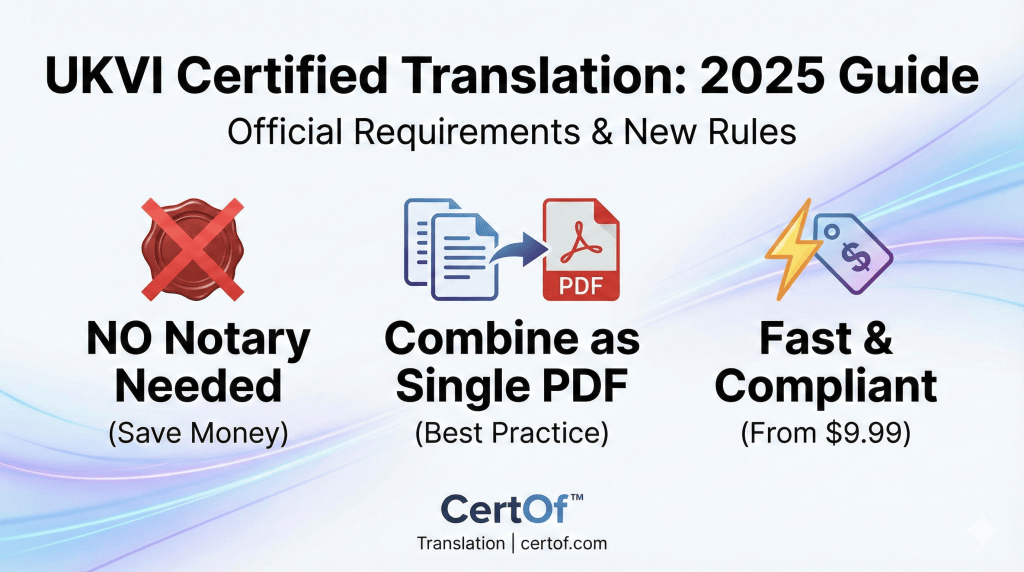
- Do not pay for notarization unless your case actually calls for it. For mainstream UKVI supporting documents, the usual issue is compliant certified translation, not notarization.
- Do not assume free help covers every category. Scotland’s Migration Service is useful, but its exclusions are real.
- Do not use an adviser who promises guaranteed success. That is exactly the kind of behaviour UK complaint pages tell users to treat as a warning sign.
Fraud, Complaints, and What to Do If Something Feels Wrong
If your issue is with an immigration adviser, use the official complaint route. GOV.UK says you can complain to the Immigration Advice Authority about poor service from an IAA-regulated adviser or advice from an unregulated person. The same page lists unreasonable fees, missed deadlines, work not done, and advisers claiming you will be successful as complaint grounds.
If the person you are dealing with is a solicitor rather than an IAA-regulated adviser, verify them through the Law Society of Scotland’s Find a Solicitor tool and read its public guide on how to spot a scam solicitor before sending documents or money.
If your dispute is mainly about translation delivery or consumer charging rather than immigration law, keep screenshots, invoices, email threads, and the exact wording you were promised. That paper trail matters whether you seek a refund directly or need to escalate the problem.
What Local Applicants Keep Saying
Community reports are not law, but they are useful for deciding what to prepare for. Across Reddit threads, public reviews, and local student discussions, the recurring themes are consistent:
- people regret paying appointment-day document handling costs when they could have uploaded earlier
- students often get faster practical direction from their university immigration team than from random online groups
- many applicants overestimate the need for notarization and underestimate the need for a clean, traceable certified translation
- the most stressful part is often not the appointment itself, but assembling a coherent evidence pack before it
That matches what document-heavy UKVI work usually looks like in practice in a city where people often juggle visa deadlines, study schedules, and busy support channels at the same time.
FAQ
Do I need a certified translation for immigration paperwork in Edinburgh?
If the document is not in English or Welsh, you should expect to provide a full translation that UKVI can independently verify. In practice, that means a compliant certified translation.
Where do Edinburgh applicants usually go for biometrics?
If your application requires biometrics, you will be directed to the UKVCAS service point shown in your booking journey. Treat it as an appointment-only step and prepare your translated files before the appointment rather than expecting staff to sort out a messy evidence pack on the day.
Is notarization required for UKVI documents in Edinburgh?
Usually no. For standard supporting documents, the normal requirement is certified translation, not notarization.
Can I upload translated documents myself before a UKVCAS appointment?
You can prepare and upload documents through the relevant commercial partner route before the appointment, or pay for a document-submission service at the appointment. GOV.UK also says you cannot add more evidence after submission, so checking your files early matters.
Where can I get free immigration help in Edinburgh?
Start with Citizens Advice Edinburgh if you need first-line guidance. If you fall within the published eligibility rules, Scotland’s Migration Service is another free route. If you are a university student, your own institution’s immigration team may be the most useful first stop.
What if my adviser in Scotland is unregulated or overcharging me?
Use the IAA complaint route for IAA-regulated advisers or to report unregulated immigration advice. If the person is a solicitor, verify and escalate through the Scottish legal-profession channels instead.
How CertOf Fits In
CertOf is not a law firm, does not decide your visa route, and cannot book official appointments for you. Where CertOf is useful is the document-preparation layer: translating foreign-language documents, adding the certification elements UKVI expects, preserving structure, and delivering files in a format that is easier to upload and review.
If you already know which documents you need, you can upload your files for a quote. If you want to understand the process first, start with Certified Translation for UKVI, Electronic Certified Translation: PDF vs Word vs Paper, or Upload and Order Certified Translation Online. If you need to discuss a document set before ordering, use the contact page or return to CertOf for service details.
Disclaimer
This guide is general information for people handling UK immigration paperwork in Edinburgh and is not legal advice. Immigration rules, appointment systems, and service-point arrangements can change. Always confirm the current requirements on the official page for your application route and in your own booking portal before you submit or attend an appointment.