Can I Translate My Own Documents for a UK Visa? UK Home Office Rules on Self-Translation, Google Translate, Notarization, and Certified Translation
If you are asking can I translate my own documents for a UK visa, the practical answer is usually no. For UK immigration paperwork, the real test is not whether your English is good enough. It is whether the translation can be independently verified by the UK Home Office, contains the right details, and fits the way UKVI, UKVCAS, or an overseas visa application centre actually handles supporting evidence. This is a UK-wide issue, and the core rule is national. The local differences are mostly in filing workflow, Welsh-language handling, and the support and complaint routes available to you.
Key Takeaways
- For documents that are not in English or Welsh, the UK rules focus on a full translation that can be independently verified, not on a notary stamp.
- Self-translation, family translation, and machine-only translation are high-risk because they do not normally meet the Home Office standard for an independently verifiable professional translation.
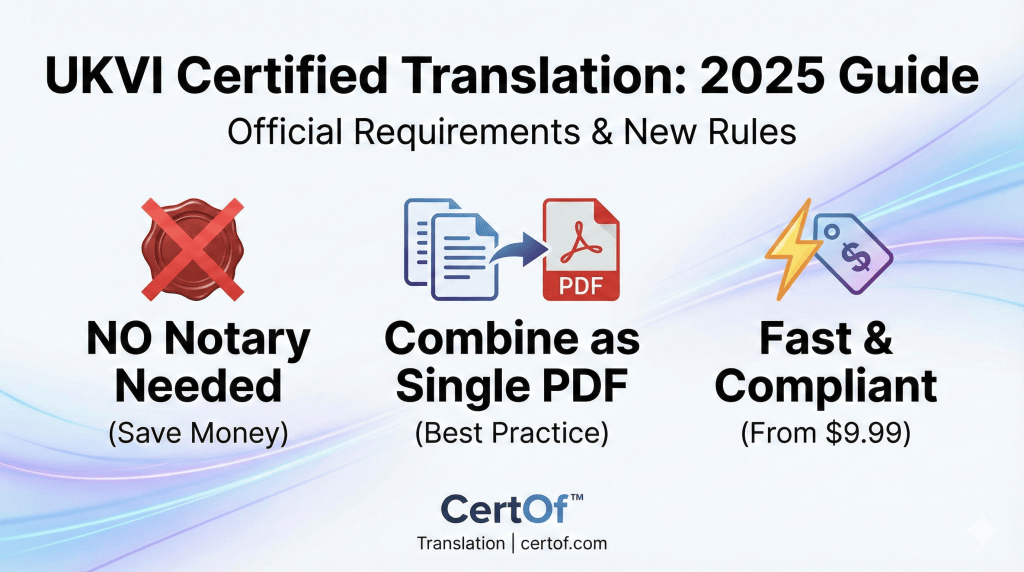
- Notarization is not the standard UK immigration requirement. In ordinary visa, extension, and settlement cases, applicants usually need a compliant certified translation, not a notarized one.
- If you are applying for leave to remain or indefinite leave to remain, the rules can be stricter because they refer to a qualified translator and the translator’s credentials.
Disclaimer: This guide is about document translation for UK immigration applications, not legal advice on whether your route qualifies or what evidence strategy you should use. If you need route-specific or case-specific immigration advice, use a regulated adviser or solicitor.
Who This Guide Is For
This guide is for people applying to enter, stay, extend, or settle in the UK where the receiving authority is the Home Office or UKVI. It is especially useful for DIY applicants, sponsors, and paralegals handling mixed document packs such as birth certificates, marriage certificates, police certificates, bank statements, payslips, tenancy records, divorce papers, household registers, and employer letters.
The most common situation is very practical: the application is nearly ready, the upload deadline or biometrics appointment is close, and someone suddenly realizes that a key document is not in English or Welsh. That is the moment applicants start asking whether they can translate it themselves, run it through Google Translate or DeepL, or pay a solicitor or notary for a stamp. In the UK system, those are not interchangeable fixes.
Can I Translate My Own Documents for a UK Visa? The Short Answer
For most UK immigration applications, do not rely on your own translation. The Immigration Rules Part 1 and Appendix FM-SE require a full translation for documents not in English or Welsh, and that translation must be capable of independent verification. The rules also require the translator’s name, signature, contact details, and, for some in-country stay and settlement applications, the credentials of a qualified translator.
That makes self-translation a poor fit for the rule. Even if your language skills are excellent, you are not an independent third party to your own application. A family member or sponsor translation is also a poor fit for the same reason, even if that person is bilingual.
What the UK Home Office Actually Checks
| Source | Level | What it says | Why it matters |
|---|---|---|---|
| Immigration Rules Part 1 | National rule | For non-English or non-Welsh specified documents, provide the original-language version and a full translation that can be independently verified. The translation must be dated and include accuracy confirmation, translator name and signature, and contact details. For leave to remain or ILR, it also refers to certification by a qualified translator and credentials. | This is the strongest rules-level source for ordinary immigration evidence. |
| Appendix FM-SE | National rule | Uses substantially the same standard for family-route specified evidence. | Important for spouse, partner, and family-based cases where finance and civil-status evidence are heavily scrutinized. |
| Route caseworker guidance | Home Office guidance | Uses the phrase fully certified translation from a professional translator or translation company that can be independently verified by the Home Office, and says an unverifiable translation will not be accepted as evidence. | This is where the practical meaning of certified translation becomes clearer for applicants. |
| GOV.UK certifying a document | General government guidance | A translator should confirm that the translation is a true and accurate translation, dated, with full name and contact details. | Useful for certificate wording and for explaining why a translator statement matters more than a generic stamp. |
For route-specific background, see our broader UKVI certified translation guide. For the generic difference between certification and notarization, keep that section short and use this comparison page.
Quick Checklist: What a Compliant Translation Should Include
Before you upload anything, check for these five points:
- confirmation that the translation is accurate
- the date of translation
- the full name of the translator or an authorised official of the translation company
- a signature
- contact details and, where the rule requires it, the translator’s credentials
This is the most useful part of the page to save. If any one of these items is missing, the problem is usually not fixed by adding a notary stamp afterwards.
Self-Translation vs Machine Translation vs Notarization vs Certified Translation
| Option | Usually safe for UK immigration? | Main problem |
|---|---|---|
| Self-translation | No | Normally fails the independent-verification logic built into the rules. |
| Friend or family translation | Usually no | Hard to present as an independent professional translation when the translator is personally connected to the applicant or sponsor. |
| Google Translate or DeepL output only | No | No professional signatory, no contactable translator, no verification path. |
| Machine draft reviewed and formally certified by a professional translator or translation company | Potentially yes | The certifying party must take responsibility for the final text and certificate, not just glance at machine output. |
| Certified translation by a professional translator or translation company | Yes, usually the normal path | Must still contain all required details and cover the whole document clearly, including stamps, notes, and back-page entries where relevant. |
| Notarized translation | Only in edge cases | Notarization does not replace the translation content UKVI asks for. |
What a Compliant UK Immigration Translation Should Include
A UK immigration translation should usually include all of the following:
- a statement that it is an accurate or true and accurate translation of the original document
- the date of translation
- the full name and signature of the translator, or an authorised official of the translation company
- contact details for the translator or translation company
- for leave to remain and settlement contexts, details showing the translator is qualified and their credentials can be checked
The basic government wording page is here. If you are delivering digitally, the practical file-format question is separate from translation validity. For that, use our guide to electronic certified translations.
The Most UK-Specific Point Many Applicants Miss: English or Welsh
This is the most useful UK-specific boundary to surface early. The rule is not non-English documents must be translated. The rule is non-English or non-Welsh documents must be translated. That matters in Wales and for bilingual Welsh civil records. Home Office guidance for the Hong Kong BN(O) route states that birth, marriage, civil partnership, and death certificates issued in Wales are often issued in English only or bilingually and therefore do not require translation.
It also matters for complaints and correspondence. UKVI complaints can be made in English or Welsh, while the Immigration Advice Authority can arrange translation support for complaints about advisers. That language-handling split is a very UK-specific operational detail.
Where Translation Problems Actually Hit the Filing Path
Most applicants do not get stuck on theory. They get stuck at one of these four points:
- Document gathering: you realize your civil or financial documents are partly handwritten, multi-page, or carry stamps and back-page notes that are easy to omit.
- Upload stage: if you are using the app-based route, you self-upload evidence; if you are using UKVCAS, you either upload online or pay for scanning at the appointment. The official UKVCAS page confirms both options for many in-country cases. See also our practical UKVCAS upload preparation guide.
- Verification stage: if the caseworker cannot verify the translation or understand the document, the evidence may simply be discounted rather than rescued by a fancy stamp.
- Decision timing: if supporting documents need to be verified or more evidence is requested, the application can slow down. That matters even more on routes where people are trying to preserve status or avoid travel disruption.
In the current UKVCAS workflow, the practical question is usually whether the signed certificate page and the original document are readable in the upload set. Do not assume you need a wet-ink paper bundle unless a separate authority asks for it.
Do You Need Notarization?
Usually, no. For standard UK immigration filing, the main authorities cited above ask for a compliant translation, not notarization as a default requirement. This is where many applicants overpay. A solicitor or notary certifying a copy, or witnessing a signature, is doing something different from a translator or translation company certifying the translation itself.
The safest way to phrase this in UK terms is simple: notarization is an edge-case add-on, not the normal translation standard for UKVI. If a document must also be used abroad, at an embassy, or in a separate foreign legal process, that is a different question and should not be confused with the standard Home Office translation rule.
What Happens If the Translation Is Missing or Weak?
Home Office caseworker guidance says that if no translation is provided, the caseworker should request one; if the applicant still does not provide a translation, or if the translation cannot be verified, the document will not be accepted and the case will continue as though that evidence was not provided. In some routes, that can directly lead to refusal if the untranslated document was essential.
This is one reason cheap shortcuts are risky. The refusal risk often comes indirectly: not because UKVI is punishing you for using a bad translation vendor, but because your birth certificate, finance evidence, or relationship proof ends up carrying no evidential weight.
How to Verify a Translator in the UK Before You Order
The UK translation market is not licensed in the same way as immigration advice. That means you should screen for professional signals yourself. Two useful public checks are the ITI Directory and the CIOL member check. These are not legal requirements for every UKVI translation, but they are practical ways to check whether a translator has a professional profile you can verify.
Ask the provider one direct question before you pay: will the final translation include a signed certificate, full contact details, and all stamps, annotations, and back-page entries if those details matter to the document?
Real UK Applicant Pain Points
Across community discussions on r/ukvisa and ImmigrationBoards, the same patterns repeat:
- people assume strong personal English is enough and discover too late that independence and verifiability matter more
- people think a notary stamp makes a translation stronger when the translator statement is still incomplete
- people try to translate only selected pages of long bank statements or tenancy records and then worry that the missing pages weaken context
- people upload digital files that are readable on screen but do not clearly show stamps, annotations, or back-page entries
- people confuse translation services with regulated immigration advice and end up paying the wrong provider for the wrong problem
These are useful user signals, but they are still community signals. They help explain applicant behavior, not replace the official rules.
Anti-Scam and Complaint Paths in the UK
If the problem is the translation itself, ask for correction before filing. If the problem is bad immigration advice, use the proper UK complaint route.
- Bad or illegal immigration advice: complain to the Immigration Advice Authority. The complaint form is available in different languages, translated complaints are allowed, and the page lists the Complaints Team address as PO Box 567, Dartford, DA1 9XW, email [email protected], and phone 0345 000 0046.
- Poor UKVI service: use the UKVI complaints process. Complaints must be in English or Welsh, and the published service standard says a response usually takes up to 20 working days, or up to 12 weeks for serious professional misconduct complaints.
- Visa scam or phishing message: use the official Report visa and immigration scams route. GOV.UK specifically warns that you will never be asked to pay for a visa by cash or money transfer.
A useful UK-specific warning: the IAA regulates immigration advice, not translation companies as such. A translator can prepare a compliant translation package, but they should not drift into unregulated visa advice.
UK Data That Explains Why This Topic Matters
According to the Office for National Statistics, 91.1% of usual residents aged 3 and over in England and Wales reported English, or English or Welsh in Wales, as a main language in Census 2021. A further 4.1 million people were proficient in English but did not speak it as their main language. That is one reason UK immigration applicants regularly encounter supporting evidence in other languages even when the application itself is filed in English.
The Immigration Advice Authority says it regulates more than 3,700 individual advisers and 2,000 organisations. That matters because translation confusion often overlaps with adviser confusion: applicants are not just buying words on a page, they are trying to avoid paying the wrong person for the wrong service.
Provider and Support Landscape
Commercial translation providers to vet
Examples of UK-facing providers applicants may compare include CertOf and established UK translation agencies. The key question is not who sounds most official. It is whether the provider will issue a compliant certificate, translate the whole document properly, and stay within the boundary of translation rather than drifting into unregulated immigration advice.
| Provider type | Best fit | What to check before ordering |
|---|---|---|
| CertOf | Digital-first certified translation for immigration document packs | Certificate wording, revision process, and whether your upload set is complete |
| UK translation agency | Multi-document packs or language pairs outside your existing network | Who signs the certificate, turnaround assumptions, and whether stamps and annotations are included |
| Freelance professional translator | Shorter or specialist document sets | Verifiable contact details, professional profile, and whether they will certify for UK immigration use |
Public and nonprofit support resources
| Name | Who it helps | What it helps with | Best use |
|---|---|---|---|
| Immigration Advice Authority | Anyone checking an adviser or complaining about bad advice | Regulation, complaints, reporting unregulated advisers | Use before paying an adviser and if you suspect fraud |
| Citizens Advice | People needing basic signposting or local specialist referral | Free guidance and local referral routes for immigration support | Good first stop if you do not know whether your issue is translation, evidence, or legal advice |
| JCWI | People with more vulnerable or complex situations | Immigration legal advice and specialist support | Useful where the real issue is status, appeal risk, or vulnerability, not document formatting |
Practical Low-Risk Workflow
- Decide which documents are actually required for your route.
- Flag every non-English and non-Welsh document early, including stamps, handwritten notes, and back pages.
- Use a translator or translation company that will sign, date, and provide full contact details, and can state accuracy clearly.
- If you are applying in-country, pay extra attention to the qualified-translator and credentials wording for leave to remain or settlement evidence.
- Before upload, check readability, page order, and whether the translation clearly matches the original.
- If you are using UKVCAS, decide whether you will self-upload or pay for scanning. Do not leave translation cleanup until the appointment week.
FAQ
Does UKVI accept Google Translate?
Not on its own. Machine output does not supply the professional signatory and verification trail the Home Office expects.
Can a friend or family member translate my documents for a UK visa?
Usually this is a bad idea. The safer route is a professional translator or translation company that can be independently verified.
Do I need a notarized translation for a UK visa?
Usually no. The normal requirement is a compliant certified translation, not notarization.
Do Welsh documents need translation?
Not if they are already in Welsh or bilingual Welsh-English form. The UK rule is English or Welsh.
Does UKVCAS require paper translations?
Usually the issue is upload quality, not paper form. Many applicants upload documents online, and UKVCAS also offers scanning at appointments in many in-country cases. Make sure the signed certificate page is readable.
What if my translation is missing required details?
UKVI may ask for a proper translation, but it can also treat the document as unusable evidence. If that document was essential, the case can fail.
CTA
If you already know your document needs translation, CertOf can help with the translation and preparation side of the process: accurate certified translations, digital delivery, revision support, and document formatting for online filing. Start here: submit your documents online.
If you want to compare delivery options first, see how online certified translation ordering works and what to look for in turnaround and revision support. If your question is really about whether you need immigration advice rather than translation, check the IAA register before paying anyone to guide your case.