UKVCAS Upload Translated Documents in the UK: File Preparation, Scan Quality, and Appointment Scanning
If you need to use UKVCAS to upload translated documents in the UK, the difficult part is usually not the legal rule in the abstract. It is the practical handoff between your translation, your scan quality, the UKVCAS upload route, and the way UKVI will later read the file. In the UK, that handoff matters because UKVCAS handles biometrics and document intake, while UKVI makes the actual immigration decision.
This guide focuses on that handoff: how to make foreign-language supporting documents upload-ready for a UKVCAS case, when appointment scanning is actually useful, and where certified translation fits. For the broader UKVI translation rule itself, see our related guide on certified translation for UKVI.
Key Takeaways
- If your document is not in English or Welsh, UKVI expects the original-language document and a full translation that can be independently verified under the Immigration Rules. For in-country leave to remain and settlement cases, the rule is stricter about a qualified translator and credentials. Official rule.
- UKVCAS can take supporting documents either through the online upload route or by scanning them at the appointment, but scanning at the appointment is a convenience service, not a compliance check. UKVCAS overview.
- In the UK, the most common failure point is not “wrong type of translation”. It is a messy digital file: blurred photos, missing pages, original and translation split apart, or a large PDF tested too late on the portal.
- If you are digitally excluded, the UK has a real support node: Assisted Digital support. That is more relevant to this topic than most generic certified-translation FAQs.
Who This Guide Is For
This guide is for people in the United Kingdom who are applying for permission to stay, settlement, or citizenship and have been told to use UKVCAS or a related in-country document-submission flow. It is especially relevant if you are handling your own application, your supporting documents include foreign civil records or overseas financial evidence, and your most likely language direction is foreign language to English. Typical document bundles include a birth or marriage certificate, overseas bank statements, employment letters, tenancy records, police certificates, education records, or family evidence. The usual sticking point is not knowing whether to self-upload or rely on appointment scanning, and not knowing how to package the original document, the translation, and the translator certification into one clean digital file.
Why This Problem Feels Different in the UK
The core translation rule is national, not city-by-city. In other words, this topic is mainly governed by Home Office and UKVI rules, not by local councils or local courts. The UK-specific difference is operational: digital submission is part of the immigration workflow itself. GOV.UK says UKVCAS is used to provide biometric information and supporting documents, and some applicants may not even need an appointment if their route allows them to submit digitally instead. Source.
It also means legitimate parts of the workflow may sit on a commercial partner platform linked from GOV.UK rather than on a gov.uk domain all the way through. That is normal for this process, but it is one reason applicants should start from the official UKVCAS page and not from unsolicited emails or search ads.
That creates a very British version of the problem: your translation can be accurate, but your case can still become harder if the upload package is disorganised. The move to eVisas only makes that more important; the government’s eVisa updates were still being updated as of 11 March 2026. Source.
Counterintuitive point: paying for appointment scanning does not make a weak translation stronger. It only changes who digitises the paperwork.
What UKVI Actually Requires From a Translated Document
For immigration applications in the UK, a non-English or non-Welsh document should not be uploaded by itself. Under the Immigration Rules, the translation must be a full translation, and it must be capable of independent verification. The translation must be dated and include confirmation that it is accurate, the translator’s or translation company’s name and signature, contact details, and, for leave to remain or indefinite leave to remain cases, certification by a qualified translator with credentials. Immigration Rules Part 1.
In practice, that means your upload bundle should usually contain:
- the original-language document
- the full English translation
- the translator’s certification page or statement
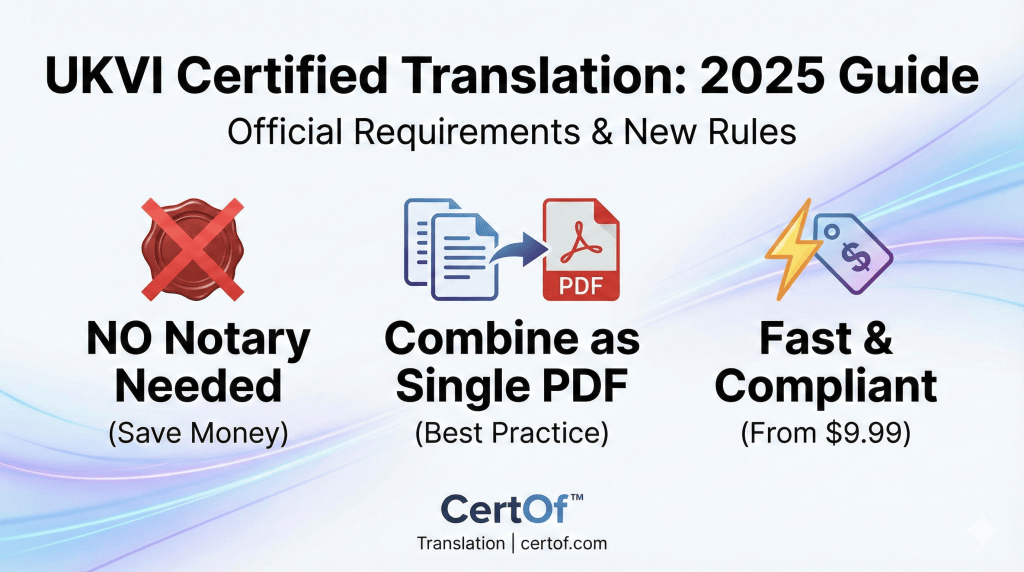
For a deeper explanation of what counts as certified translation in the UKVI context, use our internal references on UKVI certified translation requirements and certified vs notarized translation. Most UKVCAS upload problems are not notarization problems.
UKVCAS Upload Translated Documents: What a Compliant File Looks Like
GOV.UK’s upload guidance says the full document must be visible, well lit, in focus, and not obscured. The official self-upload guidance also accepts common digital formats such as PDF, PNG, JPG, and JPEG. Official upload guidance. Even though that page is written for self-upload users, the scan-quality logic carries over to UKVCAS partner uploads as well.
For translated immigration documents, the cleanest working method is usually:
- Put the original pages first.
- Place the full English translation immediately after them.
- Place the translator certification page last.
- Name the file descriptively, for example Marriage-certificate-and-translation.pdf or Bank-statements-Jan-to-Mar-and-translation.pdf.
That structure is not just tidier. It reduces the risk that a caseworker sees a translation without the source document, or a source document without the certification page. It also helps if the live partner portal applies file-size caps or upload cut-offs, because it is much easier to troubleshoot a clearly named bundle than a random stack of images.
The Real Workflow in the UK: From Preparation to Submission
- Submit the immigration application and review the document checklist.
- Identify every item that is not in English or Welsh.
- Order the translation early enough to test the final file in the upload portal before your appointment date.
- Decide whether you will upload online yourself or rely on appointment scanning.
- Check the final PDF or image file for legibility, completeness, and sensible file names.
- Attend the appointment if your route requires one, bringing your QR-code appointment confirmation, passport or travel document, and any supporting documents not already uploaded. Source.
If your route does not require an appointment, GOV.UK says you will receive email instructions on how to submit your photo and supporting documents. That is another reason not to write this topic as a generic “visa centre” article. The UK in-country process is now partly digital by design. Source.
Self-Upload vs Appointment Scanning
This is where many applicants lose time.
GOV.UK is clear that applicants using the UK Immigration: ID Check app use the self-upload service, but people attending a UKVCAS service point cannot use that same self-upload service and instead upload through a commercial partner website or pay for an added-value scanning service at the appointment. Source.
Self-upload is usually better when:
- your files are already prepared and checked
- you have multi-page translated evidence that needs careful ordering
- you want time to review what the digital bundle actually looks like
Appointment scanning matters more when:
- you do not have reliable scanning equipment
- you are not comfortable combining or naming PDFs
- you are handling a paper-heavy bundle and need operational help, not legal advice
What appointment scanning does not do:
- it does not certify the translation
- it does not tell you whether the translator’s credentials are sufficient
- it does not increase your approval chances
There is one important exception written directly into the UKVCAS page: if you are applying under the EU Settlement Scheme, you must upload your supporting documents when you apply and cannot have them scanned at the UKVCAS appointment. Source.
Scan Quality: The Minimum Standard That Saves Rework
Official guidance allows either scans or photos, but “allowed” is not the same as “wise” for every file type. Dense evidence like foreign bank statements, stamped certificates, or documents with side notes usually needs better image control than a quick phone photo.
- Make sure every page is complete, including seals, margins, annotations, and back pages where relevant.
- Keep pages flat and avoid glare.
- Use enough resolution to keep signatures and stamps readable.
- Preview the full file after uploading, not just before uploading.
- For long financial evidence, split the material logically if the live portal rejects very large files.
Community discussions on UKCEN and ImmigrationBoards repeatedly show the same operational mistake: people leave PDF testing until the night before the appointment. Treat the portal test as part of document preparation, not as the final click.
Common UKVCAS Pitfalls With Translated Documents
- Uploading the translation without the original. UKVI wants to see what was translated.
- Uploading only the “main page”. If the source document has stamps, handwritten notes, reverse-side entries, or registrar remarks, those usually need to be reflected in the full translation.
- Assuming UKVCAS staff judge the translation’s legal adequacy. They handle intake; UKVI assesses the evidence.
- Leaving foreign financial evidence uncompressed until the end. Large statement bundles are where portal limits usually hurt first.
- Confusing certified translation with notarization. For most UK immigration uploads, the core issue is a properly certified and verifiable translation, not notarization.
Scheduling, Cost, and Submission Reality in the UK
UKVCAS appointments are appointment-only. GOV.UK says service point costs depend on the type of service point and whether you buy extra services. Extra charges can apply for out-of-hours, weekend, next-day, or same-day appointments. Source. That matters because a late translation does not just create stress; it can push you toward paid convenience options.
The more useful planning rule is simple: if your foreign-language documents are material to the case, do not wait until the appointment week to see whether the digital bundle opens cleanly in the portal. Commercial partner interfaces can apply technical limits and submission cut-offs that are easy to underestimate if you only prepare the file at the last minute.
What Applicants Run Into in Practice
Official rules tell you what is required. Community experience tells you where people still stumble. Across long-running UK immigration forums, the recurring operational complaints are:
- uncertainty about whether the original and translation should be merged into one file
- uploads that look fine locally but become unreadable after compression
- foreign bank statements and civil records being scanned in the wrong order
- users assuming appointment scanning will “fix” a translation package that was never organised properly
Those signals are consistent across UKCEN and ImmigrationBoards, so they are useful as workflow warnings even though they are not legal authorities. See UKCEN and ImmigrationBoards.
UK Data Points That Explain Why This Keeps Happening
This is not a niche edge case. According to the Office for National Statistics, in England and Wales in Census 2021, 91.1% of residents had English (or English/Welsh in Wales) as their main language, meaning a significant minority did not; a further 7.1% were proficient in English but did not speak it as their main language, and 1.5% could not speak English well. ONS language data.
Why that matters here: a country with millions of residents using other main languages will naturally produce immigration files containing overseas records, bilingual households, and evidence that is legally relevant but not already in English. In the UKVCAS context, that turns translation quality and digital file readiness into an everyday intake problem, not a rare one.
UK-Based Translation Providers Readers May Compare
This is not a ranking. It is a short comparison of publicly verifiable UK-facing providers that readers can compare when they need certified translation for upload-ready immigration evidence.
| Provider | Publicly verifiable signal | What it appears suited for | What to check before ordering |
|---|---|---|---|
| Translayte | Listed in the ATC member directory; contact page available at translayte.com/contact; London address publicly listed as 20-22 Wenlock Road, London N1 7GU; phone 0208 629 1290 | Applicants wanting a UK-based provider with publicly visible certified-translation positioning | Whether your language pair, turnaround, and final PDF packaging support fit your deadline |
| Absolute Translations | Listed in the ATC member directory; London address publicly listed as 25 Wilton Road, Victoria, London SW1V 1LW; phone 0333 577 0767 | Applicants comparing larger UK agencies with formal quality-management signals on public profiles | Whether the final certification wording and document layout meet in-country UKVI needs |
| Translation Services 24 | Listed in the ATC member directory; London address publicly listed as 5 Saint John's Lane, London EC1M 4BH; phone 0208 677 3775 | Applicants comparing ATC-listed providers focused on personal documentation and legal work | Whether the provider will bundle source, translation, and certification in a way that is easy to upload |
The practical question is not “which company sounds most official”. It is whether the provider understands full translation + verifiable certification + clean digital handoff.
Public Support and Related Resources
| Resource | Who it helps | What it does | Key public details |
|---|---|---|---|
| We Are Group Assisted Digital | Applicants who struggle with online forms or digital document submission | Helps with the online process; this is the closest thing to public digital-submission support in this workflow | GOV.UK page; phone 0333 344 5675; email [email protected]; text VISA to 07537 416 944 |
| Citizens Advice | People who need free and confidential guidance on where to get regulated immigration help | Helps identify next steps and, where available, specialist immigration support | Citizens Advice immigration advice |
| Immigration Advice Authority adviser finder | Applicants checking whether an adviser is regulated | Lets you search for registered immigration advisers | Find an immigration adviser |
Complaints, Fraud, and When to Escalate
If the problem is with service delivery rather than legal eligibility, use the right path.
- If you need to complain about UKVI service standards, use the official UKVI complaints process. GOV.UK says complaints are usually answered within 20 working days, with the most serious cases taking longer.
- If your issue is that an adviser may be acting improperly, use the IAA complaint route.
- Start from the official UKVCAS page before clicking through to a commercial partner portal. That is the safest way to distinguish the real workflow from fake “priority” offers or unofficial upload help.
- Be cautious of any provider claiming to be “officially approved by UKVI” or implying that a paid scanning service improves the immigration decision. That is the wrong promise for this stage of the process.
Need Help With the Translation Itself?
If you already know which documents you need but the practical problem is turning them into a clean certified translation package, CertOf fits the document-preparation part of the workflow, not the legal-advice part. You can upload your files and order online, and you can also review our related guides on ordering certified translation online, electronic certified translation formats, and revision and turnaround expectations.
The main value here is straightforward: a translation package that is easier to verify, easier to upload, and easier to review. CertOf does not provide immigration legal representation, does not book UKVCAS appointments, and does not act as an official government partner.
FAQ
Should I upload the original and the translation as one PDF for UKVCAS?
Usually yes. As a working method, one bundled file per foreign-language evidence item is clearer than scattering the original, translation, and certification across different categories.
Can I have translated documents scanned at my UKVCAS appointment?
Usually yes, but that is a convenience option, not a substitute for a compliant translation. If you are applying under the EU Settlement Scheme, GOV.UK says your supporting documents must be uploaded when you apply and cannot be scanned at the appointment. Source.
Does UKVCAS decide whether my translation is acceptable?
No. UKVCAS handles document intake and biometrics. UKVI decides the application and assesses whether the evidence is acceptable.
Can I use my phone to photograph a translated document?
Officially, photos are allowed if the full document is visible, well lit, and in focus. In practice, dense multi-page evidence is safer when scanned properly. Source.
Can I use a scanner at a local library instead of paying for appointment scanning?
Often yes, if the scanner lets you create a clear, complete file that opens properly in the upload portal. The safer approach is to test the finished file early and not assume the appointment-day scanning option is your only backup.
Do I need notarization for UKVCAS uploads?
Usually no. Most applicants need a properly certified translation rather than notarization. The key test is whether the translation is full, accurate, and independently verifiable under UKVI rules.
What if I am bad with online uploads?
Start with Assisted Digital support. If you still plan to attend a service point, appointment scanning may be useful for the digitisation step, but it does not replace the need for a compliant translation.
Disclaimer
This guide is general information, not legal advice. Immigration rules, commercial partner interfaces, appointment options, and technical upload limits can change. Always check the live guidance and your own route-specific checklist on GOV.UK before you submit supporting documents.