Anchorage USCIS Document Translation and Paperwork: What Local Applicants Actually Need
If you are handling immigration paperwork in Anchorage, the first practical fact to know is that the local USCIS office most people can verify publicly is the Anchorage Application Support Center in the James M. Fitzgerald US Courthouse and Federal Building at 222 W 7th Ave, Suite 128. It handles biometrics appointments. It is not a walk-in filing counter, and USCIS says there are no direct filings at that ASC. That makes Anchorage USCIS document translation less about finding a local stamp or counter and more about getting non-English documents right before you mail or upload your package.
For most applicants here, the core rules are the same nationwide: USCIS requires a full English translation with a signed certification for any non-English document. The local difference is workflow. In Anchorage, your friction points are the downtown biometrics-only office, mailing or online filing to out-of-state USCIS intake routes, winter closure risk, and a support ecosystem that is concentrated in Anchorage but split between translation providers, legal referrals, and nonprofit help.
Key Takeaways
- The Anchorage USCIS ASC is for biometrics, not paper filing. If you show up expecting to submit your packet, you will lose time.
- Certified translation matters before filing, not after. Birth certificates, marriage records, divorce decrees, family registers, police certificates, and name-change records should be translated before you mail or upload your case.
- You usually do not need notarization for USCIS. If you are unclear on the difference, start with certified vs. notarized translation and keep the Anchorage article focused on local workflow.
- In Alaska, legal-help and referral resources are concentrated in Anchorage. Translation can solve document-prep problems, but it cannot replace a lawyer or accredited representative when the issue is eligibility, court, asylum, or removal defense.
Who This Guide Is For
This guide is for people living in Anchorage and nearby Alaska communities who are preparing USCIS immigration paperwork that includes non-English civil or supporting documents. It is especially relevant for family-based adjustment, spouse or parent immigration, naturalization-related civil record issues, and status-related filings where the document set commonly includes birth certificates, marriage certificates, divorce decrees, family relationship records, police certificates, passport pages, or name-change records.
It is most useful if your paperwork involves common language pairs seen in Anchorage-area public language access and community support work, such as Spanish-English, Russian-English, Ukrainian-English, Tagalog-English, Chinese-English, or Korean-English. The typical problem is not the form itself. It is the mismatch between what USCIS wants and what applicants actually have: a certificate with back-page stamps, handwritten notes, alternate spellings, old family records, or multiple documents that refer to the same person in slightly different ways.
Why Anchorage Feels Different From a Generic USCIS Guide
The federal rules are still federal rules. Anchorage stands out because the local workflow is easy to misunderstand.
- The downtown ASC is appointment-based, open Monday through Friday from 8:00 a.m. to 4:00 p.m., and USCIS says public transportation is available through People Mover bus 12. Parking is limited, and the office is inside a federal building, so expect screening and bring your appointment notice and ID.
- If the ASC closes because of weather or facility issues, USCIS says it will automatically reschedule biometrics appointments. That matters more in Alaska than in many warmer markets because a missed winter trip can add stress and delay.
- Your filing address is often outside Alaska. USCIS filing locations vary by form and category, so you need the current filing guidance instead of assuming you can hand-deliver a packet locally.
- Anchorage is also where Alaska’s most visible immigration support nodes cluster. The state’s Office of Citizenship Assistance and several Anchorage-based immigration practices are listed in public directories, which is useful when translation alone will not solve the problem.
The counterintuitive part is this: in Anchorage, the practical value of certified translation is not getting a local office to bless your documents. It is reducing the chance that a packet routed out of state comes back with a request for evidence because a name, stamp, note, or back page was handled badly.
USCIS Certified Translation in Anchorage: What Documents Need Translating
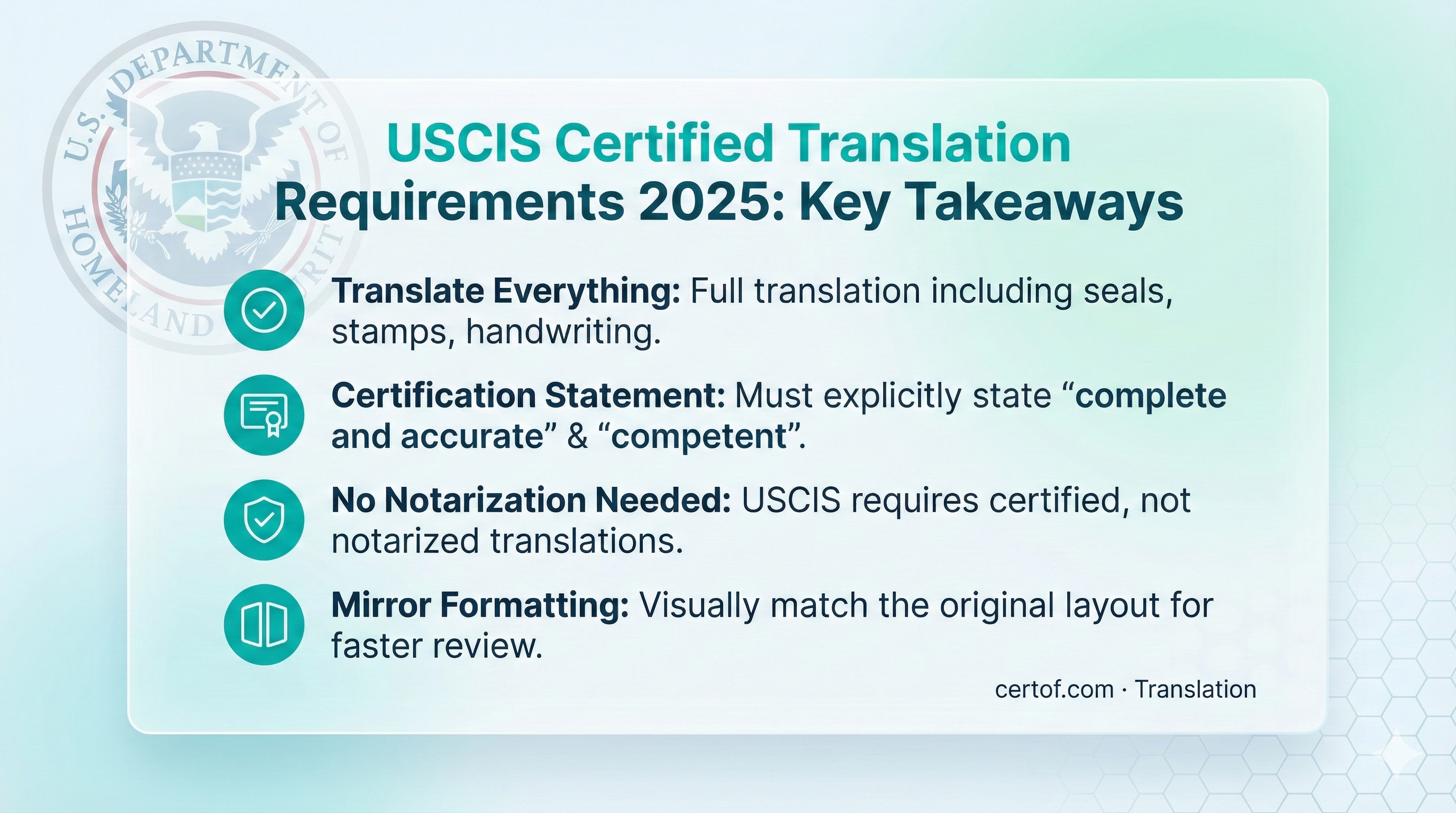
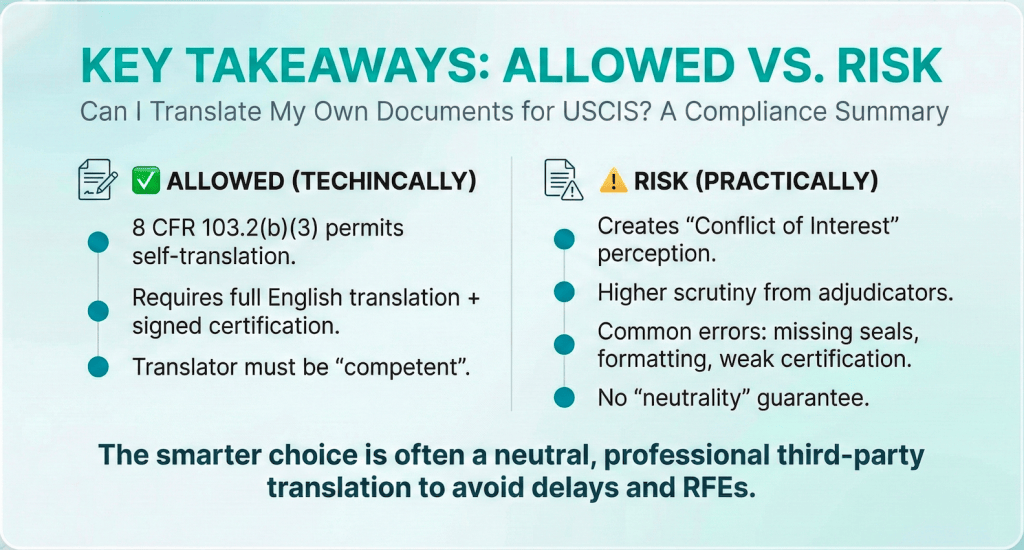
For USCIS, the hard rule is national. The agency’s policy manual requires a full English translation with a certification signed by the translator for any document containing foreign language text. If you need the full rule, sample wording, or edge cases, use the dedicated internal guides on USCIS certified translation requirements, who can certify a translation for USCIS, and whether you can translate your own documents. This Anchorage guide keeps that explanation short and focuses on where local applicants get stuck.
The documents that most often need translation in Anchorage USCIS cases are:
- Birth certificates
- Marriage certificates and divorce decrees
- Household or family registration records
- Police certificates or foreign clearance records
- Name-change documents
- Adoption, custody, or guardianship documents
- Supporting evidence with foreign-language text, including message excerpts, tax pages, tenancy evidence, or relationship records
The mistakes that trigger trouble are also predictable:
- Only translating the front page and leaving the back-page registry notes or stamps out
- Ignoring handwritten annotations or side notes
- Leaving inconsistent names unexplained across birth, passport, marriage, and police documents
- Paying for notarization even when the filing does not require it
- Using a machine translation draft as if it were a finished USCIS submission
If your packet is mostly civil records, translation is usually a document-prep issue. If the real question is legal strategy, admissibility, waiver eligibility, or court risk, translation is only one small part of a larger case.
Step by Step: How the Anchorage Workflow Usually Looks
- Confirm the filing path. Start with the USCIS form page or filing guidance, because Anchorage is not the place where most applicants submit the package itself.
- List every non-English document before filing. This is where many delays begin. Do not wait for a biometrics notice to think about translation.
- Translate the full document set consistently. If one name is spelled three ways across four documents, handle that before submission, not after an RFE.
- Submit online or mail to the correct USCIS intake address. Filing addresses vary by form and category. Some Alaska filers go to Phoenix; others go to Dallas or other USCIS intake points depending on the form.
- Attend biometrics in downtown Anchorage if USCIS schedules one. Bring the notice and arrive ready for federal-building screening.
- Use local help selectively. Translation companies fix document language problems. Lawyers and accredited or nonprofit support nodes help when the issue is legal eligibility, risk, or case posture.
What Local Applicants Complain About Most
Public case-timeline reviews on VisaJourney and recent community posts in r/USCIS do not change the law, but they are useful for reality-checking the Anchorage workflow. The same themes keep repeating.
- People assume the federal building downtown can accept their packet or answer case-status questions, then learn the Anchorage ASC is there for biometrics only.
- Winter travel and building closures matter. Community posts repeatedly describe winter drives and appointment logistics as more stressful than the biometrics appointment itself.
- Applicants with family-based cases often report that the interview or biometrics visit itself is straightforward, while document prep, medical follow-up, or civil-record consistency creates the real delay.
- Cases involving foreign civil records are especially vulnerable to back-page omissions, stamp omissions, and name mismatch issues.
Treat those user voices as logistics signals, not official processing promises. They are helpful because they line up with the local facts that USCIS and Alaska resource pages do confirm.
Common Anchorage Pitfalls
- Going downtown to file. The Anchorage ASC does not accept direct filings. That is the most local, most avoidable mistake in this market.
- Treating notarization as the default. For ordinary USCIS document translation, notarization usually adds cost without solving the actual problem.
- Translating only what looks important. USCIS cares about complete translation, not your guess about what matters. Stamps, seals, and handwritten notes can matter.
- Waiting until after receipt notices. Translation should usually happen before you mail or upload a packet, not after biometrics is scheduled.
- Using translation to substitute for legal advice. If the issue is asylum, removal, prior status problems, or complex inadmissibility, a translated packet alone is not a strategy.
Where to Get Help in Anchorage
Anchorage has several useful support nodes, but they do different jobs.
Public and Nonprofit Resources
| Resource | Public signal | Who it helps | What it does not replace |
|---|---|---|---|
| Office of Citizenship Assistance, 3301 Eagle Street, Suite 100, Anchorage, AK 99503, (907) 754-3470 | The Alaska state office says in its FAQ that it serves legal immigrants in Alaska, offers phone, email, or video support outside Anchorage, and keeps office hours Monday to Friday, 8 to 5, closed on holidays. | People who need orientation, employment-related guidance, language assistance, or referral to legal support. | It is not a filing counter and it does not replace a translator or immigration lawyer. |
| Alaska Institute for Justice / Alaska Immigration Justice Project, 431 W 7th Ave, Suite 208, Anchorage, AK 99501, (907) 279-2457 | AIJ publicly lists its Anchorage office and Language Interpreter Center at the same address. | People who may qualify for nonprofit legal support, especially in family, protection, or vulnerable-client matters. | It is not a general commercial translation desk for every applicant, and wait times may differ by case type. |
| Alaska Bar Lawyer Referral Service, listed in the OCA attorney directory | The Alaska Bar’s public service caps the first half-hour consultation at $125 and refers callers to Alaska lawyers in good standing. | Applicants who need a lawyer and do not know where to start. | It does not provide legal advice itself and it does not translate documents. |
Commercial Translation and Related Services
| Provider | Public signal | Best fit | Boundary |
|---|---|---|---|
| CertOf | Online ordering through translation.certof.com, with related service pages for online ordering, electronic certified delivery formats, and hard-copy mailing options. | Applicants who already know what USCIS documents they need translated and want a clean certified translation package, digital delivery, revisions, or a multi-document workflow. | Not a law firm, not a government intermediary, not a local filing or appointment service. |
| RUSA, Inc., 9048 Little Brook Street, Anchorage, AK 99507, (907) 351-7602 | Public site shows an Anchorage office and Russian-English document processing and notary services. | Applicants who need local, appointment-based help with Russian-English document handling. | Niche language orientation; not a substitute for immigration legal advice. |
| Anchorage immigration law firms listed by OCA, including Alaska Immigration Law Center at 821 N Street, Suite 101 and Fields Immigration Law at 405 W. 36th Avenue, 1st Floor | The state OCA attorney directory publicly lists addresses and phone numbers for Anchorage-based immigration lawyers. | Cases where the question is legal path, case strategy, or document sufficiency review rather than translation alone. | Legal review and representation cost more than translation-only work and are not necessary for every straightforward packet. |
This split matters. If you already have a document checklist, a translation provider is often enough. If you are unsure whether a document should be filed, whether a discrepancy needs legal explanation, or whether your case belongs in a different immigration path, start with legal help, not just translation.
Fraud, Notarios, and Where to Complain in Alaska
Anchorage applicants should take scam prevention seriously, especially because many people searching for translation are also searching for immigration help at the same time.
- If a business or consultant takes your money for deceptive translation or immigration-related services, Alaska’s Attorney General has a consumer complaint process. The state says you can attach contracts, receipts, and supporting documents.
- If your issue is really unauthorized legal practice, use public legal-referral channels before signing anything. A translator can certify language accuracy. A translator cannot legally decide your immigration strategy.
- If a provider promises guaranteed approvals, secret shortcuts, or special access to the Anchorage office, treat that as a warning sign.
Why Anchorage Data Still Matters
Even though USCIS translation rules are federal, local population data helps explain why this issue is not hypothetical in Anchorage. According to U.S. Census QuickFacts for Anchorage municipality, foreign-born persons made up 10.9% of the population in 2020-2024, while 17.2% of residents age five and older spoke a language other than English at home in 2020-2024. That matters because a market with a sizable multilingual population naturally produces more packets built around foreign civil records, mixed-language evidence, and name-format differences across documents.
The data does not tell you which language pair is most common in your exact case. It does explain why Anchorage applicants regularly face document-translation issues that go beyond a single birth certificate. In practical terms, it means translation demand in Anchorage is tied to real population patterns, not just tourist traffic or one-off international cases.
What Certified Translation Can and Cannot Do for You
Certified translation can do a lot of practical work in a USCIS packet:
- turn a non-English civil document into a submission-ready English version
- keep names, dates, places, and family relationships consistent across a packet
- reduce the risk of avoidable translation-related RFEs
- help you submit electronically or by mail with cleaner supporting evidence
But it cannot decide whether you qualify for a green card, whether a waiver is needed, how to answer a prior immigration violation, or what to do with a court issue. If you need those answers, translation is supporting infrastructure, not the lead service.
FAQ
Can I submit my immigration papers in person at the Anchorage USCIS office?
No. The publicly listed Anchorage ASC is for biometrics appointments, and USCIS says there are no direct filings at that office.
Do I need certified translation for USCIS documents in Anchorage?
Yes, if the document contains foreign-language text. The rule is federal, not Anchorage-specific. The local issue is making sure the translation is complete before the case leaves Alaska or is uploaded online.
Do I need notarization for a USCIS translation in Alaska?
Usually no. For normal USCIS filings, the key requirement is a complete English translation with the translator’s certification, not notarization. For the longer explanation, use this guide.
What happens if bad weather affects my biometrics appointment?
USCIS says that if the ASC closes because of weather or a facility issue, it will automatically reschedule your appointment and send a new notice.
Where can I get immigration legal help in Anchorage if I also need translated documents?
Start with the OCA attorney directory, the Alaska Bar referral route, or Anchorage immigration firms listed publicly by OCA. Use translation separately for the document-prep portion unless your lawyer wants to coordinate the packet review.
What if my birth certificate and passport spell my name differently?
Do not ignore it. This is one of the most common packet-level problems. The translation needs to reflect the document accurately, and the overall filing may need a clean explanation or supporting record. If the mismatch could affect identity or eligibility, get legal advice before filing.
CTA
If you already know which USCIS documents you need to submit, CertOf can help with the document-prep side: certified English translation, PDF delivery, format support, and multi-document consistency checks for civil records and supporting evidence. You can start an order at CertOf’s translation portal, review how online ordering works, or see when bundle pricing for a full immigration packet makes more sense than ordering one file at a time.
If you are not sure what to file, whether your case belongs in a different path, or whether a discrepancy creates legal risk, speak with a lawyer or qualified nonprofit first. CertOf handles translation and document preparation. It does not provide legal representation, government filing, appointment booking, or official USCIS endorsement.
Disclaimer
This guide is for general informational purposes and is not legal advice. Immigration eligibility, filing routes, and evidence requirements can change by form, case type, and personal history. Always check the current USCIS form page and filing instructions for your exact case, and get legal advice if your matter involves court proceedings, asylum, removal issues, prior immigration violations, or uncertainty about eligibility.