Disclaimer: This article provides general information about USCIS translation requirements and professional best practices. It does not constitute legal advice. If your case involves complex legal issues, consult a qualified immigration attorney.
About the author: Erin Chen is the Co-Founder and Translation Strategist at CertOf™. With over a decade in bilingual editorial risk control and hands-on experience navigating the U.S. immigration process, Erin helps applicants prepare USCIS-ready certified translations that reduce avoidable delays.
Asylum claim evidence translation: faster submission, safer confidentiality, fewer technical mistakes
For many applicants, asylum claim evidence translation is where otherwise strong cases lose momentum. In my review work, the most common failures are not factual. They are procedural: partial translations, weak certification wording, missing metadata in chat screenshots, and late evidence packaging that creates avoidable RFE risk.
Key Takeaways
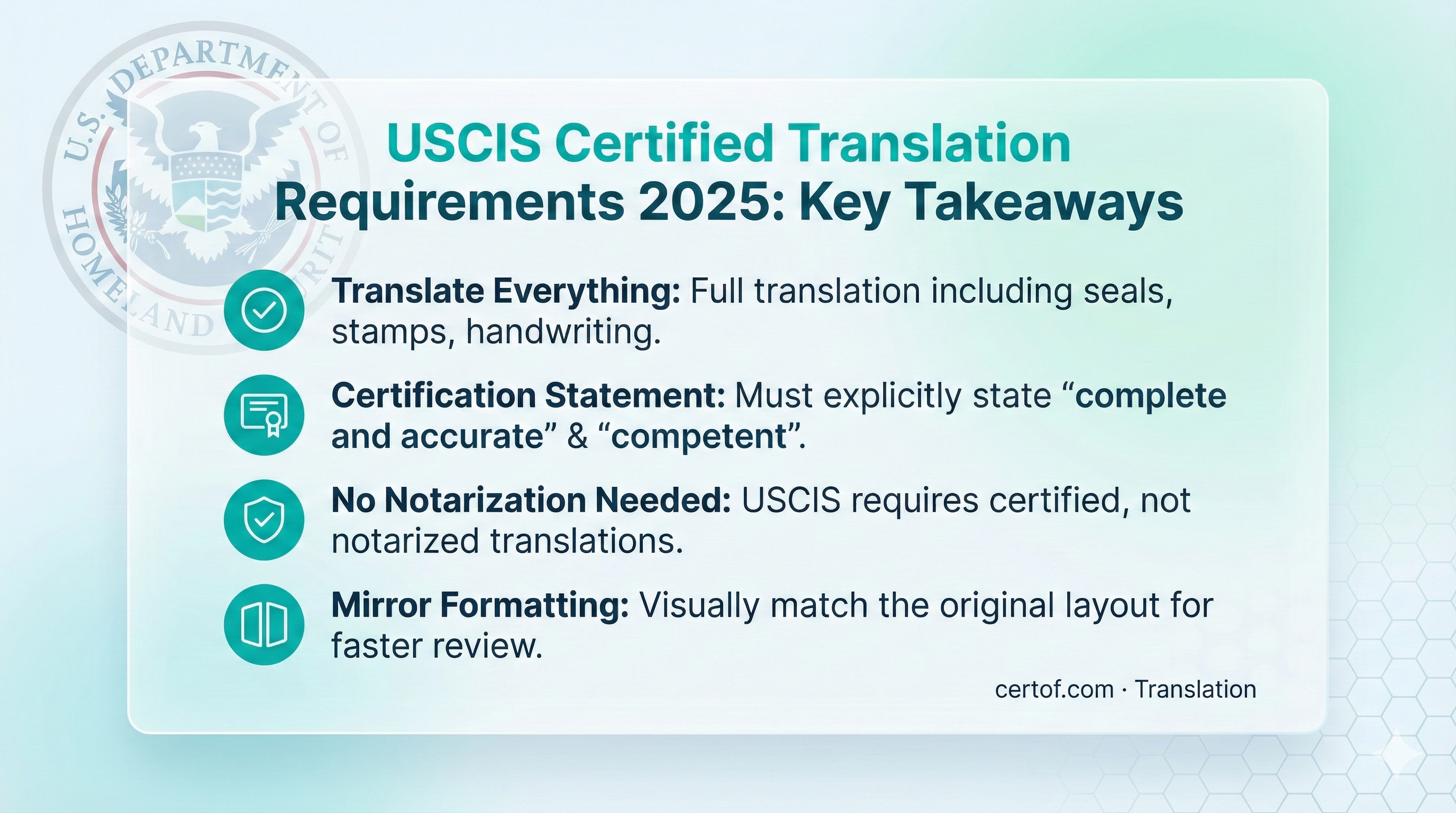
- USCIS requires a full English translation plus translator certification of completeness, accuracy, and competence under 8 CFR 103.2(b)(3).
- Asylum confidentiality is governed by 8 CFR 208.6; it is strong, but not absolute.
- For applications considered under 8 CFR 208.2(a)(1)(i), documentary evidence is generally due 14 calendar days before interview under 8 CFR 208.9(e).
- If the case is in immigration court, filings must follow certified translation rules in EOIR Practice Manual 3.3 and 8 CFR 1003.33.
Who this guide is for
- Applicants preparing Form I-589 evidence under tight interview timelines.
- Paralegals and attorneys assembling multilingual asylum exhibits.
- Families submitting high-sensitivity records: threat messages, police records, medical files, and social/chat screenshots.
This article intentionally focuses on confidentiality boundaries and timing. For foundational USCIS translation mechanics, use USCIS certified translation requirements, USCIS certified translation sample, and certified translation for request for evidence.
Official rules to anchor your filing workflow
| Rule | What it means in practice | Action for your packet |
|---|---|---|
| 8 CFR 103.2(b)(3) | Foreign-language documents filed with USCIS need full English translation and translator certification. | Translate all pages you submit, including seals, stamps, handwritten notes, and back-side text if relevant. |
| 8 CFR 208.6 | Asylum records are protected from unauthorized disclosure, with listed exceptions for official functions and legal processes. | Treat provider privacy terms as part of legal risk control, not just IT detail. |
| 8 CFR 208.9(e) | Evidence timing differs by track; 14-day rule applies to applications considered under 208.2(a)(1)(i). | Build backward from interview date and leave QA buffer for corrections. |
| EOIR 3.3 and 8 CFR 1003.33 | Court filings must be in English or include certified translation with proper translator certification format. | If referred to court, re-check certificate format before filing. |
| USCIS Form I-589 page | Edition dates and filing instructions may change. | Verify final instructions before final submission: Form I-589. |
Timing map: 14-day rule vs. other asylum interview tracks
One recurring mistake is treating all asylum interviews as if they follow one identical evidence deadline. They do not always work the same way.
| Interview context | Evidence timing signal | Source |
|---|---|---|
| Affirmative asylum interview under 208.2(a)(1)(i) | Documentary evidence generally due at least 14 calendar days before the interview date. | 8 CFR 208.9(e)(1) |
| Asylum merits interview after positive credible fear | USCIS guidance states supplements are generally due 7 days before interview if submitted in person, or postmarked 10 days before if mailed. | USCIS Asylum Merits Interview guidance |
| Immigration court proceedings | Deadlines are usually set by the judge or scheduling order; translation certification still required. | EOIR Practice Manual 3.3 |
If your packet depends on fresh translation, do not wait until the final week. Your safest plan is early draft, legal review, then certified final package for on-time submission.
Counterintuitive point: over-redaction can weaken credibility
Applicants often assume heavier redaction always increases safety. In practice, aggressive redaction can remove the exact anchors adjudicators use to cross-check your timeline: dates, sender IDs, issuing authority lines, and case numbers. The story may be true, but the evidence becomes harder to verify.
Better approach: coordinate redaction scope with counsel, keep core evidentiary anchors, and label each deletion explicitly as [Redacted for Safety] in both source and translation.
Document-level checklist for asylum claim evidence translation
| Evidence type | Translate in full? | Officer usually checks first |
|---|---|---|
| Affidavits and declarations | Yes | Name/date consistency and sequence across exhibits |
| Police reports, summons, detention records | Yes | Authority name, case number, allegations, stamps/seals |
| Medical and psychological records | Yes | Diagnosis wording, provider identity, timeline coherence |
| Chat logs and social posts | Yes for all submitted pages | Sender handle, timestamp continuity, context labels |
| Court notices and rulings | Yes | Court name, order type, signature blocks, seals |
Deeper file-type references: certified translation of medical records, certified translation of police clearance certificates, and proof-of-address document translation.
Common mistakes and likely consequences
- Partial translation only. Consequence: RFE for complete translation and delayed adjudication.
- Weak certification wording. Consequence: technical rejection risk when reviewer cannot confirm a competent translator.
- Raw machine output for legal evidence. Consequence: mistranslated legal/political nuance that harms credibility.
- No metadata on screenshots. Consequence: messages look decontextualized and less probative.
- Last-minute packaging. Consequence: exhibit mismatch, extra legal rework, and missed interview prep windows.
Troubleshooting paths: fix rejected USCIS translation, can I use Google Translate for USCIS, and can I translate my own documents for USCIS.
CertOf vs traditional path for asylum evidence packets
| Factor | CertOf workflow | Typical traditional route |
|---|---|---|
| Entry price | From $9.99 per page | Often quote-based and higher for urgent jobs |
| Speed for many standard files | Typically minutes for reasonably legible files; complex files may take longer | Often 24-48+ hours |
| Formatting | Mirror formatting to preserve source layout | Varies by provider |
| Ordering process | Online upload, pay, download | Email-heavy handoff and manual revisions |
| Policy transparency | Pricing and refund terms published in advance | Policy details may appear only after quote |
Commercial links: order certified translation services online, certified translation pricing from $9.99 per page, and urgent certified translation support for asylum deadlines.
3-step workflow for urgent asylum evidence
- Upload scans/photos at the secure translation portal.
- Confirm page count and complete payment online.
- Download certified package and map each translation to its exhibit number before filing.
Privacy and confidentiality checks before upload
- Read provider privacy terms for encryption, third-party processing, and retention language.
- Confirm whether cross-border operational access is disclosed and whether deletion requests are supported.
- Align legal strategy, privacy risk tolerance, and filing timeline before uploading sensitive evidence.
Policy links: Privacy Policy, Refund and Returns Policy, and Terms of Service.
FAQ
Does USCIS accept digital certified translations for asylum evidence?
In many filing contexts, yes, if the translation is complete, legible, and properly certified under 8 CFR 103.2(b)(3). Follow the instructions on your filing channel and official notice. Start with USCIS certified translation requirements.
Can I translate my own asylum evidence?
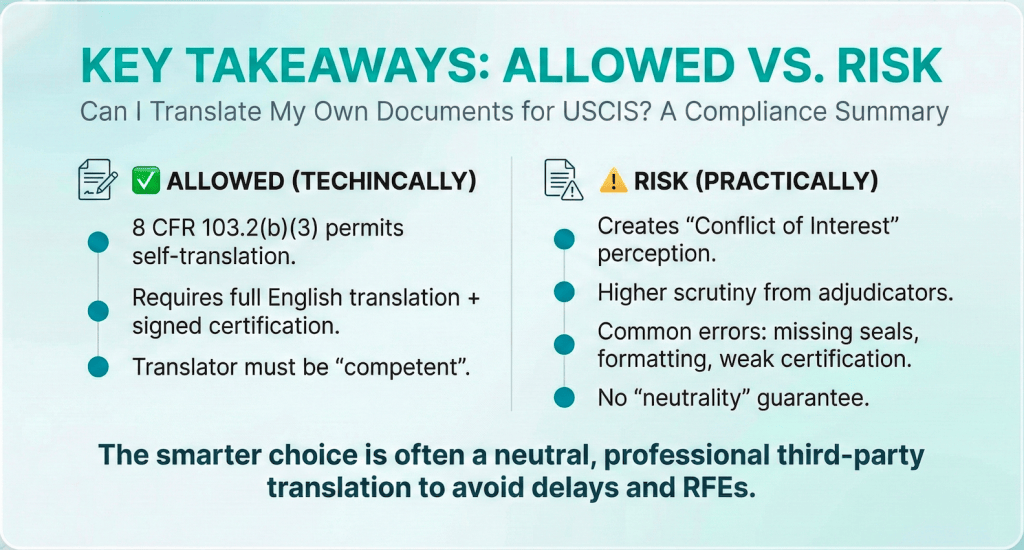
The regulation emphasizes translator competence, but self-translation creates bias risk in high-stakes asylum records. A neutral third-party translation workflow is usually safer. See can I translate my own documents for USCIS.
Do I need to submit original documents with translations?
Not always. USCIS often accepts copies unless original documents are specifically requested. Review do I need original document with certified translation USCIS before filing.
Can one certified translation be reused later in another filing?
Often yes, if the document content has not changed and recipient requirements are met. See reuse certified translation in multiple USCIS cases.
What if I miss the 14-day interview evidence window?
The regulation allows officer discretion in some situations, but you should not plan around discretionary acceptance. Move quickly, prepare a complete packet, and if needed request help via urgent support.
Final CTA
If your interview timeline is tight, handle asylum claim evidence translation early and professionally. Start your certified translation order now.