Disclaimer: This article provides general information about USCIS translation requirements and professional best practices. It does not constitute legal advice. If your case involves complex legal issues, consult a qualified immigration attorney.
About the author: Erin Chen is the Co-Founder and Translation Strategist at CertOf™. With over a decade in bilingual editorial risk control and hands-on experience navigating the U.S. immigration process, Erin helps applicants prepare USCIS-ready certified translations that reduce avoidable delays.
Certified Translation for Passport Application: Fast, Compliant, and Cost-Smart
If you need a certified translation for passport application documents, accuracy alone is not enough. The real issue is using the correct standard for the actual reviewer: USCIS, U.S. passport adjudication, or NVC/consular review. Most avoidable delays come from compliance mismatch, not language quality.
Bottom line: confirm your filing stage first, then format your translation packet to that stage. This one step prevents rework, reduces risk of checklist delays, and usually saves money.
- For foreign-language passport citizenship evidence, the U.S. Department of State asks for a professional English translation and a notarized translator letter.
- For NVC, translation rules depend on English plus the official language of the country from which you are applying.
- Counterintuitive but true: in some consular cases, translating everything into English is unnecessary and can waste time and budget.
- You can order online certified translation services for passport and consular documents in minutes, with policy terms published before checkout.
Who This Guide Is For
This guide is for applicants handling time-sensitive official filings, especially:
- U.S. passport applicants submitting foreign-language civil records.
- NVC-stage immigrant visa applicants preparing CEAC uploads and interview files.
- Families coordinating multiple records across different countries and language pairs.
Common pain points are practical, not theoretical: notarized vs certified, originals vs scans, CEAC one-file packaging, and whether a USCIS translation can be reused for consular review.
2026 Update You Cannot Ignore: Interview Location Now Drives Translation Logic
As of February 25, 2026, the Department of State confirms that immigrant visa interview assignment rules changed effective November 1, 2025. For nonimmigrant scheduling guidance, updated instructions were published effective September 6, 2025. See the central policy page: U.S. Visas – Where to Apply.
Counterintuitive point: this can mean fewer translations, not more. If your document is already in the language accepted for your assigned interview location, NVC may not require an additional English translation. The correct order is: confirm interview location, then decide translation scope, then finalize the packet.
If you are unsure about your specific post-language logic, start with an instant certified translation quote for your exact document set.
USCIS vs Passport vs NVC: Same Document, Different Standard
| Stage | Authority | What usually works best |
|---|---|---|
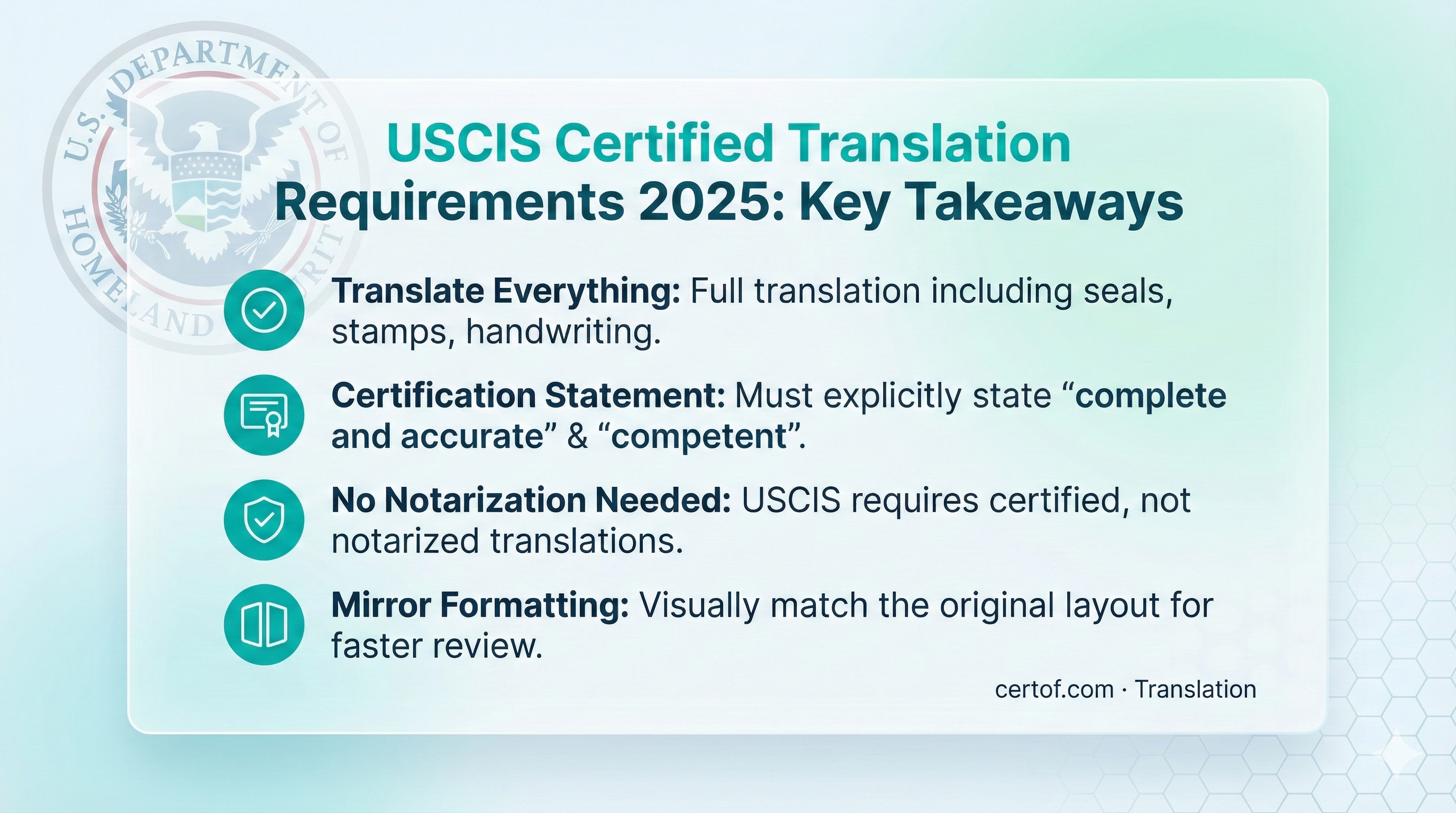
| USCIS filing | 8 CFR 103.2(b)(3) | Full English translation with translator certification of accuracy and competence. |
| U.S. passport citizenship evidence | Passport Citizenship Evidence | Professional English translation and notarized translator letter for foreign-language evidence. |
| NVC civil document rule | NVC Step 7 Civil Documents | Certified translation required when the document is not in English or not in the applicable official language. |
| NVC scan/upload rule | NVC Step 8 Scan Documents | Upload source and translation in one file; include front and back when seals or writing exist. |
For USCIS-specific detail, use this deep guide: USCIS certified translation requirements. For edge cases around notarization, use: difference between certified and notarized translation.
Official Translation of Birth Certificate for Consulate: CEAC One-File Checklist
- Keep each document package in one clear file (native-language document first, translation second).
- Use color scans and include both sides when stamps, seals, or notes appear on the back.
- Follow NVC Step 8 limits, including file type and size limits (for example, 4 MB per file).
- Use a single upload-ready format; this companion guide helps with file decisions: one file.
- Do not mail documents to NVC unless specifically instructed, and do not send originals unless requested.
- interview stages usually require originals for inspection. If you need mailed paper copies fast, review originals handling and hard-copy delivery options.
Translation for Administrative Processing 221(g) and Common Pitfalls
In practice, translation defects often appear under broader document deficiency patterns that lead to administrative processing 221(g) delays. These are the mistakes we see most:
- Using USCIS-only certificate language for passport evidence. Consequence: correction request because passport review may expect notarized translator letter.
- Uploading translation and original as separate files. Consequence: checklist friction and slower NVC review.
- Ignoring dry seals or back-side annotations. Consequence: document treated as incomplete.
- Translating before confirming assigned interview location. Consequence: avoidable cost or retranslation after post transfer.
- Sending partial fixes after a document issue notice. Consequence: longer processing than one complete corrective package.
If you are already in correction mode, follow this operational checklist: USCIS RFE translation services checklist. Official post-interview context: After the Interview guidance.
CertOf vs Traditional Office Workflow
| Factor | CertOf workflow | Typical offline workflow |
|---|---|---|
| Turnaround | Often 5-10 minutes for standard civil documents | Often 24-72 hours |
| Pricing clarity | Transparent online pricing and quote flow, including current low-cost options such as $9.99/page promotional pricing references | Quote-based and office-dependent |
| Formatting | Mirror formatting for faster officer-side verification | Varies by provider |
| Acceptance and revisions | Published policy pages for refund/returns and revision process | Provider-specific and inconsistent |
| Ordering | Upload, pay, download online | Email chains, calls, in-person handoff |
Related policy pages: certified translation refund and return policy and money-back guarantee and revision speed guide.
3-Step Workflow: Upload, Pay, Submit
- Upload passport or consular documents for certified translation online.
- Review page count and complete payment with transparent pricing before final confirmation.
- Download your certified output, then submit according to your stage checklist.
Need same-day correction before interview? Use urgent certified translation support for embassy deadlines.
Trust and Privacy for High-Stakes Documents
For civil records and identity documents, speed should not compromise confidentiality. CertOf publishes data-handling terms in its privacy policy and legal terms in its terms of service. Typical supported use cases include USCIS filings, NVC/consular submissions, universities, banks, and courts.
Service overview: official certified translation services for immigration, legal, and academic documents.
FAQ (People Also Ask)
Do I need notarized translation for a U.S. passport application?
For foreign-language citizenship evidence, the State Department passport page says to include professional English translation and a notarized translator letter. That is why passport and USCIS workflows should not be treated as identical.
Do all consular documents need English translation?
Not always. Under NVC rules, documents may be accepted without English translation if they are already in the applicable official language for your interview location. Confirm your assigned post first.
Do I need original documents with certified translation?
USCIS and NVC often begin with copies/scans unless an original is requested, but interview stages typically require originals for inspection. Practical checklist: do I need original document with certified translation.
Can I reuse my USCIS translation for a consular interview?
Often yes, if the source document has not changed and file packaging matches consular requirements. Reuse checklist: reuse certified translation across multiple USCIS cases.
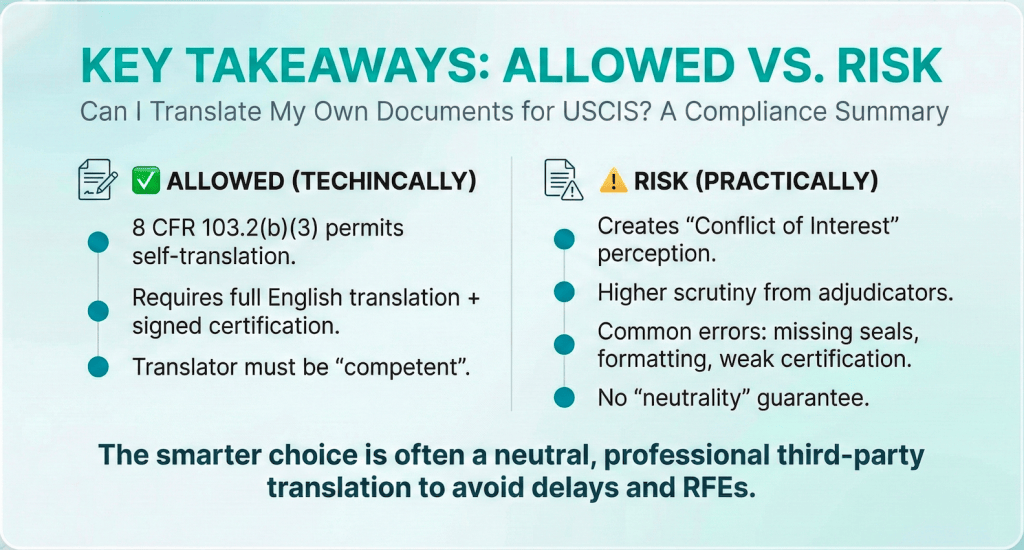
Can I translate my own documents for immigration filing?
Self-translation is high risk in practice. For USCIS-specific discussion, see: can I translate my own documents for USCIS.