Relationship Evidence Translation for U.S. Family Immigration
If you are preparing relationship evidence translation for U.S. family immigration, the hard part is usually not translating one official certificate. It is deciding how to handle messy digital evidence such as chat logs, screenshots, captions, social media posts, call records, and image-based text without making your package look selective, incomplete, or hard to verify. In the United States, the core rule is federal: foreign-language material submitted to USCIS must include a full English translation with a translator certification under 8 CFR 103.2(b)(3). But in real family immigration cases, the practical problems show up in file limits, packaging, NVC upload rules, and interview-day printouts, not in the regulation alone.
Key Takeaways
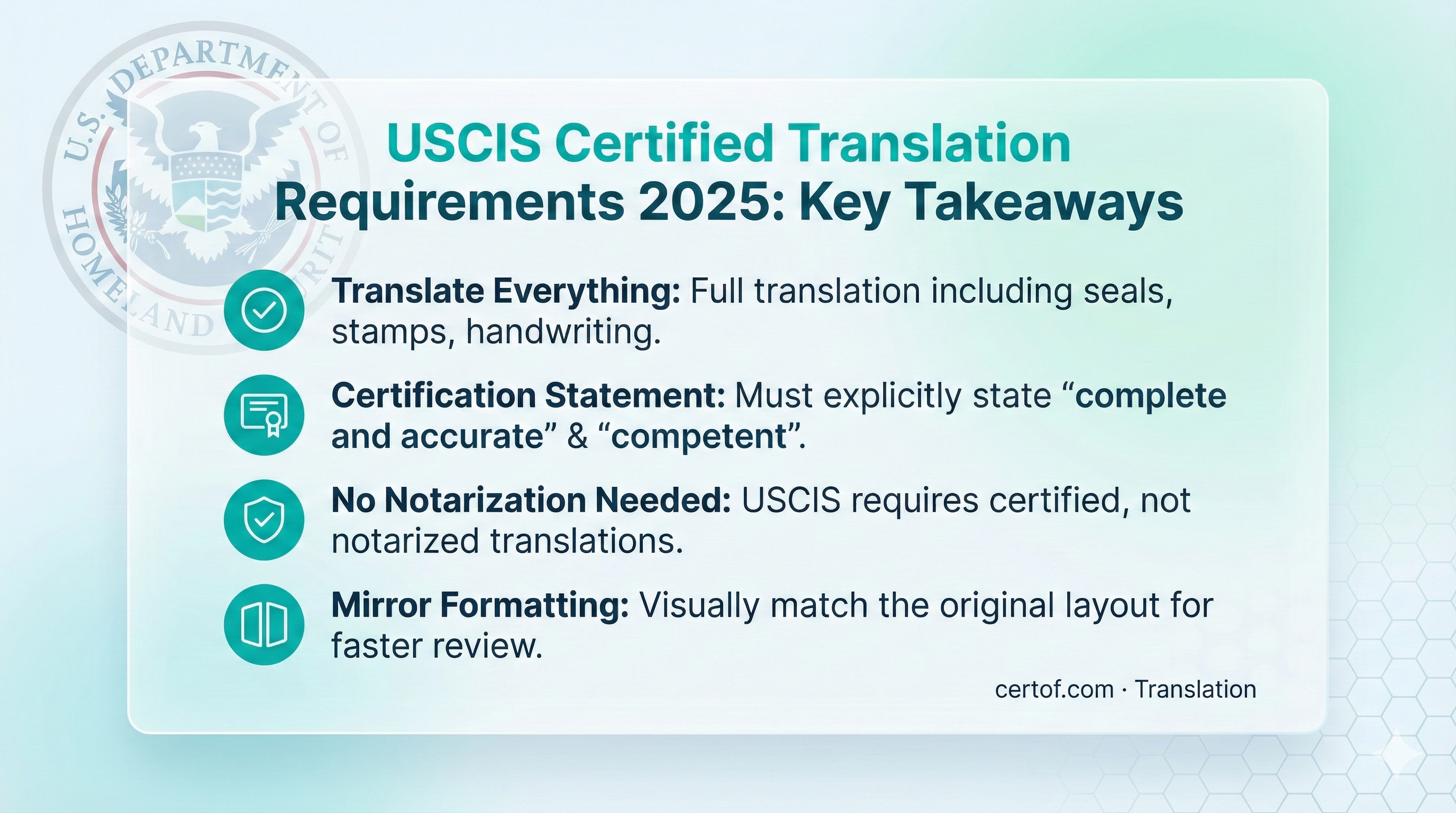
- If you submit foreign-language relationship evidence to USCIS, the portion you submit should be fully translated into English and accompanied by a proper certification. USCIS states this rule on its Form I-130 page and in the regulation.
- The biggest risk with chats and screenshots is often cherry-picking, not terminology. A thin or selective translation can make the timeline look incomplete even if every translated line is accurate.
- For NVC, the original and the English translation should be uploaded together in one file under the NVC civil documents FAQ. That affects how you build screenshot evidence packages.
- USCIS online filing accepts common formats such as PDF, JPG, and JPEG, but the single-file upload limit is 12 MB. Long chat histories often need splitting, reordering, and cleanup before submission.
Who This Guide Is For
This guide is for people handling family-based U.S. immigration cases anywhere in the United States who need to turn non-English relationship evidence into an English-ready package for USCIS, the National Visa Center, or a later consular interview.
- Couples filing or supporting an I-130 marriage case with WhatsApp, WeChat, LINE, KakaoTalk, Telegram, Instagram, Facebook, or other message history.
- Applicants using mixed evidence sets: chats, screenshots, captions, transfer notes, travel confirmations, call logs, and photo annotations.
- Families moving from USCIS filing to NVC upload and then to a consular interview where digital evidence may need to become a paper packet.
- Common language pairs in practice include Spanish-English, Chinese-English, Arabic-English, Portuguese-English, Russian-English, Ukrainian-English, Vietnamese-English, Korean-English, and Japanese-English, although USCIS does not publish a special relationship-evidence language ranking.
- Readers most likely to get stuck are those who have too much evidence, not too little: hundreds of screenshots, multiple apps, image-based text, emojis, nicknames, and unclear rules on what has to be translated in full.
Why This Is Different From Translating a Birth Certificate
A birth certificate or marriage certificate is a fixed document. Relationship evidence is usually a package. It can include partial conversations across months or years, screenshots taken on different phones, social posts with image text, and captions that only make sense when paired with names, timestamps, and context. That is why this article focuses on evidence handling and translation boundaries, not on generic USCIS translation basics.
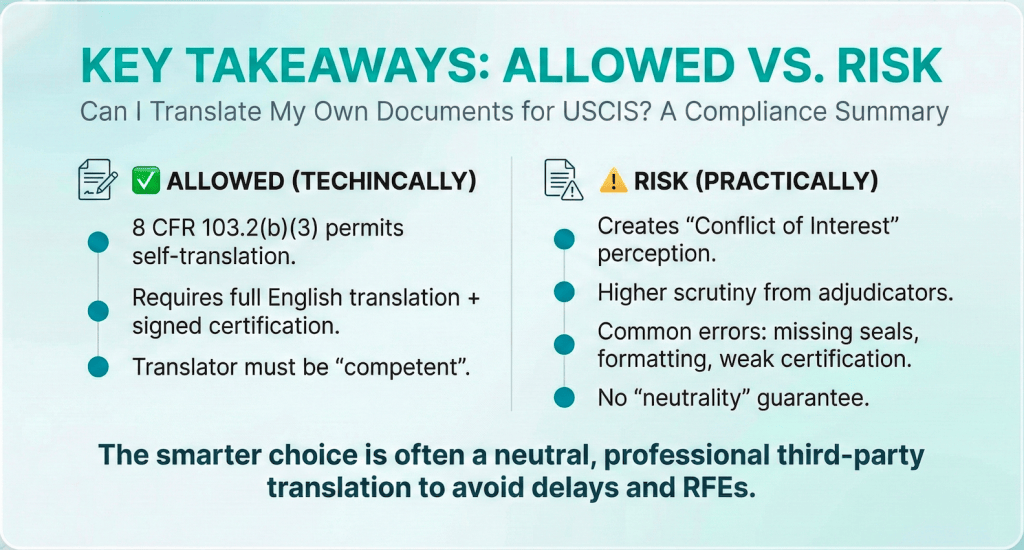
If you need the general rules on who can certify a translation, whether you can translate your own document, or whether notarization is required, keep those sections short and use the existing references on USCIS certified translation requirements, who can certify a translation for USCIS, self-translation for USCIS, and using Google Translate for USCIS.
How the U.S. Process Actually Works for Relationship Evidence
1. USCIS filing stage
At the USCIS stage, relationship evidence is submitted to support the bona fides of the relationship. USCIS makes clear on the I-130 page that evidence can include documentation of an ongoing marital union and other relevant records. If those records contain a foreign language, the federal translation rule applies. USCIS can issue an RFE, schedule an interview, or give little weight to evidence that is incomplete or not credible under its broader evidence standards discussed in the Policy Manual.
2. Online upload reality
USCIS filing is increasingly digital. The practical problem is that relationship evidence is often image-heavy. Under USCIS online filing guidance, accepted formats include PDF, JPG, and JPEG, and each uploaded file is capped at 12 MB. That means long message histories usually need to be divided into logical bundles: for example, one PDF for courtship, one for engagement or wedding planning, one for post-marriage communication, one for travel or financial interaction. If you wait until the end, you can lose hours just compressing screenshots without a clear naming system.
3. NVC upload stage
Once a case moves into consular processing, NVC introduces a different operational rule. The NVC FAQ says the original-language document and the English translation should be uploaded together in one file. For relationship evidence, that makes clean pairing essential. If the original screenshots are in one upload and the translations are in another, you make review harder than it needs to be.
4. Consular interview stage
After NVC, the file may move to a U.S. embassy or consulate. The national rule is still federal, but the real friction becomes operational: security rules, device limits, and post-specific document instructions. Many applicants learn too late that interview-day evidence often works better as a printed packet than as a phone gallery. In practice, relationship evidence that was easy to store digitally can become unusable if it is not organized in printable form.
What Should Be Translated in Full, and Where Selective Translation Becomes Risky
This is the core boundary question.
USCIS does not publish a special exemption for relationship screenshots saying you may file untranslated foreign-language content as long as you summarize it in English. The safer rule is this: if you choose to submit a page, screenshot, or excerpt as evidence, the foreign-language content on that submitted portion should be fully translated into English.
That still leaves a practical decision: do you submit the entire multi-year chat history, or do you submit selected representative portions? In most real cases, applicants do not submit every message they ever exchanged. The real compliance line is not “translate everything you ever wrote to each other.” It is “do not submit foreign-language evidence in a way that hides untranslated context or makes the selection look manipulated.”
- Low-risk approach: choose representative date ranges or event-based excerpts, then fully translate the submitted portions and keep the chronology obvious.
- Higher-risk approach: submit isolated romantic lines with no surrounding dates, no sender names, no visible context, and no explanation of why these excerpts were selected.
- High-risk mistake: translate only favorable phrases inside a screenshot while leaving surrounding foreign-language text untranslated.
- Another common mistake: translate the chat text but not captions, nicknames, image text, timestamps, or labels that show who is talking and when.
The counterintuitive point is that in relationship-evidence cases, the biggest problem is often not literal accuracy. It is whether the English package lets the officer follow the relationship timeline without suspecting selective editing.
Practical Rules to Translate Chat Logs, Screenshots, and Social Media for USCIS
- Translate the text the officer needs to evaluate the evidence. That usually includes message content, visible usernames or relationship labels, captions, comments, image-based text, and any note that changes meaning.
- Keep the original visible. Do not replace the screenshot with English only. Pair the original and the translation so the reviewer can cross-check them.
- Preserve chronology. Dates, times, and platform indicators matter because relationship evidence is about continuity.
- Handle emojis and stickers by meaning, not decoration. If an emoji changes the tone or context, note it briefly rather than ignoring it.
- Identify speakers consistently. If the app uses nicknames, explain once and keep the labels stable across the package.
- Do not over-redact. Privacy redactions may be reasonable, but if you remove too much context, the evidence may lose value.
For mixed-format evidence, it often helps to build each bundle in this order: cover page, short explanation of date range or event, original screenshots, corresponding English translations, then a translator certification. That is more review-friendly than dumping hundreds of images into a folder.
Wait Time, Cost, Mailing, and Scheduling Reality
The translation rule itself is nationwide and stable. The operational pain points are different.
- Wait time: delays often come from preparing the evidence package, not from the translation certificate. Rebuilding an oversized or badly organized upload can cost more time than the translation itself.
- Cost: there is no USCIS translation fee. Private pricing varies widely, and long screenshot sets become expensive mainly because of volume, formatting, and revision work, not because relationship evidence has a special government tariff.
- Mailing: if you file by paper or prepare a backup packet for counsel or interview use, chat-heavy evidence can become bulky fast. That creates scanning, printing, and shipping friction.
- Scheduling: NVC and consular stages reward early preparation. If you wait until interview scheduling to turn phone screenshots into a clean English packet, you compress translation, printing, and review into the riskiest part of the case.
Common Failure Points in U.S. Family Immigration Cases
- Uploading screenshots with no translation because they are “only chats.”
- Translating just a few romantic lines while leaving surrounding text untranslated.
- Using screenshots that do not clearly show dates, names, or who is speaking.
- Breaking original and translation into separate files at NVC even though the portal expects one combined file.
- Ignoring USCIS file-size limits until the night before filing.
- Assuming a phone will be enough at an interview.
- Using a translator who can produce plain text but not a reviewable evidence packet.
What Applicants Commonly Struggle With
Across USCIS forums, visa communities, and attorney case writeups, the same issues repeat: long chat histories become too expensive to translate in full; applicants are tempted to excerpt only favorable messages; captions and image text get skipped; and NVC packaging rules are discovered late. Those signals are useful because they explain why this topic deserves its own article. The federal rule is simple. The evidence workflow is not.
Provider Comparison: Commercial Translation Services
| Provider | Publicly Verifiable Signal | Fit for Relationship Evidence | Notes |
|---|---|---|---|
| CertOf | Online ordering and USCIS-focused resource library on CertOf, plus digital delivery and document-upload workflow at translation.certof.com | Best when you already know which chats, screenshots, and captions you want translated and need a clean English-ready package | Translation and formatting support, not legal strategy or case representation |
| Day Translations | Public contact details and New York office listed at 477 Madison Avenue, 6th Floor, New York, NY 10022; phone 1-800-969-6853; certified translation service publicly listed | Broad language coverage and standard certified translation workflow | Useful benchmark provider; applicants should still confirm handling of screenshot-heavy evidence before ordering |
| Tomedes | U.S. contact details listed at 9450 SW Gemini Dr #34540, Beaverton, OR 97008-7105; phone +1 985 239 0142; certified translation page publicly available | Works for applicants who need online intake and mixed-format document handling | As with any provider, ask specifically about original-and-translation pairing for USCIS and NVC packets |
What matters most in this niche is not a generic claim of “certified translation.” It is whether the provider can handle screenshot sequencing, cross-reference the original with the English version, and revise the package after you or your attorney narrow the evidence set.
Public and Nonprofit Resources
| Resource | What It Helps With | Public Signal | Best Use |
|---|---|---|---|
| USCIS Multilingual Resource Center | Multilingual agency information and scam warnings | Official USCIS resource center | Use it for language-access guidance and fraud awareness, not for translation services |
| LawHelp.org | Find nonprofit legal aid by state | National legal-help directory | Use it when you need low-cost or free legal guidance on what evidence to submit |
| Immigrant Legal Resource Center | Community education materials and service directories | General inquiries phone: 415-255-9499 | Use it for education and referrals; ILRC does not provide direct individual legal representation |
| Catholic Migration Services | Low-cost or free immigration legal help for eligible clients | Brooklyn office: 191 Joralemon Street, 4th Floor, Brooklyn, NY 11201; phone (718) 236-3000 | Example of a nonprofit legal-aid model; useful when the real question is evidence strategy, not translation mechanics |
Fraud, Notarios, and Complaint Paths
Because relationship evidence is emotional and highly personal, it is a common entry point for bad actors. Be cautious if someone promises approval, offers to “fix” your evidence by changing the substance of messages, or claims your case needs notarization when it does not. USCIS has an official immigration scam reporting page. If the misconduct involves immigration court or fraud tied to legal representation, the Department of Justice also runs the EOIR fraud and abuse program. For deceptive business conduct, the FTC complaint system is another practical path.
Related CertOf Guides Worth Using as References
- K-1 fiance visa packet translation checklist
- Marriage certificate translation for USCIS
- USCIS RFE translation services
- How to upload and order certified translation online
- Electronic certified translation: PDF vs Word vs paper
- Certified translation, revisions, and delivery expectations
FAQ
Do all chat messages need a full English translation for USCIS?
You do not usually submit every message you ever exchanged. But for the screenshots, pages, or excerpts you do submit, the foreign-language content should be fully translated into English so the evidence is reviewable and not misleading. Whether you are submitting WhatsApp, WeChat, or iMessage logs, the submitted excerpts require a full English translation.
Can I submit selected excerpts instead of an entire chat history?
Usually yes, but that is where risk increases. If you submit selected excerpts, make them representative, chronological, and fully translated. Thin or overly curated excerpts can make the package look incomplete.
Do captions, emojis, and image text need to be translated?
If they affect meaning, context, or speaker identity, yes. In relationship evidence, small elements can matter because they help show continuity, tone, and timeline.
Should the original and translation be in one PDF?
For NVC, yes, that is the safer default because the portal guidance expects the original and English translation together in one file. For USCIS, a combined packet is also often easier to review.
Do I need printed copies for a consular interview?
Often you should prepare them. Interview logistics vary by post, but relying only on a phone is a bad plan for relationship evidence.
CTA
If you have already chosen the relationship evidence you want to submit, CertOf can help turn non-English chats, screenshots, captions, and mixed-format files into a clean English-ready package with certified translation, digital delivery, and revision support. Start with the online upload form. If you first need to understand format choices, see hard-copy delivery options and turnaround benchmarks by document type.
Disclaimer
This guide is for translation and document-preparation information only and is not legal advice. It does not tell you which evidence you should choose for your immigration case. If you are unsure whether your selected excerpts are enough to prove a bona fide relationship, speak with a qualified immigration lawyer or legal-aid organization before you order translation.