Trinidad and Tobago Civil Documents for a U.S. Family Visa: Polymer Records, Certificate of Character, and Translation vs. Authentication
If you are preparing Trinidad and Tobago civil documents for a U.S. family visa, the main problem is usually not certified translation. In most cases, your records are already in English. The real risk is submitting the wrong version of a birth or marriage certificate, missing the separate overseas process for a Certificate of Character, or spending time on apostille when the case actually needs the correct original record first.
This guide focuses on that boundary: document compliance first, translation second. It is written for marriage-based and other family-based U.S. immigrant visa cases moving through USCIS, NVC, and the immigrant visa interview in Port of Spain.
Disclaimer: This is a practical document guide, not legal advice. U.S. immigration rules and Trinidad and Tobago issuing procedures can change. For the controlling U.S. civil-document rules, check the U.S. Department of State reciprocity page for Trinidad and Tobago and the U.S. Embassy Port of Spain immigrant visa instructions.
Key Takeaways
- For Trinidad and Tobago-issued birth, marriage, adoption, and death records, the biggest issue is usually getting the new polymer version, not getting a translation. The U.S. Embassy Port of Spain says older versions will not be accepted.
- A Trinidad and Tobago Certificate of Character is a police record problem, not a translation problem. If you live abroad, the process is different and still depends on fingerprints, mailing, and TT$50 equivalent payment through TTPS.
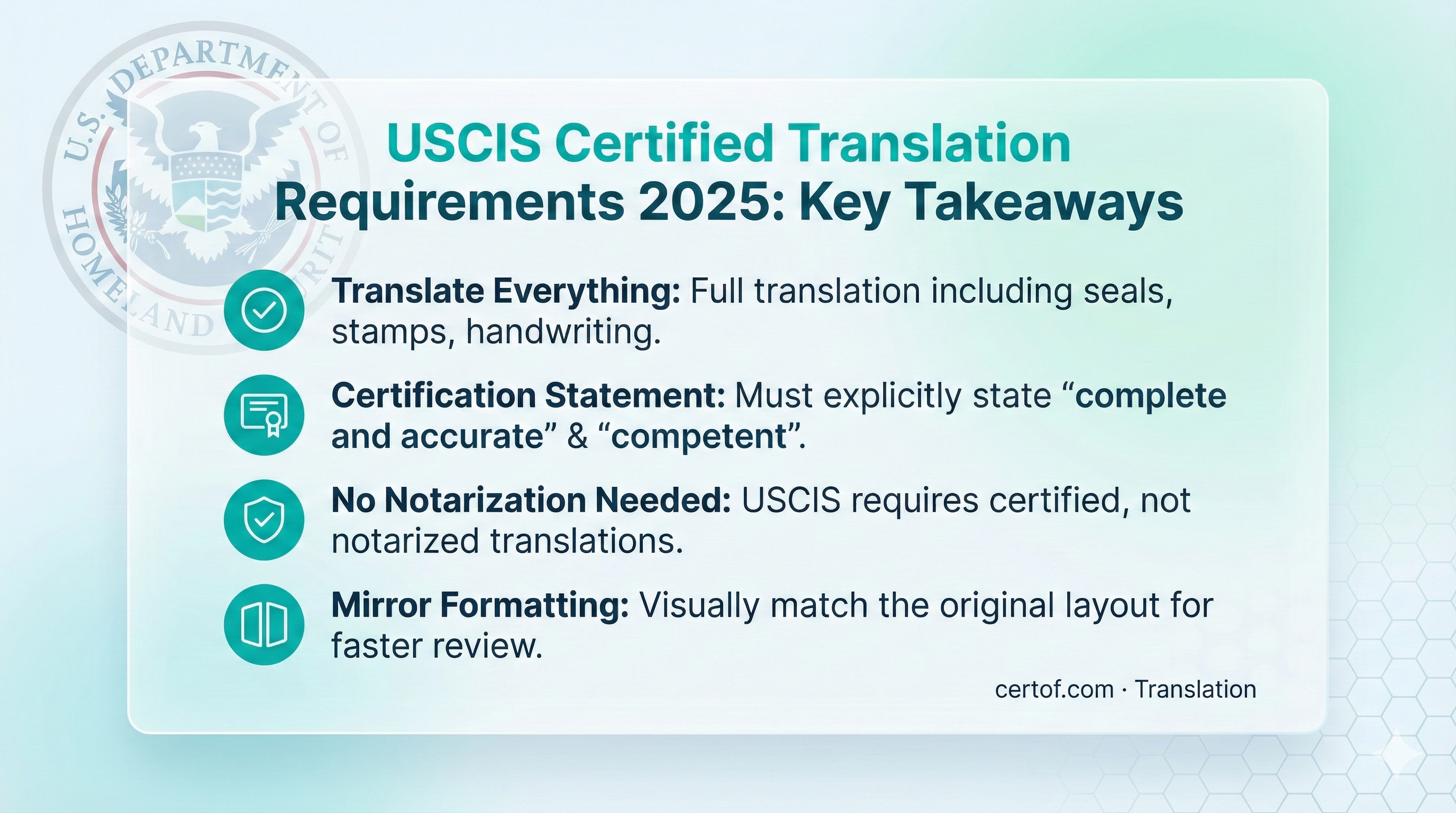
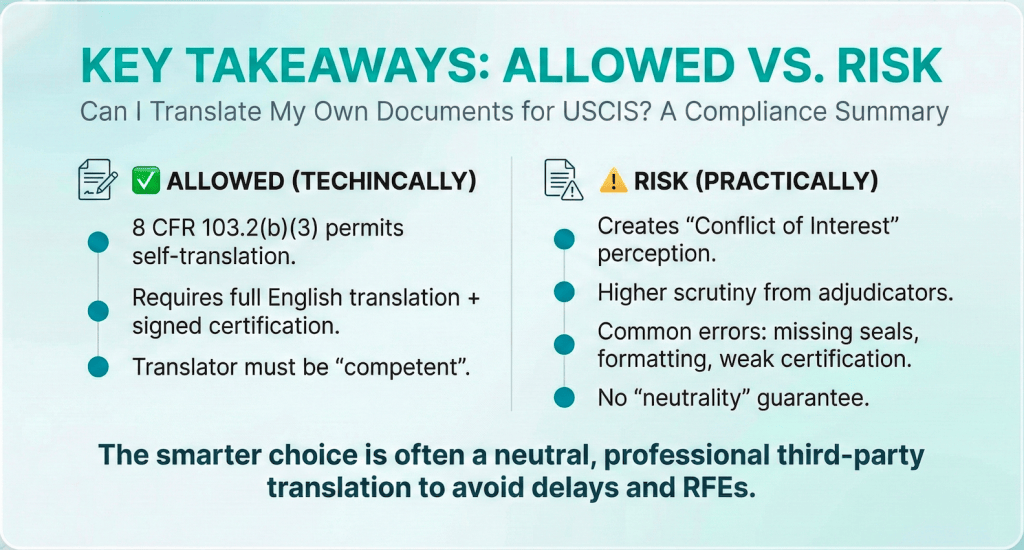
- If your Trinidad and Tobago document is already in English, you normally do not need a certified translation for USCIS, NVC, or the Port of Spain immigrant visa interview. The embassy states that only documents not in English must be accompanied by a certified English translation.
- Trinidad and Tobago can issue apostilles, but for a normal U.S. family visa case, apostille is usually not the issue that decides acceptability. Start with the right original document, in the right format, from the right issuing authority.
Who This Guide Is For
This guide is for people handling family-based U.S. immigration cases connected to Trinidad and Tobago at the country level: spouses, children, stepchildren, and applicants with prior marriages, adoption records, or police certificate requirements. The most common file set is an English-language polymer birth certificate or marriage certificate, a Certificate of Character, a passport biographic page, and sometimes a divorce decree or adoption record. The most common real-world problem is not language. It is having an older non-polymer civil record, living abroad and needing a police certificate from Trinidad and Tobago, or confusing certified translation with authentication or apostille.
Trinidad and Tobago Civil Documents for a U.S. Family Visa: Compliance First, Translation Second
Here is the counterintuitive part: for many countries, readers come to CertOf asking about translation because their civil records are in another language. Trinidad and Tobago is different. The official civil records used in U.S. family visa cases are generally issued in English, so translation is often a secondary or edge-case issue.
The first compliance test is whether your birth, marriage, adoption, or death certificate is the correct polymer, computer-generated version. The State Department reciprocity schedule says the latest versions are polymer records with enhanced security features, and repeats that the U.S. Embassy Port of Spain requires the new polymer civil documents and will no longer accept previous versions. The embassy supplement repeats the same point and warns applicants to update those records before interview to avoid delay. By 2019, the embassy was already publicly warning applicants to bring the polymer versions rather than older records, which is why many applicants now treat 2019 as the practical enforcement line. See the reciprocity page and the Port of Spain supplement.
That means a fully English document can still fail if it is the wrong version. For Trinidad and Tobago cases, that is often the single most important local fact.
Which Documents Usually Matter in a Family Visa Case
For a typical marriage-based or family-based case, the Trinidad and Tobago side of the packet often includes:
- Polymer birth certificate from the Registrar General’s Department.
- Polymer marriage certificate if the case is based on marriage.
- Certificate of Character from the Trinidad and Tobago Police Service for applicants age 16 and over where required by the reciprocity rules.
- Decree Absolute for a prior divorce. The reciprocity schedule lists the Family Court of Trinidad and Tobago as the issuing authority for the computerized decree.
- Adoption record if the relationship depends on adoption.
If you need background on translating specific document types for U.S. filings, keep those explanations short and use the detailed guides already on CertOf: birth certificate translation, marriage certificate translation, police certificate translation, and USCIS certified translation requirements.
Step 1: Fix the Polymer Record Problem Before You Worry About Translation
The Registrar General’s Department is the key issuing authority for birth, marriage, death, and adoption records. The reciprocity schedule lists the current birth and marriage certificates as polymer records with enhanced security features and notes same-day service through the Registrar General’s Department for straightforward requests. It also lists the main office at Government Plaza in Port of Spain and other offices in Arima, Point Fortin, San Fernando, and Tobago. See the State Department schedule.
The current Registrar General civil registry page also says urgent in-person requests can use same-day service and that appointments are generally not required for standard civil-registry matters handled on a first-come, first-served basis. It also confirms online ordering and courier delivery for birth, death, and marriage certificates inside Trinidad and Tobago. See the Registrar General Civil Registry page.
Practical advice: if your document is old, computerized but not polymer, or issued years ago, do not assume it is still acceptable just because it is readable and in English. Replace it before you upload to NVC or travel for interview.
Step 2: Handle the Certificate of Character as a Separate Logistics Track
The Certificate of Character has its own rules, and this is where Trinidad and Tobago cases become operationally different from many other countries. TTPS states that all Certificate of Character applications are made online through its website, not at police stations, for local applicants. Applicants choose an appointment and police station for fingerprints and pay TT$50 at the appointment. See the TTPS Certificate of Character page.
For people living abroad, TTPS gives a different route. Foreign residents must have fingerprints recorded at a police station in their country of residence, or otherwise have the fingerprint slip certified by a notary public. They must send a passport copy, a money order equivalent to TT$50, return postage, and the package by registered mail to the CID/CRO office in Port of Spain. TTPS says the completed certificate will be returned by registered mail after receipt. That overseas path is why this document causes so much practical delay.
This is also where community experience matters. Recent reports from VisaJourney and local Facebook and Reddit discussions consistently describe overseas processing and mailing as much slower and less predictable than the bare TTPS process description suggests. Treat those reports as a warning signal, not as the official rule. In practice, if you are abroad, start early and keep scans, receipts, and mailing proof.
Step 3: Check Divorce and Adoption Documents by Issuing Authority
If there was a prior marriage, the reciprocity page says the divorce document is the Decree Absolute issued by the Family Court of Trinidad and Tobago. The schedule describes the newer office copy as computerized and bearing the seal and official court stamp. For some Muslim divorces, registration with the Registrar General may also matter under the local system. Use the issuing authority that matches the reciprocity schedule rather than relying on informal copies or lawyer-prepared summaries.
If the family relationship depends on adoption, treat the adoption certificate the same way as the other core civil records: confirm that you have the current official record from the Registrar General, not an outdated version.
When Certified Translation Actually Matters
For Trinidad and Tobago-issued records, certified translation is usually a bridge term rather than the core local requirement. The Port of Spain immigrant visa instructions say that documents not in English must be accompanied by a certified English translation. The important implication is the reverse one: if the Trinidad and Tobago document is already in English, translation is normally unnecessary. See the embassy instructions.
Translation becomes necessary if your case file includes:
- A child’s birth certificate from a Spanish-speaking country.
- A marriage or divorce record from another non-English jurisdiction.
- Handwritten notes, stamps, or supporting records in a non-English language.
- Third-country police, court, school, or medical records that form part of the family case.
For the general U.S. standard on what a compliant certification should look like, use CertOf’s detailed guides rather than repeating that content here: who can certify a translation for USCIS, do you need an ATA-certified translator for USCIS, and originals vs. copies with certified translations.
Translation vs. Authentication vs. Apostille
This is the other major confusion point in Trinidad and Tobago cases. The Ministry of Foreign and CARICOM Affairs does offer document authentication and explains the apostille framework on its official site. It asks applicants to email documents to [email protected], then submit originals to the ministry after verification, and says the authentication process takes three working days. See the MFCA authentication page.
But that does not mean apostille is automatically required for a U.S. family visa case. For normal U.S. immigrant visa processing, the controlling U.S. materials focus on whether the document is the correct official civil record from the correct authority. In other words, apostille is available in Trinidad and Tobago, but it is usually not the first question you need to solve for a family visa packet. The first questions are: Is this the right issuing authority? Is it the current polymer version where required? Is it in English? If not, does the non-English part need a certified translation?
That boundary matters because many applicants lose time and money by adding notarization or apostille to a file that would still fail if the underlying record is the wrong non-polymer version.
Costs, Wait Times, and Mailing Reality
- Government Fees: State Department reciprocity entries list TT$25 for birth, marriage, death, and adoption certificates, and TT$20 to TT$25 for divorce decrees depending on the record type and issuing office.
- Police Certificate Cost: TTPS lists TT$50 for a Certificate of Character.
- Local Processing Speed: The Registrar General says same-day in-person service is available for straightforward urgent requests. That is useful if you are in Trinidad and Tobago and your record does not need correction.
- Online Delivery Reality: RGD online ordering exists, but delivery timing outside Trinidad and Tobago varies by destination. Do not build your case timeline around assumed international courier speed.
- Overseas Delay Warning: For overseas Certificate of Character requests, the official TTPS page gives the mailing steps, but recent applicant reports suggest the full end-to-end timeline can be much longer than the narrow official processing statement because fingerprints, money order preparation, and registered international mail add delay.
Local Pitfalls That Cause Real Delays
- Using an old birth or marriage certificate: this is the classic Trinidad and Tobago failure point. English alone is not enough.
- Waiting too long to start the overseas Certificate of Character process: if you live abroad, treat this as a slow logistics task, not a quick online request.
- Assuming apostille fixes everything: apostille does not cure the wrong underlying record.
- Paying for translation you do not need: if the Trinidad and Tobago civil document is already in English, translation is usually not the problem.
- Sending the only original police certificate without backup records: given community reports of mail and document-handling problems, keep scans and tracking proof and consider your timing carefully.
Official Nodes and Complaint Path
| Node | What it handles | Why it matters |
|---|---|---|
| Registrar General’s Department | Birth, marriage, death, adoption records; online and in-person certificate requests | Your main source for the polymer civil records the U.S. Embassy requires |
| Trinidad and Tobago Police Service | Certificate of Character applications, fingerprint appointments, overseas submission route | The police certificate is a separate compliance track and often the slowest one |
| Ministry of Foreign and CARICOM Affairs | Authentication and apostille services | Useful only when the receiving country or use case actually requires authentication |
| Office of the Ombudsman | Escalation for unresolved complaints against public bodies | Use after first writing to the agency and waiting about 4 to 8 weeks for a response |
The Ombudsman specifically says an official complaint should first be lodged with the government agency involved, and that the department should be given about 4 to 8 weeks to respond before the complaint is brought to the Ombudsman. See the Ombudsman complaint page.
Provider Comparison: Paid Help vs. Official Resources
The provider picture in Trinidad and Tobago is unusual because this use case is dominated by official issuers, not by commercial translation firms. That is consistent with the main conclusion of this guide: for most Trinidad and Tobago family visa files, you need the right official English document more than you need a local translator.
Paid Help
| Provider type | When it helps | When it does not |
|---|---|---|
| CertOf | Non-English third-country records, handwritten non-English notes, supporting documents that need a certified English translation for USCIS or NVC. Order online at CertOf Translation or review how online ordering works. | Getting a polymer Trinidad and Tobago certificate, obtaining a Certificate of Character, or securing apostille from local authorities. |
| Local notary public or attorney | Edge cases such as fingerprint certification support in the country where you now live, or special local document execution needs. | Replacing the official RGD or TTPS route, or solving a missing polymer record problem. |
Official and Public Resources
| Resource | Use it for | Public signal |
|---|---|---|
| RGD Civil Registry | Replacing old birth, marriage, adoption, or death records with current official versions | Official issuer named by the U.S. reciprocity schedule |
| TTPS Certificate of Character system | Local online appointments and overseas police certificate requests | Official police-service channel |
| MFCA Consular Affairs | Authentication or apostille only when the receiving authority actually asks for it | Official foreign affairs authentication channel |
| Office of the Ombudsman | Escalating unresolved delay or administrative unfairness after internal complaint | Independent public complaint body |
If your case does need translation after all, CertOf also has practical guides on electronic vs. paper delivery, hard-copy mailing options, and typical turnaround by document type.
Why the Local Data Matters
Three local data points drive real-case difficulty here. First, the U.S. side now draws a hard line between current polymer civil records and earlier versions, and applicants have been seeing that line enforced in practice since at least 2019 through embassy-facing guidance and interview preparation rules. That makes Trinidad and Tobago more format-sensitive than many other family-visa source countries. Second, the police certificate still depends on fingerprints, payment, and registered mailing for foreign residents, which creates more failure points than a simple electronic clearance system. Third, the issuing ecosystem is centralized and English-language, which reduces translation demand but increases dependence on the right government channel.
FAQ
Do Trinidad and Tobago documents for a U.S. family visa need translation or just the polymer version?
Usually just the correct polymer version. If the Trinidad and Tobago record is already in English, translation is normally unnecessary. The real issue is whether the document is the correct current official version.
Will the U.S. Embassy in Port of Spain accept an old computerized birth certificate?
No. The embassy supplement says it requires the new polymer, computer-generated civil documents and that previous versions will not be accepted.
How do I get a Trinidad and Tobago Certificate of Character if I live abroad?
TTPS says foreign residents must obtain fingerprints in their country of residence, provide a passport copy, send a TT$50 equivalent money order plus return postage, and mail the package by registered mail to CID/CRO in Port of Spain.
How long is a Trinidad and Tobago Certificate of Character valid for NVC and the embassy?
For many U.S. immigration cases, police certificates are treated as current for two years if you have not returned to live in the country that issued them. Even so, the practical problem in Trinidad and Tobago cases is often delay and document handling, not just nominal validity. Because overseas Certificate of Character requests can take time and community reports often mention mailing and document-receipt problems, keep high-quality scans, mailing receipts, and tracking records before you send your only original document.
Do I need an apostille for a Trinidad and Tobago marriage certificate for U.S. immigration?
Usually no, not for an ordinary U.S. family visa submission. Apostille is available through MFCA, but the primary U.S. concern is usually the correct official record, not apostille.
What if my case includes non-English records from another country?
That is when certified translation matters. If your file includes non-English birth, marriage, divorce, police, or supporting records from a third country, add a compliant English translation. You can start with CertOf’s order portal.
CTA
For most Trinidad and Tobago family visa files, your first move should be to confirm that every core civil record is the correct current official document, especially the polymer birth or marriage certificate and the properly issued Certificate of Character. If your file also includes non-English records from another country, CertOf can help with fast, compliant certified English translations, formatting support, and delivery options. Start here: upload your documents.