Buenos Aires University Admission Foreign Diploma Translation: Public Translation (Traducción Pública), UBA, CBC, and Recognition Steps
Buenos Aires university admission foreign diploma translation is not just a translation problem. In practice, foreign applicants usually get stuck on four things first: whether their secondary diploma can be used in Argentina, whether their documents must be translated by a local traductor público, whether UBA wants an extra legalization step through TAD-UBA, and whether a non-Spanish-speaking applicant also needs a Spanish C1 certificate. If you are aiming at UBA or CBC, that reality matters more than generic advice about “certified translation.” In Buenos Aires, the practical local term is usually traducción pública, not a broad foreign idea of certification.
This guide focuses on the undergraduate path: using a foreign secondary diploma and transcript to start university study in Buenos Aires. It does not try to cover every postgraduate or professional recognition route. Those are related, but they are different problems.
Key Takeaways
- If your secondary diploma was issued abroad, the core rule is national, not city-level: you usually need convalidación or reconocimiento before the document can work for higher education in Argentina.
- For UBA-facing filings, a generic foreign “certified translation” is often not enough. Non-Spanish documents usually need a local traducción pública by a CTPCBA-registered translator, then Colegio legalization.
- The counterintuitive part is that UBA has no general undergraduate entrance exam, but foreign applicants still face a heavy document gate through CBC, Ministry recognition, language proof, and TAD-UBA legalization.
- If your secondary certificate was issued in a non-Spanish-speaking country, UBA says you must present Spanish proof at C1 level, typically SIELE Global C1 or the advanced Spanish certificate from UBA’s Faculty of Philosophy and Letters.
Who This Guide Is For
This guide is for foreign-educated applicants in Buenos Aires who want to start undergraduate university admission, especially through UBA and CBC, and need to make their school documents usable in Argentina first.
- You finished high school outside Argentina and now have a diploma, transcript, and identity documents that are not in Spanish.
- You are trying to enter UBA or another Buenos Aires university and need to understand where recognition, translation, apostille, and legalization fit.
- You do not yet have an Argentine DNI, or you are worried that no-DNI status will block your filing path.
- You are dealing with common language pairs such as English-Spanish, Portuguese-Spanish, Italian-Spanish, French-Spanish, or Chinese-Spanish, and your typical file bundle is a diploma, transcript, passport, apostille or consular legalization, and sometimes a Spanish-language certificate.
- You are in the most common failure scenario: the school is ready to talk about admission, but your foreign school documents are still not acceptable for filing in Buenos Aires.
Why Buenos Aires Feels Different From Generic Admission Guides
The core recognition rules are country-wide, but Buenos Aires has its own practical bottlenecks. UBA is the city’s biggest gravity point for international students, and its undergraduate route runs through CBC. The official foreign-student guidance from UBA and the CBC registration pages for foreigners without Argentine DNI make that clear.
The city-specific difference is not a special municipal admissions law. It is the workflow: Ministry recognition of your foreign secondary studies, CBC enrollment rules for foreigners, UBA’s own legalization platform at TAD-UBA, and the local role of the Colegio de Traductores Públicos de la Ciudad de Buenos Aires for legally usable translations.
That is why the most natural local search intent is not simply “certified translation Buenos Aires.” It is closer to “traductor público UBA,” “CBC extranjero sin DNI,” or “convalidación título secundario extranjero Buenos Aires.”
What Actually Has To Happen Before You Can Submit
- Work out whether your foreign secondary studies must go through convalidación or reconocimiento. Argentina’s Education Ministry splits these routes based on the country that issued your diploma. The official route for countries with education agreements is explained in the convalidación procedure for countries with agreements. If your country is outside those agreement routes, the path is different and usually heavier on document chain and review.
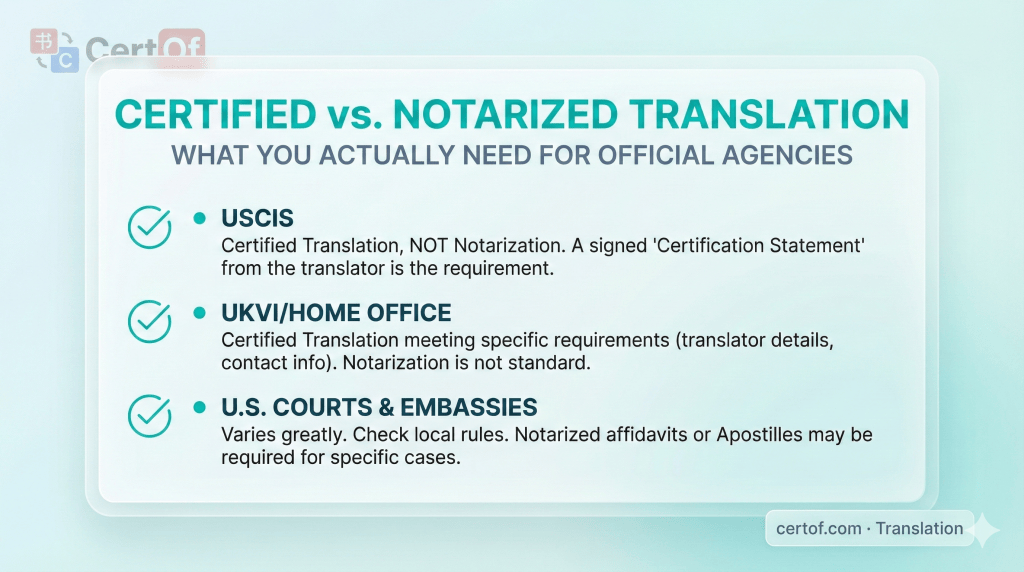
- Get the original document chain in order before translation. That usually means apostille or consular legalization on the source document first, then translation into Spanish for Argentine use. This article keeps that general legalization theory short on purpose; for the generic distinction, see our guide on certified vs notarized translation.
- Use the right kind of translation. In this context, the practical local standard is traducción pública, not a broad English-language idea of “certified translation.” CTPCBA explains that a public translation is signed and sealed by a registered public translator and then legalized by the Colegio under Law 20.305 in its overview of the public translator role.
- Prepare for CBC or UBA filing rules. CBC’s foreign-applicant page for people without Argentine DNI says the applicant must use the ID used for the school recognition process, present the recognized secondary title, and, for non-Spanish-speaking countries, present a Spanish certificate at C1 or above. The current CBC registration page for foreigners without Argentine DNI sets out that route.
- If UBA asks for legalization, use TAD-UBA. UBA’s legalization platform states that foreign documents in other languages must be translated by a public translator and that foreigners without DNI or tax credentials must use a representative route, subject to formal limits and declarations. UBA publishes the process and the no-DNI instructions at its legalizaciones site.
- Keep your filing chain consistent. Names, passport numbers, apostille pages, transcript legends, and page order matter. For academic records generally, keep formatting and legend pages intact. We cover those formatting issues in our academic transcript translation guide.
Where Certified Translation Fits in Buenos Aires
In Buenos Aires, “certified translation” works as a bridge term for international readers, but it is not the term that governs the filing path. The operative terms are traducción pública, traductor público matriculado, and legalización del Colegio. If you are navigating Argentine portals, the words you are more likely to see are convalidación, reconocimiento, and traducción pública.
That matters because many foreign applicants arrive with a perfectly good translation from home and still get blocked. For UBA-facing document use, the safer assumption is this: if the filing authority expects a Spanish version for official use, you should expect a locally valid public translation, not just a foreign translator’s certificate. Self-translation, family certification, and machine translation are not realistic substitutes for that official chain. For broader background only, see our general page on foreign diploma certified translation.
This is also where CertOf’s role needs a clear boundary. CertOf can help you organize the file set, prepare accurate translated text, support revisions, and create parallel digital document packages. But if the receiving body requires an Argentine traductor público plus Colegio legalization, the final legal stamp still has to come from the local filing chain, not from CertOf.
Buenos Aires Logistics: What Delays People in Real Life
1. CBC and no-DNI reality
CBC does allow a foreign applicant without Argentine DNI to start the process, but it is not a relaxed route. The foreign applicant page requires the identity document used in the recognition process, the recognized secondary diploma, printed payment proof, and in non-Spanish-speaking cases the C1-level Spanish certificate. This is why many applicants discover too late that the admissions form is not the main obstacle.
2. TAD-UBA is digital first, but not friction free
UBA’s legalization route is heavily digital. The platform says you can upload up to six PDF or JPG files per signature type, with size limits and order requirements. If you are a foreigner without DNI or fiscal credentials, UBA says the filing has to start through a representative and limits one representative to no more than three foreigners. That is a very local failure point: people think “digital” means simple, then get stuck on identity and representation rules.
Important local tip: do not confuse UBA’s own platform with the broader national TAD (Trámites a Distancia) system. Both are digital, but they do not solve the same problem, and both can become harder when you do not have Argentine identity or tax credentials.
3. CTPCBA is not just a directory
CTPCBA is where the local public-translation ecosystem becomes real. Its public information shows city locations, including the Corrientes legalization office, and it publishes business hours for legalizations. The same site also maintains the CTPCBA directory for checking whether a translator is actually registered. In other words, this is not a vague “translator association” reference. It is the institution that helps determine whether the translation can actually circulate in a Buenos Aires filing workflow.
4. Cost and timing are real, but variable
CTPCBA publishes legalization values and hours, which is useful because it gives you an official price anchor before you pay any private intermediary. What it does not give you is a guaranteed total timeline for your whole admission packet. Ministry recognition, translator turnaround, Colegio legalization, and TAD-UBA review all move on different clocks.
The Most Common Buenos Aires Mistakes
- Assuming no entrance exam means easy admission. At UBA, the admissions exam is usually not the problem. The document chain is.
- Translating too early. If the apostille or consular step is still missing, the translation may need to be redone or supplemented.
- Using a foreign certified translation for a filing that expects local public translation. This is probably the most expensive avoidable mistake.
- Ignoring the Spanish certificate issue. UBA’s foreign-student guidance is explicit about the C1 rule for titles issued in non-Spanish-speaking countries.
- Confusing school admission with professional recognition. If your problem is practicing a profession in Argentina with a foreign university degree, you are outside the main scope of this article.
- Paying a gestor before you understand the official route. UBA’s own legalization materials warn about legal responsibility for the documents filed and make clear that representative use is formalized, not informal.
What Local Users Commonly Complain About
User reports from CBC-focused social channels, public comments around filing periods, and discussion threads from foreign students point to the same cluster of problems. First, applicants underestimate how central recognition is and assume they can fully enroll first and fix the diploma later. Second, non-Spanish-speaking applicants often discover the language certificate requirement late. Third, no-DNI filing creates friction when a platform or office path assumes local identity credentials.
Those user voices are useful because they describe where the official rules hurt in practice. They should not replace the official rules, but they explain why Buenos Aires applicants experience this as a workflow problem, not just a translation purchase.
Commercial Translation Providers in Buenos Aires
These are not endorsements. They are examples of locally visible providers with public contact information and an explicit public-translation offering. Before paying, verify the actual translator’s registration in the CTPCBA directory.
| Provider | Public local signal | Useful for | Watchpoint |
|---|---|---|---|
| D’Emilio Traducciones Av. Pres. Roque Sáenz Peña 1119, Buenos Aires +54 9 11 6169-9919 |
States that it works with public translators registered in Buenos Aires and lists academic documents among service areas. | Applicants who want a multi-language studio used to academic and official paperwork. | Confirm who the signing public translator is and whether CTPCBA legalization is included or separate. |
| TraductoraPublica.com Olazábal 1961, piso 2 E, Belgrano, CABA +54 11 3147-4755 |
Public site identifies CTPCBA registration and mentions digital and handwritten-signature public translations. | English-Spanish educational and official documents, especially if you want direct coordination with a public translator. | Check whether your language pair is handled directly or through a network. |
| Iván Ovejero, Traductor Público Nacional Humahuaca 3345, Almagro, CABA Phone listed on site |
Public site names CTPCBA registration and specifically lists diplomas, transcripts, and study programs. | Applicants with education documents in the English-Spanish lane who prefer a named individual practice. | Treat turnaround claims as provider-specific, not a filing guarantee. |
Public Resources and Complaint Paths
| Resource | What it solves | When to use it first |
|---|---|---|
| CTPCBA | Find a registered public translator, understand legalization mechanics, and verify that a translator is actually in the local professional register. | Before hiring any translator for an official Buenos Aires filing. |
| Study Buenos Aires | Official city-level orientation for international students and a practical directory-like entry point into the Buenos Aires study ecosystem. | If you are new to the city and need orientation beyond translation. |
| Buenos Aires Consumer Protection | Consumer complaints against businesses that charged, failed to deliver, or delivered a service that does not match the contract. | If your issue is with a translation agency as a paid service provider rather than with the academic authority itself. |
If the problem is the conduct of a public translator rather than a normal business dispute, CTPCBA also publishes how to file complaints before its Tribunal de Conducta at its official organs page.
Local Data That Actually Matters
Buenos Aires is not a niche destination. The city’s Study Buenos Aires profile for UBA lists 318,217 students and 15,644 international students, which helps explain why the city has a visible foreign-student support ecosystem and why CBC/UBA deadlines generate recurring pressure points. That figure matters because it means your problem is common enough to have an institutional path, but not so personalized that an office will improvise around missing documents.
CTPCBA says its registry includes more than 9,900 professionals in more than 30 languages. That matters because document rejection in Buenos Aires is usually not caused by “there is no translator in this city.” It is caused by choosing the wrong legal route, the wrong translator status, or the wrong sequence of legalization and translation.
FAQ
Can I use a certified translation from my home country for UBA?
Do not assume that you can. For official UBA-facing use, the safer reading is that non-Spanish documents need a local public translation and Colegio legalization.
Can I start CBC before my foreign high school diploma is recognized?
The practical risk is high. CBC’s foreign-applicant rules are built around the recognized secondary title, not a promise that you will fix it later.
Do I need a notary in Buenos Aires for my school documents?
Usually, the document issue is not local notarization. It is recognition of the foreign studies plus a valid traducción pública. For the general distinction, see our certified vs notarized translation page.
What if I do not have an Argentine DNI yet?
That does not automatically block you. CBC has a foreigner-without-DNI route, and UBA publishes a representative route for certain legalization filings. But it does add friction and documentation requirements.
What is the most overlooked rule for non-Spanish-speaking applicants?
The Spanish certificate. UBA’s foreign-student guidance says applicants whose secondary title was issued in a non-Spanish-speaking country must present approved Spanish proof at C1 level.
Where should I complain if a translation service in Buenos Aires fails me?
For a consumer dispute with a business, use Buenos Aires Consumer Protection. For a professional-conduct complaint involving a public translator, use CTPCBA’s Tribunal de Conducta route.
How CertOf Fits Without Overpromising
If you need help preparing an academic document set, CertOf is best used for the document-preparation layer: clean file intake, accurate translation support, revision, digital delivery, and formatting consistency across diplomas, transcripts, and supporting pages. That is especially useful if you also need an English-language package for another school, evaluator, or employer.
What CertOf should not promise here is legal representation, official appointment booking, or a substitute for an Argentine public translator where local law or UBA filing rules require one.
If you want to organize your files before you enter the Buenos Aires filing chain, start with CertOf’s upload page. If you are sending scans only, our page on electronic certified translation formats explains the document-delivery differences. If your education packet is large, see our guide to large academic record translations. For service expectations and revision workflow, see our turnaround and revision page.
Disclaimer: This guide is practical information, not legal advice and not university admissions representation. Rules, filing windows, and fees can change. Always confirm the receiving institution’s current requirements before you pay for translation, legalization, or courier handling.