Disclaimer: This article is for informational purposes only and does not constitute legal, immigration, admissions, or licensing advice. Credential-evaluation requirements vary by evaluator, report type, partner institution, country, and applicant portal settings. Always confirm the latest instructions in your own portal and official evaluator documents. CertOf is not affiliated with WES, ECE, SpanTran, TEC, IEE, or NACES.
About the author: Erin Chen is the Co-Founder and Translation Strategist at CertOf™ Translation and the Authorized Representative of CertOf™ Translation. Erin designs business and legal translation workflows with a focus on certified translations for immigration cases, courts, universities, and other official institutions.
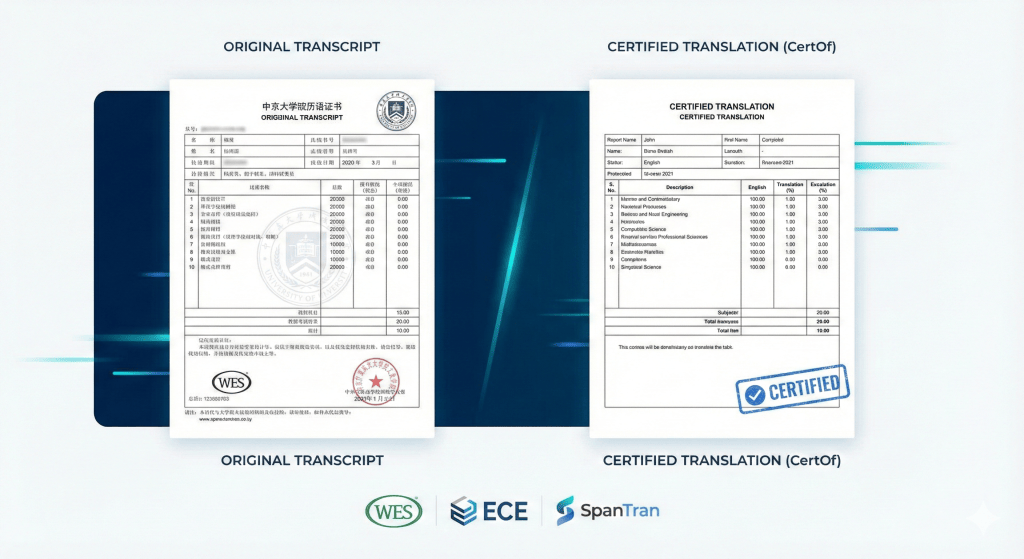
Certified translation of academic transcripts WES ECE SpanTran: fast, compliant, and lower-risk in 2026
You can pay every fee on time and still miss your deadline because one file fails review: certified translation of academic transcripts wes ece spantran. Evaluators do not score writing style. They verify records field by field: names, course codes, credits, grading legends, signatures, seals, and totals. If your translation is incomplete or reformatted poorly, your file can be paused even when your education record is strong.
- Key takeaway #1: Do not convert grades or GPA. Translators translate; evaluators evaluate.
- Key takeaway #2: Always include and translate the back-page grading legend. This is a common hidden delay trigger.
- Key takeaway #3: Mirror formatting (table rows and columns preserved) reduces clarification cycles.
- Key takeaway #4: A digital workflow can be finished in minutes: upload, pay, and download a certified PDF.
As of March 1, 2026, this guide references official sources, including WES upload guidance, ECE FAQs, TEC pricing and processing pages, NACES member directory, IRCC ECA overview, and 8 CFR 103.2(b)(3) for USCIS reuse scenarios.
Who this guide is for: target users and real pain points
- International students and professionals applying to programs that require course-by-course credential evaluation.
- Applicants on deadline who fear portal statuses like On Hold, Missing Documents, or Clarification Required.
- Professional licensing applicants (including nursing boards and CGFNS pathways) who need layout-accurate transcript translation.
- Canada pathways users who need ECA-ready translation and want to avoid resubmission loops: certified translation for IRCC Canada.
- Dual-purpose filers who may reuse academic translations for immigration packets and need compliance discipline from day one.
If this sounds like your case, your goal is not only translation quality. Your goal is reviewability: a packet the evaluator can verify quickly without guessing.
The counterintuitive rule most applicants miss: never convert grades or GPA
This single rule prevents more rework than anything else: translators should not convert 86/100 into A or 18/20 into 3.7/4.0. It feels helpful, but it can break source-to-translation consistency. In evaluation workflows, that inconsistency can trigger manual checks and delays.
What compliant certified translation means for WES, ECE, SpanTran, and IEE
- Completeness: translate all meaningful content, including stamps, seals, signatures, legends, and footnotes.
- Accuracy: preserve course codes, dates, totals, and names consistently across transcript and diploma files.
- Certification statement: include a signed Certificate of Accuracy from a responsible translator/provider.
- Layout fidelity: mirror table structure so reviewers can compare source and translation row by row.
- Process quality: use a provider with documented QC workflows (for example, ISO 17100 process guidance).
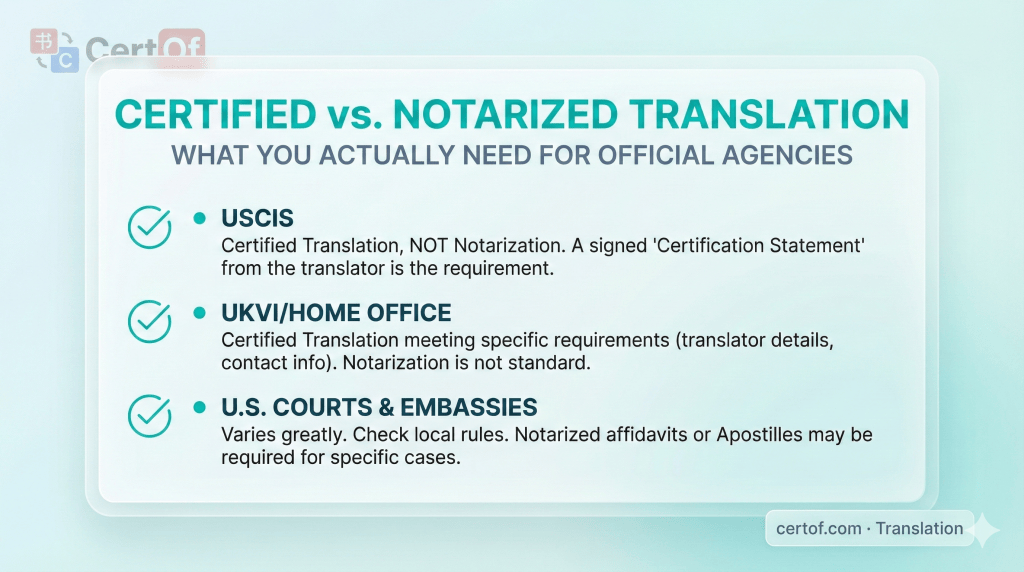
If you need the legal distinction between certification and notarization, use this explainer: difference between certified and notarized translation for official submissions.
Evaluator-by-evaluator playbook (WES, ECE, SpanTran/TEC, IEE)
WES: where avoidable delays usually start
WES cases often fail for technical reasons, not language fluency: missing back-page legend, collapsed tables, or inconsistent name spelling across transcript and degree files. Keep your document mapping clean from day one.
ECE: verify report-specific options before ordering
ECE requirements can differ by report type and country of education. Read your exact portal checklist before paying for extras, then match your translation scope to the checklist.
SpanTran and TEC: partner instructions can override assumptions
For SpanTran/TEC pathways, partner university forms can add special constraints. Use a two-step rule: portal checklist first, partner PDF checklist second.
IEE and other NACES members: acceptance is school-specific
IEE appears in the NACES member directory, and its official site is myiee.org. The key point is not brand preference. The key point is whether your school or licensing body accepts that evaluator for your specific program.
Another counterintuitive point: WES is common, but not always mandatory
Many applicants assume every program requires WES. In reality, some institutions accept ECE, TEC/SpanTran, IEE, or program-specific pathways. Follow your official portal, not forum summaries.
Compliance checklist: what must appear in a transcript translation
| Item | What compliant output looks like | Why this matters in review |
|---|---|---|
| Grading legend or key | Translated fully, including ranges and symbols | Without this, evaluator interpretation can stall |
| Course codes | Preserved exactly (CS101 stays CS101) | Prevents course mapping ambiguity |
| Stamps, seals, signatures | Rendered as bracketed notes (for example [Round Stamp: Registrar Office]) | Authenticity markers remain reviewable |
| Name consistency | Matches passport/application profile | Reduces identity mismatch queries |
| Table structure | Rows and columns mirrored, totals aligned | Speeds side-by-side verification |
| Certificate of Accuracy | Signed statement of completeness and accuracy | Core compliance element for official use |
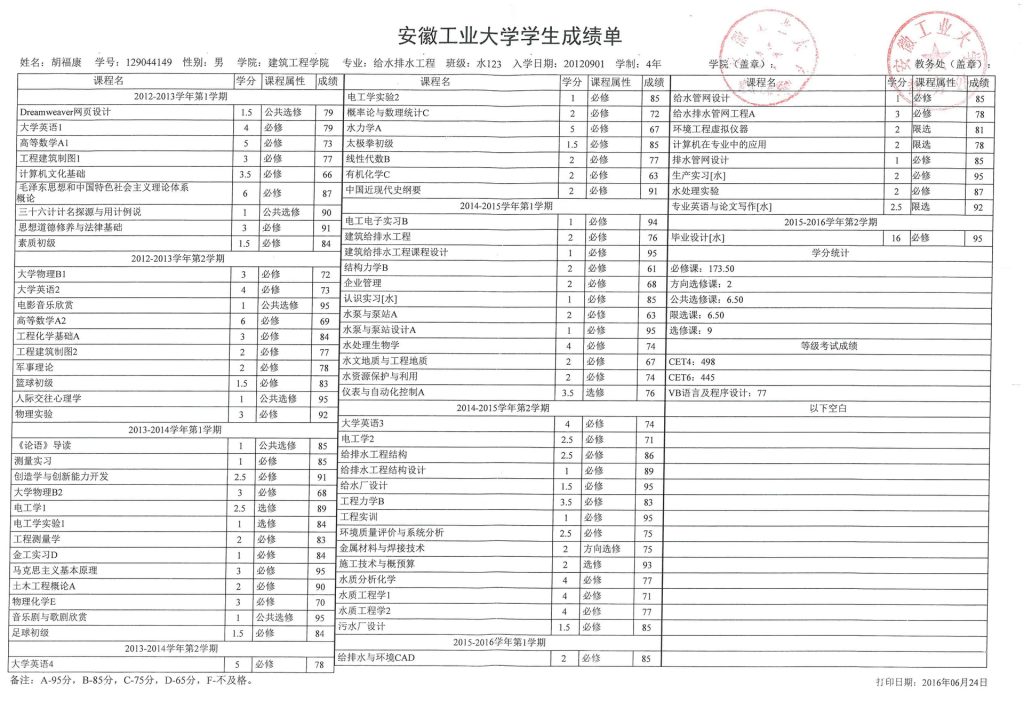
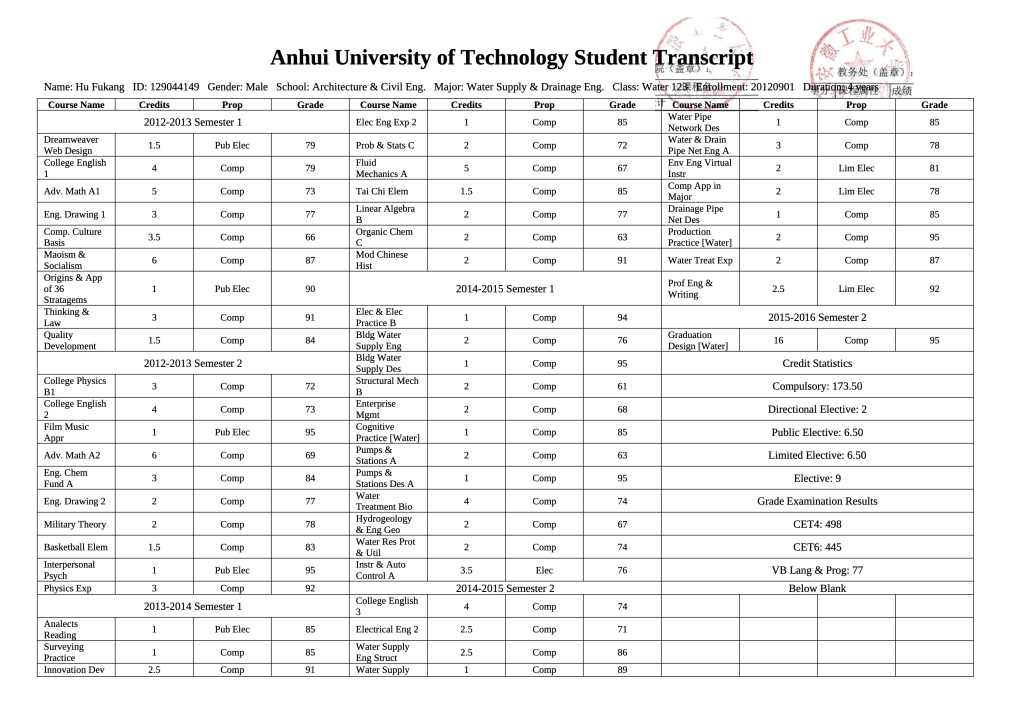
Sample side-by-side structure for certified translation sample quality control
Common mistakes and real consequences (Pitfalls)
- Pitfall #1: Grade conversion by the translator.
Consequence: source mismatch can trigger a correction cycle and delay final review. - Pitfall #2: Back-page legend not scanned.
Consequence: evaluator cannot interpret your scale and the file may sit in a pending queue. - Pitfall #3: Table collapsed into paragraph text.
Consequence: slower manual verification and more clarification requests. - Pitfall #4: Name drift across transcript, diploma, and passport.
Consequence: identity-check friction and avoidable rework close to deadline. - Pitfall #5: Missing stamp notes or handwritten remarks.
Consequence: translation can be treated as incomplete evidence.
If your file is already flagged, these recovery guides are useful: how to fix a rejected translation and USCIS RFE translation response workflow.
CertOf vs traditional agency: speed, price, acceptance policy, and workflow
| Feature | CertOf Translation | Traditional agency or law-office add-on |
|---|---|---|
| Turnaround | Often 5 to 10 minutes for standard pages | Commonly 24 to 48 hours or longer |
| Pricing | $9.99 per page transparent structure | Quote-based, variable add-ons |
| Formatting | Mirror formatting for tables and seals | Often plain text output |
| Acceptance confidence | Published acceptance guarantee with revision path | Guarantee language varies |
| Ordering experience | Upload, pay, download online | Email chain and manual quote loop |
How to order certified translation in 3 steps
- Upload documents for certified translation online (include front and back pages).
- Confirm names, course codes, and destination use case before payment.
- Download the certified PDF and submit to your evaluator portal.
Need paper delivery? CertOf also supports mailing hard copies overnight for cases where institutions still request physical packets.
Commercial action links: certified translation services homepage, start certified document translation order, review refund and returns policy, and request rush or bulk certified translation support.
Privacy, security, and institution coverage
- Digital uploads run through the CertOf portal with controlled account workflow and published policy documents.
- Data handling terms are documented in Privacy Policy and Terms of Service.
- Typical destination institutions include USCIS, universities, banks, licensing boards, and courts; final acceptance always remains with the receiving authority.
- For large projects, review certified translation of 50 plus pages academic records.
Related guides for deeper questions
- Do I need certified translation for foreign diploma WES evaluation
- Certified vs notarized translation for official submissions
- USCIS certified translation requirements explained
- Upload and order certified translation online workflow
CTA: Start your certified translation of diploma and transcript to English now and submit a review-friendly file the first time.
FAQ: certified translation of academic transcripts WES ECE SpanTran
Do I need certified translation for foreign diploma WES evaluation?
Usually yes for non-English records. Confirm the exact WES portal instructions for your country and credential type, then prepare full certified translation for transcript pages and any required diploma pages.
Can I use Google Translate for transcript translation?
You can use AI for personal understanding, but official submission generally needs accountable certified output with a signed certificate and structure preservation. See why Google Translate can fail official review.
Do I need WES, or can I use ECE, TEC, or IEE?
Use the evaluator your receiving institution accepts. Many institutions accept different providers, but acceptance is program-specific. Verify in your admissions/licensing portal and cross-check provider status in the NACES directory.
Do certified translations expire for WES, ECE, SpanTran, or IEE?
The translation itself usually has no universal expiration date, but portal rules, report versions, and document requirements can change. Always verify current portal instructions before reuse.
Can I reuse one translation for evaluator and USCIS filing?
Often yes, if content is complete and your names/identifiers stay consistent. For USCIS-specific wording and format checks, review USCIS certified translation requirements and 8 CFR 103.2(b)(3).
Final pre-submit checklist
- Front and back pages uploaded, including grading legend.
- Course codes, dates, and totals preserved exactly.
- Name spelling matches passport/application profile.
- Certificate of Accuracy included and signed.
- Evaluator and destination institution requirements rechecked in your current portal.