India Foreign Qualifications for Regulated Professional Programs
If you are trying to use a foreign degree in India for medicine, nursing, pharmacy, law, or architecture, the first practical problem is not translation. It is that India foreign qualifications regulated professional programs do not usually follow the normal UGC equivalence path. The UGC Equivalence Portal FAQ and the UGC portal homepage both state that professional qualifications in Medicine, Pharmacy, Nursing, Law, and Architecture are regulated instead by their respective statutory councils. That is why many applicants lose time by starting with the wrong authority and only later discovering that an English translation package, however polished, cannot fix a course-duration, internship, licensure, or recognition problem.
Key Takeaways
- UGC equivalence is not the main route for these professions. India carves out medicine, nursing, pharmacy, law, and architecture for council-specific rules.
- Certified translation is a bridge term, not the dominant local term. Indian regulators more often talk about English translation, translated version, attested copy, transcript proforma, approved qualification, or registration.
- The biggest risk is substantive mismatch. In medicine, nursing, pharmacy, law, and architecture, authorities may focus on course length, clinical or practical hours, licensure status, curriculum, or recognition in the awarding country.
- National rules dominate, but the logistics are real. Many applicants still end up dealing with New Delhi-based national offices, direct university dispatch rules, and state-level follow-up after the central rule is applied.
Who This Guide Is For
This guide is for people dealing with India-wide rules on foreign professional qualifications, especially Indian citizens, OCI cardholders, and foreign nationals who want to use an overseas degree for registration, admission planning, or professional progression in India. The most common file set includes a degree certificate, transcripts or marksheets, course descriptions, clinical or internship records, licensure or good-standing proof, and passport or name-match documents. The most common stuck situation is simple: the degree may already be in English, but the real reviewing body still asks for more evidence on hours, curriculum, training, or recognition.
Why India Is Different From a Generic Foreign Degree Equivalence Case
For ordinary academic equivalence, UGC says applicants upload certificates, transcripts, accreditation proof, and program details online, and the portal says decisions are typically made within 15 working days after complete submission. But the same UGC FAQ also says those rules do not apply to professional qualifications in Medicine, Pharmacy, Nursing, Law, and Architecture. That means this is not a normal foreign diploma translation article. It is a guide to exceptions.
If you need background on transcript translation, keep that separate and short. CertOf already has detailed guides on academic transcript translation, foreign diploma evaluation and translation, long academic record packets, and certified vs notarized translation. In this India guide, the main question is not what a certified translation is. The main question is which Indian authority controls your outcome.
Which Authority Controls Your Case
Medicine: the National Medical Commission. NMC’s 2021 Foreign Medical Graduate Licentiate Regulations and its July 21, 2025 alert note warn that disqualification can turn on course duration, medium of instruction, syllabus and curriculum, clinical training, and internship or clerkship arrangements.
Nursing: the Indian Nursing Council. The INC equivalency page says foreign nursing qualifications are examined individually, and the process requires a transcript proforma to be filled by the university and sent directly to INC.
Pharmacy: the Pharmacy Council of India plus, for registration, State Pharmacy Councils. PCI’s FAQ says foreign qualification equivalence for admission to pharmacy courses is still under consideration, while registration depends on statutory conditions including qualifications approved under Section 14 of the Pharmacy Act.
Law: the Bar Council of India and then a State Bar Council for enrolment. The AIBE portal says only LL.B students from BCI-recognised universities or approved colleges are eligible to apply, which is the practical clue that UGC-style equivalence alone does not unlock the practice path.
Architecture: the Council of Architecture. COA’s official site publishes a foreign qualification application route and a separate contact page for registration and follow-up.
National Contact Hubs and Office Reality
Because these are national regulators, practical follow-up often converges on New Delhi even when the applicant lives elsewhere. NMC’s contact page lists Pocket-14, Sector-8, Dwarka Phase-I, New Delhi 110077, with general query numbers +91-11-25367033 to 25367037. INC’s contact page lists 8th Floor, NBCC Center, Plot No. 2, Community Center, Okhla Phase-I, New Delhi 110020, with public visiting hours every Wednesday from 2:00 PM to 5:00 PM and phone numbers +91-11-66616800, 66616821, and 66616822.
PCI’s contact page lists NBCC Centre, 3rd Floor, Plot No. 2, Community Centre, Maa Anandamai Marg, Okhla Phase-I, New Delhi 110020, phone 011-61299900-03, and working time from 9:30 AM to 6:00 PM on working days. COA’s contact page lists its main office at India Habitat Centre, Core 6A, 1st Floor, Lodhi Road, New Delhi 110003, with working hours from 10:00 AM to 1:00 PM and 1:30 PM to 5:30 PM on working days. These details matter because the bottleneck is often not the translation itself but document routing, office access, and follow-up with the right desk.
Where Certified Translation Actually Fits
In this setting, certified translation is usually a document-preparation tool, not the rule that decides eligibility. Indian authorities often need an English version of non-English transcripts, syllabi, internship records, regulator letters, or qualification certificates so that committee members can evaluate the file. But they do not usually frame the problem in US-style wording such as certified translation requirements. They are more likely to care about whether the translated record is readable, complete, internally consistent, and aligned with the original.
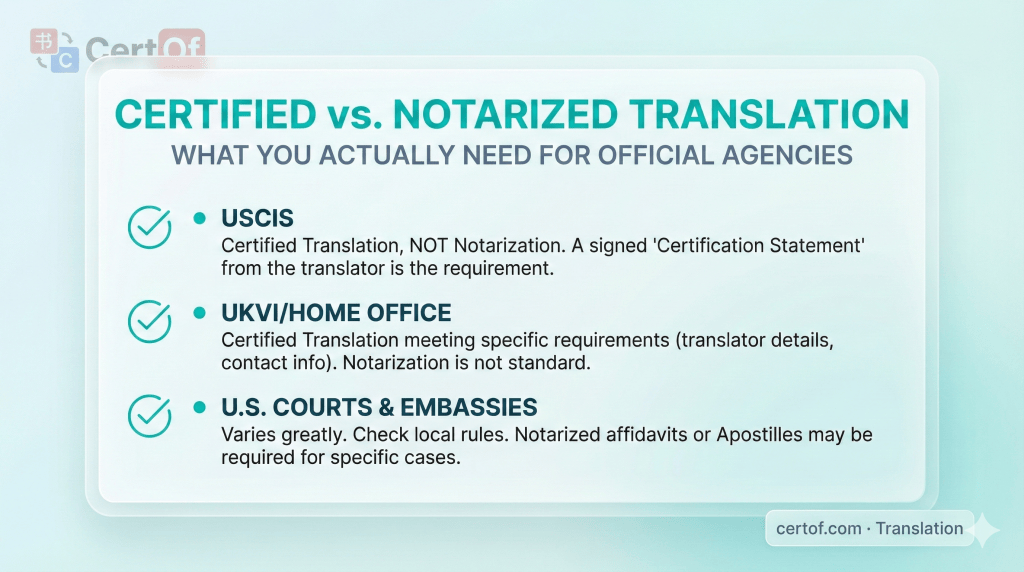
That is why this kind of case often needs more than a one-page diploma translation. You may need long transcript packs, legend pages, course descriptions, and training records translated in a way that preserves page order and terminology. For that workflow, CertOf’s practical pages on ordering certified translation online, electronic delivery formats, and hard-copy delivery options are more useful than repeating generic definitions here. Some private vendors sell notarization by default, but Indian regulators do not publish one universal notarization rule across all five professions, so applicants should not buy extra formalities before checking the receiving body’s actual instructions.
Profession-by-Profession Reality in India
Medicine
The NMC route is the clearest example of why translation is secondary. In its 2025 alert, NMC repeated that Indian students choosing foreign medical courses risk disqualification if the foreign program fails on duration, English-medium instruction, curriculum, clinical training, or internship structure. So if your degree or clinical records are in Russian, Chinese, Ukrainian, Arabic, or another language, an English translation helps the file move. But it does not cure a non-compliant program.
Nursing
Nursing is where paperwork logistics become unusually concrete. The INC equivalency page says the transcript proforma must be filled by the university or board, sent directly to INC, handwritten, and free from correction or overwriting. It also says each page must carry proper seal or stamp, the candidate must submit a demand draft of INR 5,000, and the credit-to-hours conversion must be clearly shown for theory and practical work. This is a strong India-specific pain point: even if your own translation is perfect, you still depend on the issuing institution to complete and route the official proforma.
Pharmacy
Pharmacy is unusually confusing because PCI’s FAQ openly says that equivalence of foreign qualifications for admission to pharmacy courses is still under consideration. The same FAQ also says foreign students or citizens are not eligible for registration in India as registered pharmacists in the normal sense, and that registration is handled by State Pharmacy Councils, not PCI, under the Pharmacy Act. PCI’s own introduction page says approval of foreign qualifications falls under Section 14 of the Act. In practice, that means applicants often need to separate three questions that they wrongly bundle together: admission, qualification approval, and state registration.
Law
Law is a classic trap for people who assume a foreign LL.B will work like a general academic qualification. The AIBE portal says only LL.B students from BCI-recognised universities or approved colleges may apply. The practical sequence is therefore not simply translate degree and enrol. It is first solve BCI recognition and enrolment questions, then move to State Bar Council enrolment, then AIBE. If your degree papers, transcripts, or recognition letters are not in English, translation helps. But the controlling issue is whether the institution and qualification fit the BCI practice path at all.
Architecture
Architecture does not behave like a generic university admission file either. COA publishes an application route for foreign architectural qualifications and maintains registration and complaint mechanisms on its official website. In practice, architecture applicants should expect the authority to care about the actual structure of the qualification, not just the diploma title. That is why accurate English translation of course descriptions, study structure, and supporting qualification records matters more here than a simple certificate-only translation.
How the Real Process Usually Works
- Identify the right statutory authority first, not the translation vendor first.
- Check whether your profession is excluded from ordinary UGC equivalence. For these five fields, the answer is usually yes.
- Map the full document set: degree, transcripts, curriculum, practical or clinical proof, licensure or registration proof, accreditation evidence, and identity documents.
- Translate only the records that are not already in acceptable English, but keep the translated packet consistent with the original page order and labels.
- Watch for institutional routing rules. INC is the clearest example because the university must send the transcript proforma directly.
- Only after the regulator path is clear should you decide whether you need soft copies, paper copies, or extra formalities such as notarization for a specific receiving body.
Timing, Fees, Mailing, and Scheduling Reality
UGC: the portal says 15 working days after complete submission, but that timeline is mostly a contrast point because the regulated professions discussed here are outside the route.
INC: the official page states an equivalency fee of INR 5,000 by demand draft, and INC contact information says public visitors are seen on Wednesdays from 2:00 PM to 5:00 PM. INC’s RTI details page also says the office follows a Monday to Friday, 9:30 AM to 6:00 PM schedule.
NMC: the NMC homepage currently shows visiting hours and submission of forms from 10 AM to 12 PM on working days.
PCI: the PCI contact page lists working time as 9:30 AM to 6:00 PM, Monday to Friday, excluding Saturdays, Sundays, and gazetted holidays.
What this means for applicants: the biggest delay is often not translation itself. It is waiting for a university, board, or regulator to issue or route the supporting document in the exact form the Indian authority wants. A very common failure point is genuineness verification: the Indian regulator asks the issuing institution for confirmation, and the foreign institution replies slowly or not at all.
Common Failure Points
- Starting with UGC even though the profession is excluded.
- Assuming an English-medium degree means no further evidence is needed.
- Translating only the diploma and ignoring transcripts, course outlines, or training records.
- Missing direct-sending rules, especially in nursing.
- Confusing admission, approval, and registration as if they were one step, especially in pharmacy and law.
- Buying extra notarization or legalization before checking whether the receiving Indian authority actually asked for it.
The most counterintuitive point in this whole process is simple: the better your translation, the more obvious a substantive mismatch can become. That is still useful, because it helps you avoid submitting the wrong packet to the wrong authority.
Official Complaint and Anti-Scam Routes
If the problem is corruption, delay, or misconduct at NMC, use the NMC vigilance complaints page or the broader NMC complaints portal. If the problem is nursing equivalency routing, use the contact channels on the INC contact page, including the NRTS support addresses listed there. For pharmacy, start with the PCI contact page and the State Pharmacy Council list if the issue is registration rather than central policy. For law, the AIBE helpdesk is the clearest published contact point tied to the BCI practice track. For architecture complaints and follow-up, COA publishes both a contact page and complaint tools on its site.
If a central public authority simply goes silent, Indian citizens can also use the RTI Online portal to file an RTI request or first appeal. The portal itself says it is for Central Government public authorities and should not be used for State Government bodies, including State-level authorities that fall outside the central RTI filing route. That makes RTI useful for long delays with bodies such as UGC, NMC, INC, PCI, or COA, but not a universal solution for every state registration office.
Fraud prevention is straightforward in this niche: be skeptical of any agent promising guaranteed UGC equivalence, guaranteed NMC acceptance, guaranteed BCI practice rights, or guaranteed fast-track recognition. The official rules are profession-specific and evidence-heavy. No translation provider controls those outcomes.
Commercial Translation Providers in India
These are examples of India-based providers with public websites, listed addresses, and document-translation offerings. They are not official partners of any council, and you should confirm the exact acceptance format with your receiving authority before ordering.
| Provider | Public signals | Typical fit |
|---|---|---|
| Earth Lingua Pvt. Ltd. | The company site lists a Connaught Place, New Delhi head office, additional Mumbai and Chennai offices, and educational document translation including degrees, mark sheets, diplomas, and transcripts. | Applicants who want a publicly listed India-based provider handling academic and official document packets. |
| Advika Translations | The site presents a Delhi-based office, ISO 9001:2015 certification, and certified translation plus apostille and attestation services across multiple languages. | Applicants comparing India-based firms that advertise certified document translation for official-use cases. |
If you only need the translation stage and want a digital-first workflow, CertOf is more appropriately positioned as a document-preparation provider rather than a licensing or legal-representation service. You can review CertOf’s upload page, the guide to revision and delivery expectations, and the page on hard-copy mailing options.
Public and Official Resources
| Resource | What it solves | Best use |
|---|---|---|
| UGC Equivalence Portal | Confirms whether your case belongs in UGC equivalence at all. | Use first to avoid filing the wrong kind of application. |
| National Medical Commission | Medicine-specific rules, alerts, complaints, and contact details. | Use for foreign medical graduate eligibility and complaints. |
| Indian Nursing Council | Equivalency rules, transcript proforma, office contact, and visitor window. | Use if your nursing qualification is foreign and registration in India is the goal. |
| Pharmacy Council of India | Central policy FAQ and State Pharmacy Council routing. | Use to separate central qualification issues from state registration issues. |
| AIBE and BCI path | Practice-track contact point for law graduates. | Use when the real question is enrolment and right to practise, not just academic recognition. |
| RTI Online | Escalation path for central public authorities that stop responding. | Use after ordinary follow-up has failed and only if the body falls within the central RTI route. |
Data Points That Actually Matter
- 15 working days: UGC’s stated benchmark after complete submission, useful mainly as a contrast because these regulated professions are excluded.
- INR 5,000: INC’s published equivalency fee, which shows nursing has a defined documentary process rather than a vague case-by-case inquiry.
- Wednesday 2 PM to 5 PM: INC’s published public visiting hours, important when a direct follow-up is needed.
- 10 AM to 12 PM on working days: NMC’s current published visiting and form-submission window, useful for planning contact and escalation.
FAQ
Can I use UGC equivalence for a foreign medical, nursing, pharmacy, law, or architecture degree in India?
Usually no. UGC expressly says these professional qualifications are regulated by their respective statutory councils in India.
Do I need certified translation if my foreign degree is already in English?
Maybe not for the degree itself, but you may still need English versions of transcripts, course descriptions, internship records, regulator letters, or supporting identity documents if any of those are not in English.
Is translation the hardest part of the file?
Usually not. The harder issue is whether the degree, curriculum, training, or licensure status meets the Indian regulator’s substantive rules.
Why is nursing often slower than applicants expect?
Because INC requires a transcript proforma to be completed by the university and sent directly to the council, with seals, no overwriting, and usable credit-to-hours conversion.
Can a foreign pharmacy qualification be used for admission and registration in India in the same way?
No. PCI’s own FAQ separates those issues. It says admission equivalence is still under consideration, while registration follows statutory conditions and state-level routing.
Does a translated foreign LL.B automatically let me sit for AIBE?
No. The practice path depends on BCI recognition and State Bar Council enrolment. Translation helps document review, but it does not create eligibility by itself.
Is a WES or other foreign credential evaluation report enough in India for these professions?
No. A foreign credential evaluation may still be useful background paperwork, but it does not replace the Indian statutory council route for medicine, nursing, pharmacy, law, or architecture.
Need Help With the Translation Stage?
If you have already identified the correct Indian authority and now need a clean English translation package for transcripts, course descriptions, academic records, clinical logs, or supporting civil documents, CertOf is best used at the document preparation stage. You can start with the upload form, review how online ordering works, and decide whether you need PDF, editable, or paper delivery. CertOf does not provide legal representation, council recognition, enrolment filing, or government appointment booking.
Disclaimer: This guide is for general information and document-planning purposes only. It is not legal advice, licensing advice, or an official determination of eligibility. Always confirm the current rule with the relevant Indian authority before you pay a fee, choose a program, or submit a translated packet.