Lviv University Admission With a Foreign Diploma: Ukrainian Notarized Translation and Recognition
If you are applying to a university in Lviv with a foreign diploma, the hardest part is usually not choosing a school. It is getting your documents into the format that Lviv universities, Ukrainian recognition authorities, and the migration system will actually accept. In practice, that means dealing with foreign diploma recognition for Lviv university admission, Ukrainian translation, notarization, legalization, and timing. A standard global certified translation can help you prepare a clean file set, but on the ground in Ukraine the operative format is usually a notarized translation into Ukrainian, not a US-style certification alone.
The core legal rules are national, not city-specific. What makes Lviv different is the real-world workflow: which international office receives your documents, how long you can safely wait before arrival, how digital invitation paperwork turns into in-person submission, and how quickly document mistakes can spill into residence permit problems after you land.
Key Takeaways
- Even if your program is taught in English, Lviv universities can still require your education documents, birth certificate, and other core papers to be translated into Ukrainian and notarized. Ivan Franko National University of Lviv says documents for enrollment must be translated into Ukrainian with notarization on its official enrollment page.
- The Ministry of Education and Science says a Ukrainian higher education institution can make a recognition decision for enrollment at that institution, while the Ministry handles recognition valid across Ukraine. See the official MON recognition page.
- The national application portal says the application fee is 3100 UAH, paid once, and the digital study invitation is valid for 6 months. See Study in Ukraine.
- After arrival, the residence-permit stage can become the real bottleneck. The State Migration Service says temporary residence permit applications must be filed not later than 15 working days before the end of your permitted stay and require a Ukrainian translation of passport pages containing personal data. See the official DMS service page.
Who This Guide Is For
This guide is for applicants using foreign school or university documents to enroll in a university in Lviv, Ukraine. That includes:
- students applying to Lviv Polytechnic, Ivan Franko National University of Lviv, Lviv medical programs, or other Lviv institutions with a non-Ukrainian diploma;
- applicants who already received a positive response from a school but are unsure what must be translated into Ukrainian;
- students coming with English-language diplomas or transcripts who assume English is enough for an English-taught program;
- families trying to build one accurate document set that can survive university review, diploma recognition, and later migration paperwork.
The most common document bundle is a diploma or school certificate, transcript or annex, passport, birth certificate, health insurance, and sometimes extra curriculum detail if the transcript is thin. The most common language route is English to Ukrainian, but applicants also arrive with Arabic, French, Turkish, Russian, and other source languages. The recurring problem is not language alone. It is consistency: names, grades, dates, document titles, and educational terminology all need to line up before you reach the notarization step.
Why Lviv Feels Different From a Generic Ukraine Guide
Document legalization, recognition standards, and residence-permit rules are nationwide. Lviv becomes distinct at three practical points.
- First, schools in Lviv still operate through very specific intake nodes. Lviv Polytechnic lists its Department for Foreign Students at 12 Bandera St., Main building, Room 345 on its international applicant contacts page. Ivan Franko National University of Lviv lists its Centre for International Cooperation at Universytetska Str. 1, Room 209 on its official enrollment page.
- Second, the city has a real local ecosystem of translation agencies that know education documents, apostille follow-up, and notarial certification practice. That matters because many students arrive thinking a scanned English translation will carry them all the way through.
- Third, wartime logistics are not abstract here. Your university visit, notary appointment, and migration filing can all be slowed by air-raid interruptions and queue pressure. That is one reason document rework is so expensive in Lviv even when the underlying rule is national.
What Certified Translation Means Here and What It Does Not
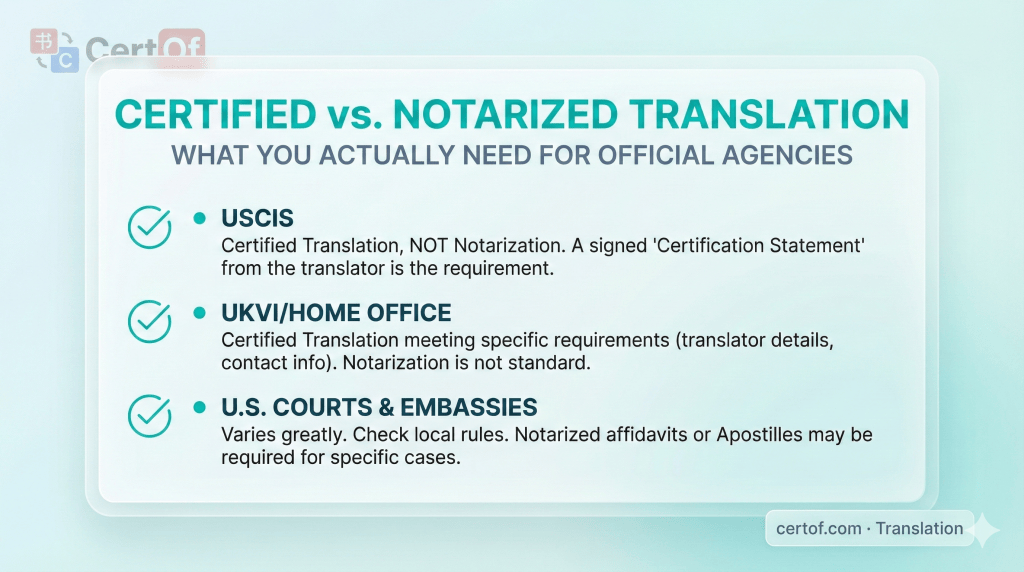
For this topic, certified translation is a bridge term, not the final local term. A clean certified translation can still be useful as your preparation layer, especially if you need a structured English rendering of a diploma, transcript, or annex before local notarization. But once you move into actual filing in Ukraine, universities and authorities usually want a notarized Ukrainian translation.
Keep the generic concept short here. If you need the broader difference between these formats, read Certified vs Notarized Translation. If your file is a long transcript packet, evaluation set, or academic annex, see Certified Translation of Academic Transcripts. If you are still in the preparation stage, these workflow guides also help: How to Upload and Order Certified Translation Online, understanding formats like PDF vs Word vs Paper, and managing a Certified Translation for 50+ Pages of Academic Records.
Getting a Ukrainian Notarized Translation for Lviv University Admission
Obtaining a Ukrainian notarized translation for Lviv university admission is usually mandatory for your core file. For a Lviv admission packet, the papers that most often trigger translation and notarization are:
- your previous education document, such as a school certificate, bachelor diploma, or master diploma;
- your transcript, annex, or grade sheet;
- your passport data page for later migration steps;
- your birth certificate if the university asks for it in the enrollment pack;
- in some cases, extra educational detail if the transcript does not clearly explain subjects, hours, credits, or grading scale.
Ivan Franko National University of Lviv is unusually clear on this point. Its enrollment page says you should prepare a copy of your education certificate with grades translated into Ukrainian for the invitation stage, and then bring the original and a notarized copy in Ukrainian for enrollment. It also says the relevant enrollment documents must be translated into Ukrainian with notarization. That is why many applicants lose time by ordering only an English certified translation and assuming they are done.
How the Document Flow Usually Works
- You create a digital account and submit your application through the national portal. Study in Ukraine says the fee is paid once and the system can route applications to universities after payment.
- The university reviews your scans and, if it approves, you move toward the study invitation stage.
- You prepare the paper set that will actually work in Lviv: originals, legalized documents when required, and Ukrainian notarized translations for the items the university and later authorities will examine in person.
- The university handles or initiates recognition for admission purposes, or it tells you how the recognition route will be handled.
- After arrival, you move into residence paperwork, where your passport translation becomes operationally important again.
This is the first counterintuitive point: the digital stage can make the process feel lighter than it really is. The portal is digital. The local compliance burden is not.
University Recognition vs Ministry Recognition
This is the second counterintuitive point. You do not always need to start with the Ministry in Kyiv just to get admitted in Lviv. The Ministry of Education and Science states that higher education establishments can make recognition decisions for enrollment at their own institution, while the Ministry handles recognition for broader use across Ukraine. In other words, the university can be the front door for admission, but that does not turn your document into a nationwide recognition certificate by default.
For beginners, the practical lesson is simple: ask the Lviv university whether it will run the recognition process for admission, whether it needs a prior ENIC or Ministry conclusion, and whether your case will still need a broader recognition step later. Do this before you buy flights, because the answer affects how many notarized copies and legalized originals you need.
If you are trying to understand evaluation concepts in a more general international context, keep that explanation outside this city guide and use Do I Need Certified Translation for Foreign Diploma WES Evaluation? as a reference page.
Where You Actually Deal With This in Lviv
- Lviv Polytechnic National University: Department for Foreign Students, 12 Bandera St., Main building, Room 345. The same official page also lists the Preparatory Department for Foreign Citizens at 2/4 Starosolskykh St., Building 1, Room 313.
- Ivan Franko National University of Lviv: Centre for International Cooperation, Universytetska Str. 1, Room 209; Preparatory School for International Students, Pasichna Str. 62b.
- Migration follow-up: residence-permit logistics run through the State Migration Service system and local service points. In Lviv, physical submission for temporary residence permit cases often routes through local Administrative Service Centers, including the service center at 32 I. Vyhovskoho St., so do not assume a simple walk-in to one office will finish everything.
The useful distinction is this: the school tells you what it will accept for admission, but the migration side later tests whether your identity documents are ready in the legally attested format it needs. That is why a passport translation that seemed secondary during admission can become urgent after arrival.
Wait Times, Scheduling, and Real Lviv Friction
There is no honest city guide here without discussing timing.
- Portal timing: the application portal itself is online, but that does not mean the physical set can wait until the last minute.
- Invitation timing: the official digital invitation is valid for 6 months, which gives room on paper, but not if your legalization or notarization is still unresolved.
- Queue timing: the DMS electronic queue page says appointments can be booked only 14 days ahead and that missing your call to the service desk for 2 minutes cancels your number. That matters if you are juggling classes, university registration, and air-raid disruptions.
- Residence timing: DMS says temporary residence permit documents must be submitted not later than 15 working days before the end of your lawful stay. Leave this too late and a small translation error can become a status problem, not just a paperwork problem.
The local mailing reality is also straightforward: scans may work for early review, but universities in Lviv still expect originals and notarized Ukrainian versions for actual enrollment. If your physical set is incomplete when you arrive, you end up solving a translation, notary, and scheduling problem all at once.
Local Risks and Failure Points
- English-taught program trap: applicants think English documents are enough because the course language is English. Official university pages say otherwise.
- Name mismatch: the spelling on your passport, diploma, annex, and visa paperwork must line up. Small differences become bigger after notarization.
- Thin transcript problem: if your transcript does not explain credits, hours, or grading legend, recognition can slow down or require clarification.
- Late legalization: apostille or consular legalization cannot be improvised after arrival if your home-country document was supposed to be legalized first.
- Arrival-stage overload: students often delay local translation until after landing and then discover they are simultaneously handling housing, registration, classes, and migration deadlines.
What Applicants Keep Reporting
The strongest non-official pattern is remarkably consistent across different source types. On Quora and general expat forums, applicants repeatedly describe the same surprise: they assumed an English-medium program would accept English-only paperwork, then had to scramble for Ukrainian notarized translations. On Facebook expat groups and Instagram case posts by education agents, a second pattern shows up: students get through the scan-and-invitation stage but stall once originals, apostille, or passport translation are checked locally.
These are anecdotal sources, not legal authority. But they match the official pages closely enough to be useful as a warning. The lesson is not that Lviv is uniquely strict. It is that Lviv exposes document weaknesses at the exact moment when fixing them becomes slow and expensive.
Local Translation and Application Resources in Lviv
Official support and public-interest resources
| Resource | What it helps with | Public signal | When to use it |
|---|---|---|---|
| Study in Ukraine portal | Digital account, application flow, invitation route | Official government-managed international student portal | Start here before paying any private intermediary |
| University international offices in Lviv | School-specific document list, intake route, enrollment questions | Official university contact pages for foreign applicants | Use when you need confirmation on what your chosen school will accept |
| Study in Ukraine agents list | Authorized intermediary check | Official public list of certified agents | Use before paying an agent or sending documents to one |
Local notarized translation agencies in Lviv
| Provider | Publicly listed local signal | Education-document fit | Boundary |
|---|---|---|---|
| ABC Center Lviv | Lists Lviv offices at 2 Vodohinna St. and Chornovola Ave. 67h, office 107, plus personal-document translation with notarization on its site | Reasonably aligned with diploma, passport, and supporting document workflows | Commercial agency, not an official university or government channel |
| Azbuka Translation Agency Lviv | Lists Lviv office at 37 Svobody Avenue and notarized document translation services on its site | Useful for applicants who need a local notarial-format translation after arrival | Commercial agency, not a recognition authority |
| Admiral Translation Bureau | Lists Lviv office at 7 Hrunvaldska St., office 2, and publicly advertises apostille, legalization, and nostrification-related services | Potential fit for education-document logistics | Commercial agency; verify exact scope and timing before relying on it |
This comparison is intentionally conservative. These agencies are listed because they show real Lviv presence and services relevant to educational paperwork. They are not official recommendations, and none of them replaces the university, the Ministry, or DMS.
Local Data and Why It Matters
Lviv has an established foreign-student intake and a visible local market for notarized document translation. That practical signal matters more than a stale headcount. For readers, the takeaway is simple: the city already has a mature paperwork ecosystem, but maturity here means formal process, multiple handoff points, and little tolerance for inconsistent names, weak transcripts, or last-minute translation fixes.
How CertOf Fits Without Replacing a Local Notary
CertOf is strongest at the document-preparation layer: turning a diploma, transcript, annex, or passport set into a clear, consistent, reviewable translation file before you move into local notarization. That is especially useful when your transcript is long, handwritten, poorly formatted, or full of grading terminology that could be mistranslated under time pressure.
Use CertOf when you want a reliable translation draft, structured terminology, readable formatting, and a file set that is easier to check before it goes to a local Ukrainian notary or agency. Do not use CertOf as a substitute for a Lviv notary, a university admissions office, a recognition authority, or an immigration representative.
If you are ready to prepare your documents now, start with CertOf translation ordering. If you want to understand delivery formats first, see PDF vs Word vs Paper. If you need an online workflow overview, use our upload guide.
FAQ
Do I need a Ukrainian translation for an English-taught program in Lviv?
Usually yes. Official Lviv university pages can still require Ukrainian translation and notarization even when the teaching language is English.
Is a certified translation enough for Lviv university admission?
Usually not by itself. In practice, the local filing format is often a notarized translation into Ukrainian. A certified translation can still be useful as your preparation layer.
Can the university recognize my foreign diploma, or do I need the Ministry first?
The Ministry says a higher education institution can make recognition decisions for enrollment at that institution, while the Ministry handles recognition for broader nationwide use. Check your school’s exact route before submission.
Can I upload scans first and bring the originals later?
Yes for the early portal stage in many cases, but do not confuse that with final acceptance. Lviv schools can still require originals, notarized Ukrainian translations, and legalized documents for enrollment.
Can I use the same Ukrainian notarized translation for admission and residence paperwork?
Often yes, especially for passport-related and identity-supporting documents, but only if the wording, spellings, and notarial form are correct from the start. Plan ahead and order enough copies.
Prepare Your Lviv Admission Documents Today
If you are building a Lviv admission file now, the safest move is to prepare the cleanest possible translation set before local notarization starts. CertOf can help you standardize names, dates, course titles, grading legends, and annex structure so your documents are easier to review, easier to correct early, and less likely to trigger expensive rework once you are in Lviv. Start your file at translation.certof.com.
This guide is for document-planning and translation-preparation purposes only. University intake rules, migration practice, and wartime operating conditions can change. Always confirm the latest school-specific requirements with your university and check the latest government guidance before you travel, pay a third party, or rely on a translation for legal filing.