Ukraine Foreign Diploma Recognition and Legalization for University Admission
Ukraine foreign diploma recognition for university admission is usually a two-stage problem, not a one-step formality. Many applicants think a translated diploma or an admission decision means their foreign education is fully recognized in Ukraine. It does not. In practice, you may pass validation for admission, but still need full recognition through the Ministry of Education and Science of Ukraine and ENIC support afterward.
If you are trying to understand where legalization, apostille, Ukrainian translation, notarization, and certified translation fit into that path, this guide is for that specific problem.
- Validation is not full recognition. A validation report can help you enroll, but it does not replace national recognition.
- The translation issue in Ukraine is usually a Ukrainian notarized translation problem, not just a generic certified translation problem.
- Document order matters. Legalization or apostille usually comes first; then you prepare the Ukrainian translation package for filing.
- The timeline gap is the real reason applicants get confused. Validation is posted at 2-5 working days, while full recognition is posted on a 45-day baseline.
Who This Guide Is For
This guide is for applicants using foreign secondary-school or university credentials to enter higher education in Ukraine, especially those deciding between school admission validation, ENIC/MON recognition, and later nostrification obligations.
It is most useful if your file includes a diploma or degree certificate, a diploma supplement or transcript, a passport copy, and legalized originals, and you are unsure whether your documents need Ukrainian translation, notarization, or both. The most common operational language direction here is from the source language into Ukrainian. The most common failure point is assuming that an English translation, a scan uploaded to a portal, or a university admission decision already equals full recognition.
Disclaimer: This guide is practical information, not legal advice or an official decision from a university, ENIC Ukraine, or the Ministry of Education and Science of Ukraine. Rules, fees, and filing steps can change, so always confirm the live instructions before paying or submitting.
The Three Recognition Paths Applicants Keep Mixing Up
In Ukraine, applicants often mix together three different things:
| Path | What it does | Who issues it | How far it reaches |
|---|---|---|---|
| Admission validation | Checks whether your foreign education documents can be used for the admission campaign | Either a university admission committee or ENIC Center | University-issued reports are typically limited to that institution; ENIC Center validation has broader use for education institutions |
| University-level recognition | Recognition by a higher education institution acting within its own competence | The university | Usually tied to that institution and its purpose |
| Full recognition / nostrification | National recognition of a foreign educational document | MON with ENIC support | Nationwide official value |
The official validation guidance is the key local rule to understand. It makes two points that matter for real applicants. First, validation is used during admission. Second, passing validation does not remove the later need to submit documents for full recognition after enrollment.
Counterintuitive point: you can be admitted and still not be done. In Ukraine, admission success and nationwide recognition are related, but they are not the same legal result.
The practical deadline is what makes this distinction dangerous. The validation route exists because full recognition takes longer, but official guidance still points applicants back to the recognition procedure after enrollment. In practice, many institutions expect the full recognition file to be submitted within 1 month after enrollment, and some universities enforce a later but still firm checkpoint before the start of the second semester.
Where Certified Translation Fits in Ukraine
For search purposes, many users look for certified translation. In Ukraine, that phrase is only a bridge term. The more natural local standard is a translation into Ukrainian that can be notarized or is notarized according to the applicable procedure.
That is why translation is not a generic global add-on here. In this filing path, translation is part of document admissibility. If your diploma, supplement, or transcript reaches the wrong stage in the wrong language, the problem is not style. It is usability.
The practical rule for most applicants is simple:
- Plan for a full Ukrainian translation package of the diploma, supplement or transcript, and often passport identity pages.
- Plan for notarization where the receiving institution or filing path expects it.
- Do not assume an English-only version solves the recognition problem, even if a school first reviews scans in English.
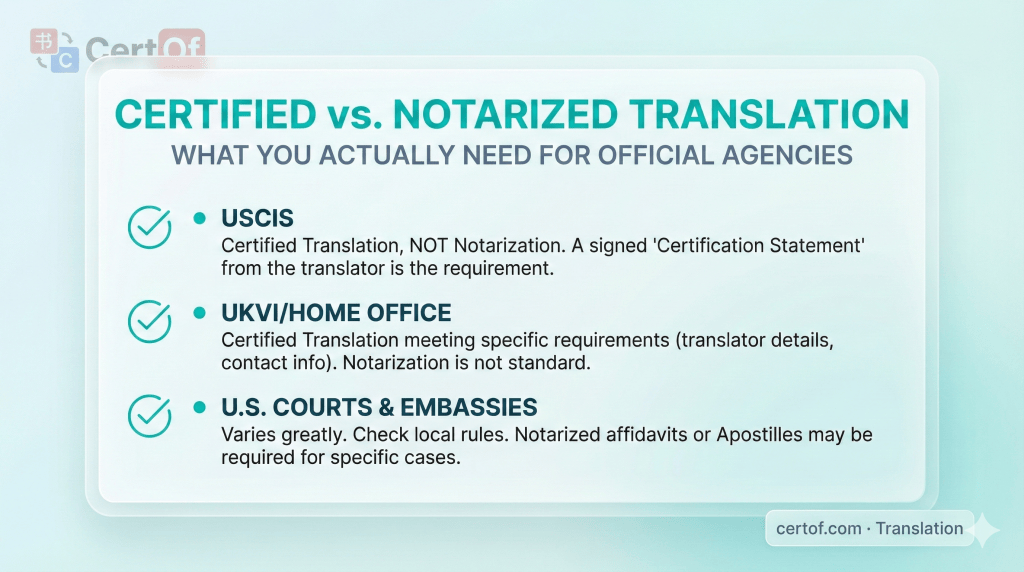
If you are unsure about the difference between plain, certified, and notarized translations, see our guides on certified vs. notarized translation, academic transcript translation, and PDF vs. paper delivery formats.
What Documents Usually Trigger Translation and Legalization Work
The common Ukraine admission-recognition package includes:
- Diploma, school certificate, or degree certificate
- Diploma supplement, transcript, or appendix
- Passport copy
- Application and consent forms where required
- Apostille or consular legalization, depending on the country of issue
- Ukrainian translations prepared for formal submission
For transfer, advanced standing, or interrupted studies, universities may also look for academic certificates or additional course information. If your transcript set is exceptionally long or complex, refer to our guides on large academic-record translation planning and whether a foreign diploma needs translation.
How the Ukraine Path Usually Works in Practice
- Confirm your admission route. Some applicants start with a university admission committee; others use ENIC validation for broader educational use.
- Legalize the original educational document first. Ukraine’s official admission guidance expects properly legalized foreign education documents, whether through apostille or consular legalization depending on the issuing country. See the official Study in Ukraine application guidance and the MON recognition document list.
- Prepare the Ukrainian translation package. This is where certified translation in the broad English sense becomes a Ukrainian translation and notarization workflow in the local sense.
- Use validation for admission if needed. The official validation page explains that validation helps with admission but does not replace full recognition.
- Enroll if the institution allows it. That is the point where many applicants wrongly stop preparing documents.
- Submit the full recognition file on time. Because validation is much faster than full recognition, applicants are commonly allowed to move forward first and finish recognition later, but the working assumption should be that you need to submit the full recognition package within 1 month after enrollment unless your institution has published a different checkpoint.
The practical implication is important: if you wait until after classes start to begin legalization and translation, you may already be late for the recognition timeline your school expects.
Costs, Timelines, and Real-World Filing Reality
Ukraine is unusually clear about posted service timing, and that timing explains the whole split between validation and later recognition. ENIC’s published costs and times page shows validation at 2-5 working days, while full recognition runs on a 45-day baseline. That time gap is exactly why validation exists as an admission-season tool.
- Validation is designed to move much faster than full recognition.
- Full recognition timing is long enough that applicants should not leave translation and legalization until the last minute.
- Fees are separate from your translation, notarization, courier, and legalization costs.
There is also a practical portal issue worth flagging for users: official Study in Ukraine pages have shown different fee figures across different guidance pages over time. Treat the live invoice in your personal account as the payment checkpoint, and confirm the amount before paying rather than relying on an older screenshot or third-party summary.
Ukraine-Specific Risks That Cause Delays
- Risk 1: confusing school acceptance with nationwide recognition. This is the most common conceptual mistake.
- Risk 2: using the wrong translation standard. Applicants often prepare an English translation because that is what they know from other countries, but the Ukraine recognition path usually turns on a Ukrainian version suitable for notarization.
- Risk 3: doing the steps in the wrong order. If the underlying diploma still needs apostille or consular legalization, translation alone will not solve the filing problem.
- Risk 4: remote upload optimism. A portal upload can move your application, but it does not erase later requirements for legalized originals and properly prepared Ukrainian translations.
- Risk 5: relying on unofficial intermediaries. ENIC has publicly warned applicants not to hand documents to third parties claiming to speed up the process near the office or outside official channels; see the official warning for visitors.
There is also a genuine local logistics issue. ENIC’s contact information identifies the Kyiv filing node at 25 V. Chornovola St., Office 220, Kyiv, with postal routing through Box 47, Kyiv, 01135; see the official contact page. ENIC’s published operating-hours notice also states that service can be interrupted during air alerts or power outages. For that reason, applicants should treat remote electronic submission through the personal cabinet as the default route whenever possible and use paper delivery strategically rather than assuming an easy walk-in experience.
What Public Guidance and Applicant Experience Point To
Official rules should control. Still, two recurring applicant problems show up both in institutional guidance and in public student discussions:
- Applicants get a positive admission signal and assume the recognition issue is finished.
- Applicants prepare scans or English translations first, then discover too late that the recognition path actually depends on a Ukrainian notarized submission package.
Those patterns matter because they are not abstract. They explain why translation should be started while you are still organizing legalization and before you rely on enrollment timing to save you.
Official Resources and Complaint Paths
| Resource | What it helps with | Best use |
|---|---|---|
| ENIC Ukraine validation and recognition pages | Core rules, filing structure, posted service times | Use first when deciding which recognition path applies |
| Study in Ukraine portal | Official applicant workflow, digital account, admission guidance | Use for the admission-side process and live portal instructions |
| MON appeal procedure | Formal challenge route if recognition is refused | Use within the official appeal window; see right to appeal |
| USCIE certified agents list | Officially listed intermediaries for admission support | Useful only if you need portal help; it is not a substitute for ENIC recognition decisions |
If you are dealing with fraud risk rather than a document-merits problem, the safest path is still the official path: use the portal or ENIC instructions directly, avoid guaranteed-recognition claims, and check whether any agent you are considering appears on the official USCIE certified agents list.
Commercial Translation and Document-Prep Providers in Ukraine
This is not a recommendation list. It is a narrow comparison of publicly visible providers whose sites show that they understand diploma legalization or recognition-related document preparation. None of them can replace an official recognition decision.
| Provider | Public signal | What it appears to help with | Boundary to keep in mind |
|---|---|---|---|
| UKRTRANSLATE | Public English-facing page about apostille and notarized translation for diplomas in Ukraine | Diploma-related translation, apostille logistics, document preparation | Commercial document support only; verify current contacts, fees, and whether notarization is handled directly or through partners |
| NTidea Translation Bureau | Public page focused on nostrification and diploma recognition support in Ukraine | Translation and paperwork support around diploma recognition | Marketing pages are not official recognition authority; confirm what is translation support versus what still must be done with ENIC or the university |
| Bonus Translation Bureau | Public page focused on nostrification of a diploma in Ukraine | Translation and legalization-related prep for education documents | Check live turnaround, language coverage, and document-handling terms before paying |
If your only real problem is translation quality and file readiness, a document-prep provider can help. If your problem is whether Ukraine will recognize the qualification itself, only the official recognition path can answer that.
Public and Official Support Resources
| Resource | Type | What it can actually do | When to use it first |
|---|---|---|---|
| ENIC Ukraine | Official | Validation, recognition guidance, posted timings, filing rules | When you need the correct path, not just a translation |
| Study in Ukraine / USCIE | Official | Admissions portal workflow, applicant guidance, official information routes | When you are still moving through admission and portal setup |
| USCIE certified agents | Officially listed commercial intermediaries | Admission-side support and navigation help | Only if you need help with application handling; not for recognition merits |
How CertOf Fits Without Overclaiming
CertOf is most useful here as a translation and document-preparation partner, not as a legal representative and not as an official Ukraine filing authority. The practical role is to help you prepare a clean Ukrainian-ready submission package for your diploma, supplement, transcript, and related identity pages so you can move more smoothly into notarization, upload, and review.
That means the right internal next steps are usually:
- upload your documents for translation when you already know the receiving side expects Ukrainian materials
- review how to order certified translation online if you are still organizing files
- use turnaround benchmarks by document type to plan around school and recognition timing
- check revision and reissue options if your school or notary asks for small formatting changes
- use hard-copy delivery guidance if you also need paper sets for later filing
What CertOf should not promise in this topic is just as important: no official recognition decision, no government appointment handling, no ENIC shortcut, and no guaranteed approval outcome.
FAQ
Do I need full recognition after validation in Ukraine?
Usually yes. The official validation guidance says validation used for admission does not remove the need to submit documents for full recognition after enrollment where required.
Can I enroll in a Ukrainian university first and submit my recognition certificate later?
Usually yes, and that is exactly why the system separates validation from full recognition. Validation is posted at 2-5 working days, while full recognition is posted on a 45-day baseline. But the practical rule is not open-ended: plan on submitting the full recognition package within 1 month after enrollment unless your institution has published a different deadline.
Is a certified English translation enough for Ukraine university admission?
Often no. In this context, the practical standard is usually a Ukrainian translation prepared for notarization or already notarized. English may help at an early review stage, but it does not reliably solve the recognition stage.
What is the difference between a university validation report and MON recognition?
A validation report helps with admission. MON recognition is the nationwide recognition outcome. They are not interchangeable.
Should apostille come before translation?
In most cases, yes. Follow the official order in the recognition and admission guidance: first make sure the educational document is properly legalized, then prepare the Ukrainian translation package for filing.
Can an agent speed up ENIC recognition?
You should be skeptical of that claim. Use only official filing routes and treat third-party promises of guaranteed acceleration as a warning sign.
What if my recognition is refused?
There is an official appeal route. Use the MON appeal instructions and act within the stated deadline rather than starting over informally.
Final Takeaway
The Ukraine-specific answer is simple once the terminology is cleaned up: admission validation, university-level acceptance, and nationwide recognition are separate layers. The translation issue is not just “do I need certified translation?” but “do I have a Ukrainian submission package that fits legalization, notarization, admission review, and later recognition?”
If you are already holding a foreign diploma and trying to avoid the usual delay cycle, prepare the Ukrainian translation package early, keep legalization in the right order, and do not treat admission as the end of the recognition process. When you are ready to organize the documents, start your order here.