If you are applying to a university in Ukraine with foreign school or university documents, the phrase you need to understand is usually notarized Ukrainian translation for foreign education documents, not just generic certified translation. That is the practical standard foreign applicants run into when they move from a simple online invitation upload to actual enrollment and, in many cases, later credential recognition.
In Ukraine, the real problem is not that translation rules are unclear in the abstract. The problem is that the process changes by stage. The official Study in Ukraine digital account is relatively light at the invitation stage, but university enrollment packets and recognition files often become much stricter later. That is why applicants who already paid for a foreign “certified translation” are often surprised when a university or notary still asks for a Ukrainian notarized version.
- Key takeaway 1: For many Ukraine admission and recognition uses, a plain foreign certified translation is not the practical finish line. You often need a translation into Ukrainian notarized under Ukrainian procedure.
- Key takeaway 2: Invitation-stage uploads and final enrollment are not the same workflow. A scan that works online may still fail when the university asks for notarized Ukrainian documents.
- Key takeaway 3: Apostille or consular legalization and translation are separate steps. If legalization is required, it usually needs to happen before the final translation package is fixed.
- Key takeaway 4: If you use an agent, verify it on the official USCIE agent list instead of assuming any recruiter can handle document compliance correctly.
Disclaimer: This guide is an information resource for document preparation and translation planning. University-specific instructions, recognition rules, and notary practice can change. Always follow the receiving university’s current written requirements and the current guidance of the Ministry of Education and Science of Ukraine or ENIC Ukraine for your exact case.
Who this guide is for
This guide is for foreign applicants using non-Ukrainian education documents to apply to universities in Ukraine or to complete later education-document recognition. It is especially useful if you are dealing with a passport, diploma, transcript, diploma supplement, or academic certificate issued outside Ukraine and you are unsure whether your documents need a Ukrainian notarized translation, whether your home-country certified translation will be accepted, or how to handle the process if you are still outside Ukraine.
It is most relevant when your documents are in English or another non-Ukrainian language and you are moving from invitation-stage uploads to a formal enrollment or recognition file. The most common stressful situation is this: the applicant has already uploaded scans, already received progress from an admissions channel, and then discovers that the university or later recognition process still expects a notarized Ukrainian package.
What translation do foreign applicants actually need for Ukraine university admission?
For this topic, the most natural local term is usually notarized Ukrainian translation. “Certified translation” is still useful as a bridge term for international readers, but it is often too vague for Ukraine admissions work.
The official recognition materials published by the Ministry say applicants must submit a translation into Ukrainian certified in accordance with the procedure established by law. ENIC Ukraine uses the same logic for foreign education documents used in recognition. In plain English, that usually means a Ukrainian-language translation prepared for a formal notary workflow, not just a translator’s certification statement from another country.
This is the first reason generic certified translation is often insufficient: it may be accurate, but it may not match the form of certification expected in Ukraine.
Why applicants get confused
The confusion comes from mixing three different stages:
- Invitation stage: The official digital account is built around online submission of scans. This stage is lighter and does not by itself prove that your final paper set is complete.
- University enrollment stage: Multiple university admissions pages publicly ask for legalized or apostilled originals together with notarized Ukrainian translations of the passport, diploma, and transcript. Examples can be seen on official university profile pages such as Kyiv National University of Trade and Economics and State University of Infrastructure and Technologies.
- Recognition or nostrification stage: The Ministry’s recognition process is national and formal. If your case needs recognition, the translation standard matters even more because the file is being reviewed for legal validity inside the Ukrainian system.
Counterintuitive but important: the Ministry’s recognition monitoring page notes that English- and Russian-language documents may be exempt from translation in some recognition contexts, but that does not create a safe blanket rule for admissions. Universities often still ask for Ukrainian translations for enrollment packets, so treating “my diploma is already in English” as a complete answer is risky. See the Ministry’s own recognition monitoring note here.
Who can translate and who can notarize the translation in Ukraine?
Ukraine’s notarial framework matters here. Under the rules for notarial acts, if a notary knows the relevant languages, the notary may certify the accuracy of the translation; if not, the translation is done by a translator and the notary certifies the translator’s signature. The underlying legal framework for notarial acts is published on the state legal portal here.
For applicants, the practical takeaway is simpler than the legal wording:
- You should not plan around self-translation.
- You should not assume any foreign certified translation automatically becomes acceptable in Ukraine.
- You should expect the receiving university or recognition workflow to care about the Ukrainian notary step, not only about linguistic accuracy.
This is also why CertOf’s role in this topic is narrower than in some USCIS-style workflows. CertOf can help produce an accurate, revision-ready translation draft and a cleaner submission file set, but the final acceptance question in Ukraine often turns on whether the receiving party wants the translation notarized in a Ukrainian-compliant way.
Which education documents usually need a notarized Ukrainian translation?
For most foreign applicants, the documents that trigger the issue are:
- passport identity page
- secondary-school leaving certificate or diploma
- transcript, annex, or diploma supplement
- bachelor’s or master’s diploma if applying for a higher degree
- academic certificate for transfer or continuation cases
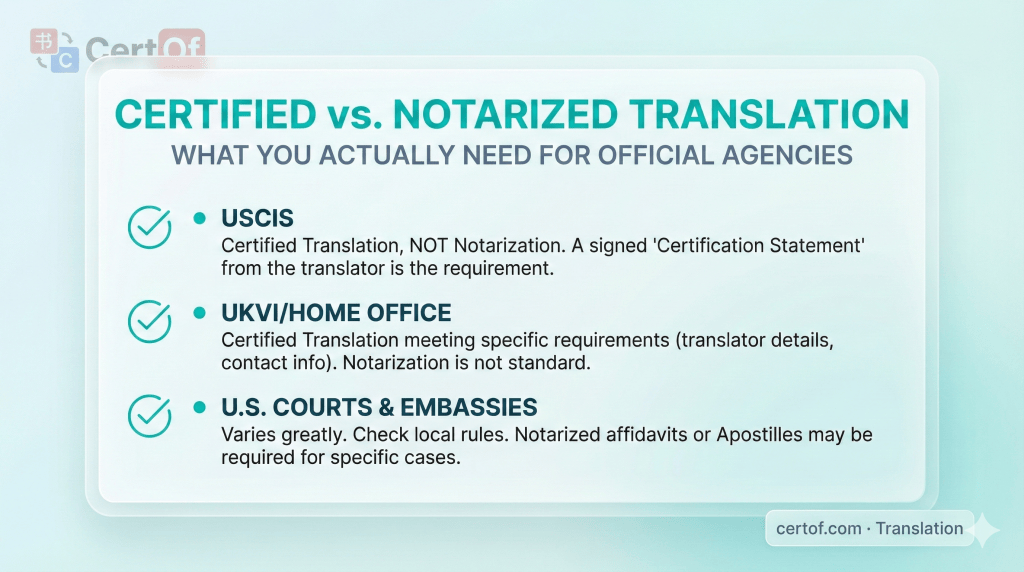
Some universities may also ask for other supporting records, but this page stays focused on foreign education documents and the translation standard. If you need broader academic-document translation guidance, keep that short and use supporting resources such as our guide to academic transcript translation, our diploma translation guide, and our overview of certified vs. notarized translation.
How the real workflow usually works
- Check the university’s current document list. Do not rely only on the fact that your scans were accepted online.
- Confirm whether legalization or apostille is required. This is separate from translation and often comes first.
- Translate the final document set into Ukrainian. Make sure names, dates, stamps, annex pages, and apostille pages are handled consistently.
- Complete the notary step required for Ukrainian use. This is the point where many foreign certified translations fail.
- Submit the package to the university and keep digital copies. If later recognition is required, you may need a similar or stricter package again.
The order matters. One of the most common failure patterns is translating too early, then receiving apostille or legalization later, and discovering that the final package no longer matches because the authentication page also needs to be reflected in the translated set.
If you are outside Ukraine, where do delays usually happen?
The biggest operational problem is not the translation itself. It is the handoff between online admissions, physical originals, and the Ukrainian notary step.
- Scheduling reality: the digital invitation system is easy compared with later paper compliance. The friction appears when the university asks for notarized documents.
- Mailing reality: applicants outside Ukraine may need to coordinate sending physical originals to a local representative, agent, or bureau. Build extra time for international courier delays and local transit, including handoff through services such as Nova Poshta once documents arrive in Ukraine.
- Cost reality: the invitation stage can feel cheap because no formal translation may be required yet. The later stage is where translation costs, notarization fees, and possibly legalization expenses concentrate.
- Revision reality: even small spelling inconsistencies can cause rework. This is why a clean draft before notarization matters.
Because pricing and timing vary by institution, page count, legalization status, and wartime logistics, it is safer not to promise fixed numbers in a national guide. If you are comparing service formats, these shorter resources may help: PDF vs. Word vs. paper delivery, delivery speed benchmarks, and how online ordering works.
Local risks that are specific to Ukraine
1. The digital-to-physical mismatch
This is the most important local risk. Applicants often assume that because the official portal accepted their scanned documents, the translation problem is solved. It is not. Ukraine’s admissions reality is split between a light digital front end and stricter enrollment paperwork.
2. The “English is enough” myth
Some readers see the Ministry’s English-language recognition note and assume they can skip Ukrainian translation entirely. That is too broad. Even where recognition guidance has a limited language exception, universities may still require Ukrainian translations for enrollment file handling and internal records.
3. Wrong sequencing
If apostille or legalization belongs in your case, translating before the final authenticated document is ready can force a full redo.
4. Agent fraud or over-promising
Ukraine has an official mechanism for agent verification. If someone claims they can “handle everything” but cannot be confirmed on the official certified agents page, slow down before sending originals or money.
What applicants and document providers commonly report
Across official university instructions, ENIC guidance, and public-facing local bureau materials, the same practical complaints appear again and again:
“My foreign certified translation was rejected.”
It may have been acceptable in the applicant’s home country, but not acceptable for Ukraine enrollment because the final file still lacked the local notary step.
“I translated first, apostilled later, and had to redo the set.”
The applicant did not realize the authentication page also needed to be reflected in the final Ukrainian translation package.
“I thought English documents were exempt.”
The applicant relied on a broad reading of Ministry guidance, then found the specific university still required Ukrainian versions for physical enrollment.
These are not reasons to panic. They are reasons to prepare the final document chain in the right order.
Commercial translation options in Ukraine
These are examples of local commercial providers that publicly market notarized translation workflows for use in Ukraine. They are not endorsements.
| Provider | Public signal | What it appears to handle | Best fit |
|---|---|---|---|
| Pereklad.ua | Local Ukraine-facing translation bureau website advertising notarized translation and apostille/legalization-related services | Translation plus Ukrainian notarization workflow support | Applicants who need a local bureau familiar with formal Ukrainian document packages |
| TEXT.ua | Local bureau website publicly offering translation and notarization-related services | Document translation for official use, including notarized formats | Applicants comparing Ukrainian-market providers rather than using a general global translator |
| Admiral Translation Bureau | Local bureau website publicly advertising notarized translation and legalization support | Education and personal-document workflows that need local notary coordination | Applicants who want a Ukraine-based execution path after finalizing document content |
What matters more than brand names in this topic is workflow fit. Ask each provider whether it routinely handles foreign education documents for Ukrainian university use, whether it can work from your final apostilled set, and whether the notarization step will be done in the form your university expects.
Official help, complaints, and anti-fraud resources
| Resource | Type | What it helps with | Public contact signal |
|---|---|---|---|
| ENIC Ukraine | Official recognition support | Recognition questions, document standards, contact point for foreign education issues | 25 V. Chornovola St, Kyiv; +38 044 484 64 25; [email protected] |
| Study in Ukraine / USCIE | Official admissions portal | Digital applicant account, invitation-stage workflow, official admissions routing | National online portal for foreign applicants |
| USCIE Certified Agents List | Official anti-fraud tool | Verify whether an education agent is officially listed before trusting them with documents | Public verification page |
| MON citizen appeals portal | Official complaint path | Complaints about conflicting guidance, administrative problems, or misconduct issues | Education ministry appeals channel |
If the dispute reaches the recognition stage itself, the Ministry also publishes a dedicated right-to-appeal explanation, which is useful when an applicant needs to understand the formal review path instead of relying on agent advice.
Why this still matters in Ukraine
Ukraine continues to maintain a formal national structure for foreign applicants, including a dedicated digital account and national recognition system. The Ministry also publicly reported the rollout and use of the digital foreign-applicant track in 2025, confirming that this is an active admissions channel rather than an abandoned legacy process. See the Ministry update here. For applicants, that means the market is active enough for document mistakes to remain common, especially when admissions happens partly online and partly through formal paper compliance.
How CertOf fits without overpromising
CertOf is a good fit for the translation preparation part of this workflow, not for pretending to replace a Ukrainian notary, a university admissions office, or ENIC Ukraine. If you already know your school will require a Ukrainian notarized translation, CertOf can help you prepare an accurate, revision-ready translation file set so you can reduce rework before the local notarization step.
If you need a fast digital workflow first, you can start at CertOf’s order portal, compare turnaround expectations with our delivery benchmarks, and review how revision support works in this service guide. For broader academic packets, see our long academic-records guide.
FAQ
Do I need a notarized translation for the Study in Ukraine digital invitation?
Usually the digital invitation stage is lighter and built around online document uploads. The bigger issue comes later, when the university asks for the paper package for enrollment or when recognition is needed.
Can I use a certified translation done outside Ukraine?
Sometimes it may help as a draft or supporting version, but you should not assume it will satisfy the final Ukrainian requirement. In many real admissions and recognition workflows, the missing piece is the Ukrainian-compliant notarization step.
Do English-language diplomas still need Ukrainian translation?
Often yes in practice for enrollment, even though some Ministry recognition contexts mention limited language exceptions. Do not rely on a broad English-only assumption without checking your receiving university’s current list.
Who can translate my diploma for use in Ukraine?
A translator can prepare the text, but the practical issue is how that translation is certified for Ukrainian use. The notary step is what usually determines acceptance.
Should I translate before or after apostille?
If your case requires apostille or legalization, it is usually safer to finalize authentication first so the full document set, including authentication pages, is reflected in the translation package.
What if I get conflicting instructions from an agent and a university?
Follow the receiving university’s written requirements first, then verify the broader rule with official resources such as ENIC Ukraine or the Ministry. If necessary, use the official Ministry appeals channel.
Final takeaway
For foreign education documents used in Ukraine, the safest assumption is not “I need any certified translation.” The safer assumption is “I may need a notarized Ukrainian translation tied to the exact stage of my case.” That one shift in terminology prevents many avoidable delays.
If you want help preparing a clean translation draft before the Ukrainian notarization step, CertOf can help with the translation and revision side of the workflow. If you want the broader background on official-format translation, you can also compare certified vs. notarized translation and review how online ordering works before submitting your files.