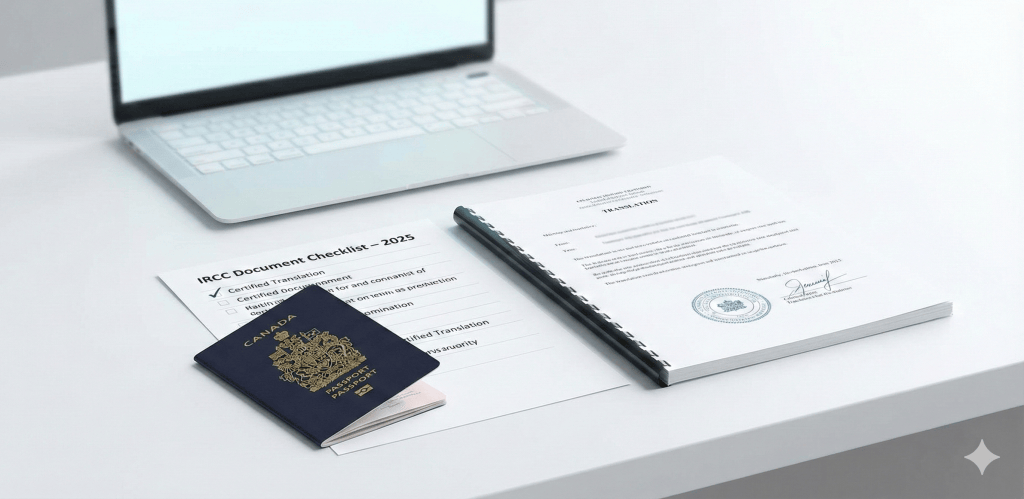
Canada IRCC Translation Requirements for Work Permits and Visitor Filings
If you are preparing a Canadian work permit, visitor visa, or related temporary residence filing, the real problem is usually not the translation itself. It is the translation packet: who translated it, whether an affidavit is required, whether the translator worked from the original or a certified photocopy, and whether your final upload is organized in a way IRCC can review without asking for more documents. That is why IRCC translation requirements for work permit and visitor visa Canada filings deserve their own guide rather than a generic certified translation explainer.
This guide focuses on Canada-wide IRCC rules for temporary resident filings, especially work permits, visitor visas, visitor records, and remote-work-as-a-visitor scenarios. It is not legal advice and it does not replace the official instruction guide for your application type.
Key Takeaways
- For non-English and non-French documents, IRCC generally expects a complete translation, and if the translator is not treated as a certified translator for IRCC purposes, an affidavit and the underlying original or certified photocopy become critical.
- The practical mistake in Canada is not usually bad English. It is mixing up certified translator, translator affidavit, and certified copy, then uploading an incomplete packet.
- Canada does not have a standalone IRCC remote worker visa. Many so-called digital nomad cases are really visitor-status cases, which means the translation issue sits inside a visitor filing rather than a separate visa category.
- The core rule is federal and Canada-wide. The local variation is mostly in who you can use as a certified translator, how you find a commissioner or notary for an affidavit, and how easily you can assemble a compliant PDF packet.
Who This Guide Is For
This guide is for people filing temporary residence applications across Canada, including applicants outside Canada and people already in Canada who need to extend or regularize temporary status. It is especially useful if you are:
- applying for a work permit and your file includes job offers, employment letters, bank statements, police certificates, or civil status records in a language other than English or French
- applying for a visitor visa or visitor-related filing with relationship proof, invitation letters, financial documents, travel history, or family records that need translation
- entering Canada as a visitor while continuing remote work for yourself or for an employer outside Canada, and need to document that situation carefully
- working with common language pairs such as Chinese-English, Spanish-English, Arabic-English, Hindi-English, Portuguese-English, Russian-English, Ukrainian-English, or French into English for mixed document sets
- stuck on questions like Can I use a non-Canadian translator, Does IRCC need a sworn affidavit, Do I need a certified copy, or Can I upload one merged PDF
The Real Filing Problem in Canada
In Canada, the translation standard itself is national, not provincial. The harder part is operational. Temporary residence applicants often submit mixed packets: passport pages, job offers, payroll records, bank statements, marriage or birth certificates, police certificates, and handwritten or stamped local documents. IRCC officers review those packets for completeness before they get deep into the merits of the application.
That creates a very Canadian filing reality: even when your substantive case is fine, your application can be delayed because the translation package is missing one layer of formal support. Common examples are:
- the translation was done by a fluent person, but there is no affidavit
- the translator used a scan, but nobody can tell whether it was the original or a certified copy
- stamps, seals, signatures, or back-page notes were not translated
- the applicant or a family member translated the documents
- the upload packet is incomplete or confusing
If you want the broader Canada-wide overview first, see our general IRCC certified translation guide. This page is narrower: it focuses on work-permit and visitor-related filings, where employment proof, funds evidence, and mixed civil documents often appear in the same packet.
Certified Translation for Work Permit Canada: What IRCC Actually Requires
IRCC’s temporary residence guides for work permits and visitor visas both state that documents not in English or French must be translated and supported properly. The work permit guide is Guide 5487, and the visitor visa guide is Guide 5256.
IRCC’s own glossary defines a certified translator as a member in good standing of a professional translation association in Canada or abroad, with certification confirmed by a seal or stamp and membership number. It also explains what IRCC means by a certified photocopy and makes clear that applicants, family members, representatives, and consultants cannot translate the applicant’s documents for IRCC purposes. See the official IRCC glossary.
For an affidavit, IRCC’s Help Centre explains that the translator must swear the translation is true and accurate in front of a commissioner or notary authorized to administer oaths where the translator lives. That link is worth reading closely because this is one of the most common compliance gaps in work-permit and visitor filings.
Certified Translator vs. Affidavit vs. Certified Copy
This is the distinction most applicants get wrong.
1. Certified translator
If your translation is done by a translator who qualifies as a certified translator for IRCC, the packet is usually simpler. The translator’s stamp or seal and member number do the heavy lifting. In practice, many applicants look for translators through provincial societies tied to the Canadian Translators, Terminologists and Interpreters Council. CTTIC lists its member societies here: CTTIC member societies.
2. Translator affidavit
If the person who translated the document is not being presented as a certified translator for IRCC purposes, then the safer path is to include the translation plus an affidavit from that translator. The affidavit is not a substitute for a weak translation. It is a formal statement about the translator’s language ability and the accuracy of the translation.
3. Certified photocopy
A certified photocopy is about the source document, not the translation. It shows that an authorized person compared the original document with the photocopy and certified that it is a true copy. This matters when the translator is translating from a certified copy rather than from the original.
Practical rule: for work-permit and visitor filings, think in packets, not pages. The compliant unit is often: original or certified photocopy + translation + affidavit if needed.
A Useful Canada-Specific Tension: The Guide Language vs. The Glossary
One of the most useful and least obvious points in this topic is that IRCC’s temporary residence guides often use narrower language such as Canadian certified translator, while the glossary definition is broader and recognizes a certified translator as a member in good standing of a professional translation association in Canada or abroad.
For applicants, the conservative takeaway is simple:
- if you are using a translator who is clearly a certified translator under IRCC’s framework, document that status cleanly
- if there is any doubt, do not argue with the portal later; add the translator affidavit and make sure the underlying source document is properly supported
This is a good place to avoid overconfidence. A lot of filing stress comes from treating certified translation as a magical label. For IRCC, what matters is whether the officer can see a complete, reviewable chain from source document to translated document.
What Documents Commonly Need Translation in Work and Visitor Cases
Work-permit and visitor-related filings usually involve mixed evidence rather than one civil certificate. The translation burden often comes from combinations like these:
- job offer letters, employment contracts, payroll records, and employer letters
- bank statements, savings records, tax documents, and proof of income
- marriage certificates, birth certificates, divorce records, and child-consent documents
- police certificates and court-related documents
- company registration records for self-employed or business-owner applicants
- passport pages, stamps, and prior visa pages if they contain non-English or non-French content
If your issue is less about the rule and more about the temporary-status strategy, see our related guide on work permit vs. remote worker entry in Canada.
Remote Worker and Digital Nomad Cases: The Translation Angle
Canada is unusual here because many users search for a remote worker visa, but IRCC has publicly framed digital nomads as people who may enter as visitors if they are not entering the Canadian labour market. See the official policy explainer on digital nomads.
The translation consequence is practical. In these cases, the key documents are often foreign employer letters, client contracts, incorporation documents, tax records, and bank evidence. Those are exactly the kinds of documents where applicants forget that IRCC still wants a compliant translation chain. The remote worker label does not reduce the document standard.
That is also why this page does not expand into a full digital nomad article. The immigration question and the translation question are related, but not identical.
How to Build a Clean IRCC Translation Packet
- Start with the exact application guide for your filing type and make a document list before you order translations.
- Identify every page that is not in English or French, including stamps, handwritten notes, and reverse-side text.
- Decide whether you are using a clearly documented certified translator or a translator who will need an affidavit.
- If the translation is being done from a certified photocopy, get that certified before the translation is finalized.
- Merge each upload packet logically so the reviewing officer can see the source document, the translation, and the affidavit or supporting credentials without guessing what belongs together.
For related practical issues, these CertOf resources are more useful than repeating generic upload advice here:
- how to upload and order certified translation online
- PDF vs. Word vs. paper delivery for certified translations
- revision and turnaround expectations for certified translation orders
Pitfalls That Delay Canadian Temporary Residence Filings
- Self-translation or family translation: IRCC bars this. It is not a shortcut.
- Incomplete visual translation: seals, stamps, handwritten corrections, and back-page notes matter.
- Wrong formal layer: applicants often order a translation but forget the affidavit or the certified copy.
- Portal packaging mistakes: work and visitor filings often involve multiple supporting documents under tight upload logic, so sloppy bundling creates avoidable review friction.
- Assuming digital nomad is its own visa class: it usually is not. Your translation package belongs to the actual IRCC filing you are making.
If you need the general distinction between notarization and translation certification, see our certified vs. notarized translation guide.
Commercial Options for the Translation Stage
| Option | Best fit | What to verify | Main limit |
|---|---|---|---|
| CertOf | Applicants who want a fast digital document-preparation workflow for IRCC-style packets | Language pair coverage, file formatting, revision support, and whether you still need a separate affidavit or certified copy | Not a law firm, not an RCIC, not a government filing service |
| Provincial certified translators located through ATIO, STIBC, OTTIAQ or other member societies | Applicants who want a translator whose professional status is easier to document for IRCC | Membership status, language direction, availability, and whether the translator handles official document formatting | Availability can vary by language pair and society |
| Local notary or commissioner services | Special cases where the translator needs an affidavit or you need a certified photocopy | Whether the service can legally administer the oath or certify the copy in your jurisdiction | They do not replace the translator and they do not solve immigration strategy issues |
If you are ordering from CertOf, the most relevant next steps are the translation order page and our guide on hard-copy delivery options. For price-sensitive users, this budget-focused guide is a better companion than guessing from forum posts.
Public Resources and Complaint Paths
| Resource | What it helps with | When to use it | What it will not do |
|---|---|---|---|
| IRCC instruction guides and Help Centre | Official document requirements for your filing type | Before ordering any translation and before final upload | It will not choose a private translator for you |
| CTTIC and provincial member societies | Finding and checking certified translators by language pair | If you want a cleaner proof path for translator status | Most societies are directories, not translation agencies |
| IRCC web form and representative complaint channels | Post-submission updates, correcting issues, or reporting representative misconduct | If a representative misled you or you need to send a correction after filing | They do not replace a complete application packet |
Why the Canada-Wide Resource Base Matters
Because this rule is federal, the most useful Canada-specific data point is not a provincial fee chart. It is the structure of the language-services market. CTTIC says its member societies represent about 2,400 language professionals, with about 1,350 certified. That matters because it explains a real filing constraint: some language pairs are easier to source through certified members than others, and applicants with less common language combinations may need more lead time to secure a translator whose status is easy to document for IRCC.
When evaluating the local market, expect availability to vary by language pair. Major pairs are usually easier to source through certified members than rarer combinations, but applicants should still verify the translator’s status, language direction, and document experience before ordering.
FAQ
Do IRCC work permit and visitor filings always need a Canadian certified translator?
Not always in the narrow sense applicants assume. IRCC’s own materials create some tension between the temporary residence guides and the broader glossary definition. If your translator’s certified status is not obvious and easy to document for IRCC, the safer route is to include the translator affidavit and make sure the source document is properly supported.
Can I translate my own documents for IRCC if I am fluent in English?
No. IRCC does not allow applicants, family members, representatives, or consultants to translate the applicant’s documents for these purposes.
When do I need a certified copy?
A certified copy matters when the translation is based on a certified photocopy of the original. It is part of the evidentiary chain for the source document, not a substitute for the translation itself.
What is the affidavit actually for?
It is the translator’s sworn statement that the translation is true and accurate. It supports a translation when the translator is not being relied on as a certified translator for IRCC purposes.
Is there a separate Canadian remote worker visa translation rule?
No separate translation rule. In most real-world cases, the issue sits inside a visitor-related or work-permit-related filing. Your document packet still has to meet the standard for non-English and non-French documents.
What if my documents were already translated abroad?
That can be workable, but the packet still has to satisfy IRCC’s expectations on translator status, affidavit if needed, and the source document chain. Many problems come from assuming that any foreign translation is automatically enough.
Disclaimer
This guide explains document-preparation standards for IRCC temporary residence filings. It does not provide legal representation, visa strategy, or government filing services. Always check the current IRCC guide for your exact application type before submitting.
CTA
If you need a review-friendly translation packet for an IRCC work-permit or visitor filing, CertOf can help with the document-preparation side: complete translation, formatting for official documents, digital delivery, and revision support. Start with CertOf’s upload page, then use this guide to confirm whether your case also needs a translator affidavit or certified copy support before you submit.