Disclaimer: This article provides general information about USCIS translation requirements and professional best practices. It does not constitute legal advice. If your case involves complex legal issues, consult a qualified immigration attorney.
About the author: Erin Chen is the Co-Founder and Translation Strategist at CertOf™. With over a decade in bilingual editorial risk control and hands-on experience navigating the U.S. immigration process, Erin helps applicants prepare USCIS-ready certified translations that reduce avoidable delays.
Certified Translation of Medical Records to English: Move Fast, Stay Compliant, and Avoid RFEs
If you are preparing a certified translation of medical records to english, speed alone is not enough. The real goal is first-pass acceptance by USCIS, your civil surgeon, or your insurance reviewer. In most failed submissions I see, the problem is not the case itself. It is incomplete translation coverage, weak certification wording, or formatting that makes review harder than it should be.
Need a low-friction path? Start here: USCIS-focused certified translation service.
Key Takeaways
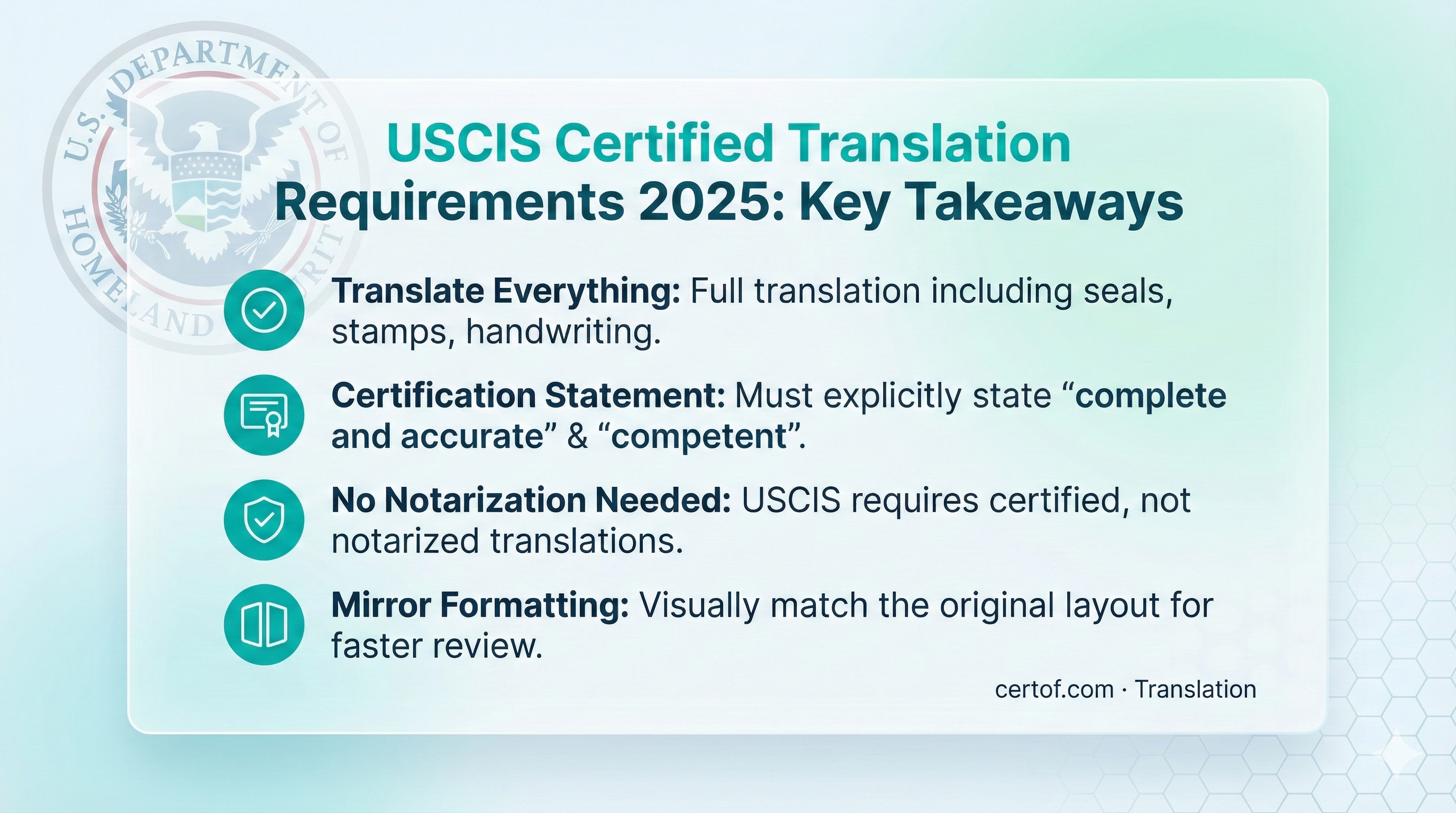
- USCIS translation baseline: under 8 CFR 103.2(b)(3), foreign-language evidence must include a full English translation plus translator certification of completeness, accuracy, and competence.
- Filing timing changed: USCIS states that if you must submit Form I-693 (or partial I-693), you must submit it with Form I-485, or the filing may be rejected.
- COVID policy changed, translation duty did not: USCIS waived COVID-19 vaccination documentation for adjustment applicants on January 22, 2025, but CDC still states that applicants are responsible for reliable English translations of non-English vaccination records.
- CertOf workflow focus: 5-10 minute average turnaround for standard files, from $9.99 per page pricing, mirror formatting, and published refund and compensation policy.
Who This Guide Is For
- I-485 applicants preparing medical and vaccination evidence under tight filing timelines.
- K-1 and family-based applicants with foreign clinic or hospital records.
- Patients filing overseas treatment reimbursement with U.S. insurers.
- Paralegals and family sponsors assembling multi-document packets.
Typical pain points are practical, not theoretical: uncertainty about notarization, fear of a Request for Evidence (RFE), confusion about digital copies, and concern about paying twice after preventable document defects.
2024-2026 Official Timeline: What Changed and What Did Not
| Date | Source | Update | Practical Impact |
|---|---|---|---|
| Ongoing | 8 CFR 103.2(b)(3) | USCIS requires full English translation plus translator certification. | Every non-English medical page in your USCIS packet needs complete certified translation. |
| December 2, 2024 | USCIS alert | I-693 or partial I-693 is required with I-485 when applicable. | Medical translation became a pre-filing task, not a “fix later” task. |
| January 22, 2025 | USCIS alert | COVID-19 vaccination documentation requirement waived for adjustment applicants. | Less paperwork for one vaccine item, but no change to translation rules for other records. |
| March 11, 2025 | CDC Civil Surgeon Technical Instructions | CDC confirms applicant responsibility for reliable English translations of non-English records. | If your vaccination record is non-English, translation quality still affects exam workflow. |
| June 11, 2025 | USCIS alert | I-693 validity policy updated again for forms signed on or after Nov. 1, 2023. | If a related application is denied or withdrawn, you may need a newly completed I-693 for a future filing. |
Note: agency policies can change. Always confirm current instructions before filing.
Why the 2025 COVID Waiver Does Not Reduce Your Medical Translation Burden
This is the counter-intuitive part. Many applicants hear “COVID requirement waived” and assume medical translation is now easier. In practice, reviewers still need clear English evidence for the remaining vaccine lines and medical details that matter to admissibility and record consistency. A weak translation of these legacy records still creates friction and can still trigger an RFE cycle.
The Handwritten Date Trap: Why AI and OCR Often Fail
One recurring failure point is date ambiguity. If a source record shows 01/02/2024, reviewers may read it as January 2 or February 1 depending on context. OCR (optical character recognition) and generic AI tools often misread faint handwriting, lot numbers, or provider initials, especially on older vaccine booklets.
Best practice is explicit rendering such as “2024-02-01 (source format: DD/MM/YYYY)” and careful annotation of stamps or partially legible text. That small discipline prevents weeks or months of avoidable back-and-forth.
What to Translate: USCIS vs Insurance Scenarios
| Scenario | Translate First | Non-Negotiable Details | Main Review Risk |
|---|---|---|---|
| USCIS I-485 / I-693 support | Vaccination pages, provider notes, seal/stamp text, date fields | Complete translation and proper certification statement | RFE or rejection for incomplete foreign-language evidence |
| Civil surgeon exam | Historical vaccine records and relevant lab titers | Reliable English translation for non-English records | Repeat tests, re-vaccination, or follow-up delays |
| Insurance reimbursement | Discharge summary, diagnoses, procedures, invoices, medication lists | Consistent names, dates, units, and structured layout | Claim hold, denial, or payout delay |
Inference from payer practice: private plans typically use payer-specific documentation checklists, so verify your insurer’s translation expectations before submission.
Common Pitfalls and Real Consequences
- Summary instead of full translation: omitted fields, back pages, or footnotes can trigger RFEs or insurer rework requests.
- Ignoring stamps and handwriting: if official marks are not translated or annotated, evidence may be treated as incomplete.
- Raw AI output without accountable human certification: fluent text can still fail legal sufficiency and medical precision checks.
- Name/date mismatch across forms: inconsistent identity data creates manual review delays.
- Paying for notarization by default: for USCIS filings, certified translation is usually the baseline; notarization is often unnecessary unless specifically requested.
CertOf vs Traditional Translation Workflow
| Factor | CertOf | Typical Traditional Workflow |
|---|---|---|
| Turnaround for standard files | Advertised average 5-10 minutes | Often 24-48 hours or longer |
| Entry pricing | From $9.99 per page | Often quote-based and higher for urgent turnaround |
| Output format | Mirror formatting plus certificate PDF and online verification | Formatting depth varies by provider |
| Policy visibility | Public refund and compensation terms | Terms often provided after quoting |
| Ordering model | Online upload-pay-download | Email + manual handoff in many cases |
Order Your Certified Translation in 3 Steps
- Upload: Order certified medical record translation online and submit clear scans or photos.
- Verify pricing: Confirm page count and review transparent certified translation pricing.
- Download: Receive your certified PDF package, then review the refund and compensation policy before filing.
If your case is urgent, high-volume, or medically complex, use translation support contact before submission.
Trust, Privacy, and Submission Hygiene
- CertOf publishes data handling terms in its Privacy Policy.
- Keep source scans clear and legible; low-quality originals often create avoidable rework even when translation is good.
- For high-stakes strategy decisions, align your translation plan with your attorney’s filing strategy.
Deeper Internal Guides for Edge Cases
- what a USCIS certified translation looks like (sample packet)
- difference between certified and notarized translation
- can I use Google Translate for USCIS documents
- how to fix a rejected USCIS translation
- uscis rfe translation services checklist
- how long a certified translation is valid for USCIS
- do I need an ATA certified translator for USCIS
- who can certify a translation for USCIS
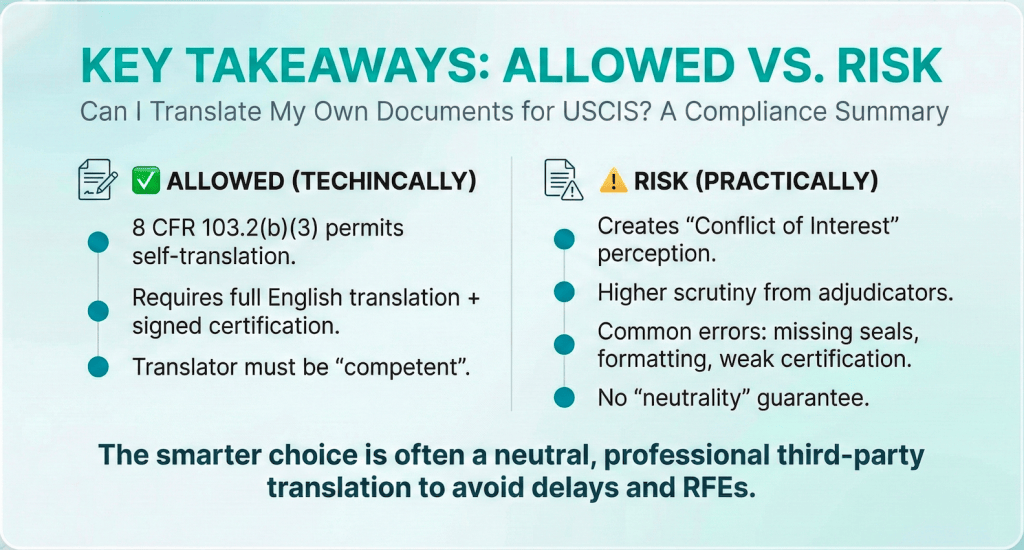
- can I translate my own documents for USCIS
FAQ
Does USCIS accept digital certified translations for medical records?
In many cases, yes, if the translation is complete and includes proper translator certification under 8 CFR 103.2(b)(3). For structure examples, see the USCIS certified translation sample.
Do I need notarization for USCIS medical record translation?
Usually no. USCIS generally focuses on complete translation plus a proper certification statement. Notarization is a separate requirement that some courts or agencies may request. See certified vs notarized translation.
Can I use Google Translate for vaccination records?
Raw machine output is risky for immigration and insurance evidence. A competent human must review and certify the final translation. See Google Translate risks for USCIS.
What should I do if USCIS already sent an RFE about my translation?
Treat it as a document-quality fix, not a rewrite of your whole case. Submit a corrected package with full translation coverage, clear certification language, and clean file organization. Use this USCIS RFE translation services checklist.
How long is a certified translation valid for USCIS?
USCIS does not set one universal expiration date for all certified translations. Reusability depends on document stability and translation quality, while medical forms like I-693 follow separate policy logic. See validity guidance.
Ready to File with Confidence?
Use a certified translation of medical records to english service, confirm pricing, and submit a cleaner packet the first time.