Disclaimer: This article provides general information about USCIS translation practice as of February 28, 2026. It is not legal advice. For legal strategy, consult a licensed U.S. immigration attorney.
About the author: Erin Chen is the Co-Founder and Translation Strategist at CertOf™. Our team handles high-volume immigration document translation workflows focused on USCIS compliance, auditability, and deadline control.
Do I Need ATA Certified Translator for USCIS? Fast Compliance, Fewer RFEs, and Lower Cost in 2026
If you are searching do i need ata certified translator for uscis, here is the real answer: USCIS does not require ATA membership for routine filings. The binding rule is 8 CFR 103.2(b)(3), which asks for a full English translation plus a signed statement that the translation is complete, accurate, and prepared by a competent translator.
For most I-130, I-485, and N-400 packets, the practical risk is not “no ATA badge.” The real risk is technical non-compliance: summary translation, missing seals, weak certification language, or inconsistent names/dates that trigger an RFE and slow your timeline.
Key Takeaways (Featured Snippet Ready)
- No ATA mandate: USCIS requires a compliant certified translation package, not a specific private credential.
- Competence over branding: Officers look for complete translation + correct certification wording + clear accountability.
- Counterintuitive but true: Literal mirror translation is often safer than polished interpretive writing.
- Speed and compliance can coexist: You can order USCIS certified translation services online and still meet USCIS evidence standards.
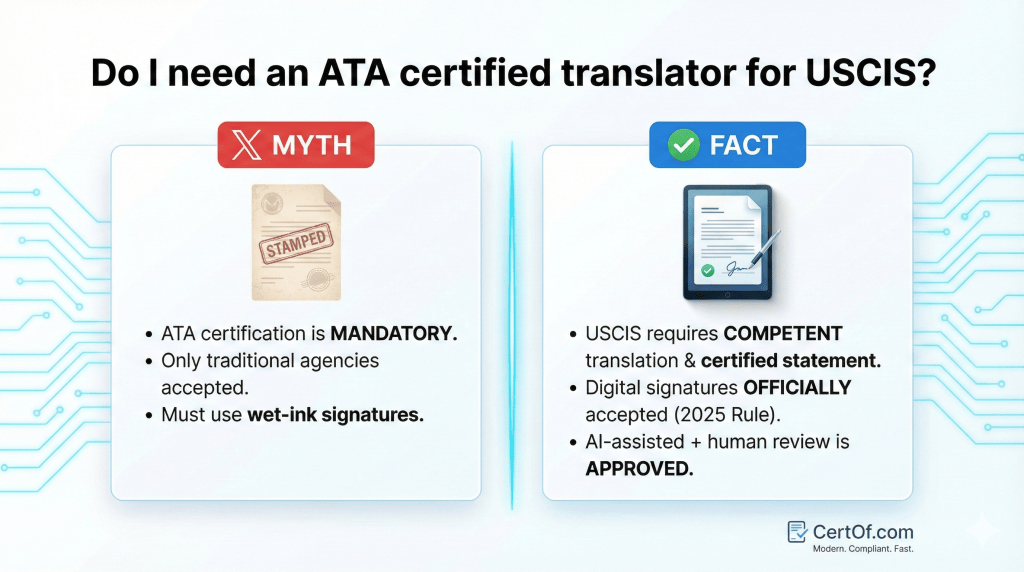
Myth: You need ATA for USCIS. Fact: You need a compliant certified translation package.
Who This Guide Is For (and Why This Search Has High Anxiety)
This guide is for families and applicants who are filing under two pressures at once: immigration deadlines and cost control. Typical scenarios include marriage-based adjustment, parent petitions, naturalization, and RFE repair after a prior translation issue.
The pain pattern is consistent: people receive conflicting advice from forums, overpay for unnecessary credentials, or use low-cost vendors with weak certification templates. The goal here is to show what USCIS really checks so you can buy risk reduction, not noise.
What USCIS Actually Requires Under 8 CFR 103.2(b)(3)
The legal baseline is simple and stable: foreign-language evidence needs a full English translation and a signed translator certification of completeness, accuracy, and competence. USCIS also repeats this requirement in form-level filing guidance (example: Form I-130 page).
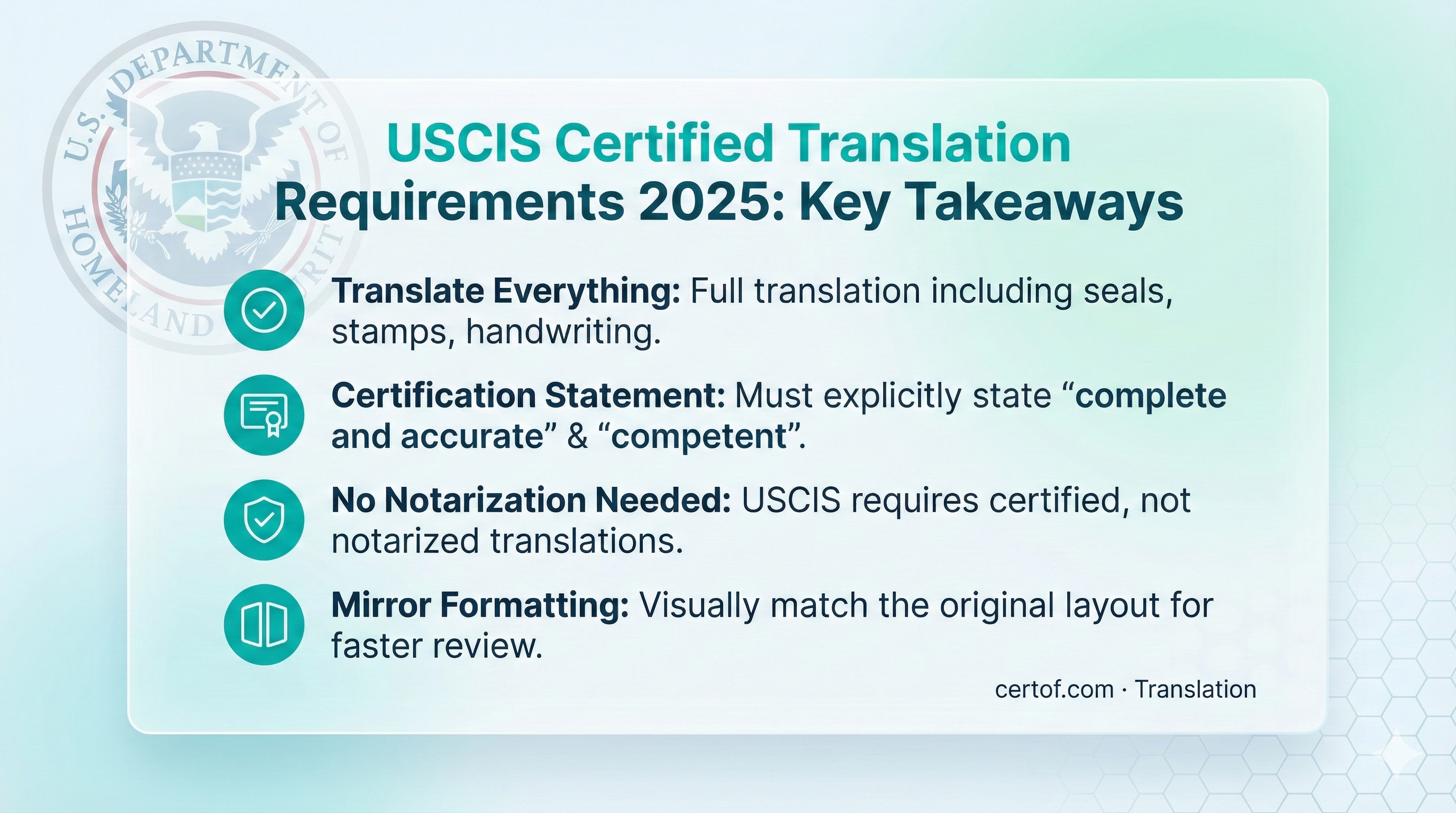
- Complete: All meaningful text is translated, including seals, stamps, side notes, and footers.
- Accurate: Facts are translated faithfully, without reinterpretation that changes meaning.
- Competent: The signer affirms language ability and accepts responsibility for the translation.
ATA certification can be valuable in certain settings, but even ATA client guidance confirms a key U.S. distinction: a certified translation is generally about the translator’s signed statement, not mandatory ATA status. See ATA’s certified translation explanation.
Counterintuitive Point: “Less Elegant” Translation Can Be Safer
Many applicants assume smoother English is always better. For USCIS, not always. Officers compare originals and translations as evidence. If a translator summarizes or rewrites for style, the officer may treat the result as incomplete or imprecise.
USCIS policy guidance on evidence draws a similar boundary: official record extracts can be acceptable, but translator-created summaries are not a substitute for full translation (see USCIS Policy Manual, Volume 1, Part E, Chapter 6). Practical rule: for USCIS document translation, literal and mirror formatting usually beat stylistic polish.
2026 Practice Details: Signatures, Digital Files, and RFE Clock Pressure
USCIS signature standards in policy guidance allow use of copies/reproductions of original handwritten signatures in many contexts, while USCIS can still request originals later (see Policy Manual Part B, Chapter 2). Operationally, this supports PDF-based certified translation workflows when done correctly.
The timeline impact is what hurts most. Under 8 CFR 103.2(b)(8), an RFE period may run up to 12 weeks and a NOID period is shorter (generally up to 30 days). A translation defect is not just a formatting issue; it can consume your response window and push interviews or approvals out by months.
What a Low-Risk Certified Translation Packet Should Contain
- Source document pages in readable order.
- Full English translation with page labels matching the source.
- Explicit treatment of seals, stamps, and handwritten annotations.
- A certificate of translation accuracy signed and dated by the translator.
- Translator identity and contact block for accountability.
- Consistent spelling/date conventions across related documents.
If you want a reference layout, use our USCIS certified translation sample and align your package structure before filing.
Common Mistakes and Real Consequences (Pitfalls Module)
Pitfall 1: Summary Translation of Multi-Page Records
Common in police certificates, tax documents, and court records. Consequence: RFE requesting full translation and possible downstream scheduling delay.
Pitfall 2: Missing Seals, Stamps, Margin Notes, or Reverse-Side Text
What looks “minor” to applicants can be material to officers. Consequence: completeness challenge and avoidable back-and-forth.
Pitfall 3: Inconsistent Name Order and Date Formatting
Example: one page uses surname-first order while another flips to given-name-first without note. Consequence: identity ambiguity and additional scrutiny.
Pitfall 4: Generic Certification That Omits Required Statements
If the certificate does not clearly state completeness, accuracy, and competence, the package can fail compliance review even with good translation quality.
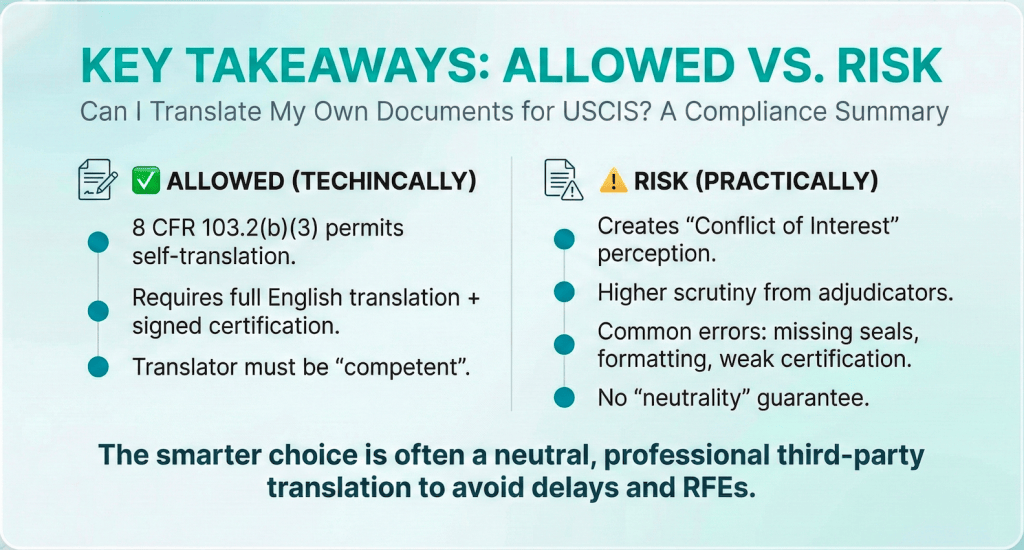
Pitfall 5: Self-Translation or Unreviewed Machine Output
These shortcuts are attractive under time pressure but frequently create repair work. Consequence: RFE, re-translation cost, and potential filing resubmission.
For remediation playbooks, see USCIS rejected my translation and USCIS RFE translation services.
When Paying for ATA-Credentialed Translators May Still Be Worth It
- Highly technical evidence: patent-heavy, medical, or scientific material where subject-matter precision is critical.
- High-conflict legal settings: where counsel wants an extra credential signal for risk management.
- Non-US destinations: jurisdictions that require sworn or court-appointed translators under local law.
For routine USCIS civil documents (birth, marriage, police, household records), a USCIS-focused compliant workflow is usually the more efficient decision than paying credential premiums by default.
CertOf vs Traditional Translation Routes (Price, Time, and Filing Risk)
| Decision Factor | CertOf | Traditional Law Office / Offline Agency |
|---|---|---|
| Typical listed price | $9.99/page transparent | Often higher and quote-based |
| Turnaround speed | 5-10 minutes for many standard files | Commonly 24-48+ hours |
| Formatting method | Mirror-format workflow for easier officer review | Varies by vendor |
| Acceptance protection | 100% USCIS acceptance guarantee + money-back policy | Not always explicit |
| Ordering and delivery | Fully online upload and download | Email chains or office intake |
3-Step Workflow: Upload -> Pay -> Receive Certified Files
For a visual walkthrough, review our upload and order certified translation online guide.
- Upload clear scans/photos through order certified translation online.
- Pay transparent per-page pricing without unnecessary USCIS notarization upsells.
- Receive a filing-ready PDF packet with translation + certificate of accuracy.
If your deadline is close, request a rush slot from our same-day certified translation support team.
Trust Module: Privacy, Institution Coverage, and Urgency
- Privacy and governance: Orders operate under published Privacy Policy and Terms of Service.
- Institution fit: Commonly used for USCIS filings, university documentation, lender underwriting packets, and court-oriented document sets.
- Urgent timelines: Rush handling is available for RFE deadlines and interview date constraints.
Related internal reading: USCIS certified translation requirements, do I need original document with certified translation, and certified vs notarized translation.
FAQ: People Also Ask About USCIS Translation Rules
Do I need an ATA certified translator for USCIS documents?
No. USCIS requires a compliant translation + certification package under 8 CFR 103.2(b)(3). ATA can be optional quality signaling, not a universal filing mandate.
Does USCIS accept online certified translations and scanned signatures?
In many filing scenarios, yes, when USCIS signature guidance and specific form instructions are followed. Keep source originals available in case an officer requests them.
Can I translate my own USCIS documents if I am bilingual?
Usually not recommended. Self-translation creates credibility and quality risk in high-stakes filings. See can I translate my own documents for USCIS.
Can I use Google Translate for USCIS if I edit it?
Raw machine output is risky. If machine tools are used, human expert review and accountable certification are still required. See can I use Google Translate for USCIS.
How long is a certified translation valid for USCIS?
The translation usually remains valid for static documents, but evidence freshness rules may vary by case type. Reference: how long is a certified translation valid for USCIS.
What if USCIS already rejected my translation?
Rebuild the full packet rather than patching a few lines. Use complete literal translation, corrected certification language, and consistent data fields. Start with this USCIS translation rejection guide.
Bottom Line: Buy Compliance, Not a Credential Label
If your question remains “do i need ata certified translator for uscis,” the evidence-backed answer is still no as of February 2026. You need complete translation, proper certification, and a workflow that reduces technical filing risk.
Start your order with fast certified document translation for immigration and keep your case timeline moving.