Port of Spain Family Visa Paperwork Guide: Certified English Translation for Spouse and Fiancé Cases
If you are preparing a U.S. spouse visa, parent or child immigrant visa, or K-1 case in Port of Spain, the hard part is usually not a generic immigration rule. It is getting the right Trinidad and Tobago documents, matching them to your CEAC upload, and making sure every non-English record in the packet has a compliant certified English translation before you reach the embassy. In other words, this is a paperwork and timing problem before it becomes a visa interview problem.
The core immigration rule is national and U.S.-driven. The local differences are practical: the embassy’s document-review workflow, Trinidad and Tobago’s polymer civil-record requirement, the police certificate timeline, strict security rules, and the fact that many applicants only discover their translation problem after mixing English Trinidad records with foreign-language divorce, birth, police, or relationship evidence.
- Key Takeaway 1: Most Trinidad and Tobago civil records are already in English, so translation is usually needed for foreign documents in your packet, not for your local birth or marriage certificate.
- Key Takeaway 2: The U.S. government requires the latest polymer or computer-generated Trinidad and Tobago civil records; older versions can delay the case. See the State Department reciprocity page.
- Key Takeaway 3: In Port of Spain, the medical exam and embassy document review are closely tied in real life. The post’s local timing and entry rules are set out in the Port of Spain instruction PDF.
- Key Takeaway 4: If your packet includes Spanish or any other non-English records, fix the translation before you show up. Do not assume a local notary, a family member, or a machine translation will solve the problem at the last minute.
Who This Guide Is For
This guide is for people in Port of Spain and the surrounding Trinidad and Tobago area who are preparing a U.S. family-based immigrant visa or K-1 fiancé(e) visa case and need to gather local records, organize a mixed-language document packet, and avoid delays at the U.S. Embassy in Port of Spain. It is especially useful if your packet combines English Trinidad and Tobago documents with Spanish or other foreign-language records, such as a foreign birth certificate, divorce decree, police certificate, chat logs, or relationship evidence. The most common document mix is birth or marriage records, a police certificate, passport pages, sponsor forms, and relationship evidence, with the biggest problems showing up when an applicant brings an old civil record, mismatched CEAC versions, or untranslated foreign records.
Port of Spain Family Visa Paperwork: Where Cases Get Delayed
The most important local reality is that this is an English-language administrative environment. That sounds easy, but it creates a trap. Many applicants assume that because Trinidad and Tobago documents are in English, translation is a minor issue. In fact, translation becomes critical precisely when the case is international: a previous marriage in Venezuela, a child’s birth in another country, a police certificate from a non-English-speaking jurisdiction, or relationship evidence in Spanish.
The second local reality is that Port of Spain is unforgiving about document format. The State Department’s Trinidad and Tobago reciprocity guidance says birth, marriage, death, and adoption records must be the latest polymer or computer-generated versions. Older records are a common reason people lose time.
The third reality is workflow. The embassy’s local instructions are not just about showing up for one interview. They set out a document-review process tied to the medical exam, which means your packet needs to be final before that local handoff happens. If your translation, originals, and uploaded scans do not line up, you are solving the problem under time pressure in Port of Spain, not from the comfort of home.
What Documents You Usually Need from Trinidad and Tobago
Most applicants will need some combination of these local records:
- Birth certificate, marriage certificate, death certificate, or adoption record from the Registrar General’s Department
- Certified copy of a divorce order or Decree Absolute if there was a prior marriage
- Certificate of Character from the Trinidad and Tobago Police Service
- Passport bio page and old passports where travel history matters
- Supporting identity or family records for children, stepchildren, or adoptions
For civil records, the Registrar General’s Department operates from AGLA Tower, Government Plaza, corner of London and Richmond Streets, Port of Spain. The office explains its walk-in and online request options on the official civil registry page, including its usual walk-in hours. If your case involves a prior divorce, the Family Court at Cipriani Place is part of the local document chain for certified copies.
For the police certificate, Trinidad and Tobago uses the Certificate of Character process. The official government guidance says applicants apply online and then attend fingerprinting, with a typical processing window of about two to three weeks. See the government Certificate of Character page. That timeline matters because it is one of the few truly fixed local bottlenecks in an otherwise case-by-case process.
When You Need Certified English Translation
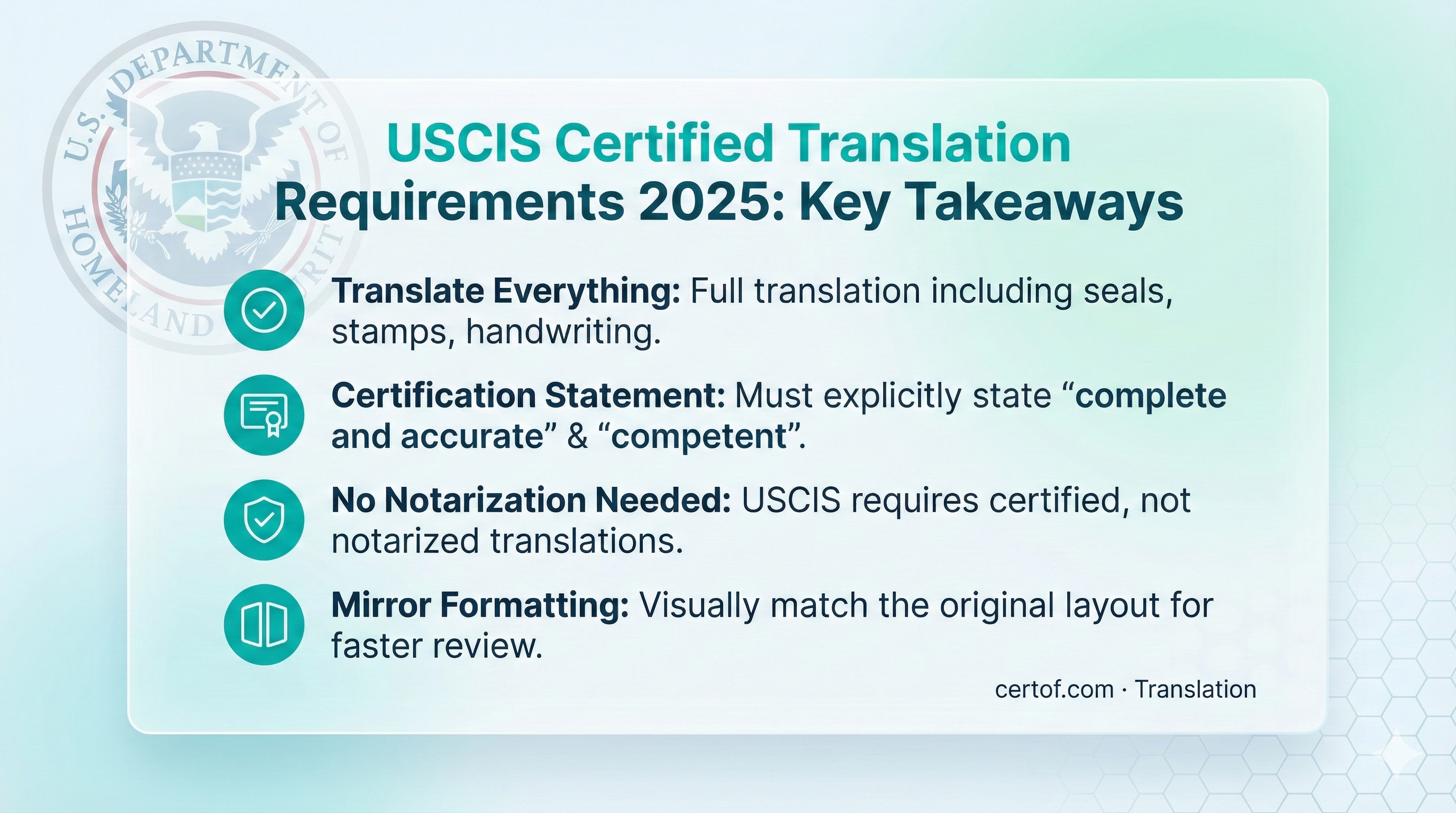
For Port of Spain cases, the clean rule is this: if the document is not in English, treat certified English translation as mandatory. The U.S. visa instructions for Port of Spain say documents not in English must be accompanied by a certified English translation in a form accepted by the U.S. government. That requirement comes from the U.S. side, not a special Trinidad rule.
In practical terms, translation usually becomes necessary for:
- Foreign birth, marriage, divorce, death, or adoption certificates
- Foreign police certificates
- Court orders or custody records from non-English-speaking countries
- K-1 or spouse-visa relationship evidence in Spanish or another language, including selected chat records, captions, and explanations where they are part of the packet
- Foreign tax, employment, or civil-status records when the consular file needs them
You usually do not need to translate a standard Trinidad and Tobago polymer birth or marriage certificate because it is already in English. That is the counterintuitive part of this location: the translation problem is usually not local paper; it is foreign paper inside a local case.
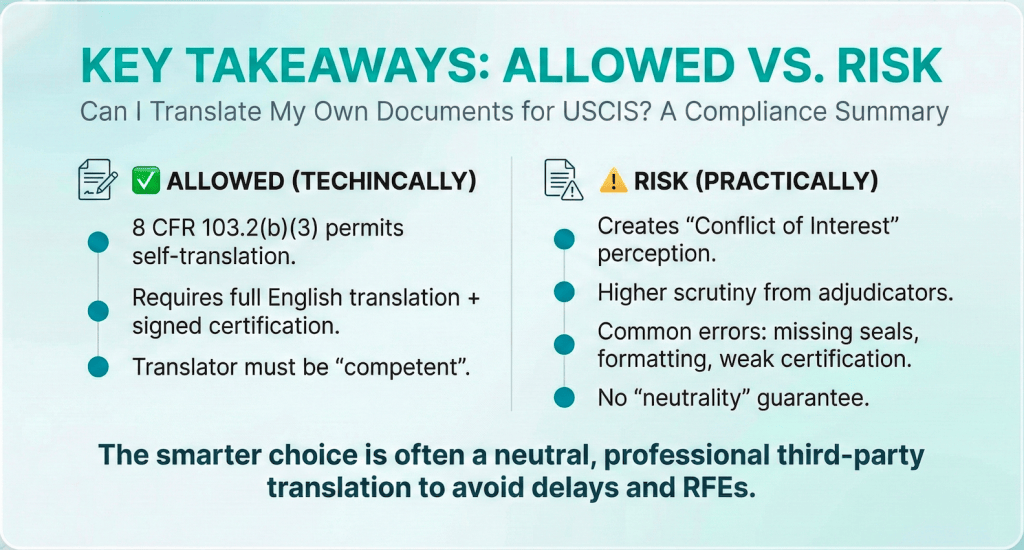
For broader USCIS-standard questions about who can translate, whether you can translate your own documents, and why notarization is a different issue, see our related guides on who can certify a translation for USCIS, whether you can translate your own documents, and certified vs. notarized translation. If one of your problem documents is a marriage record, police certificate, or K-1 packet exhibit, our document-level guides on marriage certificate translation for USCIS, certified translation of police clearance certificates, and the K-1 fiancé visa packet translation checklist cover the generic rule in more detail.
U.S. Embassy Port of Spain Document Review and Medical Workflow
Port of Spain is one of those posts where local workflow matters almost as much as the file itself. According to the Port of Spain immigrant visa instructions, applicants complete the medical exam with the panel physician and then handle document review according to the post’s local process before the visa interview.
The designated panel physician is Dr. Renata Pooran, 23 Lucknow Street, St. James, Port of Spain. The embassy instructions list the office contact details, appointment-only scheduling, and payment conditions, including exact U.S. dollar cash requirements that applicants should verify before the visit. If your file includes non-English documents, they need to be translated, printed, and ready before you enter that medical-to-embassy sequence.
The U.S. Embassy is at 15 Queen’s Park West, Port of Spain, with the public consular entrance on Marli Street. The local instructions explain that document review follows the post’s specific walk-in timing after the medical exam and warn applicants about security: do not bring phones, electronics, or bags beyond what the post allows. Bring a clear, organized file. In applicant timelines, one repeated source of stress is not the interview itself but the scramble between medical timing, document review timing, originals, and translated copies.
Local Timing, Cost, Mailing, and Scheduling Reality
Here is the realistic local timeline most people should plan around:
- Civil records: The Registrar General offers walk-in and online options. Walk-in service is typically offered during the office’s posted business hours, while online requests can add delivery time even when the record is issued quickly.
- Police certificate: The Certificate of Character usually takes about two to three weeks after the online request and fingerprint step. That makes it an early action item, not a last-week task.
- Medical exam: Appointment only. You need to build the embassy’s local document-review timing around it.
- Authentication or apostille: Usually not needed for routine U.S. immigrant-visa translation compliance. Most readers need translation accuracy more than local authentication.
- Passport return: The embassy’s local guidance warns applicants to expect courier return rather than same-day hand-back, so do not plan travel around immediate passport pickup.
For cost, the most concrete public numbers are usually the government document fees, such as the civil-record and police-certificate fees listed by the relevant agencies. Translation cost is less standardized because it depends on language pair, handwriting, certification page, urgency, and whether you need a full packet or only selected exhibits translated. If you want a realistic sense of turnaround and delivery formats before ordering, our guides on fast certified translation benchmarks, electronic certified translation formats, and how to upload and order certified translation online are the most relevant starting points.
Common Port of Spain Pitfalls
- Bringing the wrong Trinidad civil record. Older certificates are a known problem. If your birth or marriage record is not the current polymer or computer-generated version, fix that first.
- Assuming local English means no translation issue. The translation issue usually comes from foreign records in the packet, not the Trinidad documents.
- Uploading one version and carrying another. Problems start when CEAC uploads, originals, and translations do not match cleanly.
- Starting the police certificate too late. Two to three weeks is long enough to derail a rushed schedule.
- Showing up with loose files and electronics. Port of Spain has strict security and a real-world queue environment; organized paper matters.
Applicant reports across VisaJourney timelines and NVC-related discussion forums point to the same pattern: Port of Spain cases often go sideways because of document format and timing, not because the legal category is unusually exotic. That makes translation quality and packet consistency much more valuable than last-minute improvisation.
Understanding Port of Spain Document Timelines and Rejection Risks
In Port of Spain, missing operational timelines or misunderstanding document rules causes predictable delays. The police-certificate requirement creates a hard two-to-three-week wait. The polymer-record rule turns an apparently minor paperwork detail into a hard acceptance issue. Success depends on strict file matching between your CEAC uploads and your physical papers, plus a workflow that compresses medical, document review, and interview preparation into a narrow sequence.
That is why applicants who look fully prepared on paper can still lose time locally. A correct visa category does not fix an old certificate, a late police record, or a missing certified English translation for a foreign divorce decree. In this post, good paperwork discipline is a real local advantage.
Local Rules, Support Nodes, and Complaint Paths
This is a case type where the main rule is federal and U.S.-driven, while the local differences sit in records, logistics, and support channels. For normal cases, you do not need a special Trinidad sworn-translator label for the U.S. embassy. What you need is a compliant certified English translation for any non-English record.
If you are dealing with a local civil or family-law problem that affects the packet itself, such as obtaining a divorce record or sorting out a custody document, the Legal Aid and Advisory Authority may be relevant for income-qualified residents. That is a legal-support path, not a translation path.
For scam and fraud issues, the U.S. Embassy in Trinidad and Tobago publishes a scam alert page covering common visa-related fraud patterns. If the problem is a local consumer issue with a service provider, use Trinidad and Tobago’s normal consumer-protection channels in parallel rather than waiting until your interview date is close.
Provider Comparison: Translation and Related Help
Commercial Translation Options
| Provider | Public signal | Best fit | Boundary |
|---|---|---|---|
| CertOf | Online certified translation workflow, PDF delivery, revision support, and immigration-focused content across USCIS and visa document types | Applicants with Spanish or other non-English records who need a clean certified English translation before document review | Strictly handles the certified English translation of non-English records; not a law firm, not an embassy representative, and not a government filing service |
| Local registered public translators in Trinidad and Tobago | Local-use translation option for some domestic paperwork contexts | Special cases where another local institution separately asks for a local translator | For U.S. family visas, this status is not the embassy’s core requirement; the key issue is a compliant certified English translation |
For most readers of this guide, the practical default is simple: if your packet includes foreign-language civil records, get the translation done accurately, in a format you can print and carry, and keep the translated version aligned with the document you uploaded. If you want predictable delivery and a straightforward ordering path, start with CertOf’s order page, review how revision and turnaround work, and decide whether you also need a mailed hard copy through our guide on hard-copy certified translation delivery.
Legal and Public Resources
| Resource | Public signal | Good fit | Boundary |
|---|---|---|---|
| Legal Aid and Advisory Authority | Public legal-aid body in Trinidad and Tobago for qualifying residents | Local civil or family-law document problems that affect the packet | Not a U.S. visa strategy service and not a translation provider |
| Embassy fraud-reporting channels | Official U.S. government reporting path for visa-related scams | Fake appointment offers, payment scams, or suspicious document services | They handle fraud reporting, not translation or case preparation |
What to Do Before You Go to the Embassy
- Replace any old Trinidad and Tobago civil record with the latest polymer or computer-generated version.
- Start the police-certificate process early.
- List every non-English document in the packet, including foreign civil records and any relationship evidence you plan to rely on.
- Get certified English translation for those non-English items and keep the translation matched to the exact document version you uploaded.
- Print a clean packet and remove anything you cannot take through embassy security.
- Build your medical and document-review timing around the Port of Spain post’s local instructions.
FAQ
Do Trinidad and Tobago documents need translation for a Port of Spain family visa case?
Usually no, because the standard Trinidad and Tobago civil records are already in English. The bigger issue is making sure they are the correct current version, especially polymer or computer-generated civil records where required.
Can I use my old birth certificate or marriage certificate?
That is risky. The U.S. State Department’s Trinidad and Tobago reciprocity guidance points applicants to the latest polymer or computer-generated versions, so older records are a common delay point.
How long does the police certificate take in Trinidad and Tobago?
The official Certificate of Character guidance says applicants should expect roughly two to three weeks after the online request and fingerprint step. Do not leave it to the last minute.
Do I need a local sworn translator in Port of Spain?
For a normal U.S. family-visa packet, the core requirement is a compliant certified English translation for any non-English document. The embassy does not make a local sworn-translator label the main issue.
What kinds of foreign documents are most likely to need translation?
Foreign birth certificates, divorce decrees, police certificates, court orders, and selected relationship evidence such as chat logs or captions when they are part of the packet.
Can I fix translation problems after the medical exam?
You may be able to fix translation problems later, but that is exactly the kind of avoidable delay this guide is trying to help you avoid. Port of Spain works best when your packet is already complete before the local medical-to-document-review sequence starts.
Disclaimer
This guide is for document-planning and translation-preparation purposes only. It is not legal advice, and it does not create an attorney-client relationship. Embassy procedures, document fees, and scheduling rules can change, so always confirm the current requirement with the relevant government source before relying on any checklist.
CTA
If your Port of Spain case includes Spanish or other non-English records, handle the translation before you enter the embassy workflow. CertOf can help with certified English translations for mixed family-visa packets, including civil records, police certificates, and supporting evidence, with digital delivery and revision support built for document review. You can start your order here, learn how online ordering works, or compare options in our guides to budget-friendly certified translation and digital versus paper delivery.