Disclaimer: This article provides general information about USCIS document translation rules and filing practice. It is not legal advice. For legal strategy or case-specific risk, consult a licensed immigration attorney.
About the author: Erin Chen is the Co-Founder and Translation Strategist at CertOf. She works on USCIS-facing translation QA, bilingual risk control, and repeat-filing document systems.
Last reviewed: March 2, 2026.
Can I reuse certified translation for multiple USCIS cases? 2026 digital master checklist for fast, compliant filing
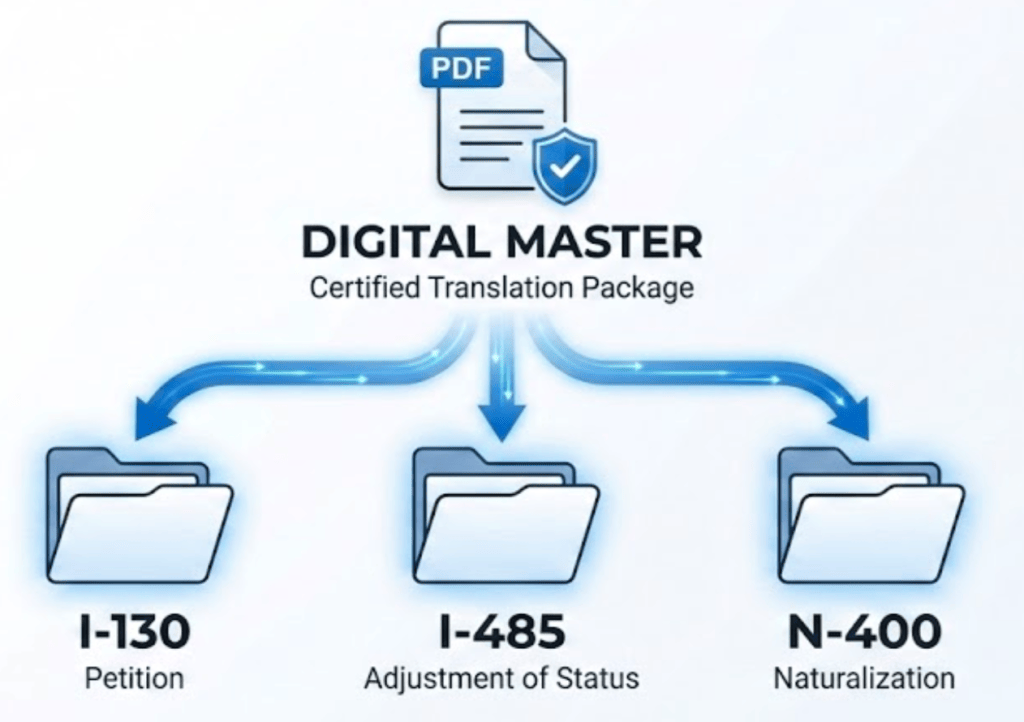
If you searched for reuse certified translation multiple uscis cases digital master checklist, the short answer is yes in most filings. You can usually reuse one USCIS certified translation packet across I-130, I-485, and later N-400 if the source record is the same version and each filing includes a complete packet.
Key Takeaways
- Reuse is usually allowed: same source document version, same complete translation packet.
- No fixed USCIS expiration date: the rule focuses on completeness and accuracy, not translation age.
- Biggest avoidable risk: missing certification page, blurred re-scan, or document version mismatch.
- Fast compliance path: keep one clean Digital Master PDF and upload a full packet for every new case.
If you need baseline rule detail first, read our USCIS certified translation requirements guide. If you want to start immediately, you can order USCIS certified translation services online.
Who this guide is for (and where people lose time)
This guide is written for applicants and families who file in stages: petition first, adjustment later, naturalization later. The pain point is simple: you do not want to pay twice for the same document translation, but you also cannot risk an RFE because of a preventable formatting or packet error.
- You filed I-130 and now need I-485 with mostly the same civil records.
- You are preparing N-400 and want to reuse old marriage, birth, or divorce translations safely.
- You are budget-sensitive and want predictable pricing, not retranslation for no reason.
- You are worried about high-stakes delays from a missing page or unreadable upload.
What USCIS actually requires in 2026 (official baseline)
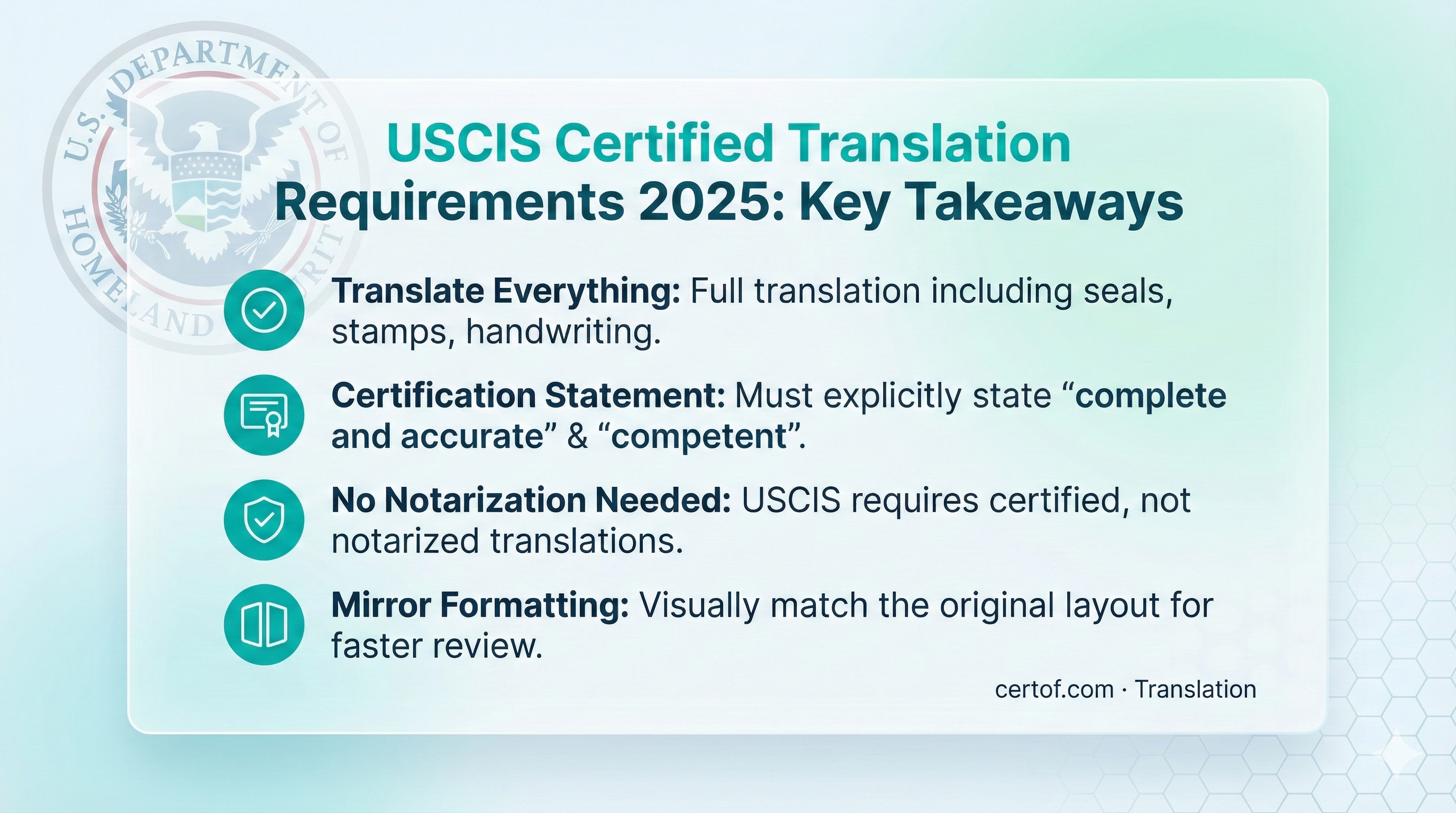
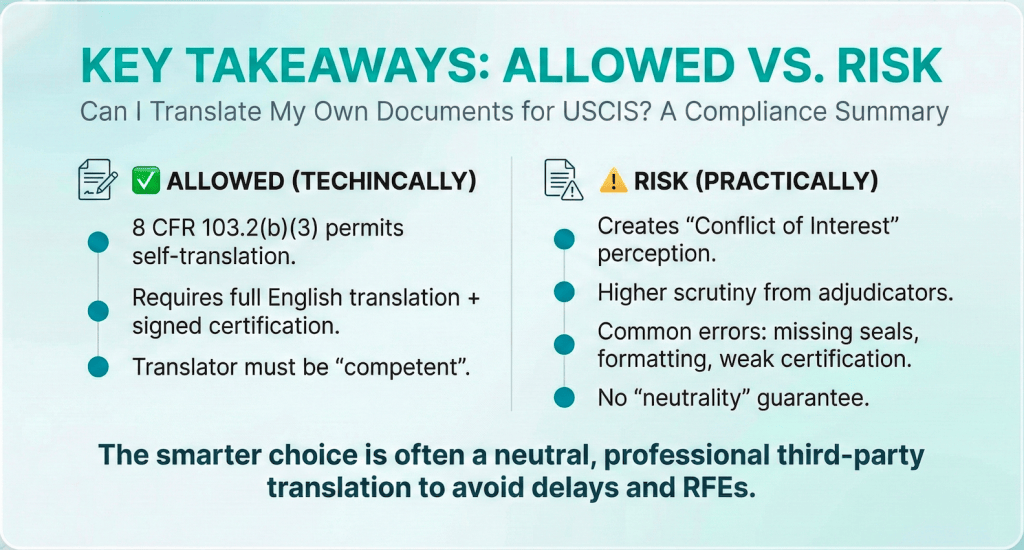
As of March 2, 2026, the core USCIS translation baseline is unchanged: 8 CFR 103.2(b)(3) requires a full English translation plus a translator certification of completeness, accuracy, and language competence. You can also see the official CFR publication on GovInfo.
USCIS repeats the same standard in its policy manual. In USCIS Policy Manual, Volume 1, Part E, Chapter 6, USCIS also clarifies a practical point many people miss: translator summaries are not accepted as substitutes, while official extracts from a proper record keeper may be accepted if they contain all decision-relevant facts.
The checklist language on the USCIS form pages is consistent across family and naturalization flows, including Form I-130, Form I-485, and Form N-400.
- USCIS does require: full translation, translator certification, readable supporting evidence.
- USCIS does not publish: a universal expiration date for certified translations.
- USCIS may request: original documents later if needed for adjudication.
Counterintuitive point: a Digital Master PDF is often safer than paper
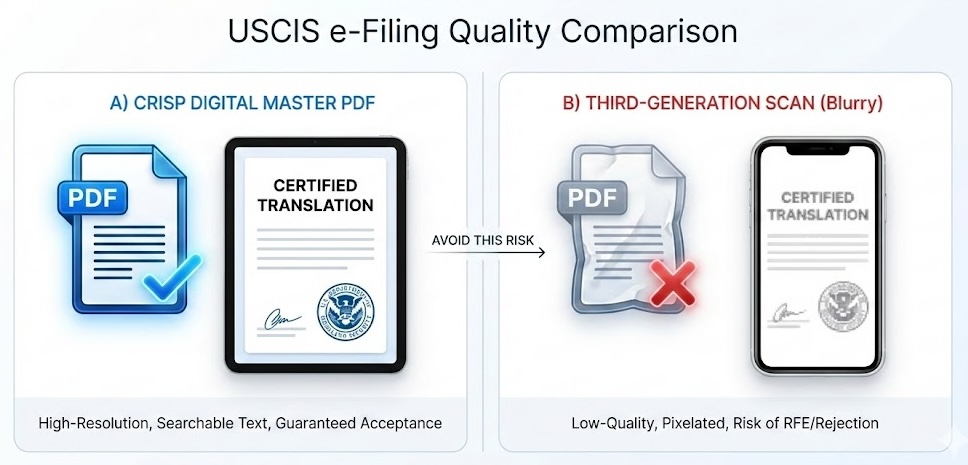
Most people assume paper is safer. In modern e-filing, the opposite is often true. Repeated print-scan cycles create generation loss: faint seals, skewed text, shadowed margins, and low-contrast stamps. That is exactly how a previously valid translation packet becomes risky during reuse.
We recommend a controlled Digital Master workflow: keep one original certified PDF packet untouched, then export submission copies when needed. If you want file-format detail, see our guide on electronic certified translation PDF vs Word vs paper.
Pro tip: Do not rely on default phone camera mode for final uploads. Use a true scanning workflow (flat perspective, full page edges, readable seal contrast) to reduce avoidable RFE risk.
2026 reuse certified translation multiple uscis cases digital master checklist (before every re-upload)
- 1) Confirm source identity: same document number, issue date, seal, QR code, and backside content.
- 2) Confirm full translation coverage: stamps, handwritten notes, footers, margin notes, and reverse side text are included.
- 3) Confirm certification page is attached: do not upload translation pages without translator certification.
- 4) Confirm legibility at 100% zoom: officer must read names, dates, serials, and seals without guessing.
- 5) Confirm upload compatibility: follow USCIS file guidance (including size and clarity limits) on Tips for Filing Forms Online.
- 6) Confirm version control: file names should show document type, language pair, and revision date.
- 7) Confirm per-case completeness: each new receipt number gets its own full packet upload.
- 8) Confirm no triggering change: if the authority reissued the record, treat it as a new source and get a new translation.
Related reading: do I need the original document with certified translation for USCIS and how long a certified translation is valid for USCIS.
Form-by-form reuse map: I-130, I-485, N-400
Before each filing, cross-check current evidence expectations on the official USCIS form pages for I-130, I-485, and N-400.
| Form | Common reusable items | What to verify before reuse | Frequent failure mode |
|---|---|---|---|
| I-130 | Marriage certificate, birth records, prior divorce records | Same certificate version and complete certification page | Newly reissued civil record paired with old translation |
| I-485 | Civil status records already translated for petition stage | PDF readability and packet order for online upload | Compressed file causes illegible seal text |
| N-400 | Long-standing civil records that did not change | No data mismatch after years, still fully legible | Old scan copy missing one page or faded details |
Common mistakes and risks (Pitfalls)
- Ghost stamp mismatch: you renewed a certificate with new metadata, but reused an old translation. Likely result: RFE and rework.
- Partial packet upload: translated pages uploaded, certification page omitted. Likely result: translation deficiency notice or RFE.
- Third-generation scan blur: repeated print-scan cycle degrades names and seals. Likely result: illegibility challenge and delay.
- Machine-only output without accountable certification: no competent human certification tied to the final text. Likely result: credibility and completeness concerns.
- One document reused for different people: same template applied where personal details differ. Likely result: inconsistency findings and costly correction.
If you are already in a bad cycle, start with USCIS rejected my translation, then review a clean USCIS certified translation sample.
USCIS filing stage vs consular interview stage: important nuance
Another counterintuitive reality: your translation may still be reusable while the underlying civil document is not. For consular processing, document recency can be post-specific. If your case includes police certificates, verify both document recency and translation completeness. For Department of State civil-document timing, see DOS immigrant visa civil documents guidance.
CertOf vs traditional routes: speed, cost, and acceptance risk
| Factor | CertOf digital workflow | Traditional offline route |
|---|---|---|
| Starting price | $9.99 per page, transparent | Often quote-based, variable surcharges |
| Turnaround | As fast as 5-10 minutes for standard files | Often 24-72 hours or longer |
| USCIS acceptance safeguard | 100% USCIS acceptance guarantee policy | Usually no formal acceptance guarantee |
| Reuse-ready formatting | Mirror formatting and packet structure | Inconsistent layout across providers |
| Order experience | Fully online upload, payment, delivery | Email chains, office visits, fragmented handling |
3-step CertOf process (upload to certified packet)
- Step 1 – Upload: submit your files at order USCIS certified translation services online.
- Step 2 – Pay: transparent pricing from $9.99/page, no hidden notarization upsell for standard USCIS requirements.
- Step 3 – Receive: get a complete packet with translation + certification, formatted for reuse and portal submission.
Need confidence before purchase? Review our money-back certified translation policy, our acceptance and revision standards, and our fast certified translation benchmarks by document type.
- Privacy: encrypted transmission and access-controlled handling for sensitive immigration records.
- Institution coverage: USCIS, universities, banks, employers, and court-facing document workflows.
- Rush options: urgent queues and hard-copy support paths when your deadline is close.
You can also compare service flow in upload and order certified translation online and decide whether you need hard-copy certified translation mailed overnight.
FAQ
Can I reuse the same certified translation for multiple USCIS cases in my family?
Yes, if the shared source document is the exact same document version and each filing includes the complete packet. For household planning, see certified translation for parents immigration documents and bundle price for full immigration packet translation.
Does USCIS keep old translations on file for my new case?
Do not rely on that assumption. Treat every new filing as a new evidence packet and upload the required translation set again. This avoids record-fragment issues and helps adjudicators review your case faster.
Do certified translations expire for USCIS?
USCIS does not publish a universal expiration rule for certified translations. Reuse fails when the source document changes, the packet is incomplete, or the file becomes unreadable. Full discussion: how long is a certified translation valid for USCIS.
Can I submit a scanned copy of certified translation for USCIS?
Usually yes, if the upload is complete and legible. If readability drops, risk rises. For practical file strategy, read electronic certified translation PDF vs Word vs paper.
What should I do if USCIS rejected my translation?
Fix root causes, do not patch blindly. Rebuild one clean packet: source document, full translation, correct certification, and clear PDF. Then respond within your notice deadline. Start with USCIS rejected my translation and verify structure against a USCIS certified translation sample.
Bottom line
Yes, you can usually reuse one certified translation across multiple USCIS cases. The safe rule is strict: identical source version, complete packet every time, and clean digital evidence quality. If you want a professional setup built for reuse, get fast certified translation from $9.99/page, review refund and acceptance terms, or explore official certified translation services by CertOf.