Ukraine Occupied-Territory Civil Records for U.S. Family Immigration
If you are preparing a spouse, parent, or child case and your key records come from occupied Crimea or occupied parts of Donetsk, Luhansk, Kherson, or Zaporizhzhia, the first question is not translation quality. In U.S. family immigration cases involving Ukraine occupied-territory civil records, the first question is whether your document is legally usable at all. Only after you have a Ukrainian-valid certificate, court decree, or DRACS extract does certified English translation become the right next step.
This guide focuses on that narrow problem. It is not a full family-immigration walkthrough, and it is not a generic USCIS translation article with a country name added.
Key Takeaways
- Counterintuitive but critical: translation is usually step three, not step one.
- According to the U.S. Department of State reciprocity page for Ukraine, marriages and divorces performed in occupied Crimea and occupied parts of Donetsk, Luhansk, Kherson, and Zaporizhzhia are not legally recognized in Ukraine and are not valid for U.S. immigration purposes.
- For births and deaths from occupied territory, the same reciprocity page says applicants may need a Ukrainian court decree first, and then a valid Ukrainian birth or death certificate.
- Ukraine’s Law No. 2217-IX lets occupation-issued civil records be attached as supporting evidence when applying for Ukrainian state registration, but it does not turn them into Ukrainian-valid certificates by itself.
Who This Guide Is For
This guide is for people dealing with U.S. family immigration cases connected to Ukraine at the country level, especially where the key birth, death, marriage, or divorce records come from occupied territory and the applicant now needs a document set that USCIS or the National Visa Center can actually use.
It is most useful if your file includes a mix of occupation-issued records, later Ukrainian court decisions, re-issued Ukrainian certificates, DRACS extracts, passport pages, and name-change records, usually in Ukrainian or Russian that now need English translation. Typical readers include:
- a spouse-visa applicant with a marriage record from occupied Crimea;
- a parent or child case where the birth happened in occupied territory;
- a family petition where an old Russian spelling and a newer Ukrainian spelling do not match;
- someone abroad who only has scans or phone photos and needs to know which document must be fixed before translation.
Why This Issue Is Different in Ukraine
This topic is governed mainly by national Ukrainian civil-status law and U.S. federal immigration document rules. There is no meaningful city-by-city immigration translation rule to describe here. The local differences are in record validity, wartime logistics, digital-service limits, court remediation, mailing reality, and support resources.
The most important split is this:
- Marriage and divorce from occupied territory: legal-recognition problem.
- Birth and death from occupied territory: court-decree and re-issuance problem.
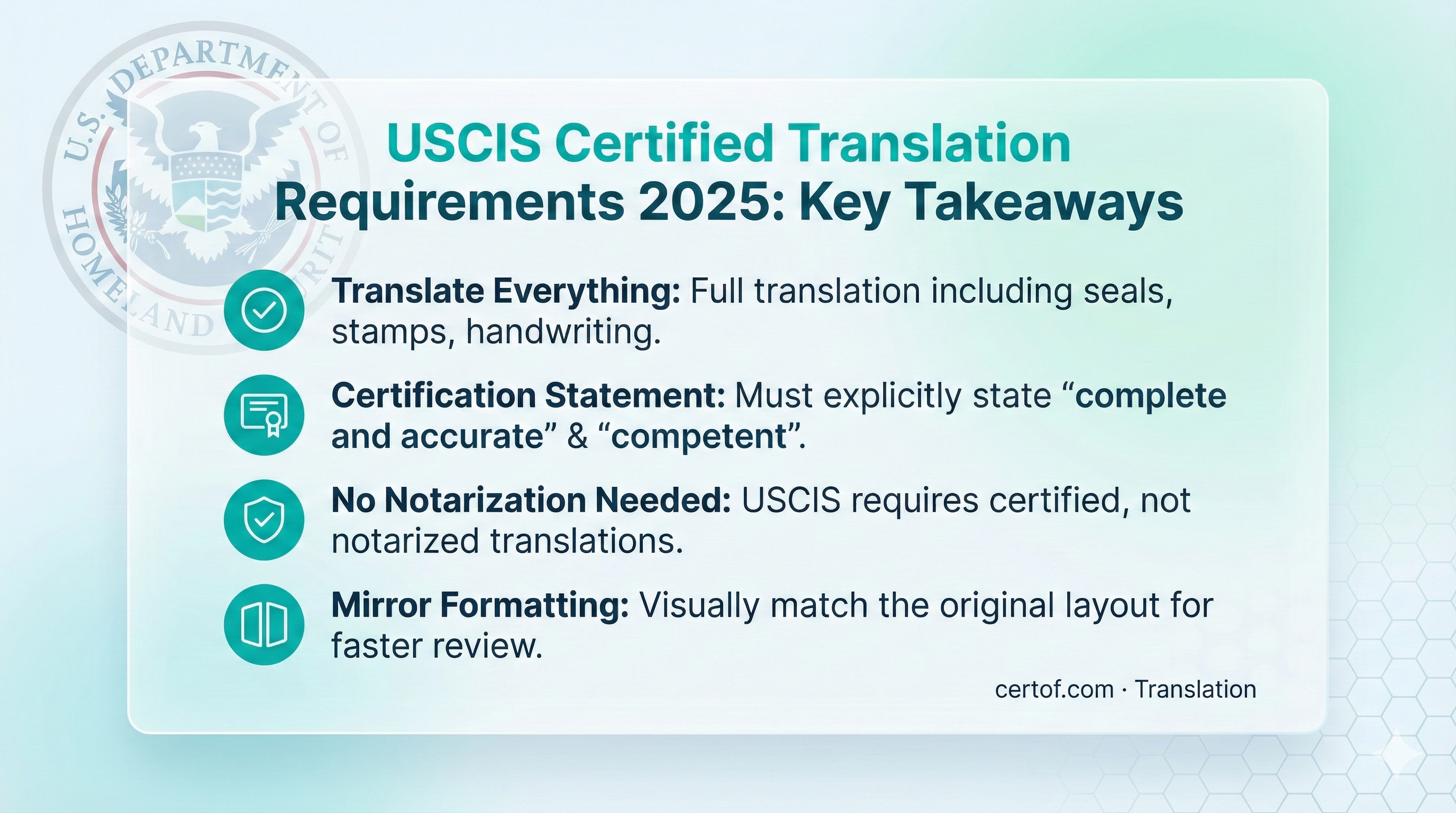
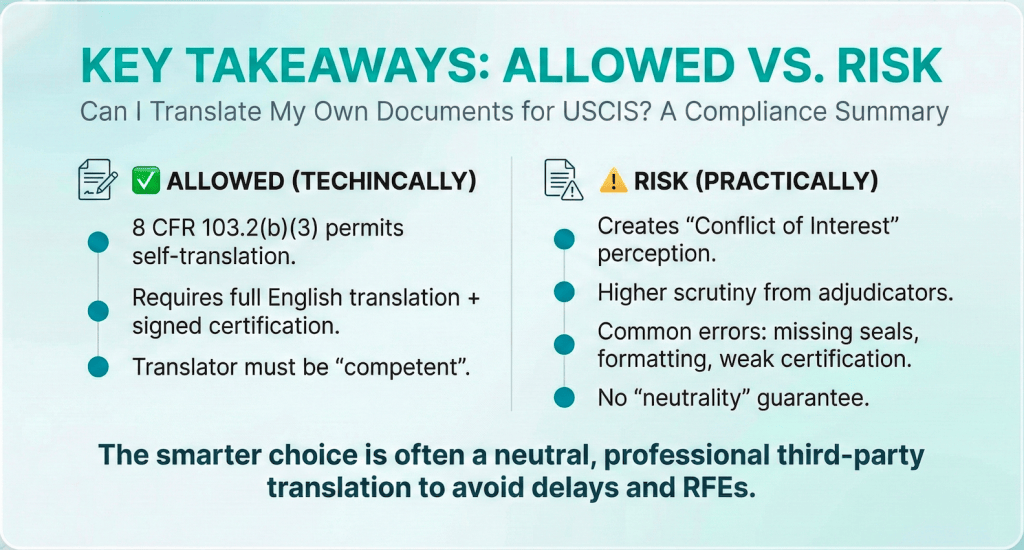
That split matters more than any general article about certified translation. If you need a refresher on the general USCIS translation rule, keep it short and use our existing references: USCIS certified translation requirements, who can certify a translation for USCIS, and whether you can translate your own documents.
Ukraine Occupied-Territory Civil Records for U.S. Family Immigration: The Working Order
- Identify the record type. Do not treat birth, death, marriage, and divorce as interchangeable.
- Fix legal validity first. For many occupied-territory cases, that means a Ukrainian court decree, a Ukrainian re-issued certificate, or a DRACS extract.
- Translate the final Ukrainian-valid record set. That often means the re-issued certificate plus the court decree, and sometimes an extract that explains a surname change or prior marital status.
- Then assemble the U.S. filing packet. At that stage, certified English translation becomes the document-preparation tool that reduces RFEs and rework.
U.S. Validity Rules by Ukrainian Document Type
Marriage and divorce records
The State Department reciprocity page is unusually clear here: marriages and divorces performed in occupied Crimea and occupied parts of Donetsk, Luhansk, Kherson, and Zaporizhzhia are not legally recognized in Ukraine. For family immigration, that means a clean English translation of the occupation-issued marriage or divorce paper does not fix the underlying problem.
For a spouse case, readers need a blunt answer: if the legal relationship was created only through an occupied-territory record, the real task is not “get it translated faster.” The real task is to establish a Ukrainian-recognized legal relationship first.
Birth and death records
Birth and death records follow a different logic. The same reciprocity page states that Ukrainian authorities do not issue birth or death certificates based solely on Russian-authority or proxy-issued documents from occupied territory, but affected individuals may seek a Ukrainian court decree to obtain a valid Ukrainian birth or death certificate. This is where the working chain usually becomes:
occupation record -> court decree establishing the fact -> Ukrainian certificate or extract -> certified English translation
Ukraine’s 2022 Law No. 2217-IX matters because it allows occupied-territory civil records to be attached as evidence when applying for state registration. That helps explain why applicants often still need the occupation-issued paper in the file, even though it is not the final document they should rely on for the U.S. case.
How to Actually Get a Usable Ukrainian Record
For many readers, this is the real bottleneck. Translation becomes useful only after this stage.
1. Court route for birth or death facts
If the birth or death happened in occupied territory and the only record you have is occupation-issued, the Ukrainian court route is often the practical bridge to a valid Ukrainian certificate. Community reports from Reddit, VisaJourney, and Ukrainian rights groups are consistent on one point: applicants who skipped this step and sent only the occupied-territory record with translation ran into rejection or rework.
A 2025 Ministry of Justice rule update, Order No. 3567/5, states that birth registration based on a court decision on the fact of birth in occupied territory can be completed by the DRACS office at the place where the court decision was issued, or by any DRACS office at the applicant’s request, on the day the decision is received. That is a major practical point for people who assume they must return to the original region.
2. DRACS re-issue or extract
Ukraine’s civil-status system is centralized enough that the decisive document is often not the first paper you have in hand, but the later Ukrainian record: a re-issued certificate or an extract from the civil-status register.
This matters especially in family cases involving:
- premarital surname proof;
- divorce history;
- name changes after marriage or divorce;
- a need to connect an older Russian-language record with a newer Ukrainian-language record.
For readers dealing with surname continuity, the practical question is often not “Do I need translation?” but “Do I need the full certificate, the court decision, or a DRACS extract that shows the registry history?”
3. Diia, mailing, and wartime limits
Diia’s re-issued birth certificate service lists a standard service time of 3 working days and a fee of 51 kopiykas, but it also warns that air raids and power outages can delay review. Diia’s marriage certificate re-issue page explicitly says the service is unavailable in temporarily occupied territories and active combat zones. The marriage extract page also says the service is unavailable in occupied territories and active combat zones and lists a fee of 73 UAH.
That is why many affected families cannot simply click through a smooth digital workflow. The law may be national, but the lived experience is shaped by delivery blocks, security disruptions, and the fact that Ukrposhta delivery is not a real option for occupied territory itself.
When Certified Translation Actually Starts Helping
Once you have the right Ukrainian-valid documents, translation becomes a document-preparation problem instead of a legal-validity problem. That is where certified translation matters.
In this category of cases, the usual translation set is:
- the re-issued Ukrainian certificate;
- the court decree, if the certificate depends on it;
- the extract, if it explains the registry history or surname trail;
- passport bio pages or name-change records if spellings differ.
For common USCIS document types, keep the general guidance short and route readers to the more stable references: birth certificate translation, marriage certificate translation, name-change decree translation, and relationship-evidence translation.
The translation risks that are unusually important for Ukraine occupied-territory cases are:
- transliteration mismatch between Ukrainian, Russian, and English spellings;
- mixed document chains where one record explains another;
- stamps, handwritten notes, and registry annotations that should not be silently dropped;
- translating the wrong paper first, which wastes money without solving admissibility.
Wait Time, Cost, Mailing, and Scheduling Reality
This is one of the few places where the Ukraine-specific reality really changes the user’s plan.
- Online timing: Diia lists 3 working days for several re-issue and extract services, but the same pages warn that air raids and power outages can extend processing.
- Territory limits: occupied territories and active combat zones are explicitly excluded from some Diia services.
- Mailing reality: postal delivery to occupied territory is not the fallback users often expect.
- Court timing: community and NGO reporting points to court backlogs that can run much longer than the translation stage, especially where a representative or overseas coordination is needed.
The practical takeaway is simple: if you are budgeting time, the long pole is usually record remediation, not English translation.
Common Pitfalls
- Submitting an occupied-territory marriage certificate with a perfect translation and assuming that translation makes the marriage usable for a spouse petition.
- Ordering translation before confirming whether you need a Ukrainian court decree.
- Using only the certificate and leaving out the court decree or extract that explains why the certificate exists.
- Ignoring surname history and letting Russian and Ukrainian spellings drift in the English packet.
- Assuming notarization or apostille solves a validity problem when the real problem is the lack of a Ukrainian-recognized civil record.
Common Roadblocks: What Community Experiences Show
User reports are not a substitute for official rules, but they help explain why this topic feels so difficult in practice. Across Reddit immigration discussions, VisaJourney threads, and NGO reporting by ZMINA, three themes repeat:
- translation alone does not cure a document-validity problem;
- birth/death remediation and marriage/divorce recognition are not the same legal problem;
- name mismatches across Russian, Ukrainian, and English often trigger extra scrutiny or RFEs.
ZMINA has repeatedly described the documentation barriers faced by people in occupied territory and the central role of court-based remediation for civil-status records, including the continuing burden on courts and applicants. See, for example, this 2025 report and its earlier reporting on court-based registration volume.
Legal and Logistical Facts That Affect Your Timeline
- Law No. 2217-IX in 2022: occupied-territory records can be attached as evidence, which explains why applicants may still need them even when they are not the final U.S.-ready document.
- Diia service design: several DRACS-related services show short standard processing times, but the same service pages carve out occupied territories and active combat zones. That directly affects route planning.
- Court-based registration is not rare: rights-group reporting cited by ZMINA says Ukraine issued tens of thousands of birth and death certificates on the basis of court decisions over the years. That helps readers understand that the court route is a real system path, not an obscure workaround.
Commercial Translation Options
The table below is not a recommendation ranking. It is a factual comparison of providers with published contact details that may be relevant after you have a Ukrainian-valid record set.
| Provider | Public signal | Published contact details | Fit for this issue |
|---|---|---|---|
| CertOf | Online ordering and document upload | Digital workflow via upload page | Good fit once you already have the correct Ukrainian certificate, extract, or court decree |
| Kyiv Regional Translation Agency | Publishes civil-registry translation, notarization, and apostille services | Taras Shevchenko Lane, 7/1, Kyiv; +38 (044) 500-87-87; Mon-Fri 09:00-18:00; online 24/7 | Potential option for applicants who want a Ukraine-based agency after record validity is resolved |
| TRUST Translation Bureau | Publishes legal and personal-document translation services | Bulvarno-Kudriavska Street, 35, 2nd floor, office 2, Kyiv; +38 063 279 96 04; Mon-Fri 10:00-18:00 | Potential option for post-remediation translation; not a substitute for court or DRACS steps |
If your goal is to move quickly once your valid records are ready, relevant CertOf pages include how online ordering works, bundle pricing for immigration packets, and revision and turnaround expectations.
Public and Legal-Aid Resources
| Resource | What it solves | Cost | Verified details |
|---|---|---|---|
| Free Legal Aid contact center | Questions about court procedures, civil-status recovery, and legal next steps | Free inside Ukraine; normal carrier cost from abroad | 0 800 213 103 in Ukraine; +38 (044) 363 10 41 from abroad |
| Government hotline 1545 | Complaints, routing, and general government problem escalation | Free on major Ukrainian networks; standard charges from abroad | Works 24/7; abroad number +38 (044) 284-19-15 |
| Diia / DRACS services | Re-issued certificates, extracts, and service instructions | Nominal state fees vary by service | Service availability depends on territory status and delivery limits |
Fraud and Complaint Warnings
Be cautious with anyone promising to “legalize” an occupied-territory marriage for USCIS just by translating it, notarizing it, or attaching an apostille. For this topic, that is exactly the kind of shortcut that conflicts with the State Department’s Ukraine reciprocity guidance.
If you run into a fixer, paid helper, or document-recovery service making unrealistic claims, use the government hotline 1545 for routing and escalation, and contact Ukraine’s free legal aid system if the real problem is understanding the lawful court-and-registry path.
FAQ
Can I use a marriage certificate issued in occupied Crimea for a U.S. spouse visa?
Not by itself. The U.S. reciprocity page for Ukraine says marriages performed in occupied Crimea and other listed occupied regions are not legally recognized in Ukraine and are not valid for U.S. immigration purposes.
Do I need a Ukrainian court decision before translating an occupied-territory birth record?
Often, yes. For occupied-territory births and deaths, the practical path is commonly court decree first, Ukrainian certificate second, translation third.
What is the difference between a Ukrainian certificate and a DRACS extract for immigration?
The certificate proves the civil act itself. The extract can help show registry history, surname changes, or status details that matter in a family-based case. In some files, the extract is what makes the relationship chain readable.
Can I order a re-issued Ukrainian certificate through Diia if I live in occupied territory?
Do not assume that. Several Diia pages explicitly say the service is unavailable in temporarily occupied territories and active combat zones, and mailing constraints are part of the problem.
Is apostille the missing step here?
Usually no. In these cases, the missing step is more often a valid Ukrainian record, not an apostille. Once the correct document exists, the next useful step is certified English translation for the U.S. filing.
CTA
If you already have the right Ukrainian documents, CertOf can help you turn them into a clean, USCIS- or NVC-ready English packet. That includes re-issued certificates, DRACS extracts, court decrees, and mixed-language supporting records where spelling consistency matters. Start with the upload page, or read our family-immigration translation guide and our RFE translation guide if your file is already under pressure.
Disclaimer
This guide is for document-preparation and translation planning. It is not legal advice, and it does not replace advice from a qualified lawyer or official guidance from Ukrainian authorities, USCIS, the National Visa Center, or the U.S. Department of State. In occupied-territory cases, small factual differences can change the correct remediation path, so verify your record type before ordering translation.