Ukraine Apostille vs. Certified Translation for U.S. Family Immigration
If you are preparing Ukrainian civil documents for a U.S. family immigration case, the most common mistake is treating apostille, notarization, and certified translation as if they were the same thing. They are not. For Ukraine apostille vs certified translation for U.S. family immigration, the right answer depends on which stage you are in: a USCIS filing in the United States, NVC/CEAC document upload, or interview processing through U.S. Embassy Kyiv. In routine family-immigration cases, apostille is usually not the U.S. requirement. The practical requirement is getting the right Ukrainian source document from the right issuing authority, then adding a certified English translation only when that step actually needs it.
Key Takeaways
- For routine U.S. family-immigration cases, apostille is usually not the core issue. The bigger issue is whether you have the correct Ukrainian civil record from the correct issuing authority.
- At the Kyiv immigrant-visa stage, documents that are already in English or Ukrainian generally do not need English translation; that is stated in the Kyiv pre-interview guidance.
- The U.S. Department of State’s civil-documents rule focuses on official civil records plus certified translation when required. It does not list apostille as a routine family-immigration requirement.
- For Ukraine specifically, the hardest cases are often not translation cases at all. They are occupied-territory record, re-issuance, previous-surname, and old Soviet-format document cases.
Disclaimer: This guide is practical information, not legal advice. If your marriage, divorce, birth, or death record involves occupied territories, court recognition, or a disputed identity history, you may need a Ukrainian lawyer for the source-document problem and a translation provider only after that issue is fixed.
Who This Guide Is For
This guide is for people in Ukraine preparing family-based immigration paperwork for the United States, especially spouses, parents, and children using Ukrainian- or Russian-language birth certificates, marriage certificates, divorce records, death certificates, police certificates, and name-change documents. It is especially relevant if you are dealing with a re-issued DRATsS document, a Diia police certificate, an older Soviet-era record, an occupied-territory record problem, or a case where you are unsure whether the next step is apostille, certified English translation, or both.
Why This Question Is So Confusing in Ukraine
Ukraine has a strong administrative habit of treating apostille as the normal “document for abroad” step. That makes sense in many cross-border situations. But U.S. family immigration is not simply a generic “abroad” use case. It has its own stage-based document rules.
The result is a very Ukrainian form of over-preparation: applicants pay for apostille because a local office, local bureau, or community contact says “you will use this abroad,” even though the U.S. step they are actually completing only needs an official document and, in some stages, a certified English translation.
This is why the safest question is not “Do I need apostille?” but:
- Which U.S. stage am I in?
- Which Ukrainian authority should issue this document?
- Is my document in Ukrainian, Russian, or another language?
- Is this for direct U.S. immigration use, or also for a separate foreign notary, court, or non-U.S. authority?
Ukraine Apostille vs. Certified Translation by Stage
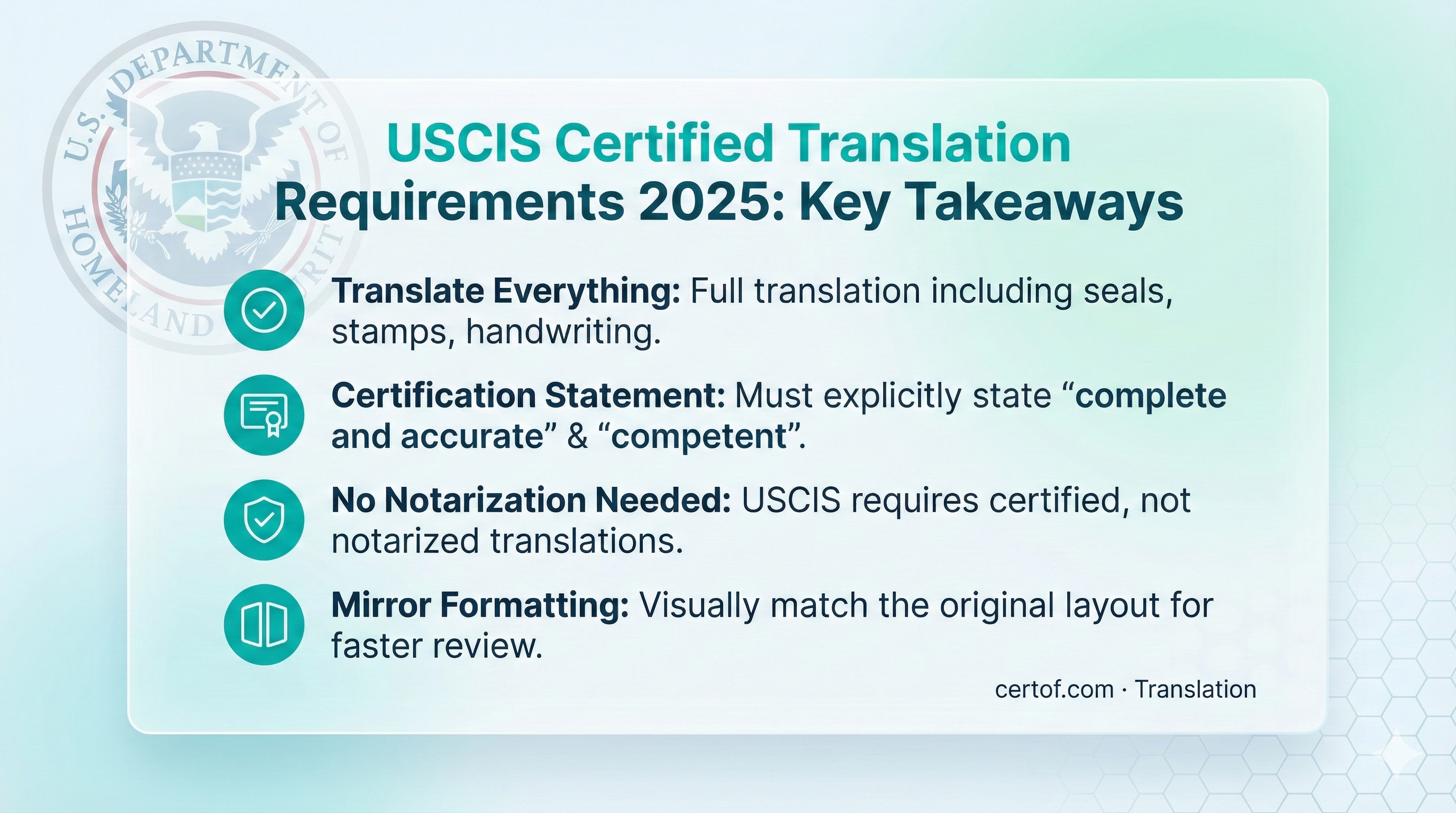
USCIS stage: If you are sending a foreign-language document to USCIS in the United States, USCIS expects a full English translation with the usual translator certification statement. This is the same baseline rule summarized in the Department of State’s civil-documents guidance. For ordinary family-immigration civil records from Ukraine, apostille is usually not what USCIS is waiting for.
NVC / CEAC stage: This is where many applicants still assume apostille helps. In practice, the main issue is whether you uploaded the right civil document and whether the translation rule for that stage is met. Apostille is still not the normal deciding factor for routine Ukrainian family-immigration civil documents.
U.S. Embassy Kyiv stage: This is the most important Ukraine-specific distinction. The Kyiv post says that documents not in either English or Ukrainian must be accompanied by a certified English translation. That means Ukrainian-language civil documents can often be presented without English translation at the interview stage. This is the local rule that makes Ukraine different from a generic template article.
Bottom line: If your document is a standard Ukrainian birth, marriage, divorce, death, or police record for a routine U.S. family-immigration case, your default decision should be: get the correct Ukrainian document first, then add certified English translation only for the U.S. stage that needs it. Do not assume apostille is the “safer” version.
The Most Important Ukraine-Specific Rule: Kyiv Accepts Ukrainian-Language Documents
This is the most useful anti-intuitive point in the whole topic. The Kyiv immigrant-visa checklist says documents not in English or Ukrainian need certified English translation. So if your civil record is already in Ukrainian, the Kyiv interview stage usually does not force you to pay for English translation just to carry the original to the interview.
That does not mean you never need translation anywhere in the case. It means applicants in Ukraine need to separate:
- translation for USCIS or earlier U.S. filing steps,
- translation for NVC upload when applicable, and
- the Kyiv interview rule itself.
This difference alone can save money and avoid duplicate work.
Which Ukrainian Documents Usually Need Only Translation, Not Apostille
- Birth certificates: Usually the key issue is whether the certificate is the correct official record or whether a newer DRATsS re-issue would be cleaner.
- Marriage certificates: Usually used as issued or re-issued, with translation only when the relevant U.S. step requires English.
- Divorce records: The real risk is using the wrong divorce evidence, especially if the divorce touches occupied territory or older records.
- Death certificates: Same logic as other civil-status documents; apostille is usually not the core U.S. immigration need.
- Police certificates: For Kyiv, the post-specific guidance focuses on the full version. The question is usually full version vs short version, paper vs electronic, and previous surnames, not apostille first.
The U.S. country page for Ukraine also makes another useful point: it accepts original or re-issued Ukrainian civil documents, including older historical formats, while noting that notarized or certified copies are not the standard Ukrainian record form for these purposes. See the Ukraine reciprocity schedule.
When Apostille May Still Make Sense
Apostille is not meaningless. It is just often aimed at the wrong problem.
Apostille may still make sense when:
- the same document will be used for a separate non-U.S. foreign authority,
- a lawyer handling a separate Ukrainian or third-country process specifically asks for it,
- you are building a paper chain for non-U.S. official use outside the family-immigration file,
- you are not actually solving a U.S. immigration requirement, but a second downstream use.
That distinction matters because apostille adds time, paper handling, and in some cases the wrong workflow. In Ukraine, it can push applicants into an extra office trip or courier step even though the U.S. immigration file did not need that step in the first place.
How to Handle the Process in Ukraine Without Wasting Time
1. Start with the source document, not the translation vendor. For civil-status records, the first question is usually DRATsS, TSNAP, or Diia re-issue. For police records, it is the MVS/Diia route. Ukraine’s official police-record service is available through Diia.
2. Decide the U.S. stage before ordering translation. If you are filing something with USCIS in the United States, English translation is often needed. If you are preparing for the Kyiv interview and your document is already in Ukrainian, the post-specific rule may let you use the original without English translation.
3. Use apostille only if your actual next step needs it. Ukraine now also promotes an online path for a police certificate with apostille through Diia news updates, including the apostilled police-record service announcement. That is useful for some cross-border uses, but it should not be mistaken for a universal U.S. family-immigration requirement.
4. If the record comes from occupied territory, stop and verify the source issue first. The reciprocity guidance explains that marriages and divorces registered in occupied Crimea and occupied parts of Donetsk, Luhansk, Kherson, and Zaporizhzhia are not recognized by Ukraine in the normal way, and birth/death events may need court-based recognition before a usable Ukrainian record can be issued.
Local Logistics, Wait-Time Reality, and Common Friction Points
For Ukraine, the case is mainly governed by U.S. federal rules and Ukraine-wide record systems, not city-by-city office discretion. The local differences are mostly about logistics, source-document availability, and digital-vs-paper workflow.
- Re-issuance is normal: If your original is old, damaged, handwritten, or hard to translate, re-issue through DRATsS/TSNAP is often more practical than paying someone to decode a poor copy.
- Mailing and timing matter: The Ukraine reciprocity page says some in-person re-issuance can be same day at the record location, while mailed re-issuance may take up to 15 business days.
- Diia helps, but does not remove every paper problem: Digital access is convenient, but some applicants still need a paper chain depending on the downstream use.
- Embassy scheduling is not a walk-in process: Kyiv immigrant-visa processing is appointment-based. The issue is usually case stage and document readiness, not showing up at a local counter.
High-Risk Local Pitfalls
- Occupied-territory documents: The biggest failure is not poor translation. It is presenting a record that Ukraine itself does not recognize in the normal way.
- Previous surnames: This is especially important on police records and family-link documents. If name history is incomplete, translation quality alone will not fix the problem.
- Old Soviet-era records: They can be acceptable, but many applicants prefer a clean re-issued Ukrainian document because it reduces ambiguity in names, seals, and dates.
- Paying for notarization or apostille by default: For ordinary U.S. family-immigration use, that money often solves the wrong problem.
- Using the wrong “short” police record: Kyiv guidance is clear that the full version matters.
If your case is specifically about police certificates or occupied-territory civil records, use the deeper CertOf explainers here: Ukraine police certificate and previous-surname issues and occupied-territory civil records for U.S. family immigration.
What Local Users Keep Getting Wrong
Many applicants share in online immigration communities that they spend money on apostille first because it feels “more official,” only to learn that the actual U.S. family-immigration issue was translation timing, the wrong document type, or the wrong issuing authority. Those community reports are not legal authority, but they are useful because they match the official rules closely: the document source and the stage-specific language rule matter more than the extra stamp.
A second recurring complaint is digital-vs-paper mismatch. Ukraine’s digital services are very useful, but applicants sometimes order an electronic police record, then discover that a lawyer, another foreign authority, or a paper-heavy workflow wanted something else. For direct U.S. family immigration, that still does not mean apostille was required; it means the workflow was not planned around the actual destination step.
Local Data and Why Ukraine Creates This Confusion
Ukraine’s digital government ecosystem is one reason this topic is unusually confusing. Diia already allows online police-record requests, and the service now also advertises an apostilled version. That combination teaches users to think in terms of “upgrade the document for foreign use,” even though U.S. family immigration often cares much more about whether the record is the right one than whether it has an apostille attached.
War-related displacement also matters. Re-issued civil records, replacement documents, and court-based recognition of events from occupied territories are not edge cases in Ukraine. They are part of everyday document reality, which is why a country-specific article makes more sense here than a generic certified-translation article.
Local Provider Snapshot
For ordinary U.S. family-immigration cases, a local Ukrainian bureau is usually useful only after you already know whether you need translation at that stage. You do not usually need a local notary or a local lawyer unless the source document itself is the problem.
| Commercial provider | Public signal | Visible office/contact details | Why someone might use it |
|---|---|---|---|
| Kyiv Regional Translation Agency (TEXT.UA) | Long-running Kyiv bureau with public pages for certificate translation and apostille handling | Taras Shevchenko Lane 7/1, Kyiv; +38 (044) 500-87-87 | Applicants who want a local bureau that visibly works with personal documents and paper workflows |
| Glebov Translation Bureau | Kyiv bureau with public contact page and certification/notary options | Brullova Street 12, Office 5, Kyiv; +38 (044) 248-11-19 | Applicants who need in-person Kyiv handling and want a bureau that publicly mentions document certification |
| UKRTRANSLATE | Multi-office Ukrainian translation network with Kyiv intake points and public hotline | Dmytrivska 48G, Kyiv; 0 800 217-517 | Applicants comparing local bureaus for paper intake, notarized translations, or apostille-related service packaging |
These are examples of visible Ukrainian providers, not recommendations. For a normal U.S. family-immigration file, the main comparison point is not who promises the most stamps; it is who can handle your exact document set accurately and revise quickly if USCIS or NVC asks for a correction.
| Public or support resource | Who it is for | What it helps with |
|---|---|---|
| Diia support | Applicants using Ukrainian digital public services | Police-record service access and digital-document troubleshooting |
| Central Justice / DRATsS contacts | People re-issuing birth, marriage, divorce, or death records | Civil-status record routing, re-issue questions, and contact paths |
| Visa Navigator / U.S. visa support for Ukraine | Applicants already in the U.S. visa process | Case-routing and post-specific process questions, especially once your file is at the embassy stage |
For more details on general U.S. translation requirements, you can refer to CertOf’s dedicated guides on USCIS certified translation requirements, who can certify a translation for USCIS, and certified vs. notarized translation.
FAQ
Do I need an apostille for a Ukrainian birth certificate for U.S. family immigration?
Usually not as a routine U.S. family-immigration requirement. The bigger question is whether you have the correct official birth record and whether the U.S. stage you are in requires English translation.
Does U.S. Embassy Kyiv accept documents in Ukrainian without English translation?
Yes, for the immigrant-visa stage, the post guidance says documents not in English or Ukrainian need certified English translation. That means Ukrainian-language documents can usually be used without English translation at the Kyiv interview stage.
Is a certified English translation enough for Ukrainian civil documents?
Often yes, especially for USCIS-style submission of foreign-language documents. The translation must be complete and include a translator certification statement. CertOf explains the format here: certified English translation for family-immigration documents.
Is a Diia police certificate enough for a U.S. immigrant-visa case?
The key question is whether it is the correct full version for the U.S. stage you are in. The Kyiv guidance focuses on the full version. If you also need the same police record for a separate non-U.S. paper workflow, that may create a different document-chain question.
What if my marriage or divorce was registered in occupied territory?
That is a source-document problem first, not a translation problem first. Ukraine’s reciprocity guidance explains that occupied-territory marriages and divorces are not recognized in the normal way, so court recognition or a new Ukrainian record may be necessary before translation becomes useful.
CTA
If you already have the correct Ukrainian civil document and only need the U.S.-compliant translation step, CertOf can help with online document submission, certified-translation ordering, and delivery format options. If your case later needs a revision, formatting fix, or a hard-copy follow-up, see revision and turnaround options and hard-copy delivery options.
CertOf does not replace a Ukrainian lawyer, does not issue apostilles, and does not act as an embassy or government intermediary. It fits best when your source document path is already clear and you need the translation package prepared correctly for the U.S. step in front of you.