Disclaimer: This article provides general information about USCIS translation requirements and professional best practices. It does not constitute legal advice. If your case involves complex legal issues, consult a qualified immigration attorney.
About the author: Erin Chen is the Co-Founder and Translation Strategist at CertOf™. With over a decade in bilingual editorial risk control and hands-on experience navigating the U.S. immigration process, Erin helps applicants prepare USCIS-ready certified translations that reduce avoidable delays.
CGFNS certified translation requirements: pass foreign transcript translation for nursing board review without rework
For internationally educated nurses preparing NCLEX-RN or NCLEX-PN pathways, cgfns certified translation requirements are not a formatting detail. They directly affect whether your foreign transcript translation for nursing board review moves forward or gets sent back. The most common failure point is using one translation workflow for every file, even though CES Professional and state boards often apply different document-routing rules.
Key Takeaways
- For CES Professional under current published guidance, secondary-school diplomas may follow applicant-arranged translation logic.
- Professional nursing education records are usually stricter: think Source-to-Source routing from institution to evaluator/board.
- The biggest delay is usually source collection, not translation output. TruMerit reports an average of 14 weeks to receive primary-source records, and then many CES reports are issued quickly once complete.
- If TruMerit translates required documents, the current listed add-on is $85 per page (standard size), so routing correctly from day one saves both time and money.
Important 2026 update: CGFNS is now TruMerit
CGFNS International announced its name change to TruMerit on February 25, 2025. In practice, many applicants and legacy board instructions still use “CGFNS,” while active service portals are under TruMerit branding. That dual naming is normal in current filings. Official notice: CGFNS name-change announcement.
Who this guide is for
- You are preparing a Credential Evaluation Service (CES) Professional Report packet.
- You need certified translation for nursing license application documents under deadline pressure.
- You are filing a mixed packet: school records, nursing transcripts, license validations, and civil support documents.
- You need a practical path to reduce avoidable re-submission cycles.
Official rule map: foreign transcript translation for nursing board cases
The table below consolidates practical filing logic from CES Professional guidance, TruMerit processing/fee policies, and New York Form 2F requirements.
| Document type | Official direction | Submission path | Practical translation action |
|---|---|---|---|
| Secondary school diploma or exam certificate | Documents must be in English; CES Professional guidance states applicant-arranged translation may be used for this category. | Follow your active CES Professional portal instructions. | Use complete literal translation, including seals and side notes. Do not summarize. |
| Professional nursing education transcript | Primary-source academic records are expected directly from each nursing institution. Translation handling is stricter than typical civil documents. | Institution-to-evaluator/board route (Source-to-Source). | Do not assume applicant-handled transcript translation is acceptable in every pathway. |
| License/registration validation | Records generally must come from issuing authority and meet current validity windows. | Authority-to-evaluator/board route. | Translate all visible elements, including seals, signatures, and back-page text. |
| State board overlay (example: NY Form 2F / CVS for New York context) | For NY Form 2F route, school-sent transcript handling and qualified translation language apply when not in English. | School-to-board channel as instructed by NY form. | Check board form wording line by line before final upload/mail. |
Official references: TruMerit CES Professional Report, TruMerit application processing times, TruMerit fee schedule, NYS Form 2F.
The counterintuitive rule most applicants miss
Many applicants assume this: “If one document can be handled by applicant-arranged translation, all documents can.” In nursing licensure packets, that assumption often causes delays. Secondary-school records and professional nursing transcripts can follow different rule paths. Another common misconception: notarization alone does not cure routing errors. A notarized translation can still be rejected if the board expected institution-sent records or complete mirror-format content.
Timeline and budget reality under TruMerit certified translation requirements
TruMerit reports that many CES reports are issued quickly after complete primary-source documents are received and validated, but average document collection time is much longer. This is why routing accuracy matters more than “rush translation” promises. In parallel, TruMerit lists a per-page translation add-on fee for required documents. Translation cost can be controlled, but source delays often cannot.
Practical sequence that works: source routing first, translation completeness second, submission packaging third.
Common mistakes and real consequences (Pitfalls)
- One workflow for every file. Consequence: category mismatch and preventable re-submission.
- Skipping grading legends or reverse pages. Consequence: incomplete-document flags and manual review delays.
- Name mismatch across passport, transcript, and certificate of translation accuracy. Consequence: identity reconciliation requests.
- Applicant submits records that must come from institution/authority. Consequence: processing pause until primary-source re-send.
- Paying for notarization while missing required routing/completeness. Consequence: extra cost without improved acceptance odds.
CertOf vs traditional agency for professional license document translation services
| Decision factor | CertOf online workflow | Typical traditional workflow |
|---|---|---|
| Turnaround for standard legible pages | Typically minutes; often around 5-10 minutes for standard files | Often 24-48+ hours |
| Price visibility | Published entry pricing from $9.99/page | Quote-based and variable |
| Formatting | Mirror formatting for side-by-side review | Varies by provider |
| Ordering method | Fully online upload and delivery | Email/manual quote chains are common |
| Policy transparency | Public policy pages for privacy and refunds | Often split across email terms |
How to order certified translation for nursing license application in 3 steps
- Upload complete files: start at certified translation order online and include all pages, seals, and reverse pages.
- Confirm pricing and scope: check certified translation pricing and identify any documents that must stay in primary-source routing.
- Download and verify: review names, dates, seals, and layout, then submit through the exact evaluator/board channel required.
Trust and privacy for high-stakes files
- CertOf policy describes encryption in transit (such as TLS/HTTPS), access controls, and security operations for service delivery.
- Policy also states full payment card details are not stored on CertOf servers; payments are handled by third-party processors.
- For paid documents, policy states they are not used to train or improve models by default.
- Read policies directly: privacy policy and refund and returns policy.
Related reading on CertOf (so this page stays focused)
- certified translation of academic transcripts (WES/ECE/SpanTran)
- difference between certified and notarized translation
- upload and order certified translation online
- can I translate my own documents
- do I need an ATA-certified translator for USCIS
- fast certified translation benchmarks by document type
FAQ
Can I translate my own documents for CGFNS/TruMerit?
It depends on document category. For CES Professional under current published guidance, some secondary-school documents may use applicant-arranged translation, but professional nursing transcript workflows are stricter and often institution-routed. See official program guidance: CES Professional Report requirements.
Do I need notarized translation for nursing board files?
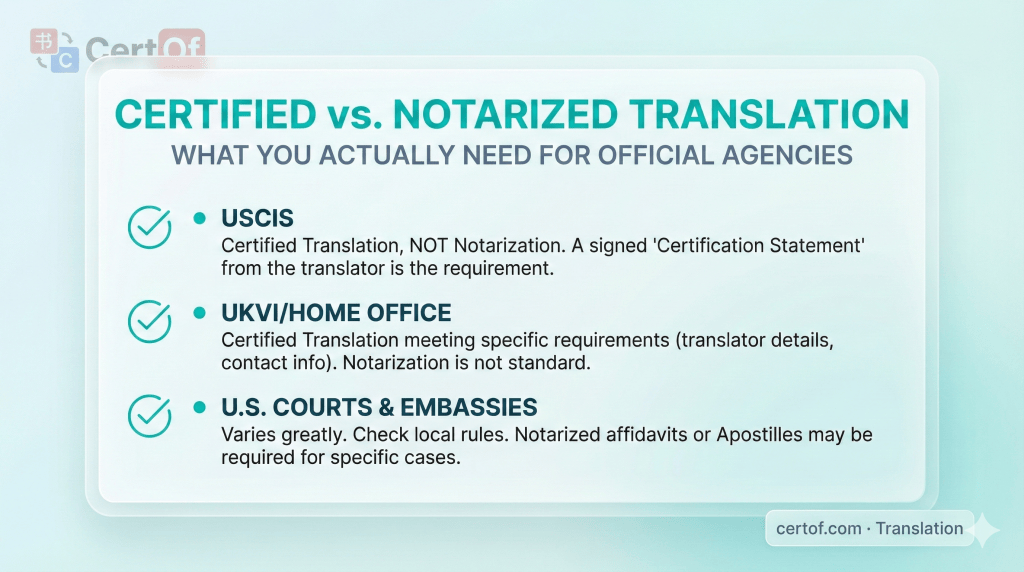
Not always. Many workflows require certified or qualified translation rather than notarization. Use board wording first, then compare with this practical explainer: certified vs notarized translation.
What if my school cannot provide an English transcript translation?
TruMerit states it can translate required documents for an additional fee in applicable scenarios; current fee schedule lists per-page add-on pricing. Confirm in your active portal before placing external orders: TruMerit fee schedule.
Can one translation be used for both licensing and USCIS?
Sometimes, but acceptance standards differ by receiving authority and case type. USCIS-specific baseline: USCIS certified translation requirements.
How do I reduce delays if my NCLEX timeline is tight?
Prioritize source routing first, then translation completeness. Fast output cannot fix missing primary-source documents. Keep a request log, submit full mirror-format files, and avoid partial uploads.
Ready to move your case forward?
If you want a practical workflow for certified translation for medical licensing board and nursing filings, start with complete documents and compliance-first routing.