Ohio Nursing License CES Translation Rules for Foreign-Educated Nurses
Ohio nursing license CES translation rules are easy to misunderstand because Ohio splits the process across the Ohio Board of Nursing rule, the Ohio page at CGFNS/TruMerit, the CES Professional Report document rules, and the eLicense Ohio portal. For most applicants, the real problem is not “Do I need a certified translation?” It is “Which documents must come straight from my school, which ones may be translated by me or a third party, and where do TOEFL and background checks go before the Board will review my file?”
This guide is for the document stage before Board review. It is not legal advice, and it does not replace the Board, TruMerit, or ETS instructions. Always confirm current requirements before paying for translation, mailing, or expedited service.
Key Takeaways
- Ohio requires a CES Professional Report for initial licensure by examination for foreign-educated nurse graduates, but the Ohio-specific CGFNS page says CES is not required for endorsement.
- The most important Ohio rule is a routing rule: your professional nursing transcript must go directly from the school to TruMerit, and the school must provide the English version if it can. If it cannot, TruMerit offers its own translation add-on.
- A counterintuitive point: TOEFL is a Board issue, not a CES issue. Ohio requires English proficiency under Rule 4723-7-04, but the Ohio CGFNS page also says exam scores are not required to be submitted to CGFNS for Ohio CES.
- For some supporting documents, including many secondary-school records, TruMerit allows translation by the applicant or a person chosen by the applicant, which means a third-party certified translation service can help there. That flexibility does not carry over to your nursing transcript.
Who This Guide Is For
This guide is for foreign-educated nurses applying at the state level in Ohio, especially RN or LPN applicants pursuing initial licensure and trying to clear the CES and document-preparation stage before the Ohio Board of Nursing reviews the file. It is most useful if you are handling a mixed packet such as:
- nursing school transcript or academic record
- nursing diploma or degree certificate
- license validation from another country
- secondary-school certificate
- passport and name-match documents such as a marriage certificate or court name change order
- TOEFL score reporting
The most common real-world situation is not a translation theory question. It is a practical one: your school will not issue English records, you are unsure whether your translator can touch the file, and you do not know whether to send each item to TruMerit, the Board, or both. Language pairs often include English with Tagalog, Spanish, Arabic, Chinese, or French in this type of workflow, reflecting the diverse backgrounds of international nurses entering Ohio’s healthcare workforce.
What Makes Ohio Different
This topic is partly governed by national CES rules and partly by Ohio rules. The national piece is TruMerit’s primary-source document system. The Ohio-specific piece is how Ohio uses that system.
- Ohio requires the CES Professional Report for foreign-educated nurses seeking initial licensure by examination under Ohio Admin. Code 4723-7-04.
- Ohio treats English proficiency separately. You still deal with TOEFL for Board review, but the Ohio CGFNS/TruMerit page says Ohio CES does not require exam scores to be sent to CGFNS.
- Ohio uses one statewide filing system, eLicense Ohio, but technical support there is not the same thing as substantive licensure guidance.
That is why this article focuses on routing and document ownership. In Ohio, the failure point is usually not whether your translation looks formal enough. It is whether the right institution sent the right record to the right place.
Document-by-Document Translation and Routing Rules
| Document type | Who sends it | Who can translate it | Why it matters in Ohio |
|---|---|---|---|
| Professional nursing transcript / academic record | Directly from the nursing school to TruMerit | The school, or TruMerit if the school cannot translate | This is the core CES record. Applicant-arranged translation does not replace primary-source routing. |
| Nursing diploma / degree certificate | Usually directly from the issuing authority if requested by TruMerit | Institutional English version preferred; otherwise follow TruMerit instructions | Do not assume a scanned copy plus outside translation is enough. |
| License / registration validation | Directly from the licensing authority to TruMerit | Issuing authority or according to TruMerit rules | Another primary-source item that the applicant cannot substitute. |
| Secondary-school diploma / certificate | Submitted according to TruMerit instructions | Applicant or a person chosen by the applicant may translate, with an accuracy statement | This is one place where a certified translation service can help. |
| Name-match documents such as marriage certificate | Applicant-controlled supporting document | Applicant-chosen translator or certified translation service | Important if your school records and passport names do not match. |
| TOEFL score | To the Ohio Board of Nursing / Board review path, not to Ohio CES | No translation issue if sent through the testing channel | One of the most common Ohio mistakes is sending this to the wrong place. |
The underlying official logic appears in the CES Professional Report requirements and TruMerit’s help page on non-English transcripts. If your nursing school transcript is not in English, the default expectation is that the school handles the English version. If the school cannot do that, TruMerit offers its own translation service. That is why “certified translation” is a bridge term here, not the main official term.
What “Certified Translation” Means in This Ohio Scenario
In this workflow, “certified translation” is useful language for search and for applicant-controlled documents, but it is not the phrase that controls the nursing transcript rule. Ohio and TruMerit care more about whether documents are in English and whether they come through the correct primary-source route.
That means:
- For your nursing transcript, do not buy a third-party translation first and assume that solves the problem.
- For your secondary-school record, marriage certificate, or name-change evidence, a third-party certified translation can be the correct solution.
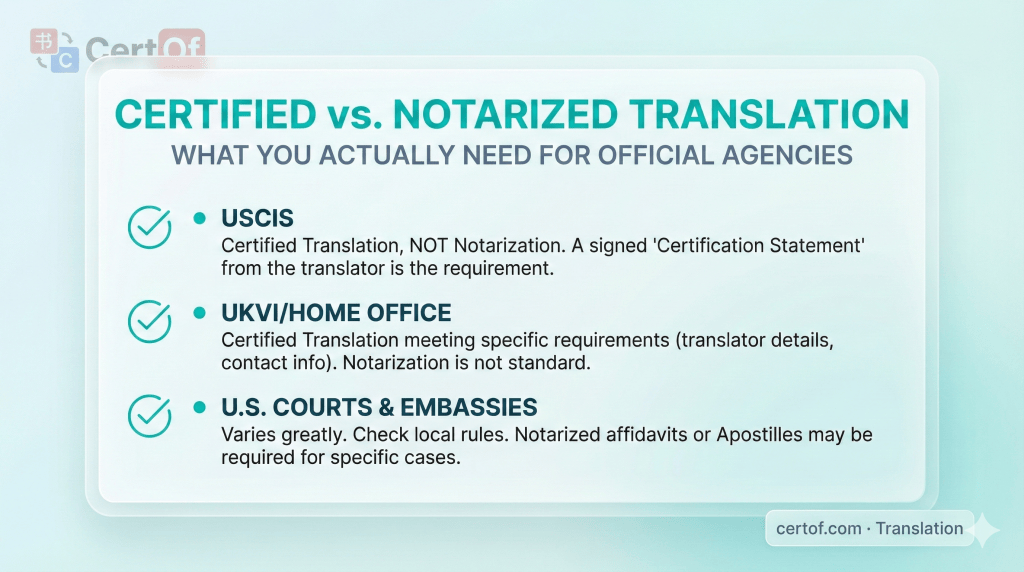
- You generally do not need notarization for this stage. If you need a refresher on that distinction, see our guides on certified vs. notarized translation and CGFNS translation requirements for nursing licensure.
Step-by-Step: How the Ohio Workflow Usually Looks Before Board Review
- Open your Ohio application path. Ohio uses eLicense Ohio for filing. This is your state portal, but it does not replace CES.
- Start the CES Professional Report. Ohio requires the full education course-by-course CES Professional Report for initial licensure by examination under Rule 4723-7-04.
- Contact your nursing school early. This is often the bottleneck in practice. If your school will not send records directly or will not issue an English version, your timeline stretches immediately.
- Separate professional records from applicant-controlled records. Your school transcript, diploma verification, and licensing authority validation follow source-to-TruMerit rules. Your supporting civil records can usually be handled on your side.
- Handle English proof on the Ohio track. Ohio requires English proficiency evidence under the Board rule, while the Ohio CGFNS page makes clear that Ohio CES does not need the exam score submission.
- Complete the separate background check. Ohio also requires fingerprint-based background review under ORC 4723.091. This is separate from translation and separate from CES, but it can still delay Board review.
Timeline, Cost, and Mailing Reality
The most useful timeline number is not an Ohio Board number. It is TruMerit’s own benchmark: according to its support material, 70% of CES reports are issued within 7 business days once all primary-source documentation has been received and validated. For applicants in Ohio, that matters because it shifts your attention to the real source of delay: school cooperation, licensing authority response times, and whether documents arrived in the right route.
For cost, the numbers that usually matter most at this stage are TruMerit’s own fees. Its fee schedule lists translation and expedited review options. If your school cannot provide an English version of the transcript, the TruMerit translation add-on is the official fallback for that record. By contrast, spending money on a third-party translation of a professional transcript before confirming routing can be wasted money.
Ohio’s own application fees are governed by state law, but applicants should verify the current amount in eLicense at checkout rather than relying on an old PDF or forum post. Always check your eLicense portal for the most up-to-date state application fees before checking out.
Common Ohio Failure Points
- Sending TOEFL to the wrong place. Many applicants assume every foreign-education item goes to CGFNS/TruMerit. For Ohio, English testing and CES are split.
- Treating all documents the same. A secondary-school certificate may be translator-friendly; a nursing transcript is not.
- Uploading a beautiful translation that no one asked for. If the document needed primary-source routing, quality alone does not fix a broken route.
- Calling the wrong help desk. eLicense support handles technical problems. If your question is “Has the Board reviewed my file?” or “How does Ohio apply Rule 4723-7-04 to my case?” that is a Board question, not a portal question.
- Buying notarization you probably do not need. Ohio and TruMerit are not framing this stage as a notarization problem.
If you are unsure whether a record belongs on the school-to-TruMerit route or the applicant-controlled route, pause before ordering translation. The cheaper mistake is waiting one day. The expensive mistake is paying for the wrong service and then having to do the official route anyway.
Local Help, Complaint Paths, and Anti-Fraud Signals
Ohio does not publish a Board-approved translator list for this workflow. That makes it even more important to separate official roles from commercial roles:
| Resource | What it is for | Best use |
|---|---|---|
| Ohio Board of Nursing contact page | Licensure questions | Use this when the issue is Board review, eligibility, or status logic rather than portal trouble. |
| eLicense Ohio support | Technical account issues | Use this for login, browser, password, or portal errors. The help desk lists (855) 405-5514, weekdays from 8:00 a.m. to 5:00 p.m. EST, for login or registration support. |
| Ohio Attorney General consumer complaint | Commercial disputes | Use this if a paid translator or third-party service made misleading promises or mishandled payment. |
A practical anti-fraud rule for Ohio applicants: be skeptical of anyone who promises to “get your transcript accepted” without direct school routing, or claims to be specially approved by the Ohio Board of Nursing. The Board rule and TruMerit document rules matter more than a vendor’s sales language.
Commercial Translation Options for Applicant-Controlled Documents Only
This comparison is intentionally narrow. It is for documents you may control yourself, such as secondary-school certificates or name-match records. It is not a recommendation to outsource your nursing transcript route.
| Option | Suitable for | Not suitable for | Notes |
|---|---|---|---|
| TruMerit translation add-on | Professional nursing transcripts when the school cannot provide English | General applicant-controlled civil documents | This is the official fallback inside the CES workflow. |
| CertOf | Secondary-school records, marriage certificates, divorce decrees, name-change records, other applicant-controlled documents | Replacing school-to-TruMerit routing for nursing transcripts | Useful when you need a fast certified English translation plus formatting and revision support. |
| Independent Ohio-based translators | Applicant-controlled supporting documents only | Any record that must come directly from the issuing school or authority | Ask for experience with academic and civil records, a clear certificate of accuracy, and secure file handling. Ohio does not publish a preferred-provider list. |
If you want to place an order for applicant-controlled documents, our pages on how to upload and order certified translation online, revision and delivery expectations, and hard-copy delivery options explain what CertOf can and cannot do.
Public and Nonprofit Help
| Resource | Type | When to use it |
|---|---|---|
| Ohio Board of Nursing | Official | Questions about Ohio review, eligibility, and requirements. |
| eLicense Ohio | Official | Portal and account problems only. |
| Ohio Attorney General | Public consumer protection | Misleading sales claims, payment disputes, or service complaints against a commercial vendor. |
What Applicants Keep Saying in Practice
A recurring applicant pattern in nursing communities is simple: once all primary-source documents are correct, the CES review itself can be more predictable than the document-collection phase. The delay usually starts earlier, when a foreign school refuses to issue English records, sends documents to the applicant instead of TruMerit, or does not understand why Ohio needs a different route from another state. A second recurring complaint is confusion over TOEFL. Applicants assume CGFNS and the Ohio Board are one combined intake point, then lose time sending the right proof to the wrong place.
Understanding these common pitfalls won’t change Ohio’s strict requirements, but it can help you avoid the preventable mistakes that cost other applicants weeks of delay.
Related Guides You May Need
- CGFNS certified translation requirements for nursing licensure
- Certified translation of academic transcripts
- Do I need certified translation for a foreign diploma?
- Certified vs. notarized translation
FAQ
Does Ohio require a CES Professional Report for foreign-educated nurses?
Yes for initial licensure by examination. Ohio requires a CES Professional Report under Rule 4723-7-04. The Ohio CGFNS page says CES is not required for endorsement.
Can I translate my own nursing transcript for Ohio CES?
No. For professional nursing transcripts, TruMerit requires direct school routing and expects the school to provide the English version if possible. If the school cannot translate, TruMerit offers its own translation route.
Do I need to send TOEFL scores to CGFNS or TruMerit for Ohio?
No. Ohio treats English proficiency as a Board-side requirement. The Ohio CGFNS page states that exam scores are not required to be submitted to CGFNS for Ohio CES.
Who can translate my secondary-school diploma for the Ohio CES process?
TruMerit’s guidance allows the applicant or a person chosen by the applicant to translate certain secondary-school documents, with an accuracy statement. That is why a certified translation service can help for this part of the file.
Who do I contact if my Ohio application is stuck?
If the issue is portal access, use eLicense support. If the issue is licensure review, Board interpretation, or status logic, use the Ohio Board of Nursing contact path.
CTA
If your Ohio file includes documents that you are allowed to control, such as a secondary-school certificate, marriage certificate, divorce decree, or other name-match record, CertOf can help with a fast certified English translation and formatting support. If you are unsure whether a document belongs on the applicant side or the school-to-TruMerit side, start with our translation order page or contact us before you pay for the wrong type of service.
Important boundary: CertOf does not replace school or licensing-authority direct submission, does not file with the Ohio Board for you, and does not provide legal representation or official approval. In this Ohio workflow, our role is document translation and preparation for the parts of the packet that the applicant is actually allowed to manage.