Who Can Translate Ohio Nursing License Documents?
If you are searching who can translate Ohio nursing license documents, the most important answer is this: for foreign-educated nurses applying for initial licensure in Ohio, the real issue is usually not whether a translation looks formal enough. It is whether the right party translated the right document and whether it moved through the right channel. Ohio sends foreign-educated initial RN and LPN applicants into the CGFNS licensure workflow for Ohio, and that workflow is stricter about document routing than many applicants expect.
Disclaimer: This guide is for document-planning and translation compliance only. It is not legal advice, immigration advice, or licensure advice from the Ohio Board of Nursing. Always confirm current requirements with the Ohio Board, eLicense Ohio, and CGFNS before you submit documents.
Key Takeaways
- For Ohio foreign-educated initial nursing licensure, your nursing school transcript and diploma normally cannot be self-translated. Under the CGFNS CES Professional Report rules, professional nursing education documents must be translated by the issuing educational institution, or handled through CGFNS translation services if the school cannot do it.
- Self-translation is not banned across the board. CGFNS allows the applicant or a person chosen by the applicant to translate certain secondary school records. That rule does not automatically extend to nursing transcripts.
- Notarization is usually the wrong fix. Ohio does not create a separate notarized-translation requirement for this nursing pathway, and a notarized translation still fails if the translator or sender is not the correct party.
- AI can help you understand a document, but it is not a safe submission route for professional nursing records. In Ohio, the compliance problem is accountability and routing, not just wording.
Who This Guide Is For
This guide is for foreign-educated nurses applying for initial RN or LPN licensure in Ohio, especially applicants using a CGFNS/TruMerit CES Professional Report and dealing with non-English nursing transcripts, diplomas, license validations, secondary-school records, passports, or name-change documents. It is most useful if you are stuck because your school will not issue English records, your licensing authority only replies in the local language, you were told to get a notarized translation, or you want to know whether a certified translation service can help with some documents but not others.
Common language pairs in this workflow are often Spanish-English, Chinese-English, Arabic-English, French-English, and Tagalog-English, but Ohio does not publish a nursing-licensure language breakdown. Treat those pairs as practical examples, not official Ohio data.
Why Ohio Applicants Get Stuck Here
Ohio is not a state where you take all your foreign documents to a local licensing counter and ask what to do. For foreign-educated initial applicants, Ohio Administrative Code 4723-7-04 pushes the credentials review to CGFNS. That means many applicants spend money on the wrong thing: a local notary, a generic translation office, or a friend who can write good English.
The counterintuitive point is simple: in this Ohio workflow, the physical and procedural path of the document matters more than the presence of a stamp. A clean English translation can still fail if it was not produced by the issuing school, the issuing authority, or CGFNS where required.
This is also where Ohio becomes locally distinct. The core translation rules come from CGFNS, but the local friction comes from the Ohio setup: initial applicants must go through CES, endorsement applicants do not follow the same translation-heavy path, eLicense Ohio only handles technical issues, and many applicants still find older Ohio PDFs online that create confusion about what goes where.
Who Can Translate Which Ohio Nursing License Documents?
| Document type | Who can translate it? | What usually does not work |
|---|---|---|
| Nursing school transcript / professional nursing diploma | The issuing educational institution, or CGFNS translation service if the school cannot provide English documents | Self-translation, friend/family translation, local notary, generic certified translation submitted by the applicant |
| Secondary school diploma / external exam certificate | The applicant, a person chosen by the applicant, or CGFNS translation service | Raw AI output with no human review, or assuming this rule also covers nursing school records |
| License validation / registration verification | The issuing licensing authority must send the validation directly; applicant-controlled translation is not the safe route | Applicant-submitted translation packet, notarization as a substitute, translator sending separately from the authority |
| Passport, civil support documents, name-change documents | A qualified third-party translation provider can usually help, subject to the receiving agency’s document-routing rules | Assuming these documents can replace school-issued English education records |
The source for this split is the CGFNS CES Professional Report page. That is the page you should trust over generic online advice about “certified translation.”
Does Ohio Require Certified Translation, Notarization, or an ATA Translator?
Not in the way many applicants mean those terms.
Ohio’s rule for this pathway is to require the CES Professional Report. The translation detail then comes from CGFNS. CGFNS does not say that a separate third-party certified translation with notarization is the universal answer. Instead, it asks whether the document is in English, who translated it, and whether it came directly from the right source.
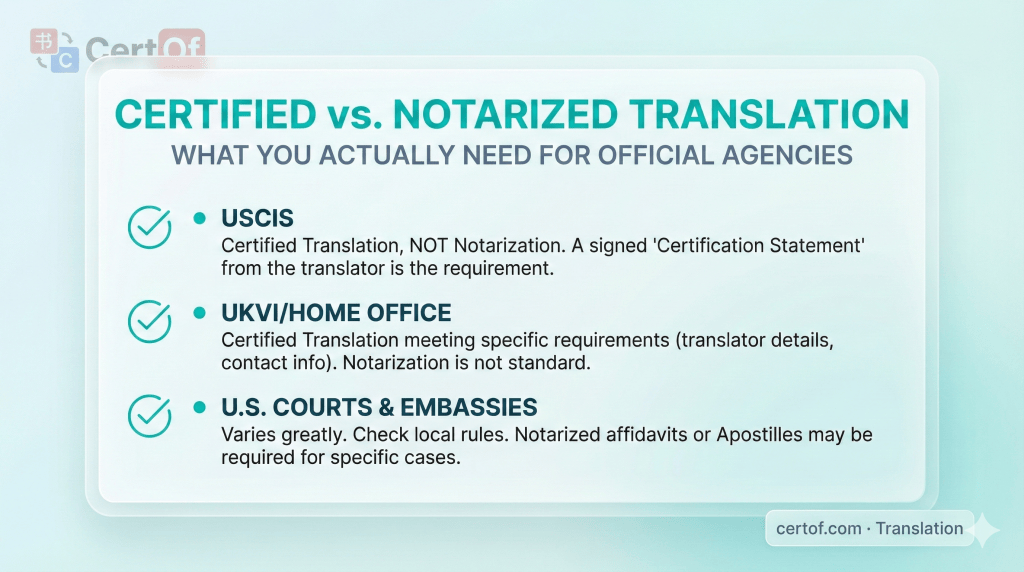
That is why “certified translation” is a bridge term in this article, not the most natural official term. If you need the broader background on certification wording versus notarization, use our concise references on certified vs. notarized translation and CGFNS translation requirements for nursing licensure.
As for ATA membership, some nonprofit guidance such as Upwardly Global’s Ohio nursing guide points applicants toward professional translators for certain documents. That can be useful for secondary school or civil documents. It is not the same as an Ohio or CGFNS rule requiring ATA for nursing transcripts.
Can You Translate the Documents Yourself?
Sometimes, yes. Sometimes, absolutely not.
You may self-translate certain secondary school records under the CGFNS CES rules. But you should not generalize that permission to professional nursing education records. For nursing transcripts and diplomas, the compliant route is typically school-issued English documents or CGFNS translation service.
This is where many Ohio applicants make a costly mistake. They see one document category where self-translation is allowed and assume all education records work the same way. They do not.
If your packet includes mixed document types, separate them early:
- Professional nursing education documents: school or CGFNS.
- Secondary school records: applicant-arranged translation may be possible.
- Civil support documents: third-party translation may be useful.
If you want a general discussion of self-translation risk in document-driven applications, our reference page on self-translation is useful background, but for Ohio nursing licensure the CGFNS document split controls.
Does Notarization Help?
Usually no. In this Ohio nursing context, notarization is often a distraction.
Applicants are sometimes told that a local notary makes a translation “official.” That advice can be expensive and misleading. A notarized translation still fails if CGFNS expected the school to translate the nursing transcript or expected the issuing authority to send the license validation directly.
This is one of the biggest practical risks in Ohio: applicants spend money on a document that looks formal but does not satisfy the actual routing rule. If a private vendor sold you notarization as the main answer and your documents were rejected for that reason, you can use the Ohio Attorney General consumer complaint process for the service issue.
What About AI Translation Tools?
Use AI only as a reading aid, not as a submission strategy.
For professional nursing records, AI is not a compliant substitute because the key requirement is that the issuing institution or CGFNS controls the translation. For secondary school records, raw AI output is still risky because you remain responsible for accuracy, formatting, names, dates, and credential terminology. In practice, AI can help you understand what a document says before ordering a proper translation, but it should not be the final product you rely on for a licensure packet.
If you want the broader background on machine translation risk, see our short reference on using Google Translate for official filings. The Ohio-specific point remains the same: AI does not solve the “who translated it” problem.
How the Ohio Workflow Actually Works
- Create or prepare your Ohio initial licensure path and confirm that you are in the foreign-educated initial route, not endorsement.
- Open the CGFNS workflow for Ohio and identify each document by category: nursing education, secondary school, license validation, civil support documents.
- Ask your nursing school first whether it can issue English documents or an official English translation.
- If the school cannot do that, review the CGFNS fee schedule and decide whether CGFNS translation service is the practical fallback.
- Use eLicense Ohio only for the online application and technical steps. For technical help, Ohio lists eLicense support at (855) 405-5514 during business hours.
The key local reality is that Ohio does not give you a special state translation desk. The translation-heavy part of the process lives upstream in the CGFNS system, not inside a walk-in Ohio office.
Ohio Cost, Timing, and Mailing Reality
There is no meaningful Ohio walk-in shortcut for this issue. Your workflow is mostly online plus direct document transmission through your school, your licensing authority, and CGFNS.
The most concrete cost in this research is the official fallback translation price at CGFNS: $85 per page for standard-sized pages under the current fee schedule. That matters because many applicants only discover the cost after a school refuses to issue English records.
Timing is usually driven by three things:
- How quickly your school responds.
- Whether the school will create English records at all.
- How quickly CGFNS can review the completed packet.
Ohio does not publish a special state translation timeline for this pathway because the core translation bottleneck sits outside the state system. That is why this article focuses more on routing than on promises about turnaround.
Common Ohio Nursing License Translation Pitfalls
- Paying for the wrong service. A local notary or generic certified translation may still be unusable for nursing transcripts.
- Using the secondary-school rule on professional documents. Self-translation may be allowed for one category and rejected for another.
- Sending translations through the wrong party. Direct submission rules matter.
- Calling the wrong office. eLicense Ohio handles technical issues, not translation compliance.
- Relying on old Ohio PDFs. Older public documents have caused confusion around English-score routing and can distract applicants from the live CGFNS instructions.
On the user-experience side, professional nursing forums (such as Allnurses) and nonprofit guidance from Upwardly Global point to the same real-world pattern: schools delay, applicants guess, and translation problems become routing problems. Those community signals are useful for planning, but the official rule still comes from CGFNS and Ohio’s licensure framework.
Local Support, Fraud Prevention, and Complaint Paths
If your issue is a technical portal problem, use eLicense Ohio support. If your issue is that a private translation vendor misled you about notarization, direct mailing, or guaranteed acceptance, use the Ohio Attorney General consumer complaint channel.
If you need broader navigation help as an immigrant nurse, Upwardly Global’s Ohio nursing guide is a useful nonprofit orientation resource. If the problem turns into a broader service dispute and you qualify for assistance, the Legal Aid Society of Southeast and Central Ohio may help with consumer or related legal issues, though it is not a translation provider.
| Public or nonprofit resource | What it helps with | Who should use it |
|---|---|---|
| Ohio Attorney General Consumer Protection | Complaints about misleading private translation vendors or payment disputes | Applicants who were sold the wrong translation solution |
| Upwardly Global Ohio nursing guide | Free orientation for immigrant nurses | Applicants who need a big-picture roadmap before paying for services |
| LASCO | Legal aid and possible referral help in eligible cases | Low-income applicants dealing with serious service disputes |
Commercial Translation Options Relevant to Ohio Applicants
There is no Ohio state-designated list of approved translation companies for this pathway. That is itself an important local fact. For most applicants, the right question is not “Which Ohio translation office is best?” but “Which option fits the document type I actually have?”
| Option | Best fit | Important limit |
|---|---|---|
| CGFNS Translation Service | Professional nursing education documents when the school cannot issue English records | Paid service; not a general-purpose local translation office |
| CertOf | Secondary school records, passport pages, name-change documents, and other applicant-controlled support documents | Not a substitute for school-issued translations of nursing transcripts or licensing-authority validations |
| Independent professional translator | Some secondary school or civil documents if third-party translation is allowed | Still not the right answer for professional nursing records that must come from the issuing institution |
If you need a third-party certified translation for a support document that CGFNS allows you to control, CertOf can help through the online order page. If you want to understand delivery format and whether a PDF is enough, start with electronic certified translation formats. If you need a simple workflow overview, see how to upload and order certified translation online. If you expect a paper-copy requirement from another institution in your packet, our page on hard-copy mailing options may help.
Local Data Points That Matter
Ohio does not publish a state-level dashboard showing which language pairs are most common in foreign nursing licensure translation problems. That means you should be careful with any vendor claim that a certain language is “the usual Ohio case.”
The two most useful concrete data points here are practical, not demographic:
- $85 per page for CGFNS translation service. This directly affects the cost of fixing a school-cooperation problem.
- Old versus current guidance conflict. Older Ohio documents still circulate online, while the live CGFNS Ohio page controls the active workflow. That mismatch increases applicant error risk even before translation starts.
The broader market signal is that foreign-educated nurse migration to the United States remains active, as reflected in the CGFNS 2024 Nurse Migration Report. That does not prove an Ohio-specific translation volume, but it helps explain why this document problem keeps recurring.
FAQ
Who can translate nursing school transcripts for Ohio licensure?
For foreign-educated initial applicants, nursing school transcripts generally must be translated by the issuing educational institution, or through CGFNS translation services if the school cannot provide English records.
Can I translate my own documents for an Ohio nursing license?
You may be able to self-translate certain secondary school records under CGFNS rules, but not professional nursing education documents. Separate your document categories before you order anything.
Does Ohio require notarized translation for foreign nursing documents?
No separate Ohio notarized-translation rule controls this pathway. Notarization usually does not solve the real compliance issue, which is translator eligibility and document routing.
Will CGFNS accept AI-translated nursing transcripts?
Do not rely on AI for nursing transcripts. The compliant route for those documents is school-issued English records or CGFNS translation service, not applicant-generated AI output.
What if my nursing school will not issue an English transcript?
Your practical fallback is to review the CGFNS translation service fee schedule and proceed through the official translation route if eligible. This is often the cleanest fix when the school will not cooperate.
Do endorsement applicants in Ohio need the same translation workflow?
Not usually. A major Ohio-specific distinction is that the CES-heavy foreign-educated document path applies to initial licensure, not the same way to endorsement. Confirm your licensure path before paying for translation.
CTA
If your Ohio nursing application includes secondary school records, passport pages, or name-change documents that you are allowed to control, CertOf can help you prepare a professional certified translation quickly and clearly. Start your file upload at translation.certof.com, or read our background guides on academic transcript translation and foreign diploma translation before you order.
But if your document is a professional nursing transcript, diploma, or licensing validation, do not assume a third-party translation service can replace the school, the issuing authority, or CGFNS. In Ohio, using the correct source is often the difference between a clean file and a costly delay.
Final note: This article is current to March 13, 2026 based on the cited Ohio and CGFNS sources. Because older Ohio nursing guidance still circulates online, verify your live portal instructions again before you submit.