Disclaimer: This article provides general information about USCIS translation requirements and professional best practices. It does not constitute legal advice. If your case involves complex legal issues, consult a qualified immigration attorney.
About the author: Erin Chen is the Co-Founder and Translation Strategist at CertOf™. With over a decade in bilingual editorial risk control and hands-on experience navigating the U.S. immigration process, Erin helps applicants prepare USCIS-ready certified translations that reduce avoidable delays.
Adoption Decree Certified Translation: USCIS Custody Agreement Checklist
Adoption decree certified translation: fast compliance, fewer RFEs, and lower total cost
If you need an adoption decree certified translation, the biggest risk is usually not legal theory. It is document execution: missing annex pages, unclear custody language, date-format confusion, or weak certification wording. In adoption cases, those details can delay I-800A review, visa steps, or later citizenship evidence. This guide helps you file once and avoid expensive rework.
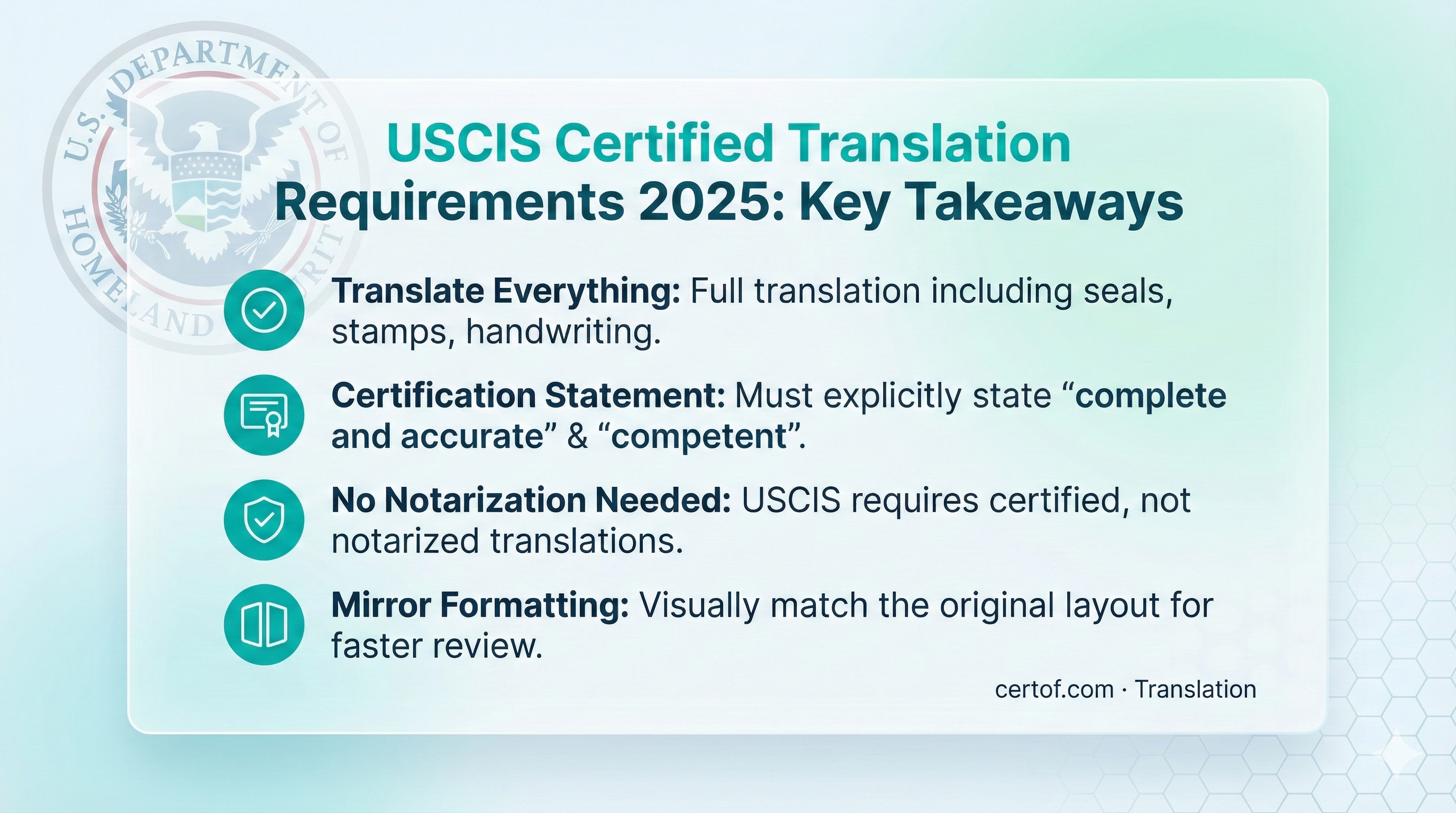
- USCIS baseline rule remains full translation plus certification of completeness, accuracy, and competence under 8 CFR 103.2(b)(3).
- In Hague cases, sequence matters: families should not complete adoption or custody steps before Article 5/17 timing is satisfied in the Convention Adoption Process.
- Counterintuitive point: notarization is often not the main USCIS translation requirement; this is why certified vs notarized translation matters.
- A mirror-formatted, complete packet can meet fast certified translation benchmarks and reduce officer review friction.
Start your adoption decree certified translation online and receive a USCIS-ready file package.
Who this guide is for
- Families in Hague adoption workflows preparing I-800A-stage and visa-stage evidence.
- Cases with separate documents: one custody order and one final adoption decree.
- Parents who also need a certified translation of birth certificate, or adult adoptees preparing post-entry citizenship evidence for Form N-600.
- Legal teams responding to document-quality questions or RFEs under tight timelines.
What this guide answers
- How does a custody agreement certified translation differ from a final adoption decree translation?
- What are the practical I-800/I-800A translation requirements families miss most often?
- Does USCIS accept online certified translations for adoption filings?
- What should a certificate of translation accuracy include to reduce RFE risk?
Official rules you actually need (USCIS and Hague)
USCIS translation law is explicit in 8 CFR 103.2(b)(3): foreign-language documents submitted to USCIS need a full English translation and translator certification. For Hague filings, USCIS evidence instructions on Form I-800A and Form I-800 repeat this requirement. Process order is controlled by Hague workflow rules, including Article 5/17 timing, as summarized by the U.S. Department of State on the Convention Adoption Process page. For post-entry citizenship evidence, USCIS details adopted-child pathways on U.S. Citizenship for an Adopted Child and policy logic for INA 320/N-600 contexts.
| Stage | Officer focus | Where translation defects hurt |
|---|---|---|
| I-800A readiness | Required evidence quality and consistency | Incomplete translation or weak certification text |
| Hague sequencing | Correct order of custody and adoption actions | Date conflicts between translated orders and process milestones |
| Visa final review | Document completeness and traceability | Missing annexes, seals, notes, or signatures in translation |
| Post-entry citizenship evidence | Proof package quality for INA 320/N-600 contexts | Using interim wording where final status is required |
2025-2026 legislative context: relevant, but still pending
As of early 2026, the PAAF Act Senate bill (S.2923) and companion House bill (H.R.5492) remain introduced measures and are not enacted law. This still matters in practice: adoption records with vague finality or custody language can create avoidable friction in later citizenship evidence review.
Adoption decree vs custody agreement: what must be translated
In cross-border adoption, titles can be misleading. Officers verify legal function, not just document label.
| Document | Typical legal function | Critical translation elements |
|---|---|---|
| Adoption decree or final order | Confirms legal parent-child relationship is finalized | Court name, case number, effective date, finality wording, judge signature, identities |
| Custody agreement or custody order | Grants custody for emigration/adoption steps before finalization in some systems | Scope of custody rights, restrictions, validity period, authority, seals, registration notes |
| Annexes and endorsements | Tie pages together for authenticity and continuity | All visible text, stamps, handwritten notes, side remarks, and back-page marks |
Counterintuitive but true: notarization is usually not your first USCIS bottleneck
Many families pay for notarization first, then still face follow-up because the translation packet was incomplete. For USCIS, first-line compliance is usually full and accurate translation with proper translator certification. If you need a deeper side-by-side explanation, use this guide on certified vs notarized translation.
Compliance checklist before upload
- Translate every page submitted, including annexes and reverse-side content.
- Preserve legal status wording exactly, including interim, final, irrevocable, and custody-limitation clauses.
- Keep names and dates consistent with passports and civil records.
- Mark seals, signatures, and unreadable text transparently.
- Use clear dates such as 16 Feb 2026 to avoid DD/MM and MM/DD ambiguity.
- Ensure certification text includes completeness, accuracy, and translator competence.
- Compare your final package with a USCIS-ready certification package format.
- For USCIS baseline format, review USCIS certified translation requirements.
Common pitfalls and what they cost
- Summary-only translation: Submitting only the decree cover page, not full legal text. Typical result: RFE and re-translation fees.
- Name meaning translation: Converting a legal name into a literal English meaning. Typical result: identity mismatch across filings.
- Interim treated as final: Translating temporary custody language as permanent adoption status. Typical result: adjudication delays or denial risk.
- Unreadable scan quality: Critical seals or dates become illegible in the translation process. Typical result: evidence re-submission and timeline slippage.
- Weak certification wording: Missing competence statement or incomplete scope language. Typical result: avoidable technical objections.
If you already received a notice, use this triage guide for USCIS RFE translation services and this fix path for avoidable technical objections.
CertOf vs traditional providers
| Decision factor | CertOf | Traditional offline workflow |
|---|---|---|
| Speed | Often 5-10 minutes for standard pages | Typically 24-72 hours |
| Pricing | Transparent, with published certified translation pricing from $9.99/page | Quote-based, often variable |
| Formatting | Mirror formatting to preserve source layout | Varies by provider |
| Compliance support | Structured deliverables aligned to a USCIS-ready certification package | Varies by provider |
| Risk policy | Published refund/compensation policy; acceptance depends on agency-specific requirements | Often unclear before purchase |
| Operations | Fully online: upload, pay, download | Email rounds and office-hour dependency |
How to order in 3 steps
- Upload adoption decree or custody agreement for certified translation online.
- Review scope and certified translation pricing.
- Download your certified PDF package and proceed with filing.
Trust module: privacy, refund terms, and supported institutions
Before placing any order, review CertOf’s data privacy policy, service terms, and refund policy and guarantee terms. Typical destination institutions include USCIS, universities, banks, and courts. If your case has unusual legal history, speak with a certified translation specialist before filing.
FAQ (People Also Ask)
Do I need notarization for an adoption decree translation for USCIS?
Usually not as a baseline USCIS translation requirement. The core requirement is full translation plus proper certification. Use this practical comparison: difference between certified and notarized translation.
Does USCIS accept online certified translations?
In many cases yes, if the packet is complete, readable, and properly certified. Start with USCIS certified translation requirements.
Do I need original documents with my translation?
Many filings are copy-first unless USCIS requests originals. See this filing guide: do I need original document with certified translation.
Can I reuse the same certified translation for later filings such as N-600 evidence?
Often yes, if the source document has not changed and your packet remains complete and legible. Use this version-control guide: reuse certified translation across multiple USCIS cases.
Can I translate adoption documents myself?
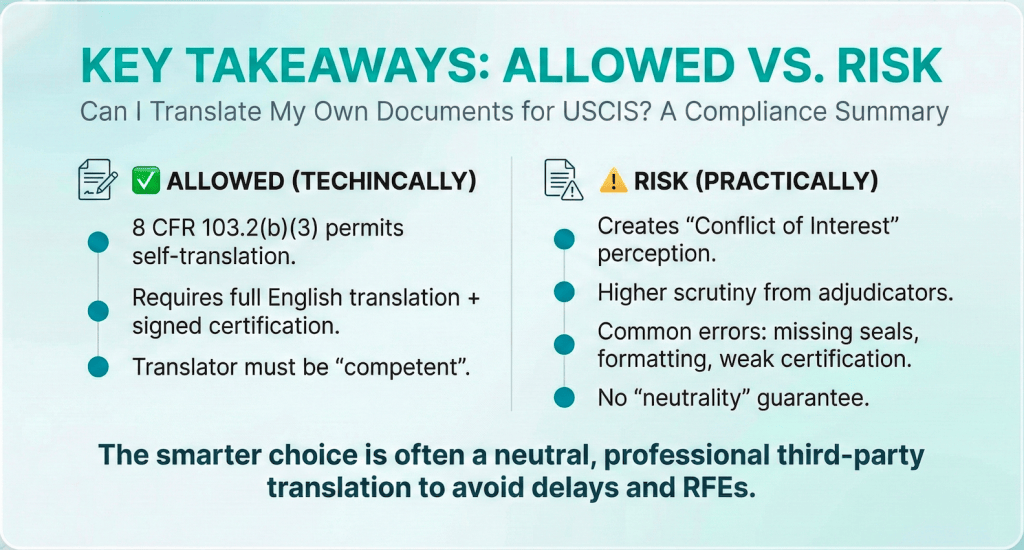
USCIS requires completeness, accuracy, and translator competence under 8 CFR 103.2(b)(3). The rule does not create a special safe harbor for self-translation, and self-translated family evidence can raise neutrality concerns in sensitive filings. For lower risk, many applicants use an independent translator. See can I translate my own documents for USCIS.
Final CTA
When adoption timelines are already sensitive, translation should be the most predictable part of the case.
Start your adoption decree certified translation order | View certified translation pricing | Get pre-filing support for custody agreement translation