Alabama Notarization or Apostille for USCIS Work Visa Documents: When It Matters and When It Does Not
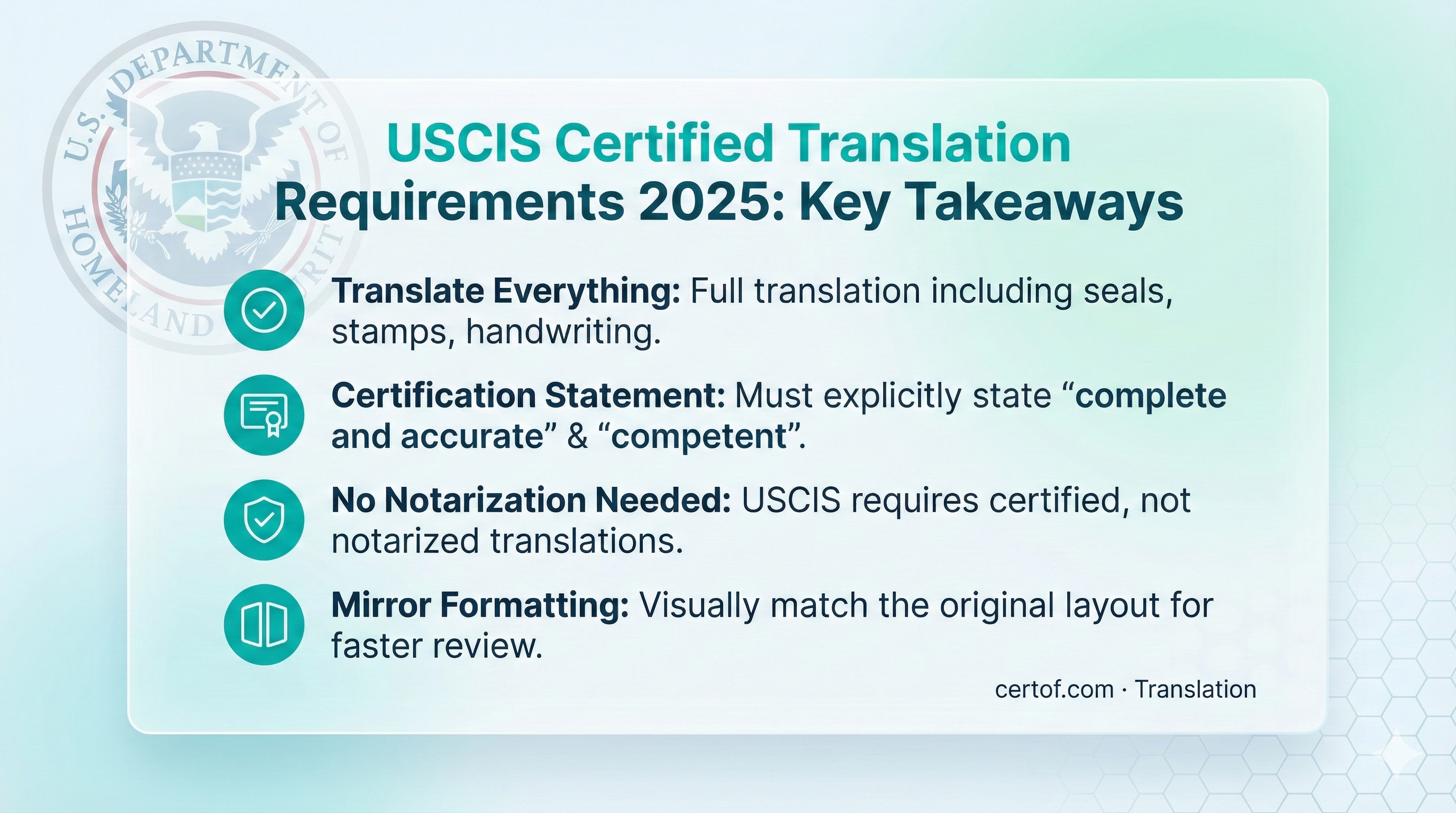
If you are in Alabama and preparing foreign-language documents for an employer-sponsored U.S. work visa case, the main question is usually not how to translate the document. It is whether you need certified translation only, or whether you also need Alabama notarization or an apostille. For most USCIS filing scenarios, the answer is simpler than many local notary shops and apostille services make it sound: USCIS generally wants a full English translation plus a translator certification, not an Alabama apostille. USCIS says this directly in its Form I-129 checklist.
This distinction matters in Alabama because the state does have a real authentication system, and it is easy to end up on the wrong track. The Alabama Secretary of State Authentication Division handles Alabama public documents for foreign use. That is a different path from sending translated foreign-language evidence to USCIS in a work visa or dependent filing.
Key Takeaways
- If your destination is USCIS, you usually need a complete English translation with a signed translator certification, not an Alabama apostille.
- If your destination is a foreign government, foreign employer, or overseas authority, Alabama notarization or apostille may matter. That is when the Alabama Secretary of State becomes relevant.
- Alabama has an extra wrinkle: for state authentication, foreign-language documents must be accompanied by a notarized English translation, according to the Secretary of State.
- For non-Hague countries, Alabama may also require county authentication from the probate judge before the state can issue a Certification, as explained in the Alabama Authentications Handbook.
Who This Guide Is For
This guide is for people in Alabama preparing an employer-sponsored U.S. work visa filing or related dependent paperwork and trying to sort out whether foreign-language documents need certified translation, notarization, or apostille. That includes H-1B, L-1, O-1, E-category, PERM follow-on, I-140, and dependent filings where the packet includes marriage certificates, birth certificates, family registers, divorce decrees, name-change records, foreign diplomas, transcripts, or experience letters. It is especially useful if you are in Birmingham, Huntsville, Montgomery, Mobile, or elsewhere in Alabama and a local notary, apostille runner, HR contact, or family member has told you to “get it notarized” without first separating the USCIS path from the Alabama state-authentication path.
The Decision Point Most Alabama Applicants Get Wrong
There are really two separate workflows:
- USCIS filing workflow: You are attaching a foreign-language birth certificate, marriage certificate, diploma, transcript, or other evidence to a petition or application. In that workflow, USCIS requires a full English translation and a certification from the translator that the translation is complete, accurate, and done by someone competent in both languages. That rule is national, not Alabama-specific.
- Alabama authentication workflow: You have an Alabama public document, or a document notarized by an Alabama notary, that must be recognized outside the United States. In that workflow, the Alabama Secretary of State may issue an Apostille or a Certification depending on the destination country.
The most useful Alabama-specific advice is this: do not confuse “official-looking” with “needed for USCIS.” A state apostille can be completely real and completely unnecessary for a USCIS packet.
What USCIS Actually Requires
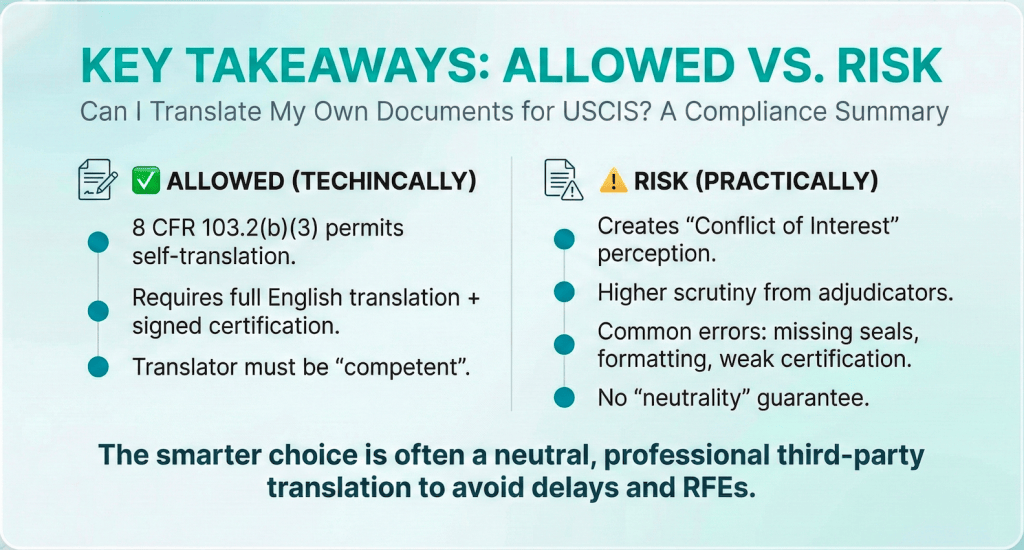
USCIS repeats the same standard across filing guidance: if you submit a foreign-language document, you must include a full English translation and a certification from the translator stating that the translation is complete and accurate and that the translator is competent to translate into English. See the USCIS I-129 checklist for work visa petitions.
For a detailed breakdown of national USCIS translation requirements, refer to these guides:
- USCIS certified translation requirements
- Certified vs. notarized translation
- Who can certify a translation for USCIS
- Work visa dependent civil document translation
For this Alabama question, the practical issue is knowing when not to add local notary or apostille steps that USCIS did not ask for.
When Alabama Notarization or Apostille Does Matter
Alabama notarization or apostille becomes relevant when the document is going outward from Alabama for use in another country. The Secretary of State says its Authentication Division is responsible for authenticating Alabama public documents that will be used in foreign countries, and gives examples such as birth certificates, marriage certificates, powers of attorney, diplomas, school transcripts, deeds, and ABI background checks. That rule is on the official state page.
That means Alabama state authentication may matter if, for example:
- your employer or affiliate abroad wants an Alabama notarized power of attorney or corporate document;
- you are separately dealing with an overseas consulate, registry, or civil authority that asked for an apostilled Alabama document;
- you need an Alabama-issued vital record or school record recognized overseas.
It does not become necessary merely because your USCIS packet contains a foreign-language document.
When Alabama Notarization or Apostille Usually Does Not Matter
If your packet is going to USCIS, the Alabama Secretary of State is usually not part of the process at all. The state says this very plainly: federal documents are not authenticated at the state level, and people should contact the U.S. Department of State for federal authentication questions. That statement appears on the Alabama authentication page, explicitly separating state from federal processes.
In practical terms, Alabama apostille is usually unnecessary for:
- a foreign marriage certificate translated into English for a dependent filing;
- a foreign birth certificate translated into English for I-539, I-485, or related evidence;
- a foreign diploma or transcript translated for an H-1B or similar petition support package;
- foreign civil records translated into English for an employment-based adjustment packet.
The counterintuitive Alabama point is that the state has a real apostille workflow, but that workflow is usually the wrong one for USCIS.
If You Really Do Need Alabama Authentication, Here Is the State Workflow
If your document truly is for foreign use, Alabama’s workflow is specific enough that it can cause delay if you guess. The state handbook says walk-in service is available Monday through Friday, 8:00 a.m. to 5:00 p.m., at Office of the Secretary of State, Authentication Division, 11 South Union Street, Suite 224, Montgomery, AL 36130. The state lists the phone number as (334) 242-5325 and the fee as $5 per document.
Important Alabama-specific steps:
- Foreign-language material: Alabama says all documents in a foreign language must be accompanied by a notarized English translation.
- Certification vs. Apostille: the destination country determines which one you need.
- Non-Hague countries: each notarized document requiring a Certification must also have county authentication of the notary commission from the probate judge in the county where the notary is commissioned.
- Mailing reality: the state says third-party return delivery depends on including a pre-addressed, prepaid carrier envelope.
For real Alabama state-authentication logistics, if you are not sending a document abroad, you usually should not be driving to Suite 224 in Montgomery or chasing county probate authentication first.
Typical Document Sets in Alabama Work Visa Cases
The most common foreign-language items in these Alabama employment-based cases are:
- marriage certificates for spouses;
- birth certificates for children;
- family registers, household books, and name-change records;
- foreign diplomas, transcripts, and experience letters;
- divorce decrees, adoption records, or custody documents where family history must be documented clearly.
The translation pain point is often not vocabulary. It is the boundary mistake: people spend time asking whether an Alabama notary must stamp the translation, when the real USCIS issue is whether the translation is complete, accurate, signed, and usable.
Alabama-Specific Friction Points
- Local over-processing: Alabama has enough state authentication infrastructure that applicants can be talked into unnecessary notarization or apostille work.
- County detours: for real non-Hague certifications, county probate authentication can add an extra trip before state submission.
- Mailing mistakes: if you truly are using the Alabama authentication path, forgetting the return envelope creates delay.
- Notary confusion: notaries verify signatures, not translation accuracy for USCIS. That distinction gets blurred in retail settings.
What Alabama Users and Immigration Communities Commonly Run Into
Community discussions are consistent on one point: people regularly confuse certified translation with notarized translation. VisaJourney threads, Reddit USCIS discussions, and practitioner Q&A all show the same pattern: applicants ask whether notarization or apostille is required, and the answer is usually that USCIS wants a signed translator certification, not a state-authentication package. While community forums are not official sources, they highlight how common it is to overcomplicate the USCIS process with unnecessary state authentication steps.
Local Data That Helps Explain the Alabama Context
Alabama’s work-visa translation demand is tied to the state’s international business footprint. In 2025, the Alabama Department of Commerce said Germany, Japan, and South Korea are Alabama’s top three international investment partners. That helps explain why employment-based cases in Alabama can involve German, Japanese, or Korean civil records, academic documents, and corporate support materials, in addition to the Spanish-language family documents that are common across many immigration filings. For this article, that local business signal matters because it explains why Alabama applicants may be comparing certified translation, notarization, and apostille options for document sets tied to cross-border employers, not just family paperwork.
Commercial Translation Options
Note: While some local agencies offer full legalization packages, you generally do not need to pay for apostille services if your only destination is USCIS.
| Provider | Local signal | Best fit | Boundary to note |
|---|---|---|---|
| CertOf | Online, built around certified document translation workflows | Readers who mainly need a USCIS-ready certified translation package without unnecessary Alabama apostille steps | Not a state apostille office and not a legal representative |
| Southeast Spanish | Birmingham branch listing, Alabama service pages, Montgomery phone line | Spanish-heavy civil and USCIS document translation; also useful where readers may separately need apostille help for international submission | Because it also offers notarization and apostille options, readers still need to separate USCIS needs from overseas-use needs |
| 001 Translations Birmingham | Birmingham contact listing on W Valley Ave and local phone number | Readers looking for a Birmingham-area option with broad language coverage | Its service menu includes legalization and apostille, which are not default USCIS requirements |
If your goal is a USCIS filing, the default buying decision should be based on translation accuracy, certification wording, formatting, speed, and revision handling, not on whether the provider can upsell notarization or apostille. CertOf’s related pages on ordering online, revisions and turnaround, and document-speed benchmarks are more relevant to this use case than a local apostille runner.
Public and Nonprofit Help in Alabama
| Resource | What it helps with | Who it fits |
|---|---|---|
| HICA 117 Southcrest Drive Birmingham, AL 35209 205-942-5505 |
Immigrant community support, referrals, practical navigation | Readers who need broader Alabama immigrant support, not just translation |
| Catholic Social Services 188 S. Florida Street Mobile, AL 36606 251-434-1550 Immigration line: 334-305-0324 |
Low-cost immigration legal services through a DOJ-accredited representative model | Readers who need case help beyond document translation |
| Legal Services Alabama Statewide call center 866-456-4995 Mon-Fri, 8:30 a.m.-4:30 p.m. |
Free civil legal aid screening and office referrals across Alabama | Readers facing broader legal or consumer issues, especially where cost is a barrier |
These are support nodes, not translation substitutes. They are useful when the real problem is case strategy, eligibility, fraud, or access to counsel rather than the translation itself.
Fraud and Complaint Paths in Alabama
If someone in Alabama tells you USCIS requires a state apostille and wants to charge for county probate authentication, state authentication, and a notarized translation without identifying an actual foreign-use destination, treat that as a red flag. The Alabama Attorney General’s Consumer Complaint page lists a hotline at 1-800-392-5658 and 334-242-7335. For notary-specific concerns, Alabama’s Notaries Public page explains that reports of notary-law violations may be made by affidavit to the commissioning probate judge or the Secretary of State.
Frequently Asked Questions
Do I need an Alabama apostille for foreign-language documents filed with USCIS?
Usually no. If the document is being filed with USCIS, the normal issue is certified English translation, not state apostille.
Does USCIS require notarized translation in Alabama for H-1B or dependent documents?
Usually no. USCIS asks for a full English translation and translator certification. Alabama notarization becomes relevant mainly when a document is being authenticated for use abroad.
When does Alabama notarization actually matter in a work visa case?
When an Alabama document, or an Alabama-notarized document, must be recognized in another country. That is an overseas-use problem, not a routine USCIS filing problem.
Do I need county probate authentication before I go to Montgomery?
Only in the Alabama Certification path for certain non-Hague destinations. That requirement comes from Alabama’s authentication rules, not from USCIS filing rules.
What if a local notary says they cannot read my foreign-language document?
That may matter if you are trying to notarize a signature for a state-authentication path. It does not change USCIS’s core requirement, which is the translation plus translator certification.
Disclaimer
This guide is for general information and document-preparation planning. It is not legal advice, and it does not replace case-specific instructions from your employer’s immigration counsel, USCIS, or any foreign authority that may separately require legalization or apostille.
CTA
If your packet is going to USCIS, the practical goal is not to collect extra stamps. It is to submit a clean, complete, certified English translation that matches USCIS standards and does not create avoidable delay. You can start with CertOf’s online order page or review the site’s guidance on what a USCIS translation package looks like before you upload.