Disclaimer: This article provides general information about USCIS translation requirements and professional best practices. It does not constitute legal advice. If your case involves complex legal issues, consult a qualified immigration attorney.
About the author: Erin Chen is the Co-Founder and Translation Strategist at CertOf™. With over a decade in bilingual editorial risk control and hands-on experience navigating the U.S. immigration process, Erin helps applicants prepare USCIS-ready certified translations that reduce avoidable delays.
Certified Translation of Handwritten Documents: Faster Compliance, Fewer RFEs, and Lower Rework Cost
If you need a certified translation of handwritten documents, the main risk is usually legibility, not vocabulary. Old ink fades, marginal notes are cut off, and seals overlap names or dates. One guessed character can create an identity mismatch and lead to avoidable rework. This guide shows a practical method to avoid RFEs, submit cleaner evidence, and reduce turnaround stress.
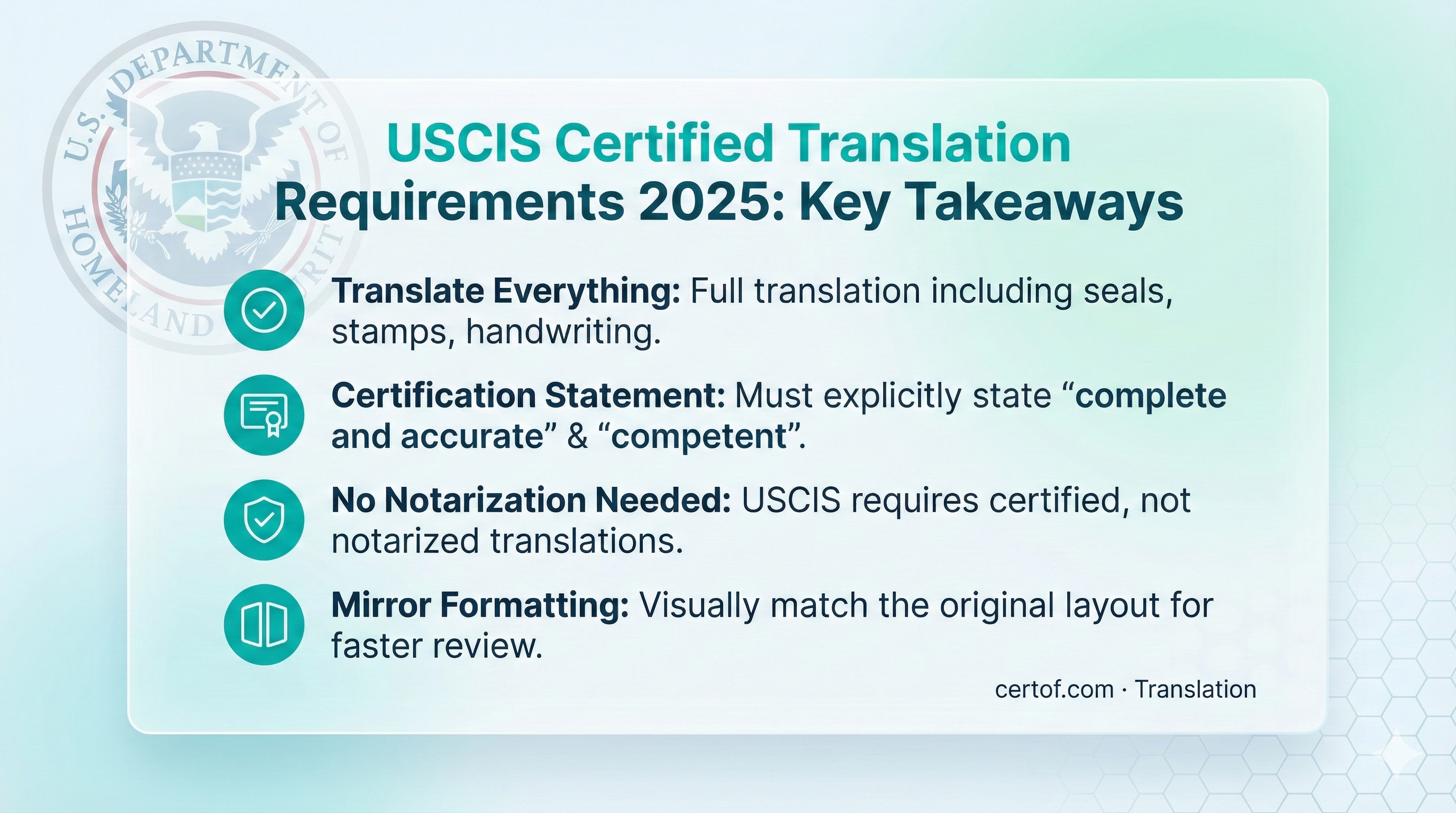
- Use full translation with proper certification, not summary text.
- Mark unclear content transparently with notes like [illegible handwriting].
- Use mirror formatting so officers can compare source and translation quickly.
- Choose a workflow with clear pricing, clear policy terms, and fast delivery options.
Target Reader and High-Stakes Pain Points
This article is for applicants handling fragile, pre-digital records that cannot be easily reissued. Typical examples include handwritten birth certificates, parish marriage entries, old police documents, and handwritten family registers.
- You have a USCIS or UKVI deadline and the document is hard to read.
- You cannot quickly obtain a cleaner official replacement.
- You worry missing side notes or stamps will trigger a review issue.
- You need a filing-ready result without law-firm level delays.
What Official Rules Require (USCIS and UKVI)
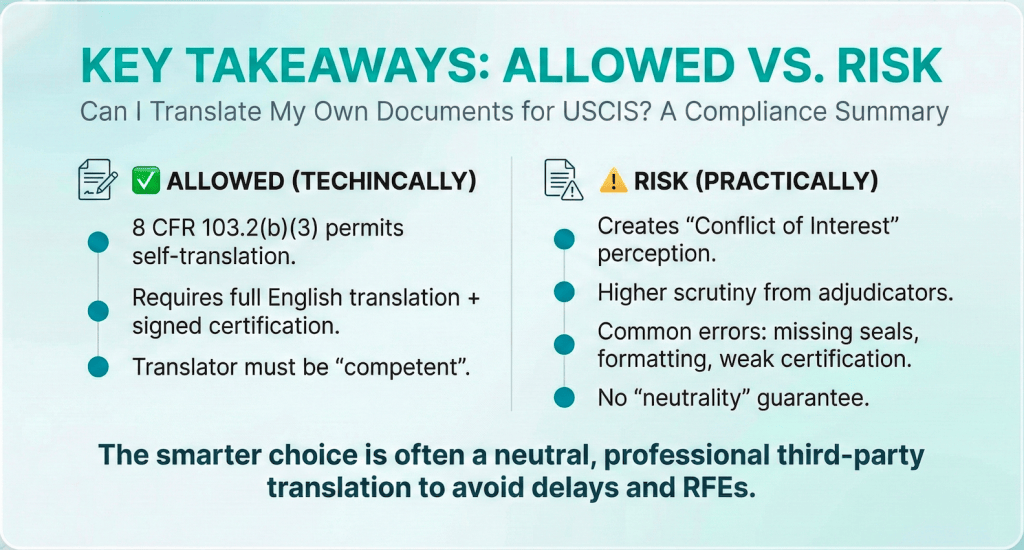
- 8 CFR 103.2(b)(3): foreign-language evidence submitted to USCIS must include a full English translation plus translator certification of completeness, accuracy, and competence.
- 8 CFR 103.2(b)(4)-(5): supporting documents follow form instructions, and USCIS may request originals later.
- USCIS Policy Manual, Volume 1, Part E, Chapter 6: translator summaries are not a substitute for full translation.
- USCIS Five Steps to File: submit legible evidence and complete translations for non-English documents.
- GOV.UK Visitor Supporting Documents: documents not in English or Welsh must include a full translation that can be independently verified by the Home Office.
- UK Ancestry caseworker guidance: if translation standards are not met and evidence cannot be interpreted, the document may be disregarded.
If a primary record truly does not exist, 8 CFR 103.2(b)(2) allows documented secondary evidence and affidavits. For older archives, this is often safer than forcing uncertain readings.
Counter-Intuitive Rule: Over-Cleaning Scans Can Increase Risk
Many applicants think stronger filters create safer evidence. In handwritten records, heavy contrast edits can erase paper texture, distort thin strokes, and hide seal edges. That can make a genuine record look altered.
Safer approach: submit the raw scan as source-of-record, and add an enhanced version only as a readability aid. Translate only what is visible and mark uncertainty directly.
- [illegible handwriting]
- [partially legible stamp]
- [signature illegible]
How We Handle Marginalia, Overlapping Stamps, and Damaged Edges
- Capture: use a clear 300 dpi scan or flat photo; include all edges and reverse side when relevant.
- Map: identify critical fields first, including names, dates, document numbers, issuing office, seals, and marginalia.
- Translate: render all legible content and annotate unclear content instead of guessing.
- Mirror format: preserve source layout so adjudicators can cross-check quickly.
- Certify: attach a document-specific certification page, not vague blanket text.
- Cross-check: align translated names and dates with passport and filing forms before submission.
For baseline compliance templates, use USCIS certified translation requirements and USCIS certified translation sample.
Common Pitfalls and Consequences
| Mistake | Review Impact | Likely Consequence | Safer Fix |
|---|---|---|---|
| Guessing faded words | Identity or date mismatch | RFE or credibility challenge | Use bracketed illegibility notes |
| Ignoring side notes or back pages | Translation appears incomplete | Rework request and delay | Translate every visible element |
| Flattening layout into one paragraph | Hard source-to-target mapping | Slower review, higher scrutiny | Use mirror formatting |
| Submitting only over-processed images | Authenticity concern | Additional review steps | Submit raw scan plus optional enhanced copy |
| Using non-specific certification text | Weak traceability | Lower evidentiary weight | Use document-specific certificate language |
CertOf vs Traditional Process
| Factor | CertOf Published Positioning | Traditional Offline Workflow |
|---|---|---|
| Ordering | Fully online | Email, office visit, or mixed process |
| Turnaround | Often minutes for many standard files | Often 24-72 hours |
| Pricing | From $9.99/page (published) | Commonly higher and quote-based |
| Formatting | Layout-preserving, mirror-oriented workflow | Inconsistent by vendor |
| Policy visibility | Public service and refund terms | Often private quote terms |
Why this matters for handwritten records: mirror formatting is not cosmetic. It reduces reviewer effort when seals, side notes, and damaged text must be cross-checked against source lines.
3-Step Online Process (Upload → Pay → Download)
- Start at online certified translation services for handwritten documents.
- Review certified translation price per page before checkout.
- Check refund and acceptance policy, then download your filing-ready package.
Need expedited help for unusual scripts or urgent timelines? Use rush certified translation support.
Privacy and Evidence Handling
- Use one secure upload flow instead of sharing sensitive records across multiple chat or email threads.
- Review published data handling terms at Privacy Policy and Terms of Service.
- For digital filing format decisions, see Electronic certified translation: PDF vs Word vs paper.
Related CertOf Guides for Edge Cases
- USCIS RFE translation services
- Do I need original documents with certified translation for USCIS?
- Can I translate my own documents for USCIS?
- Certified translation for UKVI
- How to fix a rejected USCIS translation
FAQ (People Also Ask)
Does USCIS accept certified translation of handwritten documents?
Yes, when the translation is complete and properly certified under 8 CFR 103.2(b)(3). For difficult handwriting, transparent illegibility notes are safer than guessing.
Can I submit scanned copies first and keep originals?
Usually yes for initial filing if form instructions allow copies. USCIS may still request originals later under 8 CFR 103.2(b)(5). Practical guide: original document requirements for USCIS.
What should a certificate of translation accuracy include?
It should identify the document and include statements of completeness, accuracy, and translator competence, plus signature, date, and contact details. Reference example: certificate wording sample.
Can I translate my own handwritten documents for USCIS?
USCIS rules center on competence and proper certification. In practice, self-translation can create credibility concerns, so an independent qualified translator is usually safer. See detailed self-translation guidance.
What if my translation was already rejected?
Correct the exact defect first, such as missing certification details, omitted stamps, omitted marginalia, or legibility mismatch. Then resubmit a targeted correction package using this USCIS rejected translation recovery guide.
Call to Action
If your document is old, handwritten, or partially unreadable, do not guess. Start with certified translation services online, verify your cost at transparent per-page pricing, and file with a cleaner, review-friendly package.