Disclaimer: This article provides general information about USCIS translation requirements and professional best practices. It does not constitute legal advice. If your case involves complex legal issues, consult a qualified immigration attorney.
About the author: Erin Chen is the Co-Founder and Translation Strategist at CertOf™. With over a decade in bilingual editorial risk control and hands-on experience navigating the U.S. immigration process, Erin helps applicants prepare USCIS-ready certified translations that reduce avoidable delays.
Certified Translation of Police Clearance Certificate: Fast, Compliant, and Built to Avoid Expensive Delays
If you need a certified translation of police clearance certificate, your biggest risk is rarely grammar. It is compliance packaging: complete content, correct certification wording, and a file structure officers can verify fast. In real cases, these details decide whether you move forward or get stuck in avoidable review delays.
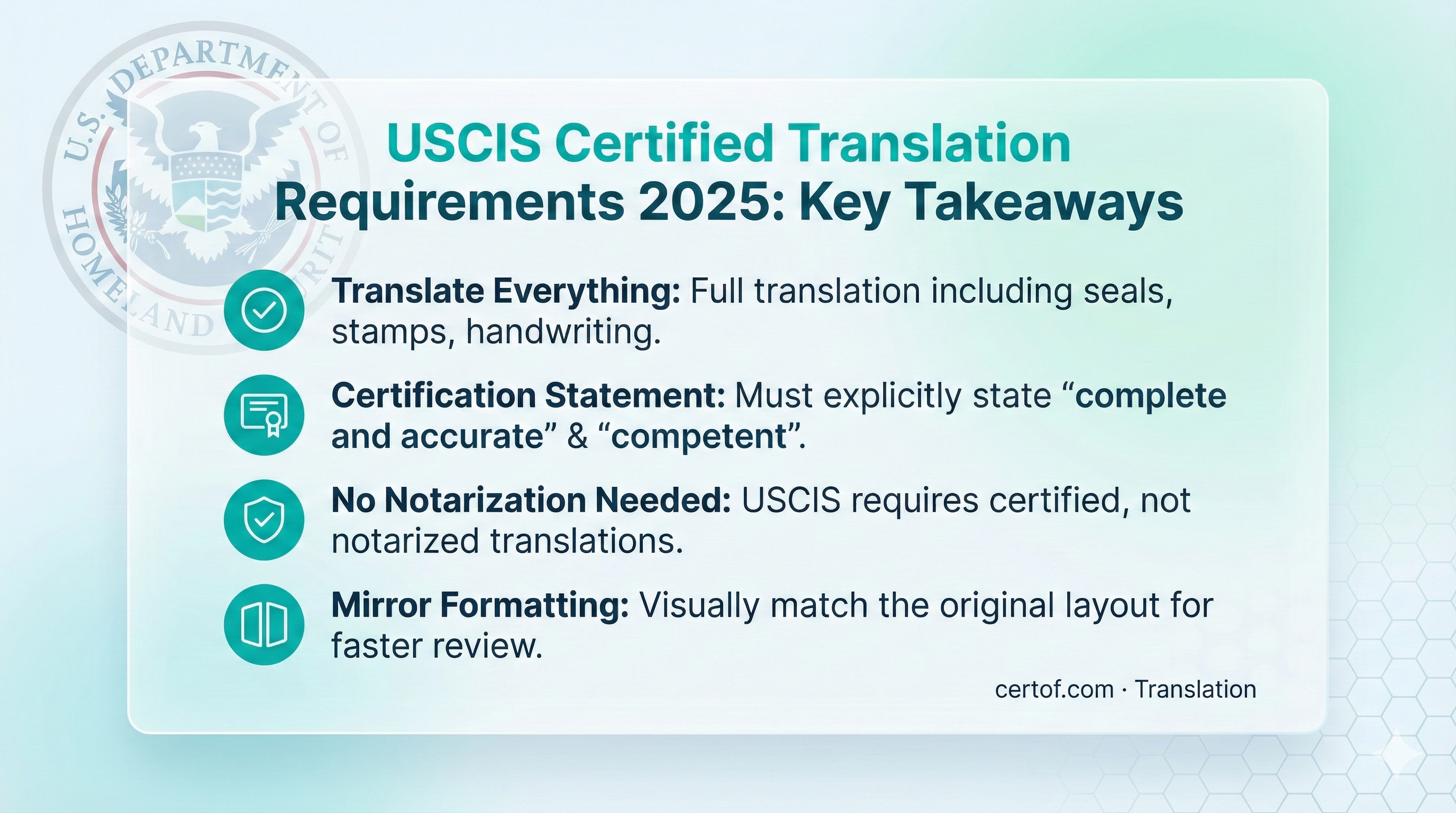
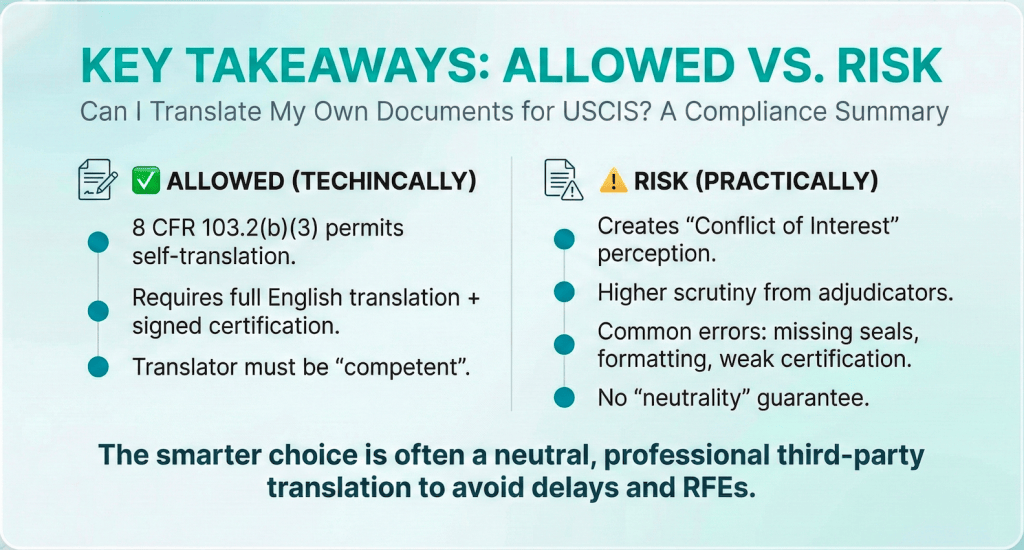
- USCIS requires a full English translation and translator certification of completeness, accuracy, and competence.
- For U.S. consular processing, police-certificate timing rules can fail even when translation quality is perfect.
- IRCC requires the original police certificate plus a translation from a certified translator when not in English or French.
- For UKVI routes that require criminal record certificates, country-history thresholds and translation rules must both be met.
Why Most Police Certificate Translations Fail (and Who This Guide Is For)
This guide is for applicants, families, and paralegals handling time-sensitive immigration packets, including criminal record certificate translation and no criminal record certificate translation.
- You are filing for USCIS, NVC/consular processing, IRCC, or UKVI under a strict timeline.
- You are unsure about certified vs notarized translation, originals vs copies, or whether an older translation can be reused.
- You want fewer additional document requests, predictable pricing, and a cleaner first submission.
If you need deeper route-specific walkthroughs, see certified translation for IRCC Canada and certified translation for UKVI.
What Official Sources Actually Say
| Authority | Official rule point | Why applicants still get delayed |
|---|---|---|
| USCIS | 8 CFR 103.2(b)(3) requires full English translation plus translator certification of completeness, accuracy, and competence. See 8 CFR 103.2(b)(3). | Partial translations, weak certification blocks, or omitted stamps/back-page notes. |
| USCIS filing mechanics | USCIS checklist language: do not send originals unless requested; foreign-language documents must include full English translation and certification. See I-485 required initial evidence checklist. | Applicants mail originals unnecessarily and lose response flexibility. |
| U.S. Consular / NVC | Step 7 civil document guidance requires certified translations and sets police-certificate sourcing criteria. It also states a 2-year police-certificate expiry rule with a specific exception. See U.S. Department of State Step 7. | Applicants re-translate old certificates instead of replacing expired police certificates. |
| IRCC (Canada) | If the certificate is not in English or French, submit the original plus a translation from a certified translator. See IRCC police certificate instructions. IRCC glossary clarifies certified translator, affidavit, and certified photocopy rules: IRCC glossary. | Translation may be fine, but supporting affidavit/certified-copy logic is incomplete. |
| UKVI (route-specific) | For categories that require overseas criminal record certificates, UKVI checks residence history (12 months or more in the past 10 years, age 18+), accepts original or scanned copies, and requires translation under paragraph 39B(f) when not in English. See UKVI criminal record certificate guidance. | Country-history thresholds are missed, not just translation formatting. |
The Counterintuitive Point: Your Translation Usually Lasts Longer Than Your Police Certificate
Most applicants assume the translation expires first. In real immigration workflows, the opposite is often true. If the source document has not changed, the translation may remain usable. But police certificate timing windows can fail first, especially in consular workflows. This is where people waste money by ordering a new translation for an already expired certificate.
For a USCIS-focused reuse framework, see how long a certified translation is valid for USCIS and reuse checklist for multiple USCIS cases.
Criminal Record Certificate Translation: Country-by-Country Timing Rules
Before you order translation, confirm the issuing country format and validity logic first. For U.S. immigrant visa cases, start with the country-specific document finder at Visa Reciprocity and Civil Documents by Country. This step saves more time than any formatting trick.
- If you lived in multiple countries, build a country timeline first, then match each police certificate to that timeline.
- For U.S. consular cases, check whether the two-year rule applies and whether the “no return to prior residence” exception applies.
- For UKVI routes, verify whether your specific route requires an overseas criminal record certificate before ordering.
- If a destination authority asks for an FBI Identity History Summary, translation rules come from the receiving authority, not from FBI issuance mechanics. See FBI Identity History Summary FAQs.
Compliance Checklist Before You Submit
- Translate all visible content: headers, stamps, signatures, handwritten notes, watermarks, and back-page text.
- Use names exactly as shown on source documents, then keep name formatting consistent across the whole packet.
- Include a clear translator certification tied to that specific document.
- Bundle source + translation in one officer-friendly PDF whenever possible.
- Confirm scan quality: no cropped corners, low-light blur, or missing seals.
- Do not assume notarization is required unless the receiving authority explicitly asks for it.
Pitfalls That Cause Rejections or Multi-Month Delays
- Partial translation: only the main paragraph is translated. Consequence: incompleteness challenge and re-submission.
- Notary trap: paying for notarization while certification language is still non-compliant. Consequence: higher cost without fixing core risk.
- Timing mismatch: fresh translation attached to an outdated certificate. Consequence: avoidable timeline reset.
- Country coverage error: one required jurisdiction is missing from residence history. Consequence: checklist failure late in process.
- Unclear packaging: source and translation uploaded as separate unlabeled files. Consequence: reviewer friction and additional document requests.
For recovery playbooks, see USCIS rejected my translation and USCIS RFE translation services checklist.
CertOf vs Traditional Offline Translation Workflow
| Factor | CertOf | Typical offline process |
|---|---|---|
| Turnaround | Often 5–10 minutes for standard records | Often 24–48 hours or longer |
| Pricing | Transparent pricing from $9.99/page | Quote variability and rush add-ons |
| Formatting | Mirror formatting that helps officers cross-check faster | Layout consistency varies by provider |
| Delivery | Online upload-to-delivery workflow | Email and manual coordination |
| Policy visibility | Public privacy, terms, and refund pages | Policy details often shared only after quote |
For data-driven context, see fast certified translation benchmarks by document type.
How to Order in 3 Steps
- Upload your police certificate to certified translation services for immigration documents.
- Confirm transparent per-page pricing and document count.
- Download your certified package and review policy coverage at refund and returns policy.
If your deadline is close, use immigration translation support contact before filing.
Trust Module: Privacy and Institution Coverage
Police and criminal-record documents are sensitive. CertOf publishes data-handling and user rights in the Privacy Policy and legal framework in the Terms of Service. Common receiving institutions include immigration authorities, universities, banks, and courts, with route-specific requirements decided by each authority.
If you are new to the platform, you can review the company background at About CertOf and start directly from CertOf home.
FAQ
Does USCIS accept online certified translations?
In many filings, USCIS accepts copies and reproduced signatures when form instructions are followed. What matters most is complete translation plus compliant certification wording. For sample packet structure, see what a USCIS certified translation sample should include.
Do I need notarized translation for immigration?
Usually, certification and notarization are different requirements. USCIS focuses on translation certification standards in 8 CFR 103.2(b)(3). Route-specific authorities may have additional rules. See certified vs notarized translation guide.
How long is a police certificate valid for U.S. consular processing?
Department of State Step 7 states police certificates generally expire after two years, with an exception when issued by a previous country of residence and you have not returned there since issuance. See official Step 7 guidance.
Can I use the same certified translation for multiple filings?
Often yes, if the underlying source document has not changed and the receiving authority does not request a fresh document package. For USCIS scenarios, see who can certify a translation for USCIS and reuse guidance linked above.
I received a translation-related USCIS notice. What should I fix first?
Triage in this order: completeness (all text/stamps), certification language, document legibility, and date validity of the underlying police certificate. Then use USCIS RFE translation services checklist.
Final CTA
If you want fast and compliant submission prep, start with certified translation services for police and immigration documents, review official per-page pricing, and submit a cleaner packet the first time.