Disclaimer: This article provides general information about USCIS translation requirements and professional best practices. It does not constitute legal advice. If your case involves complex legal issues, consult a qualified immigration attorney.
About the author: Erin Chen is the Co-Founder and Translation Strategist at CertOf™. With over a decade in bilingual editorial risk control and hands-on experience navigating the U.S. immigration process, Erin helps applicants prepare USCIS-ready certified translations that reduce avoidable delays.
Need a Chinese Hukou Translation Certified Fast? Stay Compliant and Avoid Costly Rework
If you need a chinese hukou translation certified package, the real challenge is not just translation quality. It is compliance under deadline. Hukou booklets often contain handwritten updates, cancellation marks, and police seals that many providers skip. Those missed details can trigger RFE, delays, or expensive re-issuance right before filing. For baseline rules, review the USCIS certified translation requirements checklist.
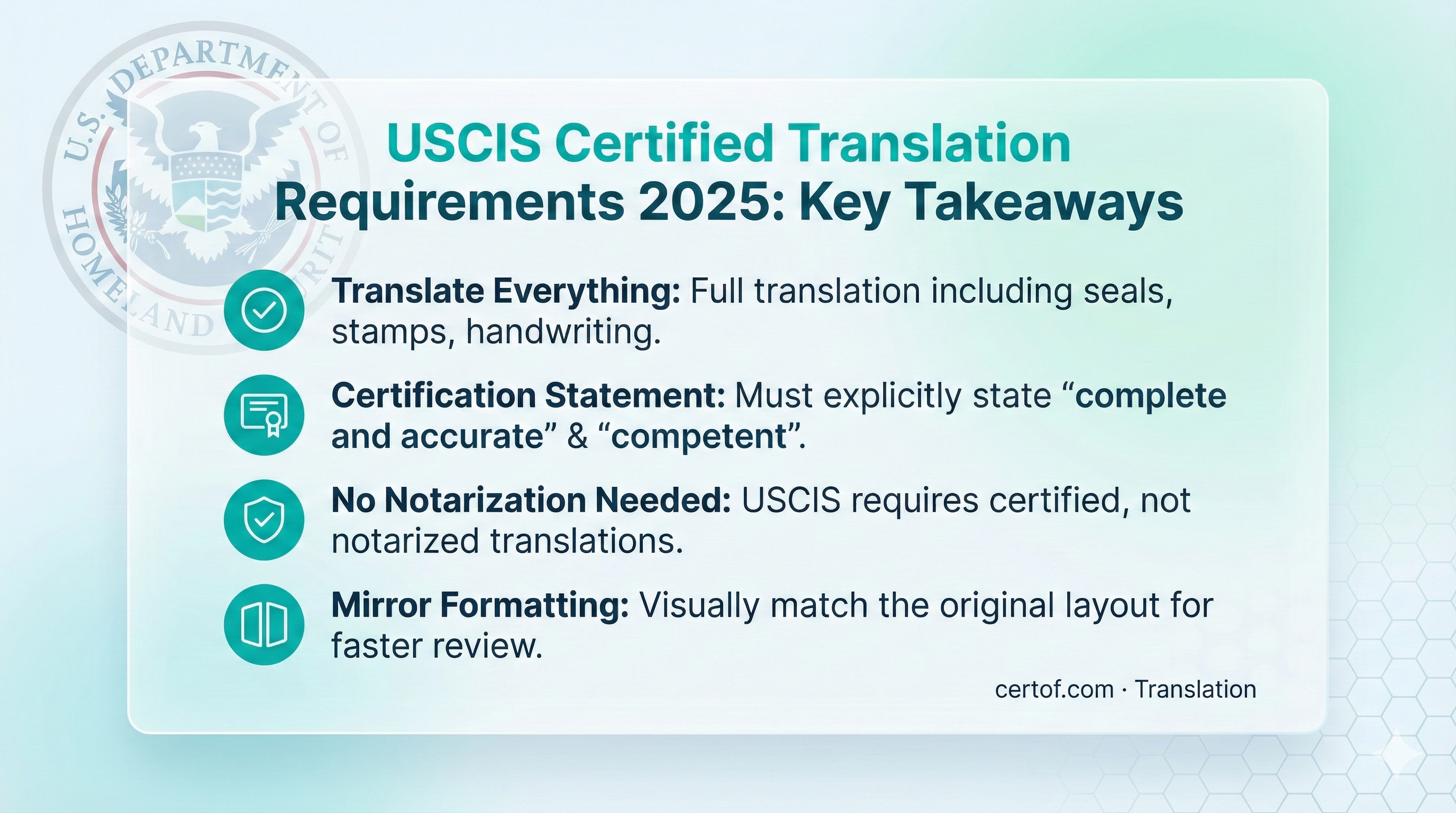
- USCIS requires a full English translation plus translator certification of completeness, accuracy, and competence.
- For many filings, copy-first is standard: do not send originals unless USCIS asks for them.
- Counterintuitive but true: a perfect hukou translation may still be supporting evidence, not the primary civil record for every filing step.
- A clean 3-step online workflow can reduce turnaround time, avoid missing pages, and cut avoidable legal rework fees.
Who This Guide Is For
This guide is for Chinese-speaking applicants, U.S. petitioners, and paralegals handling family-based immigration packets, especially I-130 and I-485. The top pain points are predictable: uncertainty about what to translate, confusion about notarization, fear of USCIS rejection, and pressure to file quickly.
What Official Rules Say (Checked on February 24, 2026)
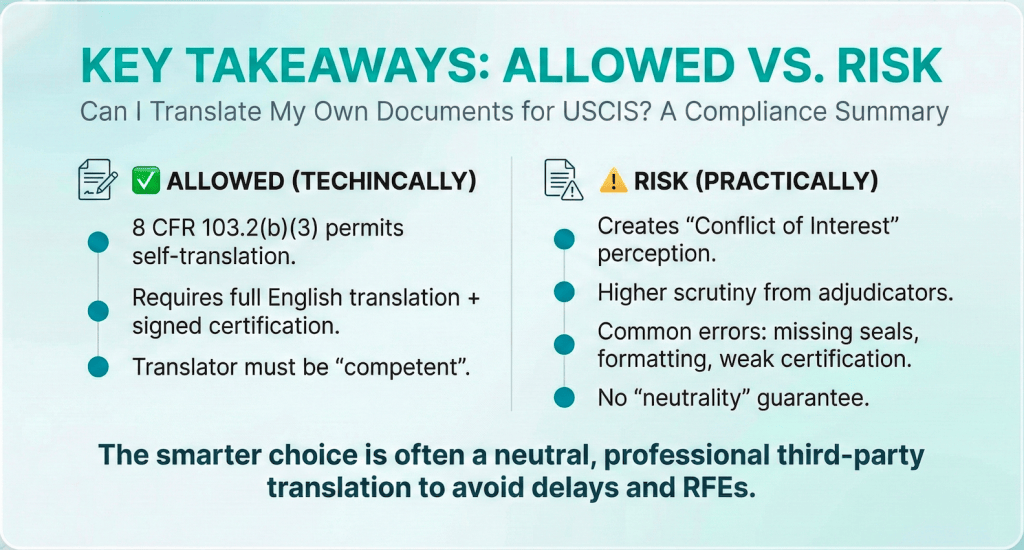
- 8 CFR 103.2(b)(3): a foreign-language document must include a full English translation and a translator certification.
- USCIS I-485 initial evidence checklist: repeats translation requirements and reminds applicants not to send originals unless requested.
- USCIS filing-by-mail tips: unrequested originals may not be automatically returned.
- USCIS Policy Manual (Signatures): copied or scanned handwritten signatures are generally acceptable unless form instructions require otherwise. A typed name on a signature line is not a valid handwritten signature.
- U.S. Department of State China Reciprocity Schedule: explains Chinese civil document pathways, including notarial issuance and source records such as hukou.
Practice clarification for 2025-2026: many USCIS-facing teams now issue one certification statement per source document (instead of one blanket statement for mixed files) to reduce document-scope disputes at intake.
The Counterintuitive Point: Hukou Matters, but It Is Not Always Your Primary Birth Evidence
Many applicants assume that once hukou is translated, birth evidence is complete. In practice, that can be wrong. In many case flows, hukou is strong supporting evidence, while the required primary civil record may be a different document type. If your packet also needs a birth or marriage record, see certified translation of birth certificate and marriage certificate translation for USCIS.
Certified Translation of Hukou Booklet to English: Field-by-Field Checklist
A professional certified translation of hukou booklet to english should mirror structure and capture every meaningful mark.
| Hukou Element | How to Translate | If Omitted |
|---|---|---|
| Cover title and issuing authority | Translate full title, office name, and document number | Document identity ambiguity |
| Household type and head-of-household details | Use consistent terms across all pages | Family-structure mismatch |
| Relationship fields | Translate kinship terms exactly | I-130 relationship inconsistency |
| Name, DOB, ID number, ethnicity | Copy exactly; annotate differences vs passport | Identity reconciliation delay |
| Address and move history | Translate historical entries, not only current address | Timeline gaps in evidence |
| Handwritten updates and cancellations | Translate notes, dates, and reasons; mark [Illegible] if needed | Officer cannot verify record changes |
| Seals and stamps | Annotate every seal and visible stamp text | Loss of authenticity context |
| Blank fields | Mark as [Blank] or [No entry] | Perceived incomplete translation |
Certified Translation of Chinese Household Registration for USCIS: 3-Step Workflow
- Upload complete scans: cover, household page, member pages, and all stamped or updated pages.
- Package by document: source page set plus translation plus certification statement for that specific document.
- Pre-filing consistency check: match names, dates, and IDs with passport, I-130, and I-485 before submission.
Start here: online USCIS certified translation order portal. Need speed support: rush certified translation support team. Protection terms: money-back and refund policy for certified translation. Service overview: official certified translation services provider.
Common Pitfalls and Real Consequences
- Partial translation only: only one member page translated. Consequence: RFE for incomplete translation package.
- Blanket certification for mixed files: one statement attached to multiple unrelated documents. Consequence: document-level scope questions and re-issuance.
- Ignoring handwritten changes: marital status or cancellation entries skipped. Consequence: relationship-history inconsistency review.
- Typed name used as signature: no valid handwritten signature trace. Consequence: avoidable intake friction.
- Name mismatch across packet: pinyin inconsistency between hukou translation and passport/forms. Consequence: clarification delay or extra evidence request.
If this already happened, use USCIS RFE translation services or the recovery guide USCIS rejected my translation.
CertOf vs Traditional Offline Translation Workflow
| Factor | CertOf Online Workflow | Typical Offline Workflow |
|---|---|---|
| Turnaround | Often 5-10 minutes for standard pages | Commonly 24-72 hours |
| Pricing | From $9.99/page (transparent) | Quote-based, often variable |
| Formatting | Mirror layout with stamp annotations | Varies by provider |
| Compliance workflow | Document-by-document package assembly | Often email-based manual coordination |
| Acceptance policy visibility | Published guarantee and refund pages | Policy often unclear before order |
Privacy and Institution Coverage
For sensitive immigration files, upload through secure channels and keep one digital master packet. CertOf publishes terms at Privacy Policy and Terms of Service. Typical receiving institutions include USCIS, universities, banks, and courts, subject to each institution’s own rules.
Related CertOf Guides (So This Page Stays Focused)
- USCIS certified translation requirements checklist
- what a USCIS certified translation sample packet looks like
- who can certify a translation for USCIS
- do I need original documents with certified translation for USCIS
- can I translate my own documents for USCIS
- difference between certified and notarized translation
- reuse certified translation across multiple USCIS cases
FAQ
Does USCIS accept online certified translations of hukou documents?
USCIS focuses on translation completeness and valid certification, not whether you ordered online or offline. Use a full document package with clear signatures and legible scans.
Do I need notarization for a hukou translation in USCIS filings?
Usually no. USCIS generally asks for certified translation. Notarization is a different legal function. See certified vs notarized translation.
Can I translate my own hukou for USCIS?
The regulation focuses on competence and certification, but self-translation can increase scrutiny. A neutral third-party package is usually safer for immigration review. See self-translation guidance.
Do I need to mail original hukou pages with my filing?
For many filings, copies are submitted first and originals are presented only if requested later. See USCIS original-document guidance.
Can hukou translation replace a notarial birth certificate for I-485?
Not always. In many cases, hukou is supporting evidence rather than the primary birth record expected in the civil-document pathway. Check the China Reciprocity Schedule and this guide on certified translation of birth certificate for USCIS.
Can I reuse one hukou translation for both I-130 and I-485?
Often yes, if the document content is still accurate and the translation packet remains complete. See digital master reuse checklist.
Final Action Step
If your deadline is close, prepare your certified translation of chinese hukou for uscis i-485 now as a complete, document-by-document packet instead of waiting for an RFE cycle. Start with fast certified translation online.