Disclaimer: This article provides general information about USCIS translation requirements and filing practice. It is not legal advice. If your case involves criminal history, prior findings, or complex inadmissibility issues, consult a licensed U.S. immigration attorney.
About the author: Erin Chen is the Co-Founder and Translation Strategist at CertOf™. She has 10+ years of bilingual document risk-control experience and reviews USCIS-facing translation packages for family, employment, and naturalization filings.
How long is a certified translation valid for USCIS? As of February 28, 2026, USCIS still does not publish a fixed expiration period for certified translations. The practical risk is not age by itself. The real risk is whether your file is still complete, readable, and matched to your current source document. This update is for applicants reusing older translations in I-130, I-485, or N-400 filings, and for legal teams trying to avoid preventable RFEs.
How Long Is a Certified Translation Valid for USCIS: Quick, Compliant, and Cost-Smart Answer
Key Takeaways
- No fixed USCIS expiration date: The controlling rule is 8 CFR 103.2(b)(3), which requires completeness, accuracy, and translator competence.
- Counter-intuitive but true: A careful 2018 translation can be safer than a rushed 2026 translation if the source document has not changed.
- Most RFEs come from defects, not age: missing back-side content, weak certification text, and low-quality scans cause far more problems than old dates.
- Digital reuse is normal: clear scans and PDFs are routinely used in USCIS workflows when signatures and text are readable.
Anti-myth point: Certified translations usually fail because they are incomplete or unreadable, not because they are old.
Who This Guide Is For and Why This Question Matters
This guide is written for people who want to avoid paying twice and avoid delays. The most common scenarios we see are:
- Applicants who already purchased a certified translation of birth certificate or a marriage certificate translation for uscis and now need a new filing stage.
- Families managing multi-step timelines across petition, adjustment, and naturalization.
- Paralegals and attorneys who need a repeatable quality checklist for reused translation assets.
- Budget-sensitive applicants deciding between safe reuse and re-translation.
The goal is simple: submit once, avoid RFE churn, and keep your certified document translation reusable for future cases.
What USCIS Actually Requires from a Certified Translation
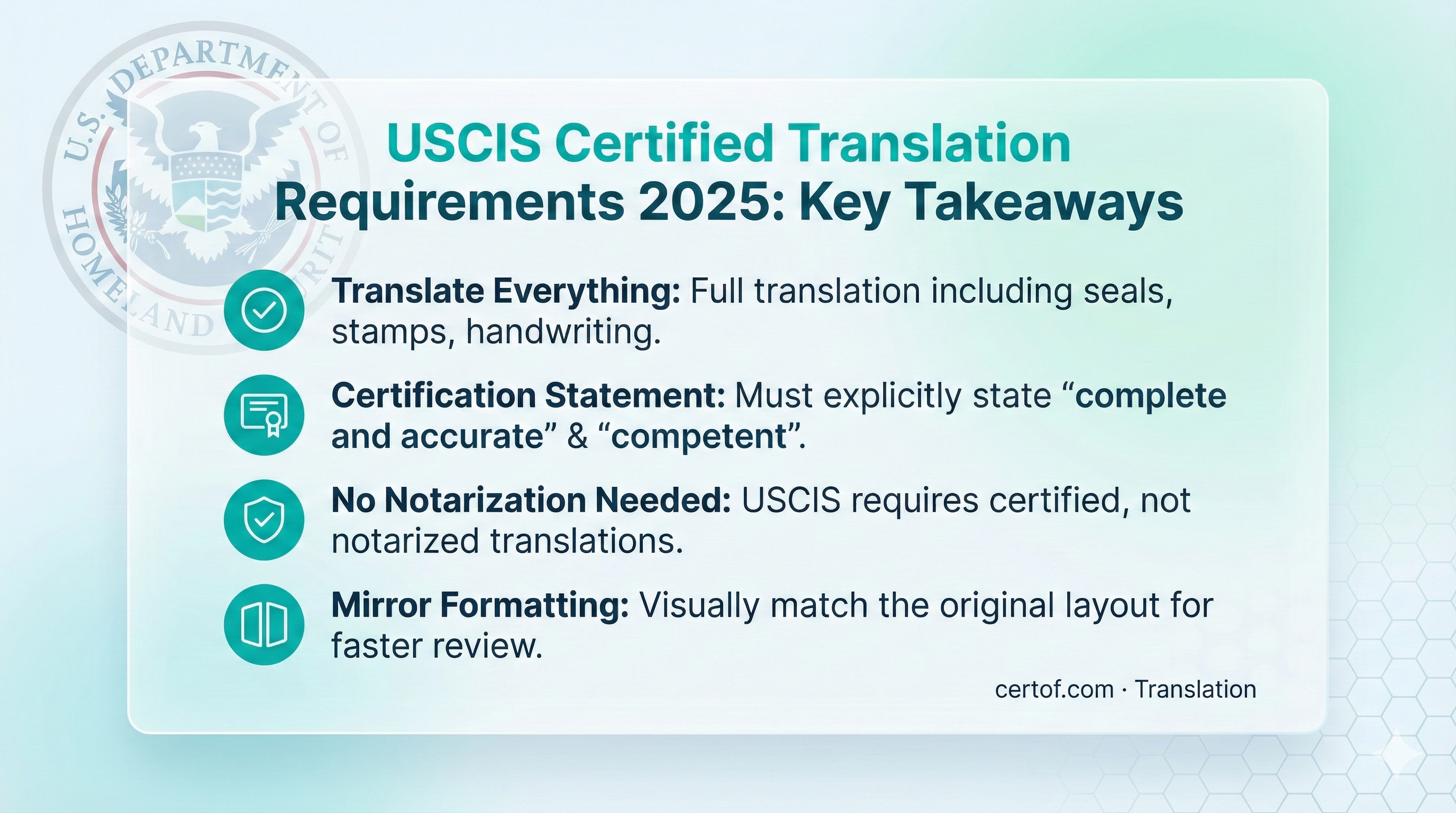
The legal baseline is short and strict. Under 8 CFR 103.2(b)(3), any foreign-language evidence must include a full English translation and a translator certification stating that the translation is complete and accurate and that the translator is competent.
- Translate all visible content, not only the main fields.
- Include seals, stamps, side notes, and reverse-side text where present.
- Attach a proper certificate of translation accuracy signed by a competent translator.
- Keep names, dates, and document numbers consistent across the filing package.
Notice what the rule does not say: there is no fixed validity period. For detailed standards and sample wording, use our USCIS certified translation requirements guide.
Do Certified Translations Expire for Immigration Cases
Usually, no automatic expiration applies. That feels unusual because many immigration documents are time-sensitive. Translation validity is different.
| Document Type | Time Rule | Why |
|---|---|---|
| Form I-693 medical exam | Time-limited under USCIS form policy | Medical conditions can change over time. |
| Police certificates in consular processing | Country and case-stage recency rules may apply | Criminal history can change over time. |
| Certified translation of an unchanged civil record | No fixed USCIS expiration date | If source facts are unchanged, a complete translation remains complete. |
For post-USCIS consular stages, check National Visa Center guidelines because NVC and consular timelines are managed separately from USCIS translation language.
Can I Reuse the Same Certified Translation for Multiple USCIS Cases
In many cases, yes. You can often reuse the same package across I-130, I-485, and later N-400 if the source record is unchanged and the translation file is still technically clean.
Reuse Checklist You Can Run in 60 Seconds
- The source document version is identical to the one translated.
- The translation includes every page and all visible marks.
- The certificate states complete and accurate translation plus translator competence.
- The signature and certificate text are readable in the submitted scan.
- No page is blurry, cropped, skewed, or partially hidden.
- Names and dates still match your current filing forms.
If one item fails, update before filing. For format checks, compare with this USCIS certified translation sample. If you are uncertain about copies versus originals, use whether USCIS needs original documents with certified translations.
Common Pitfalls That Trigger RFEs or Delays
These are the most common avoidable mistakes in reused translation files:
- Reusing a translation after the source document was amended: old translation no longer matches the new civil record. Typical result: RFE adding weeks or months to processing time.
- Missing reverse-side content or marginal notes: officers cannot fully validate context. Typical result: follow-up evidence request and avoidable delay.
- Low-quality scans from old phones: glare, folds, or cropped edges hide names and numbers. Typical result: document deemed insufficient for adjudication.
- Weak certification block: missing competence statement or unclear signature language. Typical result: request for corrected translator certification.
- Editing date or text on an old certificate: this creates credibility risk. Typical result: serious scrutiny beyond a routine translation issue.
If USCIS Rejected My Translation: Practical RFE Response Plan
If you already received an RFE or NOID, handle translation repair as an urgent production task.
- Extract each defect line from the notice and map it to a correction action.
- Re-translate from the latest source document version only.
- Issue a clean mirror-formatted package with a compliant certificate.
- Submit before the deadline with a short cover letter mapping each fix.
Use our dedicated USCIS RFE translation services guide for a fast correction workflow.
Digital Copies, Signatures, and File Quality in 2026
Two USCIS operational points matter for reuse. First, filings are document-scan driven. Second, signature policy allows reproduced copies of original handwritten signatures in many contexts, reflected in the USCIS Policy Manual Volume 1, Part B, Chapter 2.
- Keep the original signed translator certificate in your records.
- For online filing, upload clear files and keep every field readable.
- Current USCIS online guidance states a 12 MB upload limit per file in many workflows: Tips for Filing Forms Online.
- For paper filing quality standards, follow Tips for Filing Forms by Mail.
- Practical quality control: use 300 dpi scans and re-check legibility before submission.
CertOf™ vs Traditional Translation Agency: Speed, Cost, and Reuse Readiness
When comparing uscis certified translation services, prioritize acceptance risk, speed, and technical completeness instead of headline price alone.
| Decision Factor | CertOf™ | Typical Offline Agency |
|---|---|---|
| Price transparency | $9.99 per page, shown before checkout. | Higher page pricing is common, plus admin or notary upsells. |
| Turnaround | Many standard civil documents in 5-10 minutes. | Often 24-48 hours, sometimes longer. |
| USCIS risk posture | USCIS-focused formats, acceptance guarantee, and refund policy for eligible orders. | Quality and USCIS fit vary by vendor. |
| Formatting quality | Mirror formatting to preserve field mapping. | Paragraph-only format is still common. |
| Reuse support | Simple digital re-download for future filings. | Files can be lost across old email threads. |
| Order channel | Fully online from phone or desktop. | Manual email or in-person workflow is common. |
If you want direct conversion paths: order USCIS certified translation online, review upload and order certified translation online, compare fast certified translation with money-back guarantee and free revisions, and benchmark cheap certified translation services.
3-Step Process to Get a Reusable USCIS Certified Translation
- Upload: submit scan, photo, or PDF at translation.certof.com.
- Confirm: verify pages and transparent total cost before payment.
- Download: receive a USCIS-ready certified translation package built for reuse.
Process image placeholder: Upload -> Pay -> Download in minutes. Recommended image alt text: 3-step process to order uscis certified translation online.
Privacy, Institution Coverage, and Urgent Use Cases
Applicants usually ask three trust questions before ordering: file privacy, institution acceptance, and rush capability. Our workflow is designed around those concerns.
- Privacy: encrypted upload channels, controlled access, and limited handling for sensitive records.
- Coverage: USCIS, NVC-stage uploads, universities, banks, courts, and DMV-related submissions where certified translation is requested.
- Urgency: rush-friendly processing for many common civil documents.
- Packet economics: for multi-relative filings, check bundle price for full immigration packet translation.
Related Reading for Better Filing Decisions
- USCIS certified translation requirements for rule-level details.
- Certified vs notarized translation if you are unsure whether notarization is required.
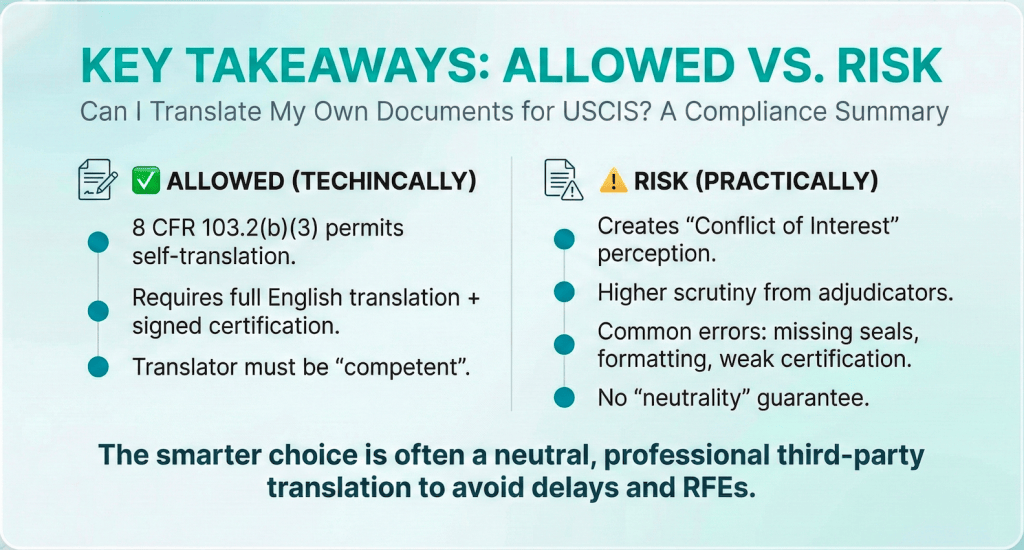
- Can I translate my own documents for USCIS for conflict and accuracy risk analysis.
- Can I use Google Translate for USCIS for machine-only translation limits.
FAQ: How Long Is a Certified Translation Valid for USCIS
Do certified translations expire for immigration filings
USCIS does not assign a universal expiration date. Reuse is usually acceptable when the source document is unchanged and the translation remains complete, certified, and legible.
Can I reuse the same certified translation for I-130, I-485, and N-400
Often yes. Keep a clean master PDF and verify names, dates, and source version against your new filing. This guide on reusing certified translation for multiple USCIS cases provides a practical checklist.
Does USCIS require a new wet-ink signature every time I file
Usually no for routine supporting evidence copies. Keep the original signed source in your records in case USCIS requests it later, and do not replace handwritten signatures with typed names.
What if my old translation certificate is missing contact details or has weak wording
Do not patch old files manually. Issue a corrected certification package and re-check against a current sample format before filing.
Can I just change the date on a previous certified translation
No. Altering certification text or date can create serious credibility problems. If you are already in this situation, start with uscis rejected my translation and prepare a clean replacement package.
Need a Safe Update Today
If your deadline is close, start at online USCIS certified translation services. You can also compare fast certified translation turnaround benchmarks by document type before ordering.