Disclaimer: This article provides general information about USCIS translation requirements and compliance practice. It is not legal advice. If your case involves inadmissibility, criminal history, prior misrepresentation, or complex evidence strategy, consult a licensed U.S. immigration attorney.
About the author: Erin Chen is Co-Founder and Translation Strategist at CertOf. Our team prepares certified document translation packages for immigration, legal, and academic filings, with a focus on USCIS intake risk control.
USCIS Certified Translation Requirements: Fast Compliance, Fewer RFEs, and Lower Total Cost
If you are filing Form I-130, I-485, or N-400, the uscis certified translation requirements are a legal checkpoint, not a style preference. I have reviewed many delayed filings where eligibility was strong but one translation detail failed: missing back-page notes, weak certification language, or layout mismatch that made officer review harder than it had to be.
This guide is written for real 2025-2026 filing pressure: you need speed, compliance, and predictable cost without gambling on avoidable RFEs.
- Rule stability: The federal translation rule is stable. Most delays come from execution errors, not rule changes.
- Must-have wording: Your certificate must confirm the translation is complete and accurate, and that the translator is competent in the language pair.
- Common triggers: Partial translation, missing stamp or seal descriptions, and bad signature workflow.
- Practical low-risk path: Mirror formatting plus document-specific certification usually gives cleaner intake and fewer follow-up notices.
USCIS Translation Quick Reference
- Focus keyword: uscis certified translation requirements
- uscis translation requirements 2025
- uscis certified translation with statement of accuracy
- does uscis accept online certified translations
- can i translate my own documents for uscis
- difference between certified and notarized translation
- how long is a certified translation valid for uscis
Who This Guide Is For and Why It Matters
This article is for applicants and paralegals who cannot afford technical delays: family-based filers, adjustment applicants, naturalization applicants, and small legal teams managing multi-document packets under deadline pressure.
The core pain point is simple: one translation mistake can turn a clean case into an RFE cycle, add mailing and response time, and force extra cost just to repair paperwork that should have been correct on day one.
USCIS Certified Translation Requirements Under Federal Law (8 CFR 103.2)
The controlling authority is 8 CFR 103.2. eCFR displays Title 8 as up to date through February 24, 2026. Subsection 103.2(b)(3) keeps the same three-part translation standard:
- Any foreign-language document submitted to USCIS must include a full English translation.
- The translator must certify the translation is complete and accurate.
- The translator must certify they are competent to translate from the source language into English.
USCIS repeats this standard across current form pages and checklists, and in the USCIS Policy Manual guidance on translations. The policy manual also notes that a summary prepared by a translator is not an acceptable substitute for a full translation.
Also note related subsections: 8 CFR 103.2(b)(4) and (b)(5) allow copies unless USCIS or form instructions request originals, and 103.2(b)(8) gives officers discretion to deny or issue an RFE when required initial evidence is missing.
USCIS Certified Translation With Statement of Accuracy: What Must Be Included
A low-risk certificate should be attached to each translated document set and include clear identity and signature elements.
- Translator full legal name
- Source language and target language pair
- Statement that translation is complete and accurate
- Statement that translator is competent in that language pair
- Date and signature
- Contact details for traceability
Certification by Translator
I, [Full Name], certify that I am competent to translate from [Source Language] into English,
and that the attached translation is complete and accurate to the best of my knowledge and ability.

Signature:
Date:
Contact Information:
For format reference, see this USCIS certified translation sample. For credential myths, see do I need an ATA certified translator for USCIS.
The Counterintuitive Rule: Do Not Fix Errors in the Original Document
This is where many applicants make a costly mistake. If the original document contains a typo, spacing issue, or clerical inconsistency, the translation should mirror the source instead of silently fixing it.
Why this matters: USCIS is evaluating evidence integrity. A certified translation is evidence reproduction, not document editing. If you alter content inside the translation, you can create mismatch risk and credibility questions.
| Original situation | Low-risk translation behavior | Why this works |
|---|---|---|
| Name misspelled on source certificate | Translate exactly as shown; if needed, annotate with [sic] and explain discrepancy separately in your packet | Preserves evidentiary integrity |
| Faded stamp or unreadable handwriting | Use bracketed notes such as [illegible stamp] or [partially legible signature] | Shows transparency instead of omission |
If your case has name mismatch issues, pair the translation with separate supporting evidence instead of editing the translated text itself.
Mirror Formatting Checklist for USCIS Accepted Translations
Mirror formatting means the English translation follows the same visual logic as the source document so reviewers can cross-check quickly.
- Preserve headings, section order, and table structure
- Map each stamp, seal, and handwritten note near its original position
- Keep registration numbers, IDs, and serial references exactly placed
- Translate both front and back pages when content appears on both sides
- Avoid collapsing the whole document into one plain paragraph
Mirror formatting is not decoration. It reduces officer review friction and helps your file look reliable at intake.
Common Mistakes and Real Consequences (Pitfalls)
- Partial translation of only main text: Skipping margins, back pages, or administrative notes can be treated as missing initial evidence and trigger RFE or denial logic under 8 CFR 103.2(b)(8).
- Generic certificate for multiple unrelated documents: A vague blanket statement creates traceability risk. Document-specific certification is safer.
- Signature workflow mistakes: USCIS form guidance such as Form I-129 warns that typed names and pasted signature images are invalid. See also USCIS Policy Manual Chapter 2 on signatures. We follow an original-handwritten-signature workflow for paper filings, or USCIS-compliant electronic signing when the form explicitly permits online filing.
- Editing facts inside translation: Changing names, dates, grades, or currency can create internal inconsistency and credibility issues.
- Sending originals when not requested: Under 8 CFR 103.2(b)(4)-(5), copies are generally acceptable unless USCIS specifically requests originals.
Time impact you should plan for: 8 CFR 103.2(b)(8)(iv) caps RFE response time at up to 12 weeks and NOID response time at up to 30 days. One translation repair can add weeks or months once mailing and queue time are included.
If you are already in trouble, start with USCIS RFE translation services and this fix rejected USCIS translation checklist.
CertOf vs Traditional Options: Price, Speed, and Compliance
| Factor | CertOf online workflow | Traditional law office or local shop |
|---|---|---|
| Pricing | $9.99 per page, transparent pricing | Often higher and less predictable |
| Turnaround | 5-10 minute delivery option for urgent workflows | Commonly 24-48 hours or longer |
| USCIS package format | Mirror formatting plus certificate of accuracy workflow | Varies by provider |
| Acceptance confidence | 100% USCIS acceptance guarantee with refund policy | Usually no formal acceptance guarantee |
| Ordering | Fully online upload and payment | Email chains or in-person handoff |
How CertOf Works in 3 Steps
- Upload: Send PDF, photo, or scan of your document.
- Pay: Confirm transparent per-page pricing and turnaround.
- Receive: Download certified translation package with statement of accuracy, ready for USCIS packet assembly.
Get USCIS certified translation services online and start in minutes.
Start a fast certified translation order for birth certificates, marriage certificates, police records, financial evidence, and more.
Review the money-back guarantee and refund policy for certified translation before checkout.
Trust Signals: Privacy, Institution Coverage, and Rush Support
- Secure upload and encrypted transmission over HTTPS
- Restricted access handling for translators and QA reviewers only
- Document types supported across USCIS, universities, banks, and courts where certified translation is requested
- Rush processing available for RFE and interview deadlines
Need human help first? Talk to a certified translation specialist.
Related USCIS Translation Guides on CertOf
- difference between certified and notarized translation
- can I translate my own documents for USCIS
- how long is a certified translation valid for USCIS
- do I need original documents with certified translation for USCIS
- who can certify a translation for USCIS
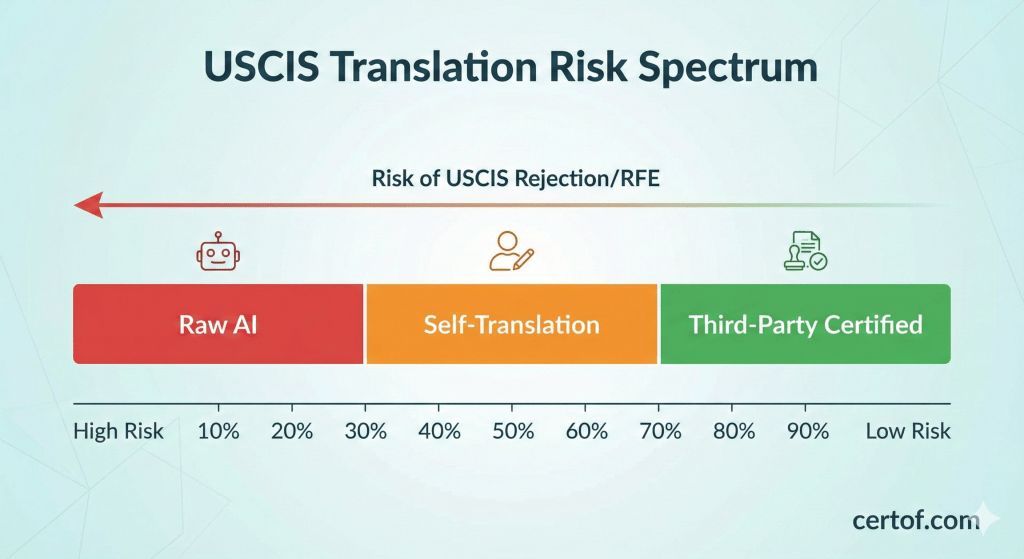
- can I use Google Translate for USCIS
FAQ
Can I translate my own documents for USCIS?
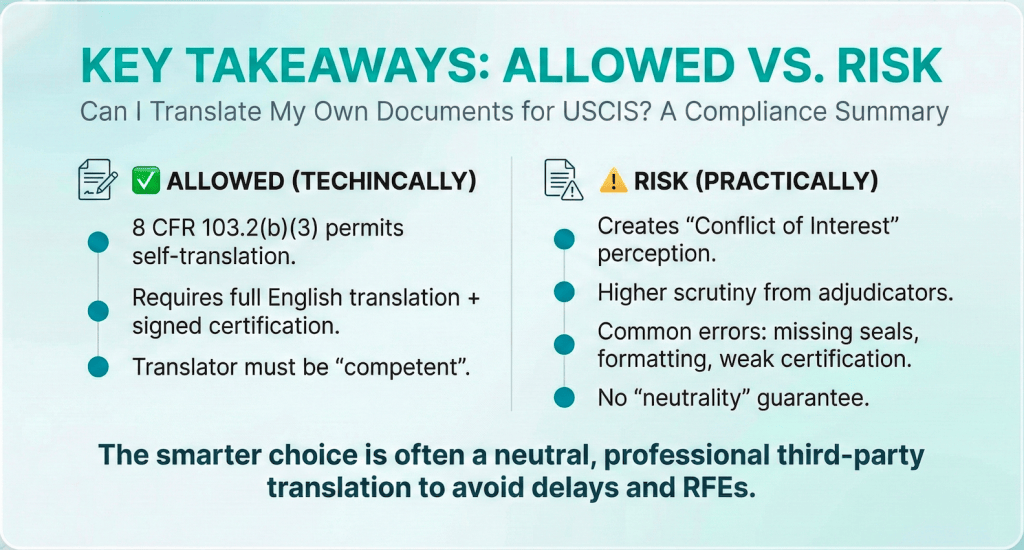
The rule focuses on completeness, accuracy, and translator competence, but self-translation creates avoidable credibility risk in high-stakes filings. A neutral third-party translator is usually safer. See can I translate my own documents for USCIS.
Does USCIS accept online certified translations?
Yes. USCIS evaluates translation completeness and certification content, not whether you ordered online. If the package is full, accurate, and properly certified, online workflow is commonly used.
Do I need notarized translation for USCIS?
In most USCIS contexts, certified translation is the baseline requirement, not notarization. Read the full breakdown in difference between certified and notarized translation.
How long is a certified translation valid for USCIS?
There is no single universal expiration period in the core translation rule. Practical validity depends on whether the underlying source document remains acceptable for your filing stage. See how long a certified translation is valid for USCIS.
What should I do if USCIS rejected my translation or issued an RFE?
Move fast: replace with a full mirror-formatted translation, attach a compliant certificate, and submit one complete response packet. Use certified translation for USCIS RFE response and USCIS rejected my translation recovery steps.
Ready to avoid preventable delays?
Use a compliant workflow built for USCIS intake: complete translation, mirror formatting, and a document-specific statement of accuracy.
Order official certified translation services for USCIS now.