Disclaimer: This article provides general information about USCIS translation requirements and filing best practices. It is not legal advice. If your case involves admissibility, criminal history, prior denials, or litigation risk, consult a licensed U.S. immigration attorney.
About the author: Erin Chen is Co-Founder and Translation Strategist at CertOf™. Our team supports certified document translation workflows for immigration, legal, education, and financial submissions, with a focus on reducing avoidable RFE cycles.
USCIS Certified Translation Sample: Fast, Compliant, and Built to Avoid RFEs
If you are searching for a uscis certified translation sample, you are usually in the final filing phase and trying to prevent one avoidable delay. The practical question is not “Can this be translated?” but “Will USCIS accept this packet without friction?” This guide shows exactly what a USCIS-ready packet looks like in 2026, including template wording, layout rules, and a final pre-submission checklist.
I wrote this for applicants and paralegals handling high-stakes evidence under deadline pressure: birth certificates, marriage records, hukou booklets, police clearances, and court documents where one formatting miss can trigger a Request for Evidence.
Key Takeaways
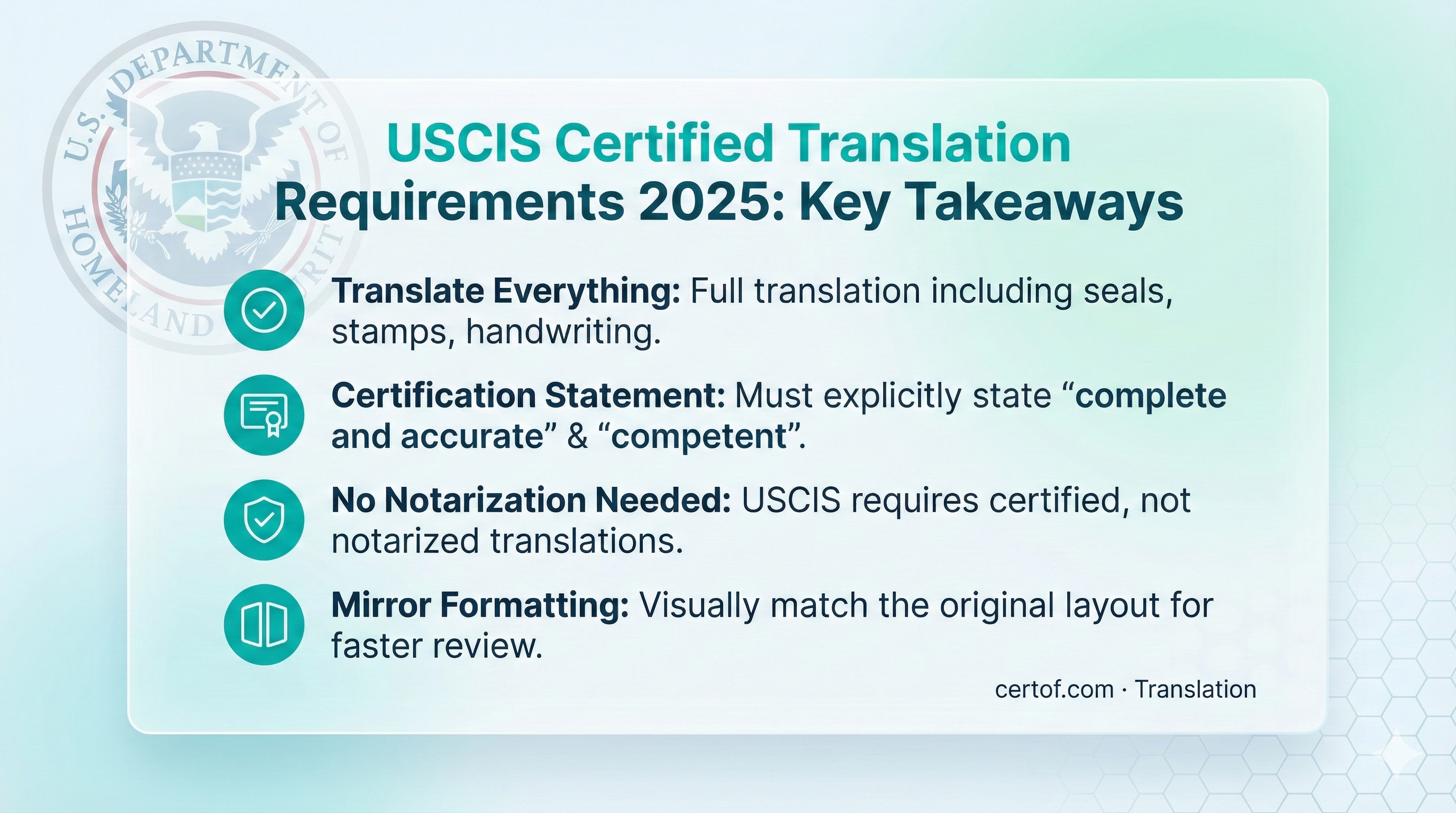
- USCIS rule baseline is stable: under 8 CFR 103.2(b)(3), foreign-language evidence needs a full English translation and translator certification of completeness, accuracy, and competence.
- A low-risk packet has three parts: source document copy, complete English translation, and a signed certificate of translation accuracy.
- Counterintuitive truth: notarized-looking documents can still fail if certification wording is weak; plain, complete, well-structured packets often review faster.
- Speed and cost can coexist: CertOf publishes $9.99/page pricing, with many standard files delivered quickly and backed by a published refund policy.
What USCIS Officially Requires (And What Rumors Usually Miss)
The controlling standard is regulation plus USCIS filing guidance. As of February 27, 2026, the core translation requirement in 8 CFR 103.2(b)(3) is unchanged.
- Full English translation of foreign-language evidence (not a summary).
- Certification that the translation is complete and accurate.
- Certification that the translator is competent in the language pair.
USCIS repeats this standard in filing resources, including the Form I-485 initial evidence checklist, the I-485 instructions page, and the USCIS Policy Manual (Volume 1, Part E, Chapter 6).
Operational reality: most translation RFEs come from execution errors, not “new hidden laws.”
The 2026 Digital Intake Reality: Build a Searchable, Scan-Clean PDF Packet
USCIS has not published a separate rule titled “searchable PDF mandate” for all cases. But USCIS does explicitly require readable uploads and scan-friendly submissions. In practice, that means document quality is part of compliance.
- For online filings, USCIS says uploads must be clear/readable and within format/size limits (see Tips for Filing Forms Online).
- For paper filings, USCIS warns about scan delays and illegible copies (see Recommendations for Paper Filings to Avoid Scanning Delays and Tips for Filing Forms by Mail).
- A practical best practice is keeping a text-searchable, high-clarity “digital master” PDF for reuse and RFE response.
This is exactly where electronic certified translation workflow decisions affect approval speed.
Who This Guide Is For
- Family-based filers preparing I-130 + I-485 evidence packets.
- N-400 applicants with foreign civil records.
- K-1 / CR-1 cases with mixed evidence types.
- Paralegals who need repeatable, low-risk packet assembly.
Main pain points are predictable: missing certification language, untranslated seals, low-quality scans, and inconsistent names or dates across forms and evidence.
What a Complete USCIS Translation Packet Looks Like
- Source document copy (all relevant pages, including marked back pages).
- Complete English translation (text + stamp/signature/note annotations).
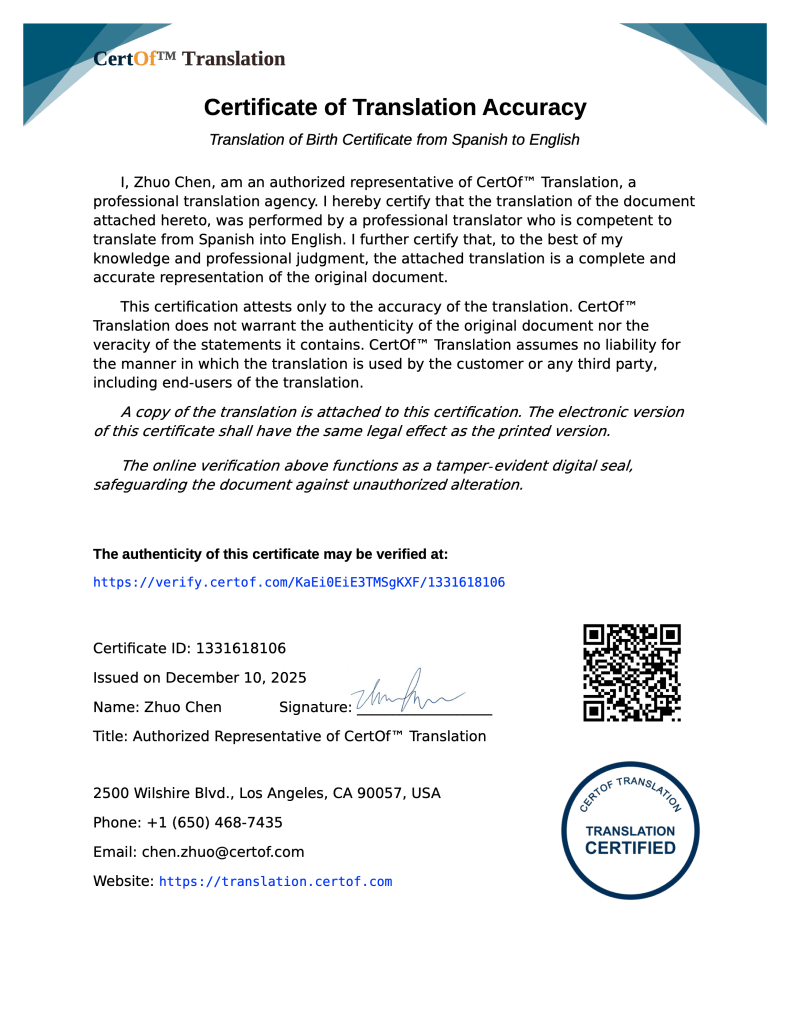
- Certificate of Translation Accuracy (signed, dated, and traceable).
For multi-document filings, one certificate per document is usually safer than a vague blanket certificate.
For deeper legal context, see USCIS certified translation requirements.
Copy-Paste Certificate of Translation Accuracy Template
CERTIFICATE OF TRANSLATION ACCURACY

I, [Translator Full Name], certify that I am competent to translate from [Source Language]
into English, and that the attached translation of [Document Name] is complete and accurate
to the best of my knowledge and ability.

Translator Signature: ____________________
Printed Name: ___________________________
Date: __________________________________
Email / Phone / Address: _________________
Related guidance: who can certify a translation for USCIS and do I need ATA-certified translator for USCIS. For credential context, see the American Translators Association (ATA) certification page.
Mirror Formatting Rules: Practical Quality Control
- Keep field order aligned with the source document.
- Recreate table structure for grid-based originals.
- Place bracketed annotations near matching source elements.
- Include back-page text, margins, and addenda.
- Do not “normalize” names, dates, currency, or grades inside translation text.
Annotation examples:
- [Round Seal: Civil Registry of XX City]
- [Signature: illegible]
- [Handwritten Note: corrected on 2021-04-16]
- [Embossed Seal Present]
Counterintuitive but True
Notarization is not the same as translation certification for USCIS. Also, over-stylized “visual cloning” (for example, trying to recreate decorative backgrounds) is not safer. The low-risk approach is text-accurate mirror layout, not graphic imitation. See certified vs notarized translation for the legal distinction.
USCIS Certified Translation Samples: Birth, Marriage, and Hukou Templates
1) Birth Certificate Translation Sample
- Full legal name, date/place of birth, and parent names as shown.
- Registration number and issuing authority.
- All visible stamps/notes, including backside entries.
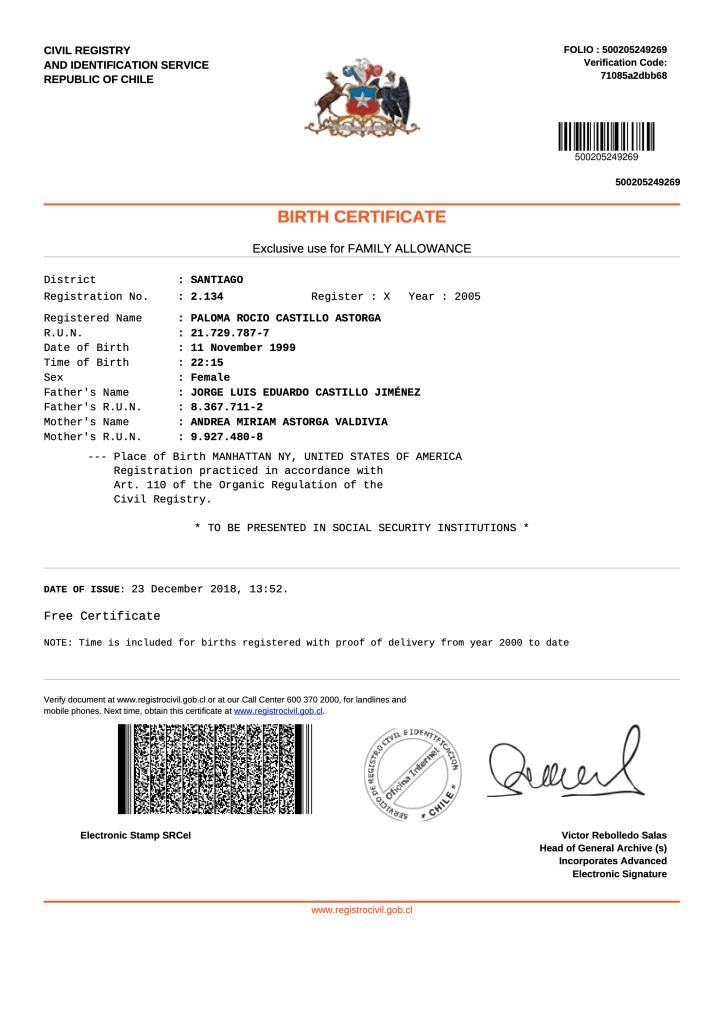
Need a dedicated workflow? Use certified translation of birth certificate.
2) Marriage Certificate Translation Sample
- Both spouses’ names exactly as shown on source.
- Marriage date/place/certificate number.
- Issuing office and any marginal amendments.
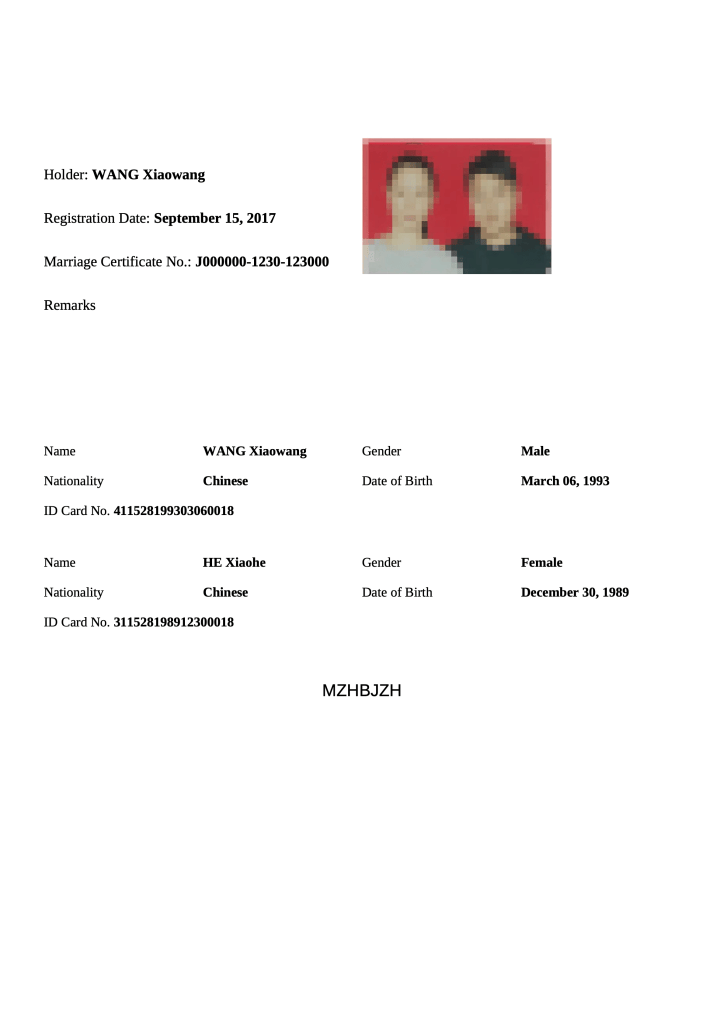
Related guide: marriage certificate translation for USCIS.
3) Hukou / Family Register Translation Sample
Common failure pattern: only one hukou page is translated. Safer packets include address page, household member table, relationship field, issuing authority, and update pages.
Reference: Chinese hukou translation certified USCIS guide.
4) Police Certificates and Court Records
For legal evidence, literal completeness matters more than “smooth writing.” Avoid raw machine output. Practical risk guidance: can I use Google Translate for USCIS and uscis rfe translation services.
Need a filing-ready packet today?
Start with order USCIS certified translation online, review the certified document translation price page, and check the USCIS acceptance guarantee and refund policy before checkout.
Common Mistakes and Risk Outcomes (Pitfalls)
| Mistake | Likely Review Impact | Safer Fix |
|---|---|---|
| Self-translation without independent certification | Neutrality and reliability concerns; RFE risk. | Use a competent third-party translator with document-specific certification. |
| Summary instead of full translation | May be treated as missing initial evidence. | Translate all visible text, including notes and stamps. |
| Backside content omitted | Material annotations may be missed. | Scan and translate both sides when marked. |
| Fact cleanup inside translation | Name/date mismatch can trigger second review cycle. | Mirror source facts exactly; explain discrepancies separately. |
| Low-quality or over-compressed files | Illegibility can cause reject/RFE and rework delay. | Follow USCIS legibility/upload guidance and keep a clean digital master. |
If USCIS already flagged your translation, use this repair path: USCIS rejected my translation and uscis rfe translation services.
CertOf vs Traditional Translation Paths
| Decision Factor | Traditional Local Agency / Referral | CertOf Online Workflow |
|---|---|---|
| Typical turnaround | Often 24-72 hours for routine documents | Many standard files delivered quickly; rush options available |
| Price transparency | Often quote-based | Published $9.99/page pricing |
| USCIS packet structure | Vendor-dependent quality | Built around source + translation + certificate model |
| Mirror formatting | Not always included | Included for field-dense records |
| Policy visibility | Often private terms | Published refund policy |
| Ordering model | Email or in-person handoff | Fully online at translation.certof.com |
How to Order in 3 Steps (Upload -> Pay -> Receive)
- Upload scans/photos at order USCIS certified translation online.
- Confirm pricing on the certified document translation price page.
- Receive your packet as filing-ready digital delivery (plus hard-copy options when needed).
Trust, Privacy, and Professional Standards
- Privacy: encrypted upload and controlled document access.
- Coverage: USCIS, universities, banks, employers, and courts (requirements vary by institution).
- Rush support: expedited options for filing deadlines and RFE windows.
- Process standards: see our ISO 17100 certified translation provider guide for quality framework context.
Need project-specific guidance before ordering? Contact certified translation support.
FAQ (People Also Ask)
Does USCIS accept digital certified translations?
Digital submission is common in USCIS workflows, but acceptance depends on packet completeness and readability. Keep files clear, complete, and properly certified. See electronic certified translation PDF vs Word vs paper.
Do I need an ATA-certified translator for USCIS?
USCIS requires competence and valid certification language; ATA certification is a quality signal but not a universal USCIS mandate. Detail: do I need ATA-certified translator for USCIS.
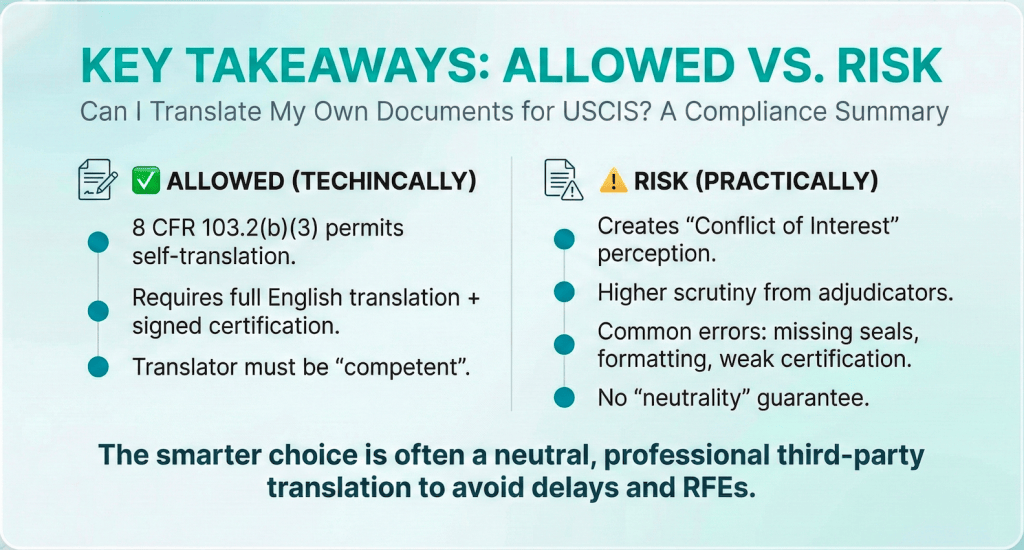
Can I translate my own documents for USCIS?
Even when technically possible in some contexts, self-translation often increases evidentiary risk. Practical breakdown: can I translate my own documents for USCIS.
What if USCIS rejected my translation or issued an RFE?
Treat it as a document-quality incident: identify the defect, replace with complete certified packet, and respond before deadline. Start here: uscis rfe translation services.
Do I need to send original documents with certified translations?
Often no, unless form instructions or a USCIS notice specifically request originals. Guidance: do I need original document with certified translation for USCIS.
Final Pre-Submission Checklist
- Source pages complete (including back pages when marked).
- English translation complete (no summary shortcuts).
- Stamps, seals, signatures, and notes annotated.
- Certificate includes competence + complete/accurate language.
- Translator signature, date, and contact details present.
- PDF is legible at normal zoom and logically named.
- Names/dates are consistent across forms and evidence.
- Packet order is source -> translation -> certificate.
Ready to file? Start your fast USCIS certified translation service, review transparent pricing, and confirm terms on the USCIS acceptance guarantee and refund policy page.