Disclaimer: This article is for general informational purposes only and is not legal advice. Your RFE notice and USCIS instructions control. If your case is time-critical, complex, or involves a NOID, consult a qualified immigration attorney.
About the author: Erin Chen is the Co-Founder and Translation Strategist at CertOf™. With over a decade in bilingual editorial risk control and hands-on experience navigating U.S. immigration workflows, Erin helps applicants build USCIS-ready certified translation packets that reduce avoidable RFEs.
USCIS RFE Translation Services: Fast, Compliant, and Lower-Risk in 2026
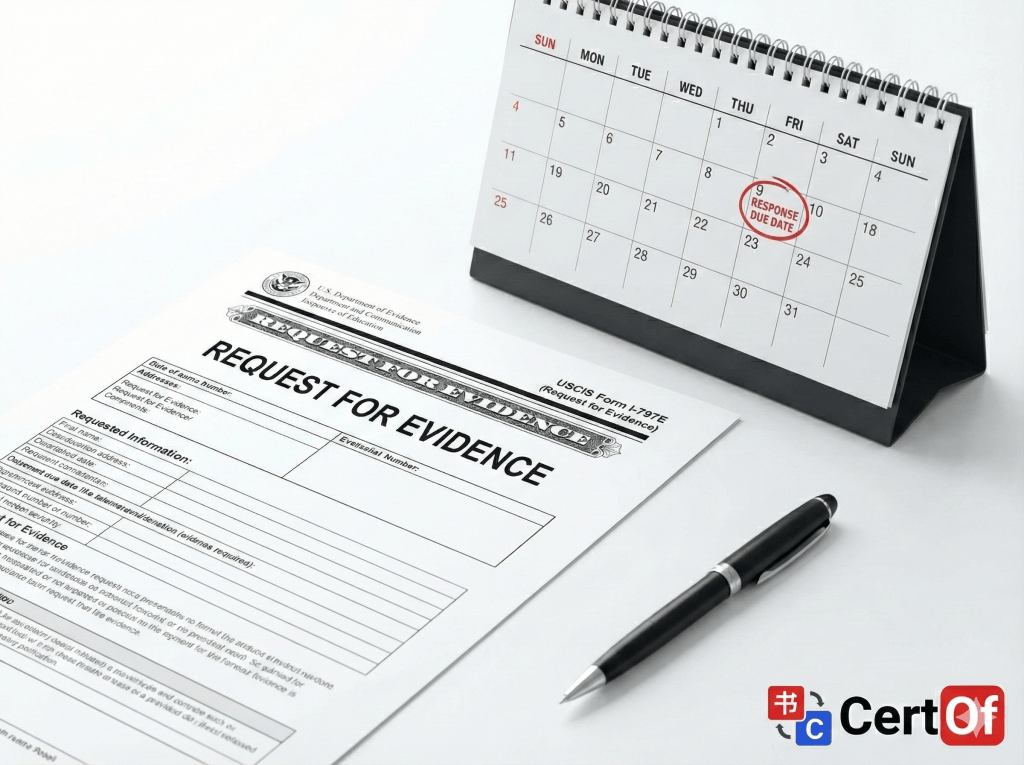
If you just received Form I-797E, you likely need uscis rfe translation services immediately, not generic document translation. In my experience, most translation RFEs are fixable in hours, but avoidable mistakes still cost applicants weeks or months. This guide gives you a practical triage flow, cites controlling USCIS rules, and shows how to submit one complete, RFE-safe packet without overpaying for unnecessary extras.
Key Takeaways (Above-the-Fold Quick Answers)
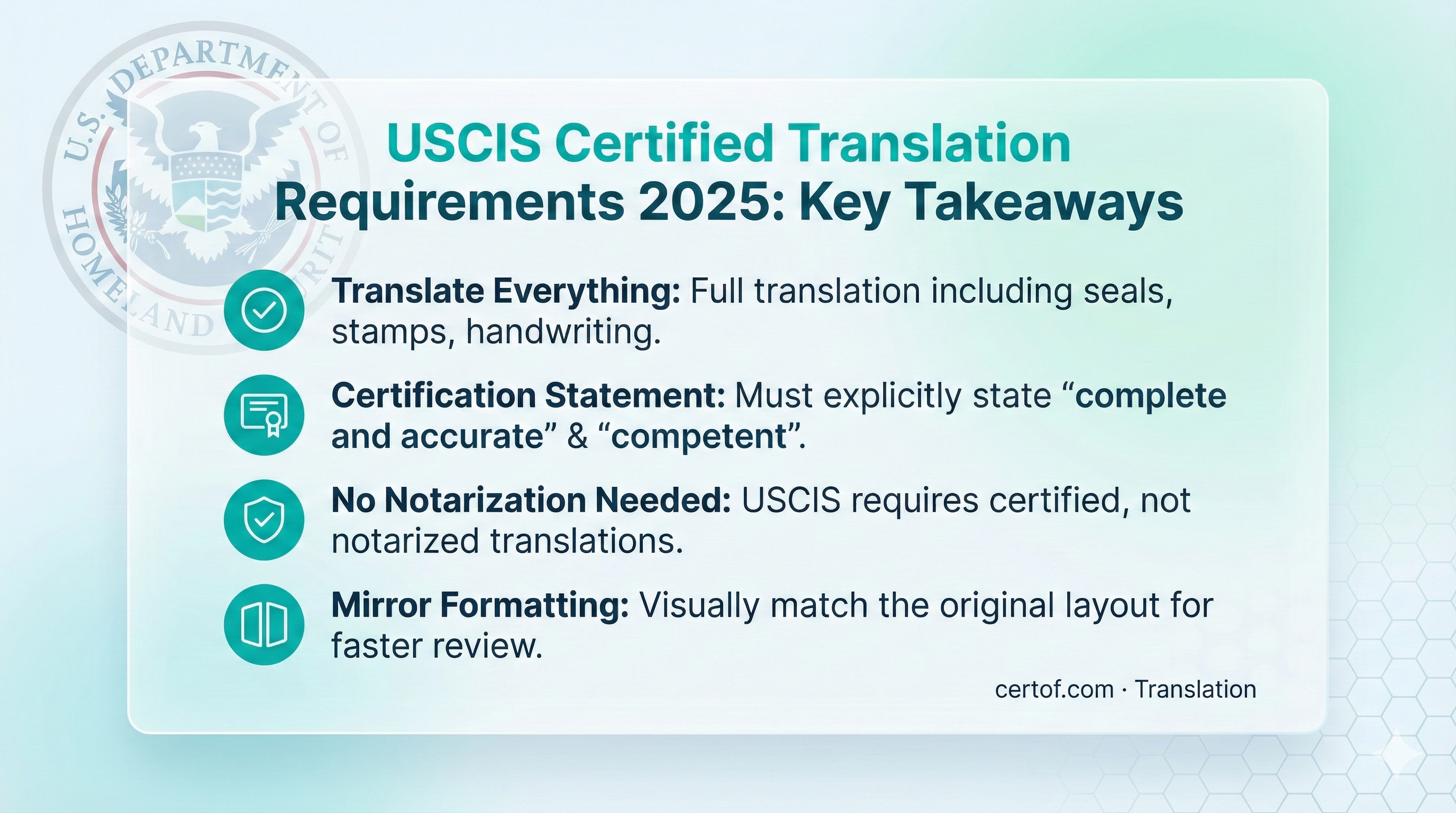
- USCIS requires a full English translation + certification of accuracy + translator competence. The rule is in 8 CFR 103.2(b)(3).
- Your RFE deadline is a hard date. Under 8 CFR 103.2(b)(8)(iv), an RFE response period cannot exceed 12 weeks and additional response time may not be granted.
- Partial responses are dangerous. USCIS can treat a partial submission as a request for a decision on the existing record under 8 CFR 103.2(b)(11).
- Counter-intuitive but true: notarization is usually not the issue. A complete certified translation often passes where a notarized but incomplete one fails.
Who This Is For (and Why This Feels So Stressful)
This article is for applicants, spouses, and paralegals dealing with a translation-related RFE on forms like I-130, I-485, N-400, or consular-stage civil documents such as Chinese Hukou, Japanese Koseki Tohon, and Korean Family Relation Certificates. The pain point is always the same: you are already on a clock, and the RFE language is technical.
People Also Ask Questions Covered Here
- What should I do if USCIS rejected my translation?
- Does USCIS accept digital certified translations?
- Do I need original documents with certified translation for USCIS?
- Can I translate my own documents for a certified translation RFE response?
What USCIS Actually Requires (Official Sources, Checked on March 1, 2026)
As of March 1, 2026, the controlling translation rule remains 8 CFR 103.2(b)(3): foreign-language documents must include a full English translation, plus a certification that the translation is complete and accurate and that the translator is competent.
- Translation standard: 8 CFR 103.2(b)(3).
- RFE timing and no-extension rule: 8 CFR 103.2(b)(8)(iv).
- Submit requested materials together: 8 CFR 103.2(b)(11).
- Original vs copies: 8 CFR 103.2(b)(4)-(5), plus USCIS Tips for Filing Forms by Mail (copy-first practice unless originals are requested).
- RFE/NOID adjudication framework: USCIS Policy Manual, Volume 1, Part E, Chapter 6.
2026 reality check: we still do not have a USCIS regulation that says “AI translation is banned by name.” The real legal test is completeness + proper certification. If an AI draft misses stamps, side notes, or back-page text, the issue is non-compliance.
For electronic processing context, see the Federal Register notice on implementation of the Electronic Immigration System (ELIIS).
Background reading on related points: USCIS certified translation requirements, certified vs notarized translation, and who can certify a translation for USCIS.
10-Minute Triage: Diagnose the Exact Translation Defect Before You Re-Submit
- Read the RFE sentence-by-sentence. Highlight words like “translation,” “English,” “certification,” “complete,” and “competent.”
- Classify the defect: missing translation, incomplete translation (stamps/notes/back page), or missing/weak certification language.
- Run a name/date consistency check. Compare against passport biographic page and the form set (I-130/I-485/N-400) to catch transliteration drift.
- Confirm packet logic. Pair each source page with its translation and label as exhibits in RFE request order.
- Confirm response strategy. Plan one complete response, not staged submissions.
- Build time buffer. Aim for 7-10 days before the deadline to absorb upload failures or courier delays.
If you need a visual model, use this format reference: what a USCIS certified translation package looks like.
Build an RFE-Safe Submission Packet (Online Upload and Paper Mail)
Online response workflow
- Keep each exhibit self-contained: foreign-language source + certified English translation + certification page together.
- Use officer-friendly names such as
RFE_Exhibit_B_Marriage_Certificate_Translation.pdf. - Do not scatter one document across many unlabeled uploads; review friction increases error risk.
Paper response workflow
- Order: RFE notice copy, concise cover letter, then exhibits matching the RFE checklist sequence.
- Clip each source document to its translation to prevent separation in intake scanning.
- Do not send original civil documents unless the notice or form instructions explicitly require them.
Common Errors and Risks (Pitfalls That Trigger a Second RFE)
- “Summary” translation instead of full translation: officer treats evidence as incomplete; you risk another RFE or denial on record.
- Missing tiny content (seals, side notes, back pages): this is still document content under 8 CFR; case can stall for months.
- Certification missing translator competence language: translation can be treated as non-compliant evidence.
- Partial RFE response: USCIS may decide the case on the existing record after a partial submission.
- Paying for notarization first, quality later: notarization does not repair incomplete translation content and often adds cost without reducing RFE risk.
If your case already received a translation rejection, use this diagnostic guide before re-filing: USCIS rejected my translation: reasons and fixes.
CertOf vs Traditional Translation Agency for RFE Recovery
| Feature | Traditional Offline Route | CertOf Workflow |
|---|---|---|
| Turnaround | Usually 24-72 hours | Typical 5-10 minutes for standard civil docs |
| Price visibility | Often quote-based + add-ons | $9.99/page transparent pricing |
| Formatting | Plain paragraph output common | Mirror formatting for easier review |
| Submission mode | Email + manual back-and-forth | Upload, preview, pay, download online |
| Risk protection | Varies by provider | 100% USCIS acceptance guarantee + refund policy |
How to Get a Certified Translation RFE Response in 3 Steps
- Upload: Start your USCIS certified translation order online with clear scans or phone photos.
- Pay: Get a fast certified document translation quote at $9.99/page and confirm names, dates, and page pairing.
- Download: Download your 5-10 minute certified translation package for RFE filing, then attach it exhibit-by-exhibit.
Privacy and trust notes: CertOf supports secure online document handling and keeps the workflow digital so you do not need to ship original documents for normal RFE translation use cases. You can review legal terms here: Privacy Policy and Refund and Returns Policy.
Institution coverage commonly includes USCIS filings, universities, banks, employers, and courts that accept certified translations. For court-specific nuance, see certified translation for court proceedings.
Recommended Internal Reading Path (Avoid Repeating the Same Error)
- USCIS certified translation requirements (official rule breakdown)
- USCIS certified translation sample and packet structure
- Do I need original documents with certified translation for USCIS?
- Can I use Google Translate for USCIS submissions?
FAQ: USCIS RFE Translation Services
Does USCIS accept digital certified translations?
In many workflows, yes, if your filing channel allows digital evidence and your packet is complete and legible. USCIS can still request originals later under 8 CFR 103.2(b)(5). Practical rule: submit clean copies first, keep originals ready, and follow the exact notice instructions.
Can I translate my own documents for USCIS after an RFE?
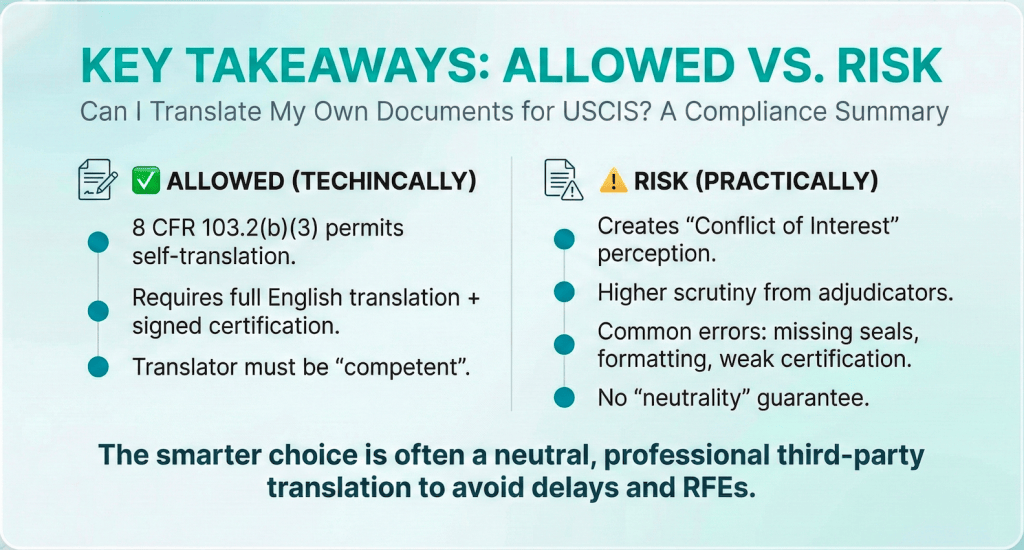
The regulation does not publish a blanket ban on self-translation, but in an RFE context it often increases adjudication risk because independence and completeness become credibility issues. See: self-translation risk analysis.
Do I need to mail original documents with my certified translation RFE response?
Usually no, unless USCIS specifically requests originals in your notice or form instructions. Use this guide for copy-first packaging logic: original document rules for USCIS.
What should a USCIS translation certificate include?
At minimum: statement of completeness and accuracy, statement of translator competence, signature, date, and clear document linkage. Use this sample page: certificate wording and layout example.
How long is a certified translation valid for USCIS?
USCIS regulations do not set a fixed expiration period. In practice, a translation remains usable while it is accurate, complete, legible, and still matches the source document you are submitting. Detailed scenarios: validity and reuse strategy.
Final Submission Checklist Before You Send the RFE Response
- I mapped each RFE item to a clearly labeled exhibit.
- Each foreign-language page has a full English translation (including seals, notes, and reverse-side content).
- Each translation includes a proper certification statement and signature.
- Names, dates, and document numbers match the full USCIS filing set.
- I am submitting with a safety buffer before the printed deadline.
Need to move now? Order your certified translation for USCIS RFE response and keep your case timeline intact.