How to Avoid a USCIS Translation RFE in the United States: Names, Dates, Stamps, and Back-Page Problems
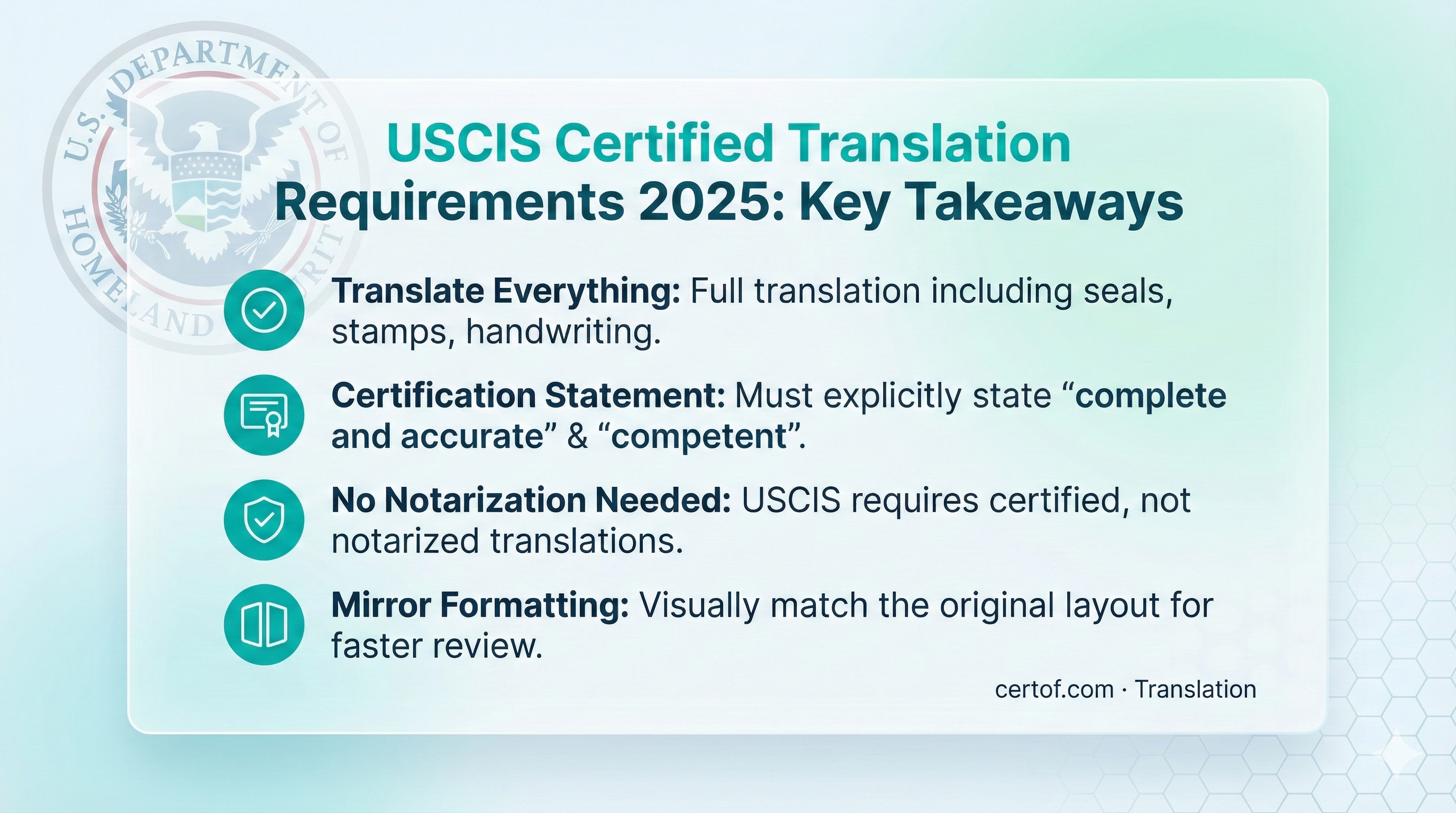
If you are trying to avoid a USCIS translation RFE in the United States, the biggest risk is usually not a dramatic mistranslation. It is a small omission: a stamp on the margin, a handwritten correction, a second surname on an older civil record, or a back-page annotation that never made it into the English version. Under 8 CFR 103.2(b)(3), USCIS requires a full English translation with a translator certification. In practice, that means the English packet must let an officer compare the original and the translation without guessing.
Disclaimer: This guide is for document-preparation and translation risk control, not legal advice. If your case involves identity fraud concerns, inconsistent civil records, or substantive eligibility issues, speak with an immigration attorney. CertOf can help with the translation and formatting side, not legal representation.
Key Takeaways
- For USCIS, complete usually matters more than elegant. Missing stamps, seals, handwritten notes, or back-page text can trigger an RFE even when the main body is translated correctly.
- Do not fix mismatched names or dates inside the translation. Translate the original faithfully, then explain the discrepancy separately if needed.
- Paper filing and online filing create different failure points. Lockbox scanning can amplify missing back pages or double-sided records, while online uploads can hide small handwriting or seals in low-quality files.
- If you already received an RFE, do not send the response back to a Lockbox unless the notice specifically tells you to. USCIS says RFE responses must go to the address or upload channel shown on the notice.
Who This Guide Is For
This guide is for applicants, family sponsors, and paralegals filing immigration evidence with USCIS anywhere in the United States. It is especially useful for people submitting Spanish-English, Chinese-English, Arabic-English, Russian-English, Ukrainian-English, Korean-English, Japanese-English, Portuguese-English, or French-English document sets that include passports, birth certificates, marriage records, divorce decrees, police certificates, hukou records, koseki records, family relation certificates, tax records, or relationship evidence.
The typical situation is not that the case is impossible. It is that the document set is messy in a very normal way: old and new spellings, maiden and married names, different date formats, issuing stamps on the back, handwritten amendments, or civil records issued years apart. This page is written for that real filing situation.
What USCIS Actually Requires, in One Minute
The core rule is national, not state-by-state. USCIS follows the same federal standard across the country: any foreign-language document must be submitted with a full English translation and a translator certification stating that the translation is complete and accurate and that the translator is competent to translate into English. USCIS repeats that standard in its Policy Manual.
This is why certified translation is still the natural term in the U.S. immigration market, even though the official phrasing is more specific. If you need the background rule, use our related guides on USCIS certified translation requirements, who can certify a translation for USCIS, and whether USCIS requires an ATA-certified translator. This page stays narrower: it is about the defect patterns that create RFEs.
Why This Problem Feels So U.S.-Specific
The translation rule itself is federal and uniform. The U.S.-specific difficulty is the workflow around that rule: Lockbox intake, digitization, officer review, online uploads, and RFE routing. USCIS tells paper filers to use single-sided pages and filing-friendly formatting because intake and scanning matter operationally, not just legally. See USCIS guidance on filing by mail and filing online.
That creates a practical lesson many applicants miss: a translation defect is often a comparison defect. The officer is not only asking whether the English is correct. The officer is also asking whether the English packet visibly accounts for everything on the source document. There is usually no walk-in fix for this problem. In the United States, the practical channels are mail, upload, Contact Center support, and formal escalation if the issue remains unresolved.
USCIS Translation RFE Triggers to Check Before You File
1. Name mismatches across records
This is one of the most common high-friction scenarios in family-based, adjustment, and naturalization filings. The passport may show one transliteration, the birth certificate another, and the marriage certificate an older surname. The wrong move is to quietly standardize them in translation. A certified translation should reflect the source document as it exists. If the source record itself uses a different spelling or older name, the translation should preserve that fact.
Practical fix: translate faithfully, keep the certification clean, and use the surrounding filing strategy to explain the discrepancy if needed. If the issue is substantial, pair the translation with documentary support such as a passport page, prior civil record, or legal name change evidence. For related edge cases, see name change decree and single status certificate translation and marriage certificate translation for USCIS.
2. Date mismatches and mixed calendar formats
Date issues do not always mean the translation is wrong. Sometimes the source records were issued in different eras, use day-month-year formatting, or include handwritten corrections. The real mistake is when the English version silently converts or harmonizes dates in a way that hides what the original shows.
Practical fix: keep the original date meaning clear in English, preserve handwritten corrections or visible overwriting, and do not turn an uncertain source into a falsely neat one. If a date is partially unreadable, the translation should mark that honestly rather than invent certainty.
3. Stamps, seals, marginal notes, and cancellation marks
This is where many avoidable RFEs start. Applicants often assume the main typed text is what matters, but USCIS officers use small notations to understand issuance, registration, cancellation, amendment, or later validation. A seal that says reissued, a registrar stamp with a separate date, a side note about a name correction, or a cancellation mark on a prior entry can all change how the document is read.
Practical fix: the translation should account for visible stamps and notes, even if they are short. If a seal is partly unreadable, label that limitation rather than dropping it. If you need more background on difficult source text, see certified translation of handwritten documents.
4. Handwritten notes and partially illegible text
Handwriting is a classic RFE trigger because it is where applicants or low-cost providers cut corners. A side note in pen, a registrar’s initials, a handwritten issue date, or a doctor note attached to a vaccine record may be tiny, but it still belongs in the English submission if it can affect meaning.
Practical fix: if the writing is legible, translate it. If part is not legible, mark it clearly, such as with an illegibility note, rather than pretending it was not there. A professional workflow should distinguish between not relevant and not readable. USCIS cares about completeness, not optimism.
5. Back-page annotations and double-sided documents
This is the most underappreciated risk in U.S. filing practice. Many civil records carry registration notes, issuing language, update stamps, or legalization marks on the back. If you paper-file, USCIS intake may scan the packet and review the digital version. If the back page never made it into the packet, or was printed in a way that becomes hard to scan, the officer may see a translation that references information not visible in the source set.
Practical fix: treat the back page as part of the document unless it is truly blank and irrelevant. This is especially important for birth records, marriage records, police certificates, family registers, and translated copies of older civil documents.
6. Summary translations instead of full translations
This is the counterintuitive point many first-time filers miss. A translation can look professional and still be wrong for USCIS if it only summarizes key facts. USCIS policy is clear that a translator-prepared summary is not an acceptable substitute for a full translation. If your provider says they will translate only the important parts, that is a risk signal, not a convenience.
Practical fix: insist on a full translation with a proper certification statement. If you need a reusable explanation page for your packet, add that separately rather than replacing the translation.
Paper Filing vs. Online Filing: Where Problems Show Up
Paper filing: the U.S. reality is Lockbox handling and scanning. USCIS mail guidance warns filers about packet preparation because document quality affects intake. If your translation packet relies on double-sided originals, unusual staples, or loosely attached back pages, a small completeness problem can become much bigger after scanning.
Online filing: the rule is the same, but the risk shifts to image quality and file organization. USCIS online filing guidance discusses accepted file types and the strict 12MB file size limit per upload. If you compress a file too much to fit under 12MB, a tiny handwritten note that was barely readable on paper may disappear entirely in the uploaded version. For translation-heavy evidence packets, clear labeling and readable source files matter almost as much as the English text.
Bottom line: the legal standard is national and stable, but the operational failure points are American and modern: intake digitization, upload limits, and officer review speed.
What to Do Before You Submit
- Lay out every foreign-language document as a comparison exercise, not just a translation job. Ask what an officer can see at a glance.
- Check names across the passport, civil records, and forms, but do not rewrite source-document differences inside the translation.
- Review every page front and back. If the reverse side has stamps, registrar text, notes, or a barcode label tied to issuance, include it.
- Check small text areas: margins, seals, stamp boxes, handwritten additions, footnotes, and amendment lines.
- Make sure the certification statement is present and signed. For broader basics, see a USCIS certified translation sample and why raw machine output is not enough for USCIS.
- If you are responding to an RFE, follow the notice instructions exactly and send the package to the notice address or upload channel, not the original Lockbox mailing address.
If You Already Received an RFE
Do not assume the fix is only to resend the same translation with a new cover sheet. First identify the exact defect type: missing seal text, omitted back page, mismatched spelling, incomplete certification, or low-quality source image. Then rebuild the packet so the English version and the source record now match visibly and cleanly.
USCIS mail guidance specifically warns not to send RFE responses to a Lockbox unless instructed. If your problem is more about translation quality than legal theory, this is usually the right workflow: get a corrected certified translation, reassemble the source document set page by page, and respond using the notice instructions. Our related page on USCIS RFE translation services covers that narrower response stage.
Community Patterns Worth Paying Attention To
Across applicant forums and provider-side quality-control stories, the same patterns repeat. People get into trouble not because the translator failed to render a long legal sentence, but because a small but meaningful visual element never made it into the English packet. Common stories include a birth certificate translation that omitted the issue-date stamp, a family register translation that ignored handwritten margin text, and a DIY translation that cleaned up an inconvenient spelling difference instead of reflecting the original.
These are not official statistics, and they should not be treated as hard USCIS rules. But they are useful because they match how officers review evidence in real life: quickly, comparatively, and under document-volume pressure.
Cost, Timing, and Mailing Reality in the United States
There is no separate USCIS filing fee for a translation itself, but translation quality can change downstream cost dramatically by forcing an RFE response, remailing, or attorney review. For ordinary civil documents, the market is usually online and national rather than local-office based. The real U.S. timing question is not whether a translation is done in a few hours or a few days; it is whether the packet is complete enough to survive intake and officer comparison the first time.
If you need an online workflow, CertOf offers direct upload at translation.certof.com, pricing details at the pricing page, and support contact at the contact page. If you are still comparing basic service types, our guides on ordering certified translation online and PDF vs. Word vs. paper delivery cover that general ground.
Commercial Provider Snapshot
This is not a ranked list. It is a quick fit check for the defect profile discussed in this article: completeness, formatting, and fast correction paths.
| Provider | Public signal | Best fit for this topic | Watch-out |
|---|---|---|---|
| CertOf | Publicly states USCIS-focused certified translation, online ordering, layout-preserving output, and pricing from $9.99/page; contact page lists Los Angeles address and +1 (650) 468-7435. | Good fit if you want fast digital delivery, translation QA on stamps and annotations, and a document-prep workflow rather than a local office visit. | Translation service, not legal strategy. If your packet needs an affidavit or attorney explanation for a discrepancy, that is outside the translation scope. |
| RushTranslate | Publicly states USCIS use cases, 24-hour delivery, unlimited revisions, and published pricing for many certified document types. | Good fit for applicants who want a traditional online agency workflow with revision capacity and broad document coverage. | Check whether your document needs more than a standard page-based workflow, especially if the defect issue is heavy on annotations or unusual formatting. |
| The Language Doctors | Publicly lists immigration translation services, ISO 17100/9001 signals, Landover, Maryland address, and +1 (202) 544-2942. | Useful when you want a provider that publicly emphasizes professional process and mirror-format handling across immigration materials. | For routine civil documents, you may not need a larger language-services setup unless the case is complex or multilingual. |
Official Help and Public Resources
| Resource | Who it helps | What it can do | What it cannot do |
|---|---|---|---|
| USCIS Contact Center | Applicants with general case or filing questions | Phone support at 800-375-5283, TTY 800-767-1833, generally available Monday through Friday from 8:00 a.m. to 8:00 p.m. Eastern Time for official case-contact pathways | Does not rewrite your translation or give case-specific legal advice |
| USCIS Lockbox Support | Paper filers with missing receipt notices or intake problems | Email support for missing receipt notices or intake questions after mailing, including cases that may have stalled during packet handling | Does not correct a bad translation on your behalf |
| DHS Case Assistance | Applicants with unresolved USCIS problems after normal contact attempts | Escalation path when the matter is still unresolved after you have already tried the regular USCIS channels | Not a substitute for filing a complete translation packet correctly the first time |
For official contact and intake information, start with USCIS Contact Us. If the problem later becomes an unresolved agency issue rather than a document-prep issue, the DHS escalation channel is Case Assistance.
Fraud and Complaint Risks
In the United States, bad translation sellers often market the wrong thing: notarization, official-looking stamps, or fake guarantees instead of completeness. That is especially dangerous for USCIS because a notarized but incomplete translation can still trigger an RFE. USCIS warns applicants to watch for immigration scams and false claims of special government access on its Avoid Scams page.
If a provider is selling certainty rather than traceable document work, slow down. The safer question is not Can you guarantee approval, but Will this translation account for every page, stamp, handwritten note, and annotation in a way USCIS can compare easily?
FAQ
Do back-page annotations have to be translated for USCIS?
If the back page contains issuing text, notes, seals, amendments, or any visible content tied to the document, treat it as part of the submission and part of the translation.
Can a translator fix a spelling or date mismatch so my packet looks consistent?
No. The translation should reflect the source document, not repair it. If there is a real discrepancy, address it through supporting evidence or legal strategy, not by rewriting the source in English.
Does USCIS accept a summary translation?
Not as a translator-made substitute for a full translation. For USCIS filings, summary-style work is a known risk. Use a full translation with a proper certification.
What if a handwritten note is partly unreadable?
The translation should identify that limitation rather than omit the note. If part is illegible, label it honestly and keep the rest of the document complete.
Where do I send a translation-related RFE response?
To the address or upload path shown on the RFE notice. USCIS mail guidance says not to send RFE responses back to a Lockbox unless the notice tells you to do that.
Need a Lower-Risk USCIS Translation Packet?
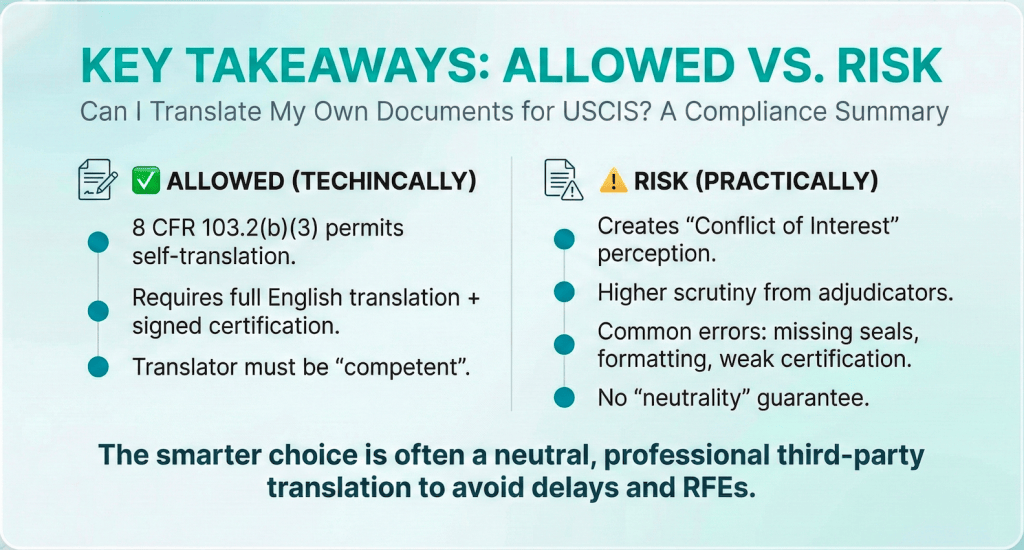
If your issue is document completeness rather than legal eligibility, CertOf is designed for the translation side of that problem: certified translations, layout-preserving output, fast revisions, and online delivery for USCIS-facing packets. You can start an order at the secure upload page, review general service details on the homepage, or compare translation workflow basics in our guides to self-translation risks and whether USCIS needs the original document with the translation.
The narrow goal is simple: make sure your English submission does not become the weak point in an otherwise valid case.