Disclaimer: This article provides general information about USCIS translation requirements and compliance best practices. It is not legal advice. Immigration outcomes depend on your full case record and agency review. If your case has legal complexity, consult a licensed U.S. immigration attorney.
About the author: Erin Chen is the Co-Founder and Translation Strategist at CertOf. She has over 10 years of bilingual editorial risk-control experience and has supported thousands of USCIS-focused certified translation workflows.
Who Can Certify a Translation for USCIS? Fast, Compliant, and Lower-Risk in 2026
If you are filing immigration paperwork and asking who can certify a translation for USCIS, you are solving a real risk point early. For most applicants, this is not a language question. It is a timeline question: submit correctly now, or lose weeks to an RFE later. In 2025-2026, the legal rule stayed stable, but officer review of translation completeness has become less forgiving.
I wrote this update for applicants under deadline pressure: I-130 families, I-485 adjustment filers, N-400 naturalization applicants, and paralegals managing large evidence packets.
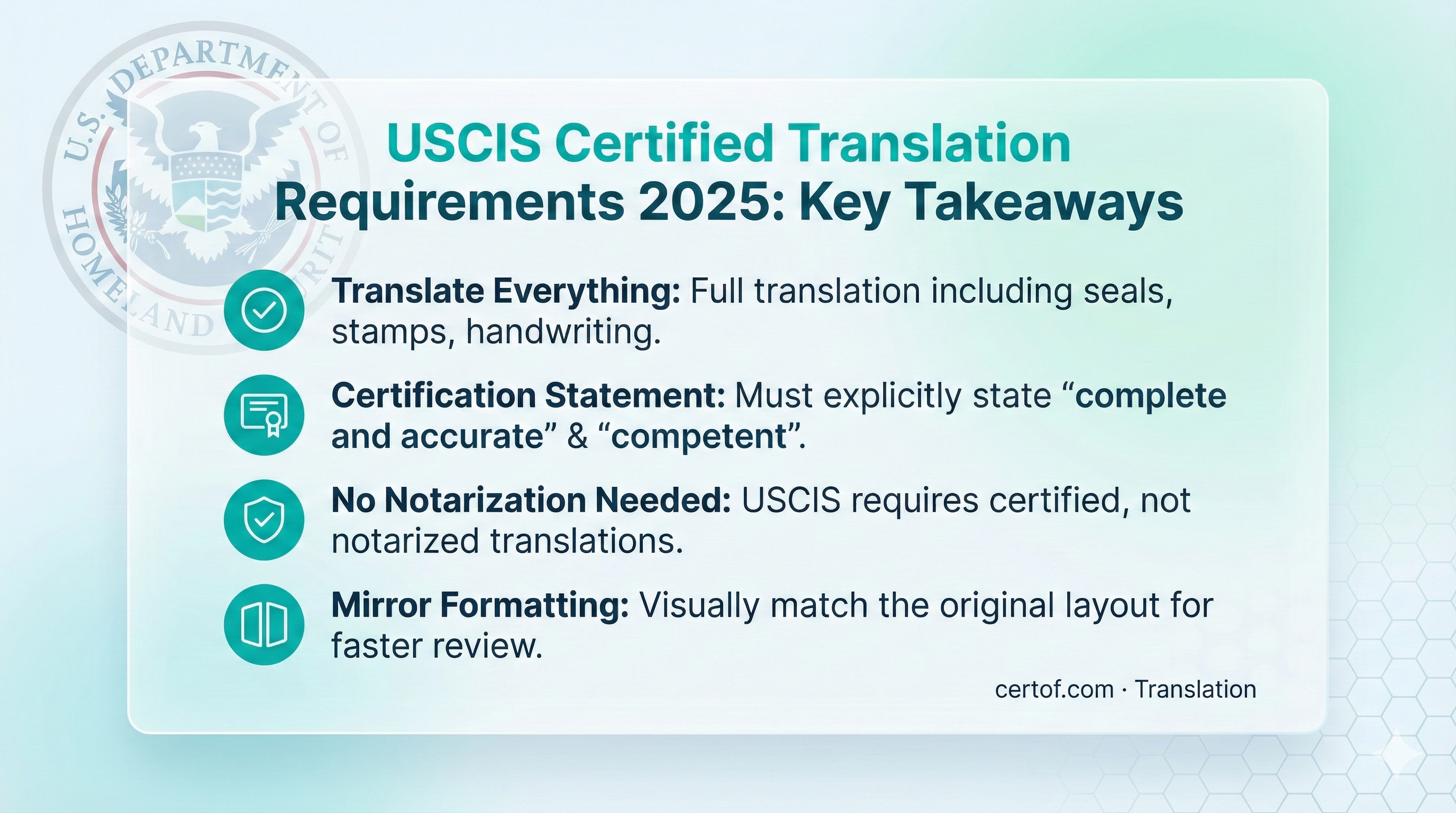
- Short answer: USCIS does not require a lawyer or notary to certify translation quality. It requires a competent translator and a proper certification statement.
- Highest-risk mistake: treating notarization as a substitute for a real translation certificate.
- Speed path: online professional workflows can deliver USCIS-ready PDFs in minutes instead of waiting 24 to 48 hours.
- Cost path: at CertOf, standard USCIS documents start at $9.99 per page with transparent pricing and no forced notarization upsell.
Questions this guide answers
- who can certify a translation for uscis
- can i translate my own documents for uscis
- difference between certified and notarized translation
- does uscis accept online certified translations
- uscis certified translation affidavit requirements
- uscis accepted certified translation of birth certificate best practices
Official Rule First: What USCIS Actually Requires
The controlling rule is 8 CFR 103.2(b)(3). As displayed in eCFR on February 24, 2026, any foreign-language document submitted to USCIS must include a full English translation and a translator certification confirming completeness, accuracy, and language competence.
USCIS repeats this standard in filing guidance, including the I-485 initial evidence checklist, and in the USCIS Policy Manual section on translations. For a clause-by-clause practical breakdown, see our internal guide to USCIS certified translation requirements.
For terminology clarity, the American Translators Association (ATA) also explains why certified translation and notarization are different steps in U.S. workflows.
- Translate all relevant content into English, not only the parts you think are important.
- Include a certification statement that the translation is complete and accurate.
- Include a statement that the translator is competent in both languages, plus signature, name, and date.
Counterintuitive but true: notarization can waste money and still fail USCIS review
Many applicants spend $50 or more on mobile notary visits expecting better acceptance odds. For USCIS, that often adds cost without solving the core requirement. A notary verifies identity and signature ceremony. A notary does not certify bilingual accuracy unless that notary is also the translator and signs a proper translator declaration. In some scanned packets, heavy notary marks can also reduce readability of underlying seals or notes, which creates avoidable back-and-forth.
For a dedicated breakdown, see difference between certified and notarized translation.
Who Can Certify a Translation for USCIS: Four Real Options
1) Self-translation by the applicant
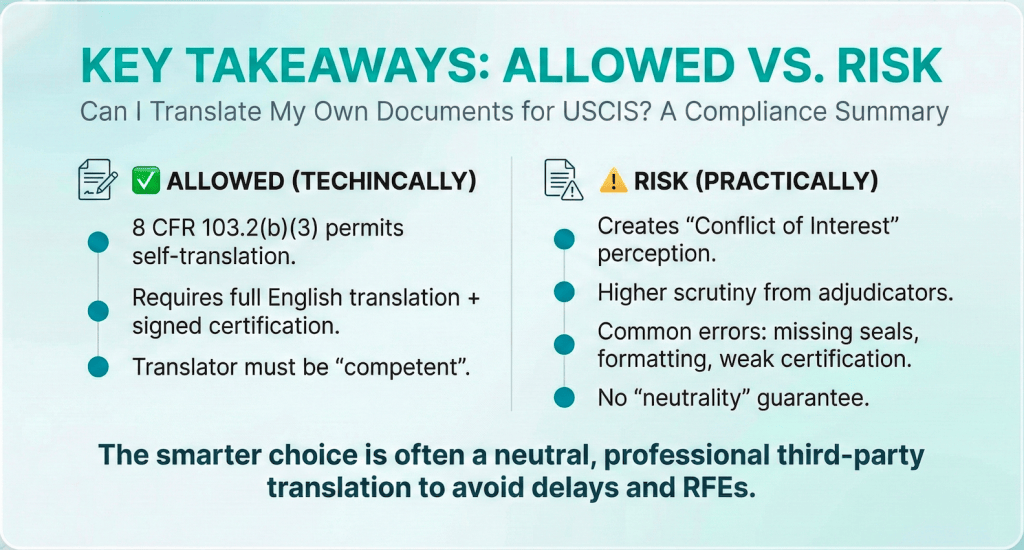
Legally possible in narrow reading, practically high risk. USCIS regulations do not explicitly say applicants are banned from translating their own documents. But in real adjudication, self-translation creates a conflict-of-interest signal. If names, dates, or status terms are questioned, the officer is now evaluating evidence translated by the same person who benefits from the outcome.
If you are considering this route, read can I translate my own documents for USCIS before you decide.
2) Friend or family translator
Technically allowed, often fragile in practice. A friend can be competent. The risk is execution quality: missing back-page annotations, wrong date format conversion, informal certificate wording, or no traceable contact details. We frequently see this with long-form birth certificates and household records where seals and side notes get dropped.
3) Notary-only approach
Usually insufficient for USCIS. If the package has only notarization and no compliant translator certificate, it can still be treated as non-compliant. Keep notarization and certification as separate concepts.
4) Professional USCIS-certified translation service
Lowest-friction option for most immigration filings. A Professional USCIS-certified translation service is designed around document-level certification, complete content coverage, mirror formatting, and clear accountability.
If you want an immediate start, you can order USCIS certified translation online and upload scans from phone or desktop.
CertOf vs Traditional Law Office or Local Agency
| Factor | CertOf online workflow | Traditional law-office add-on or local agency |
|---|---|---|
| Starting price | $9.99 per page, transparent pricing | Often higher and variable by office |
| Typical turnaround | Often 5 to 10 minutes for standard civil documents | Commonly 24 to 48 hours |
| Acceptance protection | 100% USCIS acceptance guarantee plus money-back refund policy | Usually no explicit acceptance guarantee |
| Ordering model | Upload, pay, download fully online | Email chains, office visits, or manual quote cycles |
| Formatting quality | Mirror formatting for easier officer cross-check | Quality varies by vendor |
| Rush handling | Designed for urgent immigration timelines | Rush often available at higher extra fee |
If you are ready to move, use this direct path: get a fast certified translation quote and checkout online.
Common 2025-2026 Pitfalls That Trigger RFEs
These are the failure patterns we keep seeing in USCIS packets. Most are preventable.
- One blanket certificate for multiple unrelated documents. Consequence: officer cannot confirm which certificate covers which translation, leading to RFE for missing or unclear certification.
- Partial translation that skips seals, margins, side notes, or back pages. Consequence: document treated as incomplete evidence and review pauses until corrected filing arrives.
- Typed-name-only signature workflow. Consequence: authenticity concerns. USCIS signature guidance in Policy Manual Volume 1, Part B, Chapter 2 highlights signature validity rules.
- Machine translation pasted into a template without human quality control. Consequence: terminology drift, date inversion, and inconsistent names across documents that can trigger extra scrutiny.
- Trying to silently fix source-document errors in translation text. Consequence: mismatch between original and translation, which can raise credibility questions and force additional explanation evidence.
If you already received a notice, follow our repair playbook: USCIS rejected my translation.
What a USCIS-Ready Certification Packet Should Include
- Full English translation with document structure preserved when possible.
- Document-specific certificate of translation accuracy.
- Translator competence statement for source and target language pair.
- Translator name, signature, date, and contact details.
- Readable PDF output for print or digital upload workflow.
You can compare against a real layout in this USCIS certified translation sample.
3-Step Process: Upload, Pay, Download
CertOf is built for applicants who want speed without skipping compliance controls.
- Upload: upload documents for same-day USCIS certified translation using clear scans or photos.
- Pay: confirm language pair, document count, and final transparent pricing.
- Download: receive certified translation PDF with mirror formatting and document-level certificate for filing.
Trust and Privacy for Sensitive Documents
Immigration files can include passports, birth records, police certificates, medical records, and financial proof. Our workflow uses encrypted web delivery (HTTPS), restricted production access, and auditable order tracking. We support document use cases for USCIS, universities, banks, employers, and courts, with expedited handling for urgent filing timelines.
Related deep dives for specific documents: certified translation of birth certificate, marriage certificate translation for USCIS, and do I need original documents with certified translation.
FAQ: People Also Ask About USCIS Translation Certification
Can a friend certify a translation for USCIS?
Yes, a friend can certify if they are truly competent and provide a compliant certificate. But quality and impartiality issues make this route riskier for core civil documents. For high-stakes filings, third-party professional certification is usually safer.
Does USCIS require notarized translation?
Usually no. USCIS focuses on certified translation requirements under 8 CFR 103.2(b)(3), not general notarization. If another authority asks for notarization, that is a separate requirement. See certified vs notarized translation guidance.
Does USCIS accept online certified translations and PDF copies?
In normal filing practice, yes, as long as the translation package is complete, readable, and properly certified. USCIS intake is increasingly digital, so clean scans and mirror-formatted PDFs help both machine extraction and human review during initial screening.
Can I reuse the same certified translation for multiple USCIS cases?
Often yes, if the source document has not changed and the receiving agency does not impose a fresh-date requirement. Review this guide before reusing: reuse certified translation for multiple USCIS cases and how long a certified translation is valid for USCIS.
What should I do if USCIS already rejected my translation?
Do not panic and do not send partial fixes. Replace the full translation package with complete, document-level certified output and answer exactly what the notice requests before the printed deadline. Use this response guide: USCIS RFE translation services.
Final Checklist Before You File
- Main civil documents translated in full, including seals and back pages.
- Each document has its own certificate of translation accuracy.
- Translator competence statement, signature, date, and contact details are present.
- Output is readable and filing-ready for your USCIS workflow.
When speed and compliance both matter, start here: buy USCIS certified translation services online now.