Disclaimer: This article provides general information about USCIS translation requirements and filing workflow best practices. It is not legal advice. If your case involves criminal history, prior fraud findings, inadmissibility issues, or litigation strategy, consult a qualified U.S. immigration attorney.
About the author: Erin Chen is Co-Founder and Translation Strategist at CertOf. Our team has reviewed thousands of immigration document sets across I-130, I-485, N-400, and RFE response packets.
I am Erin Chen, and the question I still hear every week from tech-first families is: can i use google translate for uscis if the output looks accurate. Usually they are filing marriage certificate translation for USCIS or certified translation of birth certificate evidence for I-130 or I-485 and want speed without paying law-firm rates. The short answer is practical: use AI for drafting if you want, but do not submit raw machine output as legal evidence.
Can I Use Google Translate for USCIS and Still Be Fast, Compliant, and Cost-Effective?
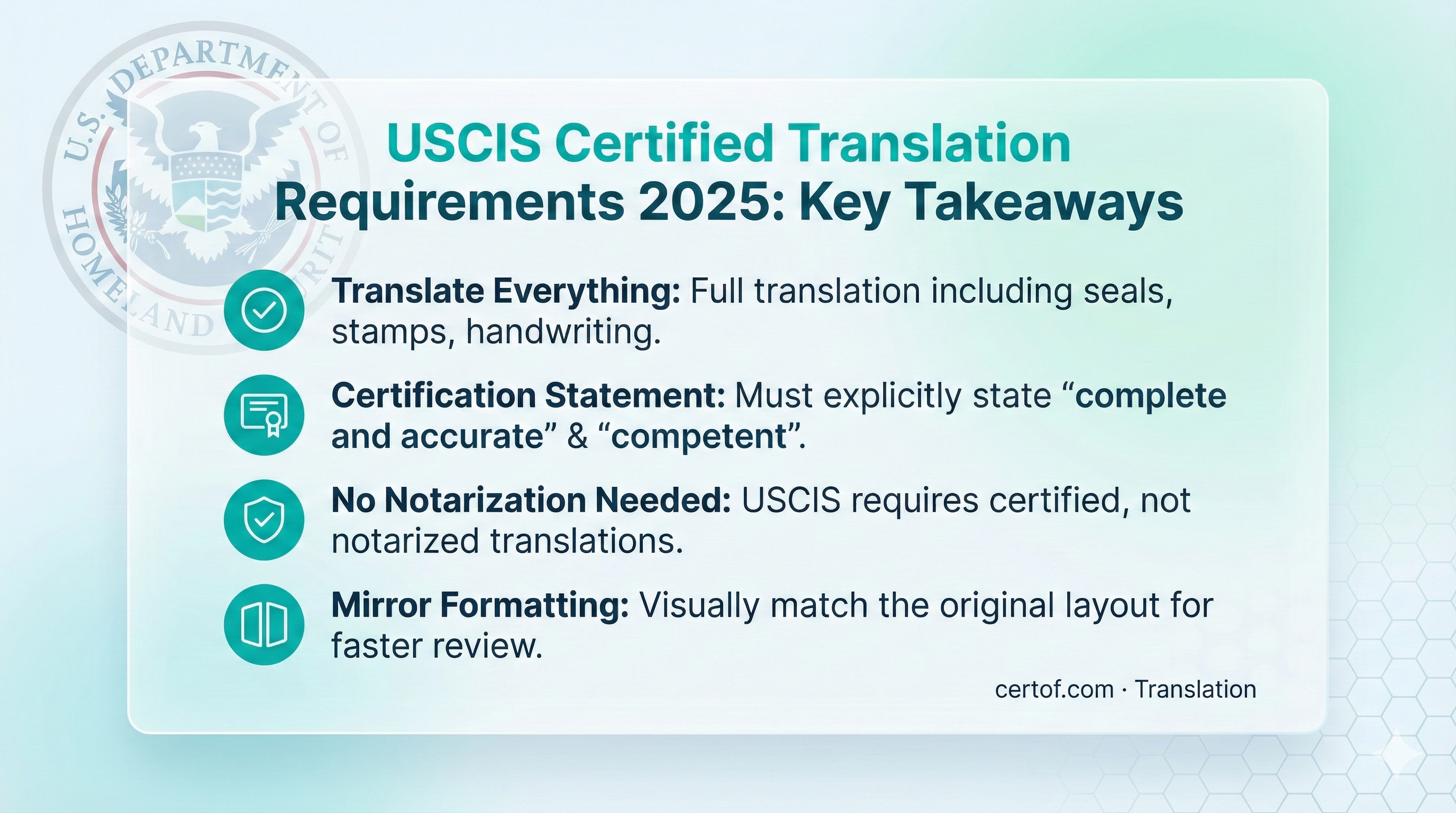
Short answer: You may use Google Translate as a private reading or draft tool, but USCIS filings require a full English translation plus a human certification of completeness, accuracy, and translator competence. A machine cannot sign legal accountability.
- Rule: USCIS requires full translation and certification under 8 CFR 103.2(b)(3).
- Risk: Machine-only output often drops seals, margin notes, and back-page text, which can trigger RFEs.
- Counter-intuitive truth: Even a linguistically perfect AI translation can fail if no competent human signs the certification.
- Safer fast path: Use a USCIS-certified translation order platform with human review, certificate of accuracy, and mirror formatting.
Who This Article Is For and Why This Decision Feels So Stressful
This guide is for applicants and families filing high-stakes civil records under time pressure: marriage certificates, birth certificates, police clearance certificate evidence, divorce decrees, and household registration documents. The pain point is simple: one translation shortcut can turn a strong case into a paperwork delay cycle.
If you are trying to save money and avoid delays at the same time, your real objective is not just cheap translation. It is cheap translation that still survives USCIS evidence review.
2026 Reality Check: The Rule Did Not Change, but Error Tolerance Is Lower
As of February 27, 2026, the legal standard is still the same. On eCFR, Title 8 currently displays as up to date through February 20, 2026, and translation language in 8 CFR 103.2(b)(3) remains unchanged. In other words, there is no brand-new USCIS AI translation law to memorize. What changed is execution pressure in digital intake workflows.
2026 practice alert: In current digital review workflows, translation omissions are being caught faster. Missing seal text, back-page notes, or unclear certification language can quickly convert a clean filing into an RFE cycle. If you are already in that cycle, use this recovery guide: USCIS RFE translation services.
For form-level context, review our I-130 certified translation requirements walkthrough and compare it with the primary authorities below.
| Authority | What it says | Practical impact on your file |
|---|---|---|
| 8 CFR 103.2(b)(3) and 8 CFR 103.2(b)(8) | Foreign-language documents need full English translation plus translator certification; if required evidence is missing, USCIS may issue an RFE or deny. | Raw Google Translate output is not enough by itself. |
| USCIS Form I-130 page and I-485 initial evidence checklist | USCIS repeats translation certification requirements in form guidance. | The same standard applies across core family-based filings. |
| Tips for Filing Forms by Mail | USCIS emphasizes legible copies and cautions against sending originals unless requested. | Before mailing, confirm do I need original documents for USCIS translation. |
| USCIS Scanning Delays Alert | USCIS highlights paper and scan quality standards. | Poor scan quality can create avoidable follow-up and timeline drag. |
The Counter-Intuitive Truth: A Perfect AI Translation Can Still Be Invalid Evidence
This is the part many smart applicants miss: USCIS does not only evaluate language quality. It evaluates evidence accountability. Even if a machine draft reads perfectly, it still fails if no competent person accepts responsibility through a proper certificate. That is why this is a compliance problem, not just a grammar problem.
If you need the full legal baseline and certificate wording, use this internal guide: USCIS certified translation requirements. If you want a visual benchmark, see this USCIS certified translation sample.
Three High-Risk AI Failure Modes I See in Real USCIS Packets
1) Faint seal and stamp loss. Civil records from China, Japan, Korea, and Latin America often include faint red seals, side stamps, or embossed marks. OCR may treat these as noise. If visible source content is missing in English, officers can read the translation as incomplete.
2) Date and name normalization errors. AI often leaves 10/05/1990 unclarified, or flips surname/given-name order inconsistently across documents. That creates cross-form mismatch risk for I-130 and I-485 review.
3) Back-page and margin omission. Common examples include household records, notarial documents, and multi-page registry extracts. Machine-first workflows miss back-side annotations unless a human reviewer checks page by page.
Document-specific examples are covered in our detailed guides for chinese hukou translation certified USCIS guide and certified translation of japanese koseki tohon for immigration.
Pitfalls That Trigger RFEs (and Their Real Cost)
- Submitting raw machine output: no valid translator certification, no accountable signer, immediate compliance gap.
- Using one blanket certificate for unrelated documents: officers cannot see clear document-level responsibility.
- Quietly fixing source typos in translation: this can create evidentiary mismatch instead of solving inconsistency.
- Ignoring layout: plain-text dumps of table-heavy records slow review and increase misunderstanding risk.
- Waiting until the RFE deadline week: even a fast translation cannot fix mailing, upload, and review bottlenecks if you start too late.
Consequence pattern: translation defects usually lead to an RFE or a reject/rework cycle, then case re-queue. In practice, many applicants lose months and pay extra legal coordination costs. If this already happened, follow a structured recovery path using USCIS RFE translation services and USCIS rejected my translation fixes.
CertOf vs Traditional Vendors vs Raw Google Translate
| Decision factor | Raw Google Translate | Traditional agency or law-firm vendor | CertOf workflow |
|---|---|---|---|
| USCIS-ready human certification | Not built in | Usually included | Included |
| Turnaround for standard files | Instant draft | Often 24-48 hours | Typically 5-10 minutes |
| Mirror formatting for officer review | Often broken | Varies by provider | Layout-preserving output |
| Price clarity | Free tool, no compliance | Quote-based, often higher | Transparent certified translation pricing at $9.99 per page |
| Acceptance and revision policy | No filing guarantee | Varies by contract | Published USCIS acceptance guarantee and refund terms |
| Online end-to-end ordering | Not a filing service | Sometimes email-based | Upload, pay, download online |
How to Get a Compliant Translation in 3 Steps
- Upload: Start on the USCIS-certified translation order platform and upload clear scans or photos.
- Pay: Confirm pages and pricing using transparent certified translation pricing so there are no surprise add-ons.
- Download: Receive your certified PDF with certificate of accuracy and mirror formatting, then file according to your USCIS channel.
What your certified PDF bundle should include
- Full English translation of all visible source text
- Seal/stamp/back-page annotations where applicable
- Translator certification of completeness, accuracy, and competence
- Layout-preserving format that is easy for officer side-by-side review
If you are comparing providers, review official CertOf certified translation services and then place your order through the fast online certified translation service.
Trust Signals: Privacy, Institution Coverage, and Urgency Handling
- Privacy: Review the published privacy policy for document handling before uploading sensitive civil records.
- Institution coverage: Typical use cases include USCIS, universities, banks, employers, and courts.
- Urgency: Time-critical applicants can use an online workflow instead of multi-email handoffs and local office scheduling delays.
- Related compliance reads: who can certify a translation for USCIS, do I need ATA certified translator for USCIS, and difference between certified and notarized translation.
FAQ (People Also Ask)
Is Google Translate accepted for immigration documents?
As a draft tool, yes. As filing evidence by itself, no. USCIS requires a full translation and a signed human certification under 8 CFR 103.2(b)(3).
Can I translate my own documents for USCIS?
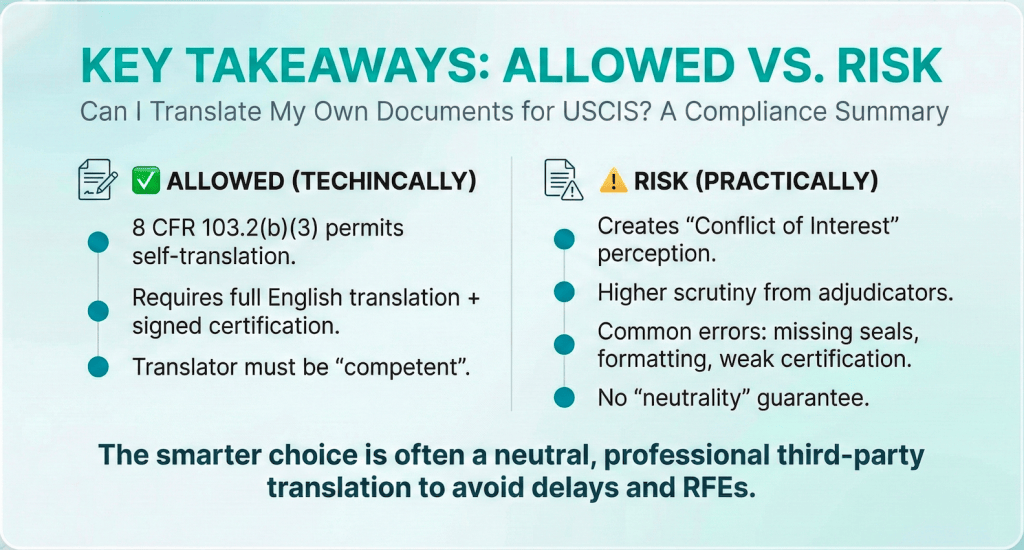
Self-translation is not explicitly banned in regulation, but it carries neutrality and quality-control risk in practice. Read the full breakdown here: can I translate my own documents for USCIS.
Does USCIS accept digital certified translations?
In many filings, scanned copies are acceptable when they meet form instructions and include proper certification. Practical format guidance is here: electronic certified translation PDF vs Word vs paper.
Do I need notarized translation for USCIS?
Usually no. USCIS generally requires certified translation, not notarization, unless another authority separately asks for notarization. See certified vs notarized translation.
What should I do if USCIS rejected my translation or issued an RFE?
Diagnose the exact defect first (missing text, missing certification, or mismatch), then submit one complete corrected response packet. Start with USCIS rejected my translation and USCIS RFE translation services.
How long is a certified translation valid for USCIS?
USCIS does not publish a fixed universal expiration date for certified translations; validity is usually tied to document relevance and case context. See practical guidance here: how long is a certified translation valid for USCIS.
Bottom Line
Google Translate is useful for speed, but USCIS evidence requires accountable certification. If you want to move quickly without gambling on avoidable RFEs, choose a workflow that combines machine efficiency with signed human responsibility.