Disclaimer: This article provides general information about USCIS translation requirements and professional best practices. It does not constitute legal advice. If your case involves complex legal issues, consult a qualified immigration attorney.
About the author: Erin Chen is the Co-Founder and Translation Strategist at CertOf™. With over a decade in bilingual editorial risk control and hands-on experience navigating the U.S. immigration process, Erin helps applicants prepare USCIS-ready certified translations that reduce avoidable delays.
Certified Translation for Parents Immigration Documents: Fast, Compliant, and Built to Avoid Rework
If you are preparing family sponsorship evidence, certified translation for parents immigration documents should be handled as a compliance task, not just a language task. In real filings, delays usually happen because a translation is incomplete, not because the relationship evidence is weak.
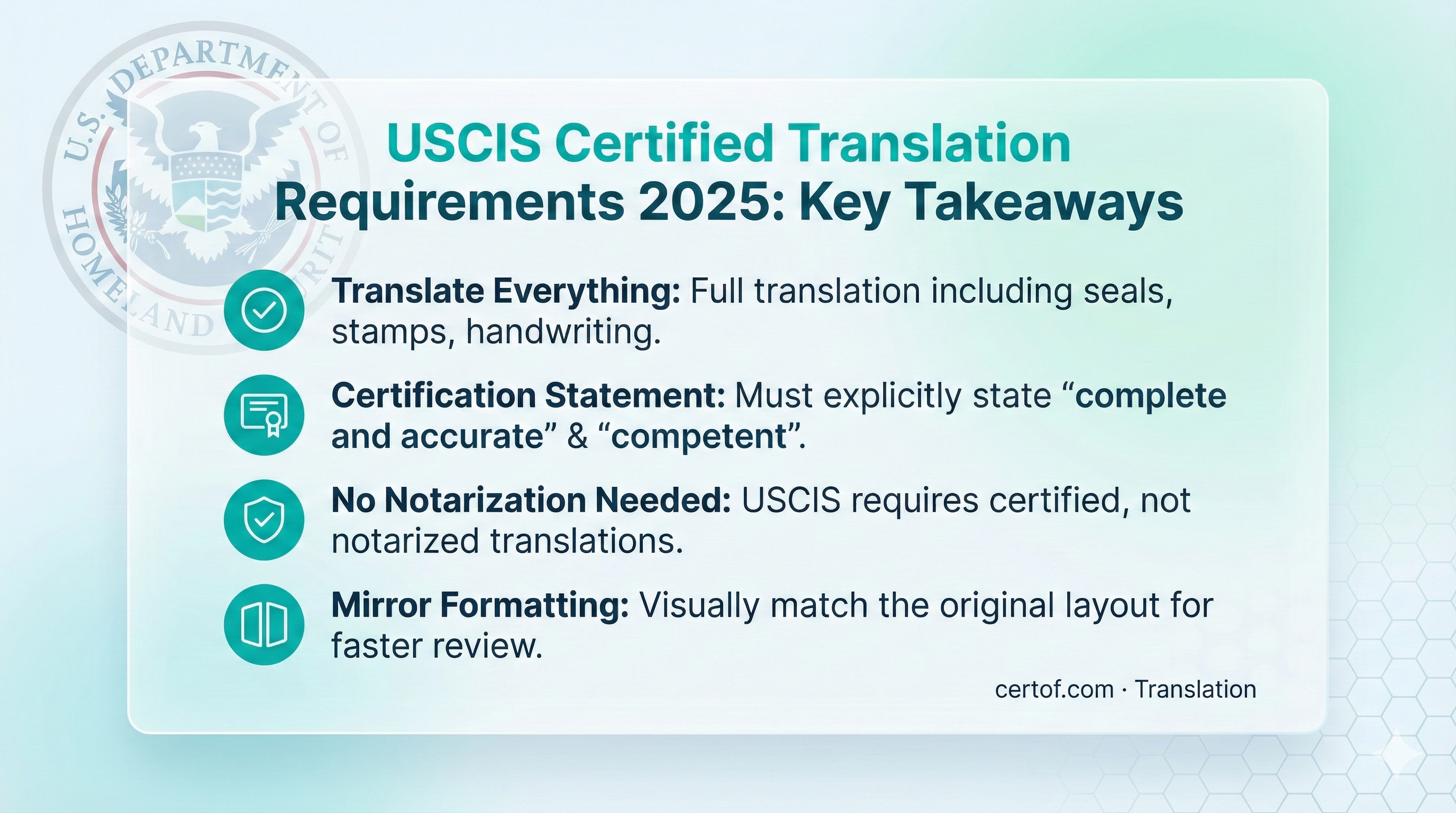
- USCIS baseline: full English translation plus translator certification of completeness, accuracy, and competence.
- Most common miss: seals, side notes, and back-page text are left untranslated.
- Counterintuitive truth: notarization usually does not fix a non-compliant translation for USCIS.
- Risk path: depending on the record, officers may issue an RFE, a Notice of Intent to Deny (NOID), or deny.
Who This Guide Is For
This page is for U.S. citizens and permanent residents filing for parents, spouse, or children and trying to avoid costly document loops.
- You are filing or preparing evidence for Form I-130 and related stages.
- You need certified translation for spouse and children documents in one filing packet.
- You want to avoid RFE/NOID stress from preventable translation defects.
- You need a predictable budget for multiple civil documents.
What USCIS and State Department Actually Require (Official Rules)
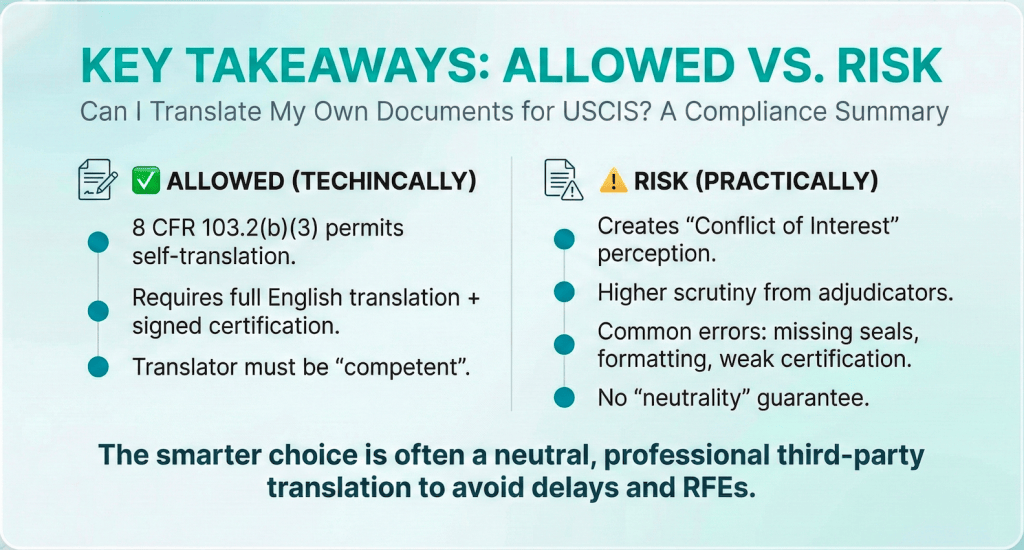
As of February 21, 2026, the core USCIS translation rule remains: under 8 CFR 103.2(b)(3), any foreign-language document submitted to USCIS must include a full English translation certified as complete and accurate by a competent translator.
USCIS filing guidance repeats this standard and instructs applicants to submit copies unless originals are specifically requested: USCIS Tips for Filing Forms by Mail and USCIS Tips for Filing Forms Online.
If your case moves through consular processing, the U.S. Department of State requires certified translations for non-English civil documents: Step 7: Collect Civil Documents.
On outcomes, USCIS policy confirms officers may request evidence or deny depending on facts, law, and initial evidence quality: USCIS Policy Manual, Volume 7, Part A, Chapter 4 and USCIS Policy Manual, Volume 6, Part B, Chapter 4.
Counterintuitive but True
Paying extra for notarization does not automatically make a USCIS translation stronger. For most USCIS filings, the core requirement is complete translation plus proper translator certification. If completeness is missing, a notary stamp does not cure the defect.
Family Packet Checklist: Parents, Spouse, and Children
| Relative type | Typical documents | High-risk detail to verify |
|---|---|---|
| Parents (IR-5) | Birth certificates, marriage records, divorce records, name-change records | Parent names and dates must match across all records exactly as written |
| Spouse (CR1/IR1 or AOS) | Marriage certificate, prior divorce decree(s), birth certificate | Translate all stamps, seals, and registrar notes, including reverse-side text |
| Children | Birth certificate, adoption decree, custody/guardianship records | Do not omit legal custody clauses or handwritten corrections |
Common Pitfalls and Real Consequences
- Partial translation: only main text is translated, while stamp legends or side notes are skipped. Possible impact: RFE, re-translation, or higher denial risk under missing initial evidence standards.
- Name “cleanup” by translator: changing spelling to make records look consistent. Possible impact: credibility problems because the translation no longer mirrors the source.
- One generic certificate for multiple unrelated files: weak traceability. Possible impact: officer questions and longer review time.
- Sending originals without request: contrary to USCIS filing guidance for many cases. Possible impact: unnecessary document-handling risk and recovery difficulty.
- Waiting to fix defects after notice: delayed corrections under tight response windows. Possible impact: timeline extension by weeks or months.
If you already received a notice, use this focused guide: USCIS RFE translation services.
CertOf vs Traditional Path for Family Cases
| Factor | CertOf™ Translation | Traditional local workflow |
|---|---|---|
| Turnaround | Typically 5-10 minutes for standard documents | Often 24-72 hours |
| Pricing | Transparent from $9.99/page | Quote-based, often higher per page |
| Compliance packaging | Certificate of Translation Accuracy + mirror formatting | Varies by provider |
| Ordering | Online upload and delivery | Mixed online/offline process |
| Assurance | 100% USCIS acceptance guarantee + refund policy | Varies |
How to Get Certified Translation in 3 Steps
- Upload: submit clear scans or photos of parents, spouse, and children documents together.
- Pay: confirm page count and transparent rate, or review bundle pricing.
- Download: receive certified files with statement of accuracy, ready for filing.
Start service actions here: order certified translation online, upload and order certified translation online workflow, request urgent certified translation support, hard-copy certified translation mailed overnight.
Trust, Privacy, and Use Cases
- Use cases include USCIS, universities, banks, courts, and consular submissions.
- For legal terms and privacy handling, review Privacy Policy and Terms of Service.
- For refund terms, review Refund & Returns.
Internal Guides for Deeper Scenarios
- USCIS certified translation requirements
- birth certificate translation for USCIS
- marriage certificate translation for USCIS
- do I need original document with certified translation
- can I translate my own documents for USCIS
- reuse certified translation for multiple USCIS cases
FAQ
Does USCIS accept online certified translations?
USCIS focuses on whether your translation is complete, accurate, and properly certified. Filing can be online or by mail, but compliance content must be correct. See USCIS certified translation sample.
Do I need original documents with certified translations?
Usually no, unless specifically requested by USCIS or form instructions. See USCIS original document guidance.
Can I translate my own documents for USCIS?
Even if language ability is strong, self-translation can create avoidable scrutiny. A neutral third-party certification is typically safer. See self-translation risk breakdown.
Do certified translations expire for immigration?
The translation itself usually does not have a fixed USCIS expiration date, but source documents and case context can change. Practical guide: how long a certified translation is valid for USCIS.
What if USCIS already questioned my translation?
Correct quickly with a complete re-translation and proper certification package. Use RFE response translation steps.
Final Checklist Before You Submit
- Confirm every foreign-language page is fully translated, including seals and notes.
- Check exact name/date consistency across parents, spouse, and children records.
- Ensure certified translation for spouse and children documents matches the names used in your forms.
- Use document-specific certification wording tied to each file.
- Submit copies unless originals are explicitly requested.
Ready to file faster: get certified translation for parents immigration documents now.