Disclaimer: This article provides general information about USCIS translation rules and filing practice. It is not legal advice. For case strategy, inadmissibility issues, or litigation risk, consult a licensed U.S. immigration attorney.
About the author: Erin Chen is the Co-Founder and Translation Strategist at CertOf™. Our team supports USCIS-facing translation workflows for family, employment, legal, and education document sets, with a focus on intake risk control and RFE prevention.
Certified Translation of Birth Certificate for USCIS: I-130 / I-485 Operational Guide
Avoid RFEs with a Certified Translation of Birth Certificate: 2026 Quick Takeaways
If you are filing Form I-130 or I-485, a certified translation of birth certificate is not a minor attachment. It is a core identity and relationship record, and small translation defects can trigger an avoidable RFE cycle.
Key Takeaways for I-130 / I-485 Filers
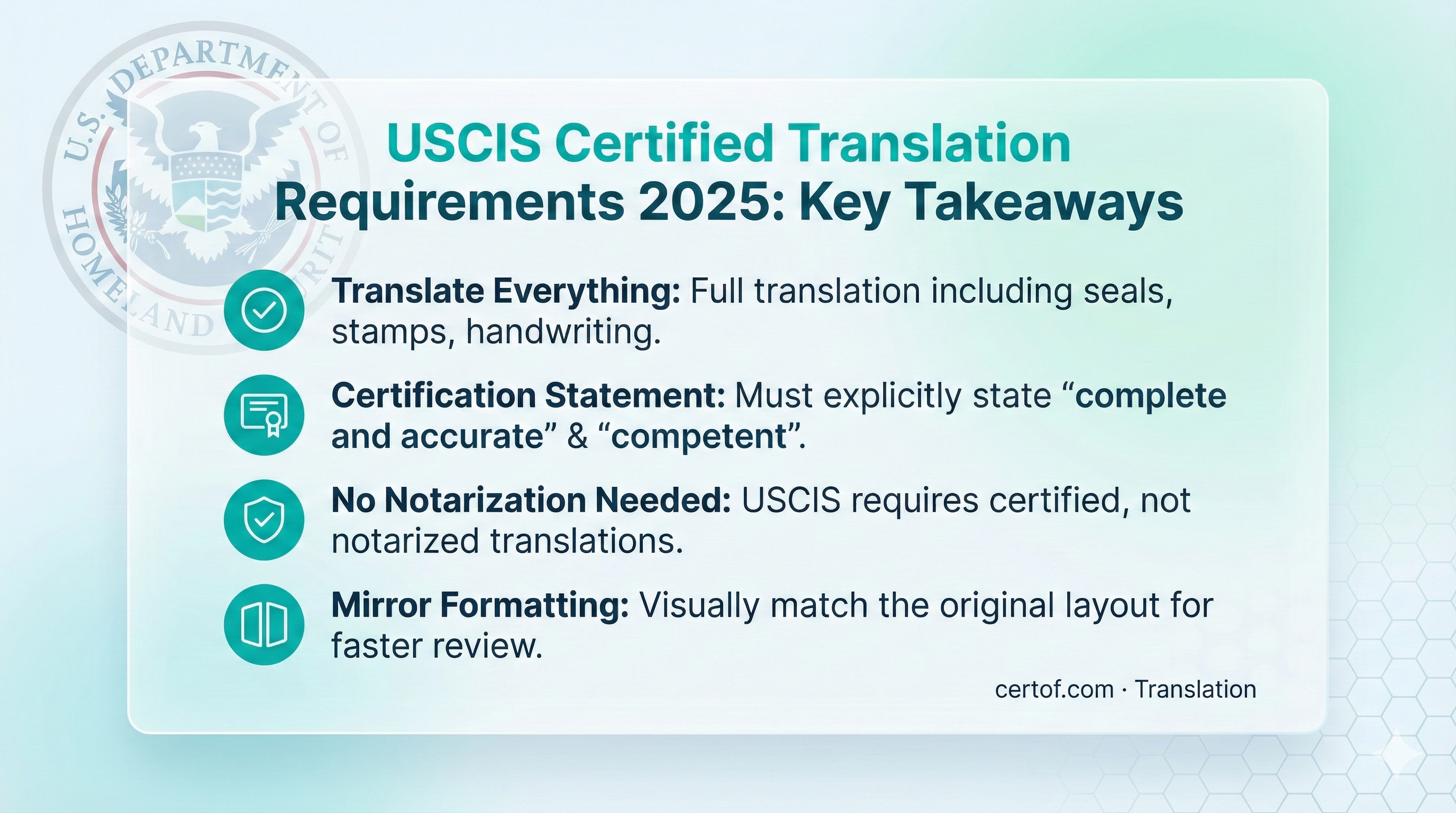
- Translate every visible element: stamps, seals, side notes, and reverse-side text all count.
- Use mirror-friendly formatting: reviewers should map source and English text quickly.
- Do not “correct” source errors: translate as written and explain discrepancies separately.
- Certification is mandatory: complete + accurate + competent + signature/date/contact.
Need a fast start? Use upload and order certified translation online and keep your packet in this order: source copy → English translation → certification page.
Who This Guide Is For (and the Pain Point We Are Solving)
This guide is written for family-based filers, adjustment applicants, and paralegals handling I-130/I-485 packets under deadline pressure. The pain point is predictable: a case with strong eligibility gets delayed because the translation package is incomplete, visually hard to verify, or certified incorrectly.
- You are filing I-130 now and I-485 concurrently or soon after.
- You have a non-English birth certificate, sometimes with seals, side notes, or re-issuance remarks.
- You want to avoid paying twice for preventable corrections.
- You need a clean PDF workflow without mailing originals unless USCIS asks later.
Official Rule Baseline (As of March 1, 2026)
The controlling rule remains 8 CFR 103.2. For translation compliance, the key section is 103.2(b)(3): foreign-language documents must be filed with a full English translation, certified as complete and accurate, plus a certification that the translator is competent in the language pair.
For I-130 and I-485 packaging, USCIS checklist pages repeat the same translation language and also remind applicants not to send originals unless requested: Form I-130 page, I-485 required initial evidence checklist, and Form I-485 Instructions (PDF).
For adjudication context, USCIS also explains evidence, copies vs originals, and translation standards in USCIS Policy Manual, Volume 1, Part E, Chapter 6.
Important 2026 context: we have not seen a published USCIS regulation that replaces the translation baseline above. In practice, most delays still come from execution failures (missing content, weak certification, poor legibility, or document mismatch).
If you want the long-form rule interpretation, use our dedicated guide: USCIS certified translation requirements.
I-130 / I-485 Birth Certificate Checklist You Can Use Today
- Use the civil authority version: long-form registry record is usually safer than souvenir or hospital-only formats.
- Scan quality first: crisp, flat, high-contrast images; include back side if it contains any notes or stamps.
- Translate all visible content: stamps, seals, handwritten marks, marginal notes, form numbers, and registration codes.
- Keep name fields explicit: label Surname / Given Name when local order differs from English order.
- Use unambiguous dates: write 04-OCT-1990 style when day/month confusion is possible.
- Do not normalize spelling silently: mirror source text exactly and handle discrepancies separately.
- Attach a complete translator certification: name, signature, date, contact details, completeness/accuracy statement, competence statement.
- Package in the right order: source copy → translation → certification page.
Need a visual benchmark? Review a USCIS birth certificate translation sample before you submit.
The Counter-Intuitive Rule: Translate Errors Faithfully, Do Not “Improve” Them
This is the one point applicants get wrong most often. If the birth certificate says “Jonh,” your translation should not silently change it to “John.” A certified translation is evidence reproduction, not correction.
- Wrong: edit typos in translation to look “clean.”
- Right: translate exactly as written; where needed, add neutral notation such as [sic] or [as written in original].
For practical repair steps after rejection, see common reasons for USCIS translation rejection and how to fix them.
Country Gotchas: Birth Record Names That Commonly Cause Review Friction
Country-specific civil records differ. Always cross-check the expected civil document type in the U.S. Department of State reciprocity schedule: Visa Reciprocity and Civil Documents by Country.
| Country / Region | Common Birth Record Names | High-Risk Miss and Best Practice |
|---|---|---|
| China | 出生医学证明, 公证书, 户口本 (Hukou) | Miss: translating only the notarial cover page. Best practice: translate all pages, seals, and registry references; keep mirror layout. |
| Mexico / LATAM | Acta de Nacimiento + anotaciones marginales | Miss: omitting marginal notes. Best practice: include side annotations because they often carry correction/legal status details. |
| Philippines | PSA Birth Certificate | Miss: skipping reference identifiers on security paper. Best practice: capture all control numbers and visible registry elements. |
| India | Municipal/State Birth Certificate | Miss: silently harmonizing mixed spellings. Best practice: preserve each spelling as shown and label fields clearly. |
| Japan | 戸籍謄本 (Koseki Tohon) | Miss: translating one line without household context. Best practice: preserve headings/relationship fields needed for officer interpretation. |
| Korea | 가족관계등록부 (Family Relation Certificate) | Miss: name-order confusion. Best practice: explicitly label surname and given name in English output. |
| Vietnam | Giấy Khai Sinh | Miss: date ambiguity and handwritten amendments ignored. Best practice: use unambiguous date format and translate all handwritten notes. |

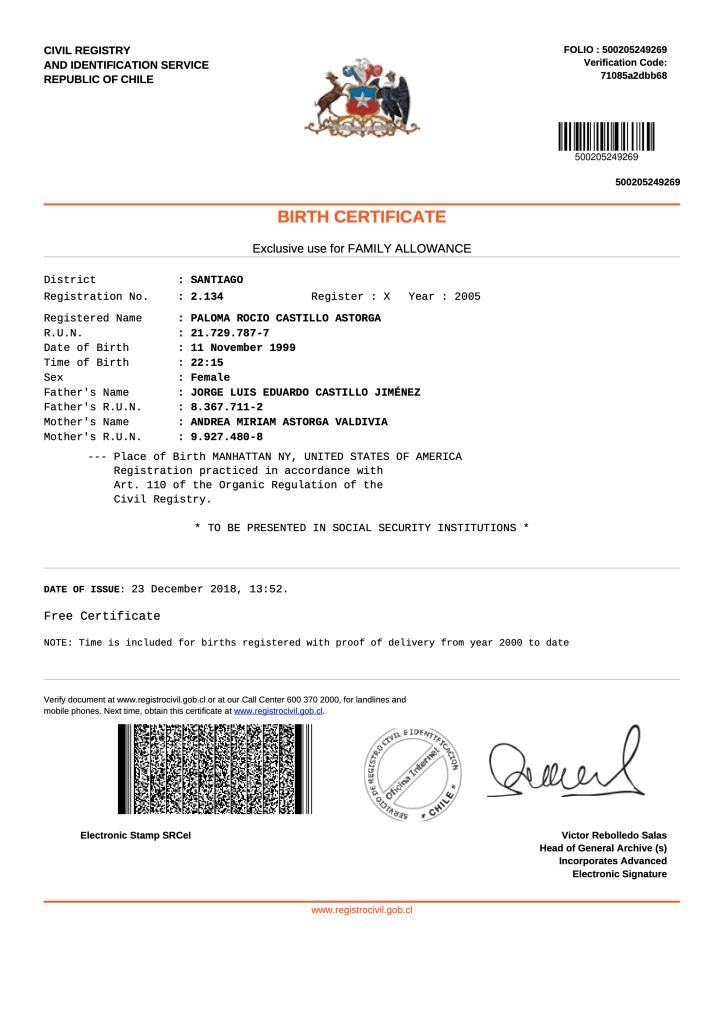
Clean source scan (left) and mirror-formatted certified translation (right), with stamps and marginal notes fully captured.
Common Mistakes and Real Consequences (Pitfalls)
If you searched for “uscis rejected my birth certificate translation” or “uscis rfe translation services,” these are the patterns we see most often in failed submissions.
| Mistake | What It Triggers in Practice | How to Prevent It |
|---|---|---|
| Skipping stamps, side notes, or reverse-side text | RFE for incomplete translation; review timeline can move from days to months | Translate every visible element, including non-body text |
| Using weak or incomplete certification wording | USCIS may treat submission as missing required initial evidence | Include completeness + accuracy + competence + signature/date/contact |
| Silently correcting names/dates | Credibility mismatch across packet; possible follow-up evidence request | Translate as written and explain discrepancy separately |
| Uploading low-quality phone photos | Officer cannot verify source/translation mapping; avoidable delay | Use high-resolution, flat, well-lit scans |
| Waiting until RFE deadline week | No buffer for revision, upload, or mailing problems; denial risk if late | Respond early; 8 CFR 103.2(b)(8)(iv) limits response windows and does not provide open-ended extensions |
If you are already in a notice cycle, use the tactical guide: USCIS RFE translation services checklist and triage steps.
If the Birth Certificate Is Missing or Unavailable
8 CFR 103.2(b)(2) allows secondary evidence and, if needed, affidavits when required records are unavailable. For birth records, this is common in older civil systems, conflict zones, and late-registration contexts.
- Step 1: confirm expected document type in the Department of State reciprocity schedule.
- Step 2: collect proof of unavailability from the issuing authority where obtainable.
- Step 3: prepare secondary records (school, church, medical) and affidavits from people with direct personal knowledge, then translate each document with full certification.
For a copy-first submission strategy, see do I need original document with certified translation for USCIS.
Digital Filing, PDF Delivery, and Signature Questions
Applicants often ask whether USCIS accepts digital certified translations. The legal focus is still completeness, accuracy, competence certification, and legibility. Under 8 CFR 103.2(a)(2), USCIS recognizes electronic signatures for benefit requests filed electronically where the form instructions permit that channel.
For paper filing hygiene and scan quality, USCIS also publishes packaging guidance: Tips for Filing Forms by Mail.
If you want deeper treatment of validity and reuse, read how long a certified translation is valid for USCIS.
Why CertOf™ Is the Practical Alternative to Traditional Translation Workflows
| Decision Factor | CertOf™ (Online) | Traditional Agency / Local Shop | Law Firm Vendor Chain |
|---|---|---|---|
| Price transparency | $9.99/page published at checkout | Often quote-based | Often bundled and opaque |
| Turnaround | 5-10 minutes for many standard pages | Usually 24-72 hours | Depends on legal queue |
| USCIS-focused formatting | Mirror formatting workflow | Varies by vendor | Varies by subcontractor |
| Acceptance protection | money-back acceptance guarantee and refund policy | Policy varies | Policy varies |
| Ordering model | Fully online upload/payment/download | Email or walk-in | Attorney-mediated |
CertOf 3-Step Workflow (Birth Certificate Edition)
- Upload: submit a clean front/back scan using USCIS-ready birth certificate translation service.
- Pay: transparent $9.99/page pricing, no hidden notarization add-on for standard USCIS certified translation needs.
- Receive: mirror-formatted certified translation package ready for I-130/I-485 evidence assembly.
[Image Placeholder: 3-step upload → pay → download flow, mobile and desktop screenshots, alt=’upload and order certified translation online workflow’]
Trust Module: Privacy, Institution Coverage, and Rush Handling
- Privacy: encrypted web upload (HTTPS/TLS), controlled access workflow, and limited retention operations for document handling.
- Where translations are used: USCIS, universities, banks, courts, consulates, and licensing bodies (based on each institution’s own rules).
- Urgency: designed for fast certified translation services for USCIS when filing windows are tight.
Check transparent certified translation pricing, review the money-back acceptance guarantee and refund terms, and start with fast certified translation services for USCIS.
FAQ (People Also Ask)
Can I translate my own birth certificate for USCIS?
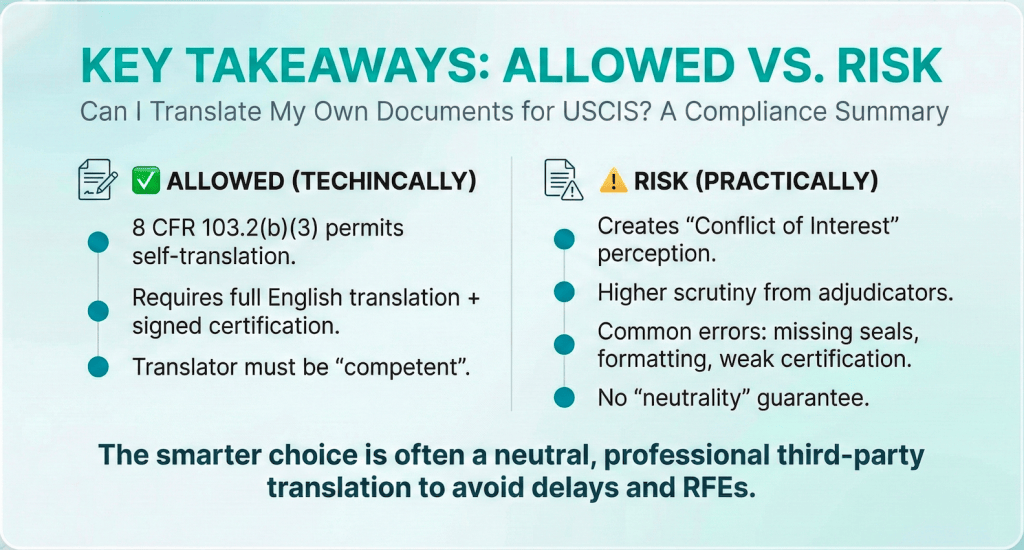
USCIS regulations do not create a simple one-line ban, but self-translation often increases credibility and quality-control risk in practice. For detailed risk analysis, see can I translate my own documents for USCIS.
Can I use Google Translate for immigration documents?
Machine output alone is not a certified translation. USCIS requires a human-signed certification of completeness, accuracy, and competence. Practical examples are here: can I use Google Translate for USCIS.
Do I need notarization for a certified translation of birth certificate?
For USCIS, certified translation is usually the requirement, not notarization. Notarization may still appear in non-USCIS contexts. Compare both standards here: difference between certified and notarized translation.
How long is a certified translation valid for USCIS?
USCIS rules do not impose a fixed expiration period for certified translations. Reuse depends on whether the underlying document and translation remain accurate, complete, and legible. See how long a certified translation is valid for USCIS.
What if USCIS issues an RFE for my translation?
Audit four points immediately: certification text, translator identity/signature/date/contact, completeness (including stamps/notes), and source legibility. Then use this repair workflow: fix rejected USCIS translation and respond correctly.
Bottom Line
A certified translation of birth certificate should be treated as critical evidence engineering, not a last-minute formatting task. If your package is complete, readable, and faithfully mirrored, you reduce avoidable RFEs and protect your I-130/I-485 timeline.
Next step: order certified translation online now.